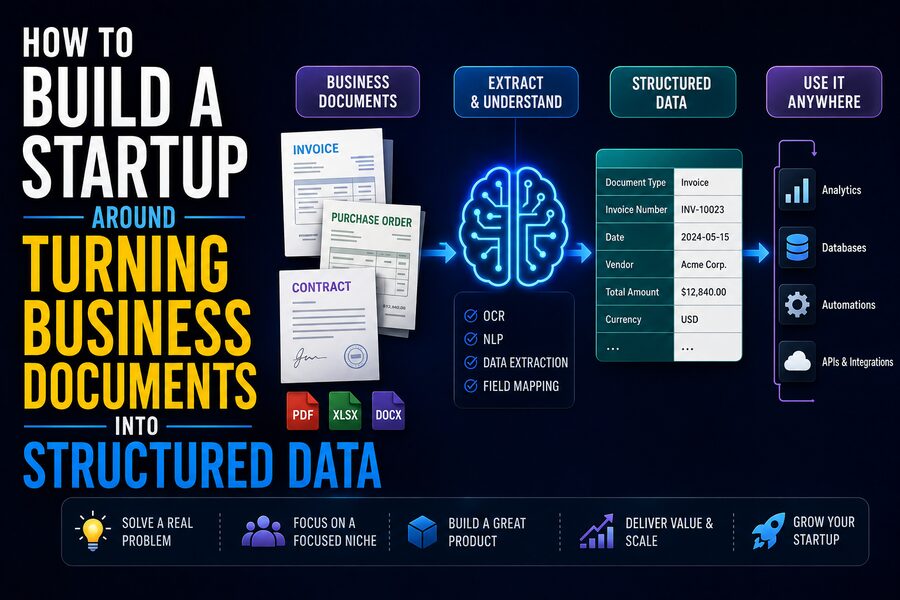

Businesses still run on documents.
Invoices arrive as PDFs. Purchase orders come through email attachments. Insurance forms are scanned. Banks receive statements, applications, contracts, and compliance documents. Logistics companies process bills of lading and delivery receipts. Healthcare organizations handle referrals, claims, reports, and administrative forms. 📑🏢
The problem is that most of this information is designed for humans to read, not for software to process.
A finance system does not naturally understand that the number beside “Invoice Total” in a PDF represents the amount payable. A logistics platform cannot automatically know that a particular line contains a container number. A CRM does not automatically extract a customer name, contract date, or renewal term from an uploaded agreement.
That gap creates a valuable startup opportunity.
A company that can reliably turn messy business documents into clean, structured, machine-readable data can eliminate enormous amounts of manual data entry, speed up workflows, reduce errors, and make previously inaccessible information usable by software. 🤖📊
The opportunity, however, is not simply “build an OCR tool.” Successful document-data startups usually win by solving a specific business workflow better than generic extraction technology alone.
Here is how such a startup can be designed.
🎯 1. Start With a Painful Document Workflow, Not With the Technology
A common mistake is beginning with:
“We have AI that can read PDFs.”
That is a capability, not a business.
A stronger starting point is:
“Accounts-payable teams spend hundreds of hours manually entering invoice fields into their ERP.”
The best opportunities usually have several characteristics:
- Large document volume
- Repetitive manual work
- Expensive human review
- Clearly defined fields to extract
- Frequent errors or delays
- Existing software that needs the extracted data
- A measurable financial benefit from automation
Examples include:
- Invoice processing
- Insurance claims
- Mortgage documents
- Customs forms
- Purchase orders
- Shipping documents
- Bank statements
- Tax documents
- Healthcare administration
- Vendor onboarding
A narrow workflow makes the product easier to sell because the customer immediately understands what problem is being solved. 💡
🧩 2. Understand the Difference Between Documents and Structured Data
A document may contain information visually, but structured software needs that information represented in a predictable format.
Consider an invoice.
A human sees:
Supplier: Delta Manufacturing
Invoice Number: INV-10328
Date: 12 March
Total: $8,450
A software system may need:
supplier_name = "Delta Manufacturing"
invoice_number = "INV-10328"
invoice_date = "2026-03-12"
total_amount = 8450
currency = "USD"
The startup’s job is to bridge those two worlds.
That involves much more than recognizing characters.
The system must determine:
- Which text belongs to which field
- Which values represent dates
- Which number is the total
- Which table rows are line items
- Whether a field is missing
- Whether the document belongs to the expected type
- Whether extraction confidence is high enough for automation
This process is often called document understanding, intelligent document processing, or document AI. 🧠
🔍 3. OCR Is Only the First Layer
Optical Character Recognition, or OCR, converts visible text into machine-readable characters.
That is important, but OCR alone does not solve the business problem.
Suppose OCR reads:
Total Due 2,587.40
The system still needs to understand that 2,587.40 is the payable total rather than a tax subtotal, balance forward, or unit price.
A robust pipeline may include:
- File ingestion
- Image cleanup
- OCR or native PDF text extraction
- Layout analysis
- Document classification
- Field extraction
- Table extraction
- Validation
- Confidence scoring
- Human review when necessary
- Export into downstream systems
The real product is the entire workflow, not one model. ⚙️
🗂️ 4. Pick a Narrow Initial Document Type
Startups often become more effective by choosing one document category first.
For example:
“We extract invoices for mid-sized manufacturing companies.”
That sounds less ambitious than:
“We understand all business documents.”
But the narrower company may build a much stronger product.
Invoice processing alone involves significant complexity:
- Different supplier templates
- Multiple currencies
- Taxes
- Purchase-order matching
- Line-item tables
- Credit notes
- Duplicate invoices
- Multi-page documents
- Handwritten annotations
- Scans of varying quality
Solving one category deeply creates proprietary knowledge, customer trust, and workflow integration.
Expansion can come later.
📊 5. Define the Output Schema Before Building the Extractor
A document-processing product becomes useful when it produces consistent structured output.
Therefore, one of the first product decisions should be:
What exact schema will customers receive?
For invoices, fields might include:
- Vendor name
- Vendor tax ID
- Invoice number
- Invoice date
- Due date
- Purchase order number
- Currency
- Subtotal
- Tax
- Total
- Line items
Each field should have a defined:
- Data type
- Required/optional status
- Normalization rule
- Confidence score
- Validation rule
A stable schema makes integration easier.
Customers do not want an AI system that returns vaguely formatted text. They want data their ERP, CRM, warehouse, or analytics system can consume immediately. 📥
🤖 6. Use Multiple Extraction Techniques
No single technical method works perfectly for every document.
A strong startup may combine:
- OCR
- Layout-aware models
- Vision-language models
- Rules
- Regular expressions
- Dictionaries
- Database lookups
- Document templates
- Large language models
- Post-processing logic
For example, an AI model may identify a vendor name, while a deterministic validation layer checks whether that vendor exists in the customer’s approved supplier database.
This hybrid approach is often much more reliable than depending entirely on one model.
The goal is not technological purity.
The goal is accurate business data. 🎯
✅ 7. Accuracy Must Be Measured at the Field Level
A statement like “our AI is 97% accurate” is almost meaningless unless accuracy is defined carefully.
Customers care about individual fields.
For example:
- Vendor name accuracy: 99.5%
- Invoice number accuracy: 99.2%
- Total amount accuracy: 99.8%
- Line-item accuracy: 94.6%
Different fields have different consequences.
A minor address error may be inconvenient.
An incorrect invoice total may create a financial problem.
Therefore, the startup should measure:
- Field-level precision
- Field-level recall
- Document-level accuracy
- Straight-through processing rate
- Human review rate
- Time saved per document
These metrics are much more useful than a single overall AI score. 📈
🧑💼 8. Human-in-the-Loop Review Is a Feature, Not a Failure
Perfect extraction is rarely realistic.
Some documents will be blurry, incomplete, unusual, or ambiguous.
Instead of pretending that AI can handle everything, successful systems often route uncertain cases to humans.
The workflow becomes:
High confidence → automatically approve
Medium confidence → request review
Low confidence → send to manual processing
The human reviewer can correct the extracted fields through a simple interface.
Those corrections can also become valuable training or evaluation data.
This creates a practical balance between automation and reliability.
For many enterprise customers, achieving 80–95% straight-through processing with reliable review may be far more valuable than promising unrealistic 100% automation. 👩💻
🧠 9. Confidence Scoring Is Essential
Every extracted field should ideally have a confidence score.
For example:
invoice_number: INV-88231
confidence: 0.998
or:
tax_amount: 1,203.50
confidence: 0.61
The application can then apply business rules.
A total amount below a confidence threshold might require human approval.
A high-confidence shipping date may be accepted automatically.
Confidence scores make the system operationally useful because they allow customers to control risk.
Without confidence, every AI prediction is treated as equally trustworthy.
That is rarely acceptable in finance, insurance, compliance, or healthcare. 🛡️
🔄 10. Validation Can Be More Valuable Than Extraction
A powerful product does not merely extract fields.
It verifies them.
For invoices, validation might include:
- Does subtotal + tax equal total?
- Does the purchase-order number exist?
- Does the supplier name match a known vendor?
- Is the invoice number duplicated?
- Does the currency match the purchase order?
- Are line-item quantities plausible?
These checks transform document extraction into business process automation.
That distinction matters commercially.
Customers are more willing to pay for a system that prevents accounting mistakes than for software that simply copies text out of PDFs.
🔌 11. Integrations Create the Real Workflow Value
Structured data is only useful if it reaches the system where work actually happens.
Therefore, integrations should be a major product priority.
Common destinations include:
- SAP
- Oracle
- Microsoft Dynamics
- Salesforce
- NetSuite
- QuickBooks
- Snowflake
- Databricks
- Internal APIs
- Data warehouses
- Workflow automation tools
Your startup may expose:
- REST APIs
- Webhooks
- CSV exports
- JSON
- SFTP delivery
- Database connectors
The easier it is to move extracted data into existing workflows, the more valuable the product becomes. 🔗
📬 12. Make Document Ingestion Frictionless
Customers should not need to redesign their operations simply to use the product.
Documents may arrive through:
- Email inboxes
- API uploads
- Shared folders
- Cloud storage
- Web portals
- Mobile apps
- SFTP
- Scanners
A strong product supports the customer’s existing flow.
For example, an accounts-payable customer may forward invoices to:
invoices@company.ai
The system automatically receives the attachment, processes it, validates the fields, and sends approved data into the ERP.
That feels far more like automation than asking users to manually upload every document.
💼 13. Sell an Outcome, Not “AI”
Enterprise buyers care about business results.
Instead of saying:
“Our transformer-based vision-language architecture extracts semantic entities.”
say:
“We reduce invoice processing time from five minutes to 30 seconds.”
Useful ROI metrics include:
- Cost per document
- Processing time
- Error rate
- Headcount saved
- Percentage automated
- Faster payment cycles
- Reduced penalties
- Improved compliance
AI is the mechanism.
The business outcome is the product. 💰
💵 14. Choose a Pricing Model That Scales With Customer Value
Common pricing models include:
Per document:
Charge a fixed amount for each processed document.
Per page:
Useful when page counts vary significantly.
Per extracted field:
Works for API-focused services.
Monthly platform fee:
Useful for enterprise customers.
Usage tiers:
Price decreases as document volume increases.
A startup might charge, for example, based on documents processed per month, with enterprise contracts adding:
- SLA guarantees
- Dedicated support
- Custom integrations
- Advanced security
- Private deployment options
Pricing should be easy for customers to compare against their current manual processing cost.
🎯 15. Find a Strong Beachhead Market
The ideal initial market has:
- High document volume
- Significant manual labor
- Strong willingness to pay
- Repeatable document types
- Accessible buyers
- Clear ROI
Potential starting sectors include:
- Freight forwarding 🚚
- Accounts payable 💳
- Commercial insurance 🛡️
- Property management 🏢
- Construction documentation 🏗️
- Lending and mortgage operations 🏦
- Healthcare administration 🏥
The smaller the initial niche, the easier it is to understand customer workflows deeply.
A startup can dominate one specific workflow before expanding horizontally.
🧱 16. Build a Data Moat Through Corrections
Every reviewed document can improve the product.
Suppose your system extracts the wrong invoice date.
A human corrects it.
That correction can be stored as labeled data for:
- Future model training
- Evaluation
- Supplier-specific rules
- Confidence calibration
- Error analysis
Over time, the company builds a proprietary dataset of real-world document structures and edge cases.
This can become difficult for competitors to replicate.
The strongest moat may not be the base AI model.
It may be the accumulated combination of:
customer workflows + labeled corrections + integrations + domain rules + evaluation data. 🧠🔒
🔐 17. Security and Privacy Are Critical
Business documents often contain highly sensitive information.
Invoices may contain bank details.
Contracts may contain confidential terms.
Insurance forms may include personal information.
Healthcare documents may contain protected data.
Enterprise customers will therefore ask about:
- Encryption
- Data retention
- Access controls
- Audit logs
- Data residency
- Model training policies
- Compliance certifications
- User permissions
- Incident response
Security cannot be treated as an afterthought.
For many enterprise deals, strong security practices are part of the product itself. 🔐
📚 18. Keep an Audit Trail
Customers may need to know exactly how a structured field was produced.
A good system can show:
- Original document
- Extracted value
- Page number
- Bounding box or text location
- Confidence score
- Human correction history
- Timestamp
- Reviewer identity
For example:
Invoice Total = $14,250
Source: Page 2, lower-right corner
This traceability builds trust.
It is particularly valuable in regulated industries where decisions need to be auditable.
🛠️ 19. Build the MVP Around One End-to-End Workflow
An effective first product does not need to support 50 document types.
A strong MVP might do only this:
- Receive invoice PDFs.
- Extract 12 important fields.
- Display low-confidence fields for review.
- Validate totals.
- Export approved records as JSON or CSV.
- Integrate with one accounting platform.
That is enough to deliver real value.
The key is building the complete workflow from input to business outcome.
A half-finished universal extraction API may be less useful than a narrow system that saves customers hours every day.
🚀 20. Expand From Extraction Into Automation
Once the startup has reliable structured data, it can move further into workflow automation.
For example, after extracting an invoice, the platform could:
- Match it against a purchase order
- Detect duplicate invoices
- Apply accounting codes
- Route approval requests
- Flag suspicious amounts
- Create ERP entries
- Trigger payment workflows
Now the startup is no longer just converting documents into data.
It is becoming part of the customer’s operational system.
That can significantly increase product value and customer retention. 🔄
🧭 21. Build vs. Buy the AI Infrastructure
A startup does not necessarily need to train every model from scratch.
It may combine:
- Commercial OCR APIs
- Open-source OCR tools
- Foundation models
- Vision models
- Custom fine-tuning
- Rule engines
The strategic question is:
Which layer creates proprietary customer value?
If a commodity OCR service works well, buying it may be sensible.
Engineering effort may be better spent on:
- Validation
- Workflow design
- Domain-specific extraction
- Review tools
- Integrations
- Evaluation systems
Infrastructure should support the business rather than becoming the business unless the underlying model technology itself is the differentiator.
📊 22. Measure Automation Rate, Not Just Model Accuracy
An enterprise customer ultimately wants to know:
How many documents can pass through without human intervention?
This is the straight-through processing rate.
Suppose your system processes 100,000 invoices monthly.
If 85,000 require no human review, the straight-through processing rate is 85%.
Improving that number may be more valuable than improving an abstract benchmark score.
Other operational metrics should include:
- Average processing latency
- Percentage requiring review
- Correction rate
- Cost per document
- System uptime
- Extraction error severity
These metrics connect AI performance directly to business impact.
🏰 23. Defensibility Comes From Workflow Depth
Generic document extraction will become increasingly accessible.
Therefore, a startup should avoid depending solely on “our model reads PDFs better.”
Stronger defensibility may come from:
- Industry-specific schemas
- Customer-specific integrations
- Proprietary validation rules
- Large labeled datasets
- Deep workflow automation
- Compliance expertise
- Embedded review processes
- Historical benchmarking
A competitor may copy a field extractor.
It is much harder to replace a platform deeply integrated into finance, compliance, approval, and reporting processes.
⚠️ 24. Common Startup Mistakes
Several mistakes can weaken document-data startups.
Trying to support every document type immediately creates complexity.
Ignoring human review reduces trust.
Measuring only OCR accuracy misses business outcomes.
Building without customer integrations creates workflow friction.
Choosing low-value use cases leads to weak willingness to pay.
Ignoring security blocks enterprise adoption.
Overpromising perfect AI accuracy damages credibility.
Successful companies usually focus deeply on one high-value workflow, prove ROI, and expand carefully.
🌱 25. A Practical Growth Path
A sensible startup trajectory might look like this:
Stage 1: Solve one document type for one industry.
Stage 2: Improve automation through customer correction data.
Stage 3: Add integrations and workflow actions.
Stage 4: Expand into adjacent document types.
Stage 5: Offer APIs and platform capabilities.
Stage 6: Become the system that connects unstructured business documents with operational software.
This progression turns a narrow extraction tool into a broader infrastructure company.
🏁 Conclusion
Building a startup around turning business documents into structured data can be highly valuable because documents remain one of the largest sources of unstructured information inside companies. 📄➡️📊
The opportunity is not simply to recognize text.
The strongest products combine:
Document ingestion
OCR and AI extraction
Field normalization
Confidence scoring
Business-rule validation
Human review
Enterprise integrations
Workflow automation
A successful startup begins with a painful, repetitive document process where automation has clear economic value.
It then builds an end-to-end system that transforms raw files into trusted data that can flow directly into the customer’s existing software.
Over time, human corrections, domain expertise, customer integrations, and proprietary validation logic create a defensible advantage.
The long-term opportunity is even larger than document extraction itself.
Once a company can reliably understand the information trapped inside PDFs, scans, forms, and attachments, it can begin automating the business decisions and workflows built around that information.
That is the real startup opportunity: turning documents from static files that people must manually read into structured, actionable data that software can understand and use automatically. 🤖📄🚀