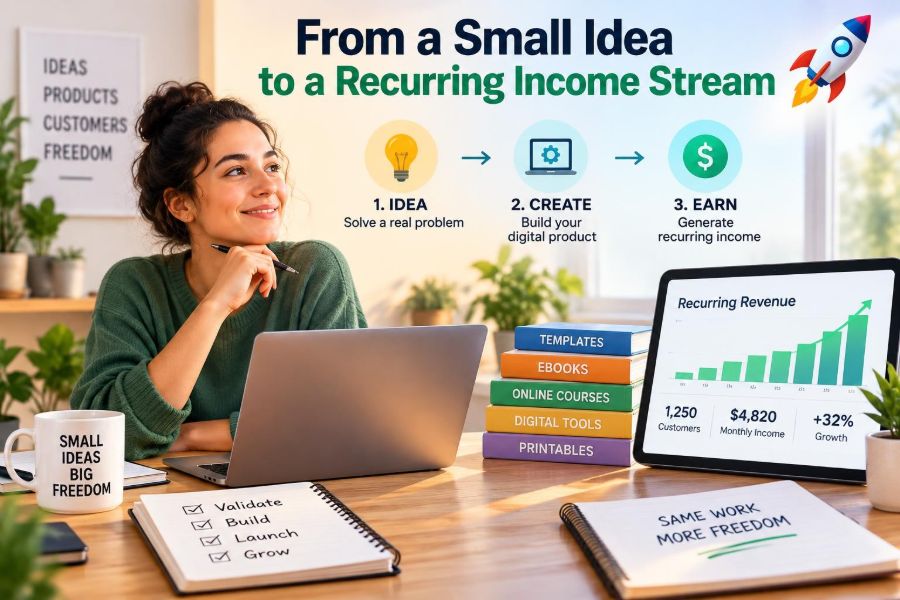

A small digital product can be one of the most practical ways to start an online business. It can be created once, delivered automatically, improved over time, and sold without inventory, shipping, or a large team.
That does not mean it is effortless. The hard part is rarely making the first PDF, template, mini-tool, or membership. The hard part is choosing a painful enough problem, earning attention from the right people, and building a reason for customers to keep paying.
This model suits people with useful experience, a niche interest, an audience, or simply the willingness to listen closely to a specific group. You do not need to be a developer or a social-media celebrity, but you do need a narrow customer and a useful result.
It matters now because many people are overwhelmed by generic information. They will pay for focused shortcuts, organized systems, specialized assets, and tools that save time in their particular work or hobby.
🎯 1. Start With a Narrow, Repeating Problem
A recurring income stream begins with a problem that returns. A one-off need can support a one-time product, but repeat payments need repeat value: new work to do, changing information, ongoing accountability, fresh assets, or a tool customers use regularly.
Do not begin with “What can I make?” Begin with “What annoying task does this person face every week or month?”
- A freelance designer needs a better client onboarding process.
- A local fitness coach needs fresh social posts each month.
- An online seller needs to monitor product margins as costs change.
- A job seeker needs accountability and tailored application materials through a search.
A small, expensive inconvenience is usually more valuable than a broad, mild interest. “Templates for everyone” is vague. “Monthly content packs for independent mortgage brokers” gives you somewhere to start.
🧭 2. Pick a Customer You Can Actually Reach
Your first market should be specific enough that you know where its members gather. Reachability is as important as market size when you have no advertising budget and no existing brand.
Choose a group where you understand the language, routines, buying triggers, and constraints. That may come from a former job, a community you belong to, clients you already serve, or a skill you use yourself.
A useful customer definition
Write one sentence: “I help specific person get specific result without specific frustration.” For example: “I help solo bookkeepers send polished monthly client reports without rebuilding spreadsheets from scratch.”
“Small businesses” is not a customer segment. A better early segment is “independent bookkeepers with five to 30 clients who use spreadsheets and want a more professional reporting process.”
🔎 3. Validate the Need Before Building
Validation is not collecting compliments. People often say an idea sounds nice because they want to be polite. Better evidence is a detailed complaint, a request to be notified, a pre-order, a paid pilot, or a customer sharing how they currently solve the problem.
Have ten practical conversations
- Ask them to describe the last time the problem happened.
- Ask what they tried, what it cost, and why it was unsatisfying.
- Ask how often it occurs and what happens if they ignore it.
- Ask what a good solution would need to do.
- Ask whether they would test a paid early version.
Do not pitch for the first 20 minutes. Listen for repeated wording. Those phrases will later become your product page, email subject lines, and onboarding instructions.
You can also publish a simple description and waitlist. Be clear that it is an early product. A small list of highly relevant people is stronger than a large list built from vague curiosity.
🧩 4. Choose the Right Digital Product Shape
Different formats create different paths to recurring revenue. Pick the smallest shape that can produce a meaningful outcome, not the format that looks most impressive on social media.
| Product format | Typical recurring value | Estimated startup cost | Effort to maintain | Profit potential |
|---|---|---|---|---|
| Template library | New or updated assets | $0–$150 | Low to medium | Medium |
| Paid newsletter | Useful analysis or curated research | $0–$100 | Medium | Medium |
| Micro-software tool | Repeated workflow automation | $50–$2,000+ | Medium to high | High |
| Membership community | Access, feedback, and accountability | $0–$300 | High | Medium |
| Asset subscription | Fresh niche-specific resources | $0–$300 | Medium | Medium to high |
These are estimates, not guarantees. Software, payment processing, professional help, taxes, and compliance costs vary substantially by country and business model.
🛠️ 5. Build the Minimum Useful Version
Your first version should solve one job well enough that someone can use it today. Resist the urge to create a course with 40 lessons when a workbook, checklist, or focused tool would deliver the first result.
For a template subscription, the minimum version might be ten high-quality templates and a short setup guide. For a micro-tool, it might be one reliable workflow rather than a dashboard with ten integrations.
Use a simple quality test
- Can a beginner understand what to do next?
- Can a customer get a useful outcome within one sitting?
- Does it remove work rather than add homework?
- Have three target users tested it without your constant help?
Manual delivery is acceptable at this stage. If delivering a file by email teaches you what customers ask for, that is valuable research, not failure.
💵 6. Design Recurring Value, Not a Forced Subscription
A subscription is justified when the customer receives continuing value. Charging every month for a static bundle that never changes will create cancellations and damage trust.
Common recurring-value engines include new content, regular updates, monitoring, usage-based utility, recurring feedback, and accountability. The best option depends on the problem, not on your preference for predictable revenue.
Examples of honest recurring offers
- A monthly library of compliant, niche-specific marketing assets.
- A weekly brief that filters regulatory or industry changes for busy professionals.
- A calculator that updates forecasts whenever users add new data.
- A membership with office hours, peer feedback, and a monthly implementation sprint.
If value is mostly one-time, sell a one-time product and offer optional updates, support, or a related membership later.
🏷️ 7. Price for the Outcome and Your Capacity
Early pricing does not need to be perfect. It needs to be clear, sustainable, and easy to test. Price against the time saved, revenue protected, stress reduced, or outcome accelerated—not just the number of files included.
A product that saves a consultant three hours a month may be worth much more than a product that offers entertainment. But do not overstate the benefit. Let customers decide whether the value is real.
A simple first pricing structure
- Starter: a low-friction version for people who want to try the approach.
- Core subscription: the main recurring outcome and regular updates.
- Premium: limited feedback, implementation support, or team access.
For example, a niche template library might offer a one-time starter pack, a monthly membership for new assets, and a higher-priced tier with a monthly review call. Keep tiers understandable. Confusing options reduce conversion.
📊 8. Know the Numbers Before You Chase Growth
You do not need a finance department, but you do need a basic operating view. Track income, direct costs, refund obligations, taxes set aside, customer support time, and the cost of acquiring each customer.
Use this simple monthly calculation:
monthly recurring revenue = active subscribers × average monthly price
net operating contribution = revenue − direct tools − payment fees − support and delivery costs
Do not treat revenue as personal take-home pay. Reserve money for tax obligations where applicable, business expenses, refunds, and slow months. Speak with a qualified local accountant when your activity becomes meaningful; tax registration and consumer rules vary by country.
🧱 9. Set Up a Lean, Reliable Product Stack
Use boring tools that let customers buy, access the product, and contact you. Complex technology rarely fixes a weak offer, and migrating later is easier than maintaining a complicated system too early.
- A landing page that explains the customer, problem, outcome, and price.
- A payment system capable of handling subscriptions and receipts.
- A delivery area for files, posts, or tool access.
- An email system for onboarding and product updates.
- A simple spreadsheet or dashboard for metrics and customer feedback.
Protect customer information, use strong passwords and two-factor authentication, and collect only data you need. If you handle personal data, review the privacy and data-protection rules that apply to your customers and location.
🗣️ 10. Write a Sales Page That Sounds Like a Helpful Human
Your sales page has one job: help the right visitor understand whether this is for them. It does not need hype, exaggerated countdowns, or claims you cannot prove.
Include these building blocks
- A direct promise of the practical outcome.
- Who the product is and is not for.
- The frustrating old way and the simpler new process.
- What customers receive now and what arrives regularly.
- A brief preview of how it works.
- Price, billing frequency, cancellation terms, and support details.
Instead of “The ultimate business toolkit,” write “Monthly client-report templates for independent bookkeepers who want a polished report without starting from a blank spreadsheet.” Specificity attracts better-fit buyers.
🤝 11. Find Your First Customers Manually
Your first ten customers are unlikely to come from a viral launch. They often come from direct, respectful outreach and useful participation in places your niche already spends time.
Make a list of people who have described the exact problem: former colleagues, existing service clients, newsletter readers, community members, and people who responded to your validation conversations.
A practical outreach approach
- Share a useful observation or small free resource related to their problem.
- Explain that you built a focused early solution.
- Ask whether they want a short preview, not whether they want to “support your dream.”
- Offer an early-user price in exchange for candid feedback.
- Follow up once, then move on politely.
Personal outreach is not spam when it is relevant, limited, and easy to decline. Do not add people to marketing emails without appropriate permission.
📣 12. Build One Repeatable Audience Channel
Once you have early proof, choose one primary way to earn attention. Trying to post everywhere usually produces shallow work and burnout. Pick the channel where your buyers already look for help.
For some products, that is search-friendly educational content. For others, it is a short email newsletter, a specialist community, partnerships with service providers, workshops, or demonstrations at industry events.
Create content that leads naturally to the product
Teach a small part of the process. Show common mistakes. Share before-and-after workflow examples without revealing private customer data. Then explain that the paid product provides the organized system, ongoing assets, or implementation support.
The goal is not to become famous. The goal is to become useful and memorable to a small group of likely buyers.
✉️ 13. Use Onboarding to Create an Early Win
Many cancellations begin because customers buy with optimism but never get started. Your onboarding should guide them toward one visible result in their first day or week.
- Send a welcome message with one clear first action.
- Show a short “start here” path rather than every feature.
- Include a realistic example of a finished result.
- Ask one question that lets you tailor the next email or recommendation.
- Invite a reply if they get stuck.
For a content membership, the first win may be publishing one post. For a tool, it may be importing one set of data and seeing the first useful output. For a community, it may be introducing themselves and attending one session.
🔄 14. Reduce Churn by Improving the Product Loop
Churn is the percentage of subscribers who cancel during a period. Some churn is normal: customers finish a project, change jobs, or reduce spending. Your job is not to trap them; it is to make continued membership genuinely worthwhile.
Ask canceling customers one short question: “What was the main reason you decided to cancel?” Keep the answer options simple, and leave space for a written response.
Turn feedback into a monthly loop
- Review support questions, cancellations, and feature requests.
- Identify the most repeated obstacle, not the loudest single request.
- Make one meaningful improvement.
- Tell members what changed and why.
- Measure whether activation, engagement, or retention improves.
Do not add every requested feature. A focused product becomes weaker when it tries to serve every adjacent need.
📈 15. Track Metrics That Change Decisions
Vanity metrics can feel encouraging while hiding a weak business. Thousands of views mean little if visitors do not match your audience or customers leave after one month.
| Metric | What it tells you | Useful question |
|---|---|---|
| Visitor-to-buyer conversion | Offer and traffic fit | Do qualified visitors understand the value? |
| Activation rate | Early product adoption | Do buyers reach the first meaningful outcome? |
| Monthly churn | Retention health | Why are people leaving? |
| Average revenue per customer | Pricing and tier mix | Are premium needs being served responsibly? |
| Support volume | Product friction | What should be clearer or automated? |
| Referral rate | Customer satisfaction | Would users recommend this without being pushed? |
Review these monthly. With a small customer base, use the numbers as clues rather than pretending they are statistically precise.
⚠️ 16. Avoid the Most Common Traps
Small digital products fail for ordinary reasons, not because the founder lacked ambition. Most mistakes are fixable when you notice them early.
- Building in isolation: talk to customers before and during creation.
- Targeting everyone: start with one narrow use case and expand later.
- Underpricing support: account for the time you spend helping each customer.
- Over-automating too early: manual work often reveals the right system.
- Ignoring cancellations: churn feedback is product research.
- Making unsupported claims: describe capabilities honestly and avoid promises of earnings, legal outcomes, health outcomes, or compliance you cannot substantiate.
If your product touches regulated areas such as finance, health, education, employment, or legal guidance, get appropriate professional advice. Disclaimers alone do not make unsuitable advice safe.
🌱 17. Scale Only After the Core Offer Works
Scale is not adding more products immediately. First make the core offer easier to discover, buy, use, and renew. A modest product with happy customers is a safer base than a broad catalog with confused buyers.
Good next-stage growth moves
- Create a referral incentive that rewards customers without pressuring them.
- Partner with complementary consultants, agencies, or educators.
- Add a team plan when users naturally share the product at work.
- Turn repeated support answers into guides and product improvements.
- Offer annual billing only when customers already see lasting value.
- Create a higher-touch implementation service for buyers who need help.
Document your process before outsourcing support, design, content editing, or development. Growth that outruns quality can increase refunds, complaints, and burnout.
🧪 18. Use Experiments Instead of Big Bets
When you are unsure what to improve, run a small test with a clear hypothesis. Change one meaningful variable at a time: the audience, positioning, price presentation, onboarding step, or content format.
For example: “If I replace a broad homepage headline with one aimed at freelance bookkeepers, more relevant visitors will request a preview.” Decide in advance what signal you will watch and how long you will test.
Keep a decision log. Write what you changed, why you changed it, what happened, and what you learned. Over time, this becomes your operating manual and prevents you from repeating the same guesses.
✅ 19. Your Action Plan for This Week
Do not spend this week building a polished platform. Spend it reducing uncertainty.
- Choose one customer group you can contact or observe.
- Write down three recurring problems they experience.
- Book or start ten short conversations using the validation questions above.
- Select one problem with urgency, frequency, and a reachable audience.
- Describe the smallest paid product that could create a first win.
- Create a plain-language waitlist or preview page.
- Ask five likely users whether they would test a paid early version.
By the end of the week, your goal is not a finished business. Your goal is evidence: clearer customer language, a sharper problem, and at least a few people willing to look closely at your solution.
The path to recurring online income is not finding a magic product; it is repeatedly delivering a small, specific value to people who have a reason to come back. Build carefully, listen often, and let real customer behavior guide the next step. 🚀🌱💻