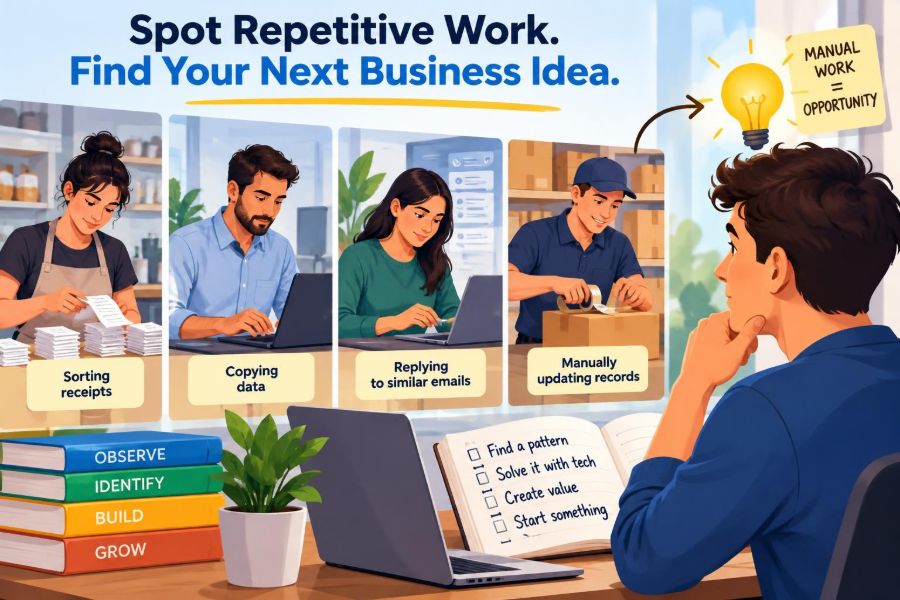

The best business ideas often do not arrive as lightning bolts. They show up as somebody copying data between spreadsheets, chasing approval in chat, sending the same reminder every Friday, or rebuilding the same document for every new customer.
That is useful because repeated manual work is evidence. Someone is already spending time, attention, and sometimes money to solve a problem badly. You do not need to invent a new human desire; you need to notice friction that people have normalized.
This approach suits founders who are observant, patient, and willing to start with an unglamorous niche. It also works well for side hustlers because you can validate a narrow service before building software, hiring a team, or quitting your job.
It matters now because small teams have more tools than ever, from no-code databases to automation platforms and AI assistants. The opportunity is not to automate everything. It is to remove one expensive, recurring annoyance for a specific group of people.
🔎 1. Learn to See Manual Work as a Market Signal
Manual work is not automatically a business opportunity. A person may do something by hand because it happens once a year, feels enjoyable, or is too low-stakes to improve.
Look instead for work with four traits: it is repeated, necessary, frustrating, and costly when done badly. Cost can mean lost revenue, wasted staff time, errors, delayed decisions, or an unhappy customer.
- Repeated: daily, weekly, or with every client or transaction.
- Necessary: the user cannot simply stop doing it.
- Frustrating: people complain, improvise, or procrastinate.
- Costly: an error or delay has a visible consequence.
A restaurant owner manually texting staff about shifts is a clue. A property manager reconciling maintenance updates across calls, emails, and photos is a stronger clue. A finance team rekeying invoices every month may be stronger still, because the task is recurring and mistakes matter.
🧠 2. Separate an Annoyance from a Real Buying Problem
People complain about many things but pay to solve far fewer. The key question is not whether a workflow is ugly. It is whether the pain is urgent enough that a decision-maker will change behavior.
Ask what happens if the work is not done. If the answer is merely that someone feels mildly inconvenienced, treat it as weak evidence. If it causes missed appointments, compliance exposure, payroll mistakes, or lost leads, investigate further.
Questions that reveal buying intent
- Who owns this task, and who feels the consequences?
- How often does it happen?
- What is the current workaround?
- How long does it take, including follow-ups and error correction?
- Has anyone tried a tool, freelancer, or internal process to fix it?
- What would improve if the task took five minutes instead of two hours?
Do not lead with your solution. Ask people to show you the last time they did the work. Real screens, folders, notes, and handoffs are more valuable than abstract opinions.
👀 3. Pick Places Where Repetition Is Easy to Observe
You do not need privileged access to discover manual workflows. Start in environments you understand or can visit respectfully: local businesses, professional communities, volunteer groups, family businesses, online operator forums, and your own workplace.
Good hunting grounds are industries with many small firms and inconsistent processes. They often rely on inboxes, spreadsheets, paper forms, and knowledgeable people who hold the operation together.
| Place to observe | Manual-work clues | Access effort | Potential |
|---|---|---|---|
| Local service businesses | Scheduling, quotes, follow-ups | Low | High for focused tools |
| Freelance and agency teams | Client reporting, approvals, onboarding | Low | Good for service-first offers |
| Property and facilities work | Inspections, vendors, status updates | Medium | High but operationally complex |
| Regulated offices | Records, checklists, document review | Medium | High, with compliance risk |
| Online seller communities | Inventory, returns, support, listings | Low | Good for niche automation |
Begin where you have trust. Your first insight rarely needs to be globally original. It only needs to be useful to a reachable group that is currently underserved.
🗒️ 4. Build a Friction Log for Two Weeks
Most people forget useful observations because they wait for a perfect idea. Instead, keep a simple friction log on your phone or in a spreadsheet for two weeks.
Record each repeated manual action you see, even if it seems boring. Boring is often where budgets live.
Date | User type | Manual task | Frequency | Current workaround | Consequence | Quote
Monday | Salon owner | Confirm appointments | Daily | Individual texts | Empty slots | I spend every evening chasing replies
Capture exact language, but do not pretend that one comment validates a market. Your job at this stage is to create a list worth testing.
📊 5. Score Opportunities Before You Fall in Love
Use a lightweight scorecard to prevent yourself from chasing the most technically interesting problem. Score each category from one to five, then compare ideas rather than relying on intuition.
- Frequency: How often does the work occur?
- Pain: How serious is the delay, error, or hassle?
- Budget: Can a buyer reasonably pay to improve it?
- Reachability: Can you identify and speak to buyers?
- Fit: Do you understand the workflow or have a credible way to learn it?
- Complexity: Can you test the offer without a large build?
Favor ideas that are painful and easy to reach, even if the first version is less exciting. A narrow workflow with clear buyers beats a vast problem with vague users.
🧭 6. Follow the Work, Not the Software Request
Potential customers may ask for an app, dashboard, AI bot, or marketplace. Those are proposed solutions, not necessarily the underlying need.
Map the workflow from trigger to finish. Note where information enters, who touches it, what decisions are made, where it gets stuck, and what must happen next.
- Identify the trigger, such as a new lead, invoice, booking, or inspection.
- List every handoff, tool, message, and copy-paste step.
- Mark delays, duplicate entry, missing information, and exceptions.
- Find the one moment where a mistake costs the most.
- Design a small intervention around that moment.
A customer asking for a general customer relationship system may really need leads contacted within ten minutes. The first offer could be a lead-capture and follow-up workflow, not another all-purpose platform.
🧪 7. Interview for Evidence, Not Praise
A polite interview can produce misleading enthusiasm. People want to be encouraging, and they often imagine that they would use a tool without changing their habits.
Ask about past behavior. A strong interview is specific, uncomfortable in a useful way, and centered on what actually happened last week.
A practical interview script
- Walk me through the last time you did this.
- What starts the process?
- Where do you keep the information?
- What goes wrong most often?
- What have you tried already?
- Who approves spending to improve it?
- Would you pay for someone to handle this now? Why or why not?
Common mistake: asking, Would you use this? Better question: What do you pay, spend, or lose because of this today? A commitment to a pilot, introduction, paid setup, or calendar time is stronger than praise.
🛠️ 8. Start as a Service Before You Build a Product
For many manual-work ideas, the fastest validation is to do the job yourself with a repeatable process. This is sometimes called a concierge approach, but the point is simple: learn the messy exceptions before automating them.
You might organize a contractor’s estimate follow-ups, compile weekly client reports for an agency, or turn inspection photos into a structured maintenance tracker. Use ordinary tools first.
- Spreadsheets or a database for records.
- Forms for collecting consistent inputs.
- Calendar and email tools for reminders.
- Automation software for simple routing.
- AI tools for drafting, classification, or summarization with human review.
Do not hide the fact that a human is involved when that matters. Your early customers are buying an outcome, and you are buying learning. Be especially careful with confidential, financial, health, or legal information.
💡 9. Idea One: Quote-to-Follow-Up Systems for Local Service Firms
What it is: a managed workflow that captures new inquiries, creates quote templates, sends follow-up reminders, and tracks whether leads become jobs. It solves the common gap between a busy owner preparing estimates and consistently following up.
Target customers: cleaners, landscapers, repair businesses, photographers, installers, and other local service firms with a steady flow of inquiries but no disciplined sales process.
Estimated startup costs: roughly $50 to $300 for a domain, basic software subscriptions, and simple marketing materials. Costs vary by country, tool choice, and whether you use paid outreach.
Skills and tools: customer discovery, basic sales, process design, a spreadsheet or database, forms, email or text workflows, and care with consent rules for marketing messages.
First customers: contact businesses that visibly invite quote requests, ask how they follow up, and offer to set up one workflow for a fixed pilot fee. Local referrals and direct conversations are usually more effective than broad ads at first.
Revenue model: charge a setup fee plus a monthly management fee, or price per location. Once results and workload are understood, you can offer tiered plans.
Risks: clients may blame the system for weak demand or poor pricing. Messaging rules, privacy requirements, and text-message consent laws differ by country and region.
How to scale: standardize onboarding by trade, create reusable templates, and eventually turn the most repetitive parts into a lightweight product. Do not promise lead generation if your service only improves follow-up.
🏢 10. Idea Two: Maintenance Coordination for Small Property Managers
What it is: a central intake and coordination service for repair requests. It gathers photos and details, routes jobs to approved vendors, updates tenants or owners, and produces a clear status record.
Target customers: independent property managers, small landlord groups, and facilities operators managing enough units to feel the pain but not enough to employ a dedicated operations team.
Estimated startup costs: around $100 to $500 for a basic database, forms, communication tools, and potentially a business phone line. Insurance, legal setup, and local registration can add meaningfully to this.
Skills and tools: operations, customer communication, vendor management, prioritization, documentation, and a simple ticketing workflow. You need clear boundaries for emergencies and approval limits.
First customers: interview local managers, then offer to organize one portfolio for thirty days. Bring a sample status board rather than a fully built application.
Revenue model: a monthly fee per managed unit, property, or ticket volume. A premium plan can include after-hours intake, but only if your staffing and liability are appropriate.
Risks: urgent repairs create real operational pressure. Housing, contractor, privacy, insurance, and local licensing rules can apply, so get professional local advice before representing yourself as a property manager or making regulated decisions.
How to scale: build repeatable intake categories, vendor scorecards, and reporting templates. Expand city by city rather than pretending that every local vendor network is interchangeable.
📁 11. Idea Three: Client Reporting Operations for Small Agencies
What it is: a service that gathers campaign or project data, checks it, turns it into a consistent client report, and prepares the account manager for the review meeting.
Target customers: marketing, design, development, recruiting, and consulting agencies that deliver recurring work but spend too much senior time assembling updates.
Estimated startup costs: approximately $50 to $250 for reporting, document, and automation tools. The real initial investment is learning each agency’s definitions and client expectations.
Skills and tools: spreadsheet fluency, writing, data hygiene, dashboard basics, project-management tools, and judgment. Never allow automated summaries to make unsupported performance claims.
First customers: approach agency owners with a narrow offer: one reporting cycle, one account, and a defined turnaround time. Show a sanitized example of a clean executive summary and source checklist.
Revenue model: charge per account, per reporting cycle, or as a monthly retainer. Setup fees are reasonable when you must build custom templates and data connections.
Risks: inconsistent source data can make reports wrong, and client information may be confidential. Use access controls, written scopes, and review steps.
How to scale: specialize in one agency type, standardize report formats, train operators, and build connectors only after you know which data sources recur across paying customers.
💵 12. Price the Outcome, Then Protect Your Time
Early pricing is an experiment, not a declaration of your worth. Start with a scope that is easy to explain: setup plus a defined monthly workflow, number of locations, reports, or active jobs.
Estimate the value of time saved, errors avoided, or revenue protected, but do not claim savings you cannot verify. Your price should cover delivery, software, support, taxes, and a margin for unexpected work.
- Use a paid pilot when the problem is meaningful but the workflow is unproven.
- Define what is included, response times, and what counts as extra work.
- Invoice in a way that matches your local tax and business rules.
- Review delivery time every month; a low price can hide an unscalable service.
The common mistake is underpricing a highly customized workflow. If every customer needs a different process, either charge for customization or narrow the customer profile.
📣 13. Get First Customers Through Specific, Helpful Outreach
Your first customers are unlikely to come from a broad launch announcement. They come from people who recognize the exact workflow you describe.
Create a short message based on an observed problem, not a generic claim about automation. Personalization should demonstrate relevance, not surveillance.
Hello, I work with small service firms that lose track of quote follow-ups when work gets busy. I am testing a simple setup that organizes inquiries and reminders. How are you handling that today?
Use conversations, referrals, niche groups, local events, and partnerships with adjacent providers. Track outreach like an experiment: which segment replies, books calls, and agrees to a pilot?
📏 14. Track the Few Metrics That Prove Progress
Vanity metrics can distract you from whether the business works. You need evidence of pain, willingness to pay, delivery quality, and retention.
- Interviews completed: whether you are learning from the right people.
- Qualified pain rate: the share of interviews with a repeated, costly problem.
- Discovery-to-pilot conversion: whether interest becomes commitment.
- Time saved per workflow: measured with customer input where possible.
- Gross margin: revenue minus direct delivery and tool costs.
- Retention and expansion: whether customers stay and add scope.
For a service-first idea, also track hours required per customer. If delivery time rises faster than revenue, you have found a process problem, not yet a scalable product.
⚠️ 15. Know When Not to Automate
Some tasks should remain human-led. Sensitive decisions, unusual exceptions, relationship-heavy work, and workflows with poor input data can become worse when automated too early.
Automation should make responsible work easier, not create a black box. Keep approval points for money movement, legal commitments, safety issues, hiring decisions, and sensitive communications.
- Do not collect data you do not need.
- Get clear permission before using customer systems or contacts.
- Document who can approve actions and spending.
- Test failure cases, not only happy paths.
- Seek legal, tax, insurance, and regulatory advice relevant to your country and industry.
A trustworthy small business can grow more slowly than a reckless one at first, but it has a far better foundation.
🔁 16. Turn Repeated Delivery into a Product Roadmap
After several customers, review what you do repeatedly. The best product features are often the tasks you are tired of performing manually because they recur across similar customers.
Do not build from a wish list. Build from repeated paid behavior. If three customers need the same intake form, status view, reminder sequence, and exception handling, that is a stronger roadmap than a hundred feature requests.
- Document your delivery process after every customer.
- Identify the steps that repeat with little customization.
- Automate one internal step at a time.
- Measure whether quality, speed, or margin improves.
- Offer the improved process to new customers first.
You may remain a profitable specialized service, become a productized service, or eventually create software. All are valid outcomes. The mistake is assuming software is the only respectable ending.
✅ 17. Your Action Plan for This Week
Do not wait to feel like a founder. Treat this week as a short field-research sprint.
- Day 1: choose one industry you can access and create a friction log.
- Days 2-3: observe or interview five people about real recent workflows.
- Day 4: score the top three problems for frequency, pain, budget, reachability, and complexity.
- Day 5: map the best workflow from trigger to outcome.
- Day 6: write a narrow pilot offer that can be delivered with existing tools.
- Day 7: ask five potential customers for a conversation or paid pilot.
Keep the goal modest: find evidence, not perfection. If nobody cares, you have not failed; you have saved months of building the wrong thing.
The business idea you need may be hiding in the task everyone accepts as normal, even though they repeat it manually every single week. 🚀🔍💪