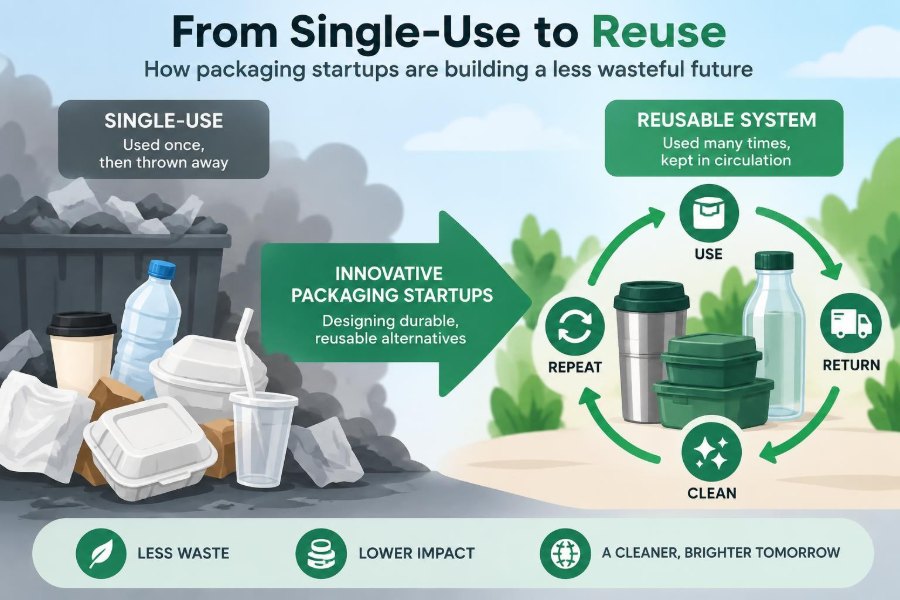

A customer orders lunch in a sturdy container, enjoys the meal, and drops the empty package into a return bin near a train station. The container is collected, washed, checked, and sent back to a restaurant for another order.
That simple journey looks different from the familiar takeaway model, where a container, lid, cup, or pouch is used once and immediately becomes waste. But making reuse work requires far more than designing a durable box.
Packaging startups are building systems around physical containers: deposits, tracking, collection points, washing operations, software, and partnerships. Their real product is not only packaging. It is a reliable loop.
For students and working professionals interested in sustainable business, this is an important lesson. Many climate and circular-economy opportunities are not about inventing a new material; they are about redesigning how products move through everyday life. 🌍
♻️ 1. The Problem With the Single-Use Default
Single-use packaging is optimized for a linear journey: make it, fill it, sell it, discard it. This model is convenient because responsibility usually ends when the customer receives the product.
Yet convenience can hide operational costs. Businesses must continually buy new packaging, customers must sort or dispose of it, and public waste systems must handle what remains.
Reusable systems try to replace that one-way flow with a circular one. A package becomes an asset that returns for many cycles rather than a consumable purchased for one transaction.
📦 2. Reuse Is a System, Not Just a Better Box
A common mistake is to treat reusable packaging as a materials problem alone. A stainless-steel cup or durable plastic container may be reusable in theory, but it only creates value if it actually comes back.
A startup therefore has to design several connected layers:
- Container design that survives repeated use and cleaning.
- Customer behavior that makes returning easy.
- Reverse logistics to move empty items back efficiently.
- Cleaning and quality control that prepares items safely for reuse.
- Data systems that show where inventory is and what it costs.
If one layer fails, the loop can become expensive or inconvenient. The startup challenge is coordinating all of them.
🔄 3. Understand the Circular Packaging Loop
A reusable package typically follows a repeatable sequence: distribution, use, return, collection, sorting, washing, inspection, and redistribution. Each stage affects the economics of every other stage.
For example, a return point that is hard to find lowers return rates. Lower return rates mean the operator needs more containers in circulation, which raises the amount of capital tied up in inventory.
Founders should map this loop before choosing technology or manufacturing a large first batch. The map turns a broad sustainability idea into a practical operating model.
🎯 4. Start With a Narrow Use Case
Many promising reuse startups begin with one setting where behavior is predictable. Examples include office campuses, universities, music festivals, sports venues, delivery kitchens, or a chain of cafés.
These settings reduce uncertainty. Customers visit repeatedly, return locations can be visible, and the startup can work with a limited group of merchant partners.
A focused launch also lets the team learn what people actually do, not what surveys say they might do. A reusable cup system at one stadium is easier to improve than a system meant for every restaurant in a city.
🧭 5. Choose a Market Where Returns Fit Naturally
The strongest early markets have a natural path back. A commuter may pass the same café, office, or station each day; a festival visitor may return a cup before leaving the site.
Return friction matters more than environmental intent. Even motivated customers can forget a container at home or postpone a return if it requires a special trip.
Useful early-market signals
- Frequent repeat purchases.
- Dense locations with short collection routes.
- Staffed or secure spaces for return points.
- Merchants with similar packaging needs.
- A clear reason for customers to participate.
🧱 6. Design the Package for the Whole Journey
Packaging design must account for filling, carrying, stacking, returning, washing, drying, and storing. A visually attractive container that jams in a dishwasher or takes too much shelf space can harm the business.
Durability is important, but so are weight, nesting ability, lid compatibility, and ease of inspection. Standardized forms can simplify operations because merchants and wash facilities handle fewer variations.
The best design question is not, “What looks most sustainable?” It is, “What package can complete reliable cycles with the least friction?”
🧼 7. Build Food Safety Into Operations
For food and beverage applications, cleaning is central to trust. Reuse operators need documented processes for collecting used items, separating them from clean inventory, washing them, drying them, inspecting them, and removing damaged items.
Requirements vary by place and application, so startups need to work with relevant local regulators, food businesses, and experienced wash partners. They should avoid assuming that a consumer-style cleaning process will be suitable at commercial scale.
Clear handling rules also help merchants. Staff need to know where returned containers go and how to prevent clean and used items from mixing.
💳 8. Pick the Right Customer Incentive
Customers need a reason to return the item promptly. The most common mechanisms are refundable deposits, account-based holds, loyalty rewards, or a membership model that includes access to reusable packaging.
A deposit is not a punishment. It is a temporary signal that the container has value and should re-enter the system. But the refund process must be simple enough that customers trust it.
Startups should test the full experience: checkout, receipt, reminders, return, and refund. A confusing refund can undo the goodwill created by a good sustainability message.
📱 9. Use Technology Only Where It Removes Friction
QR codes, barcodes, RFID tags, smart bins, and mobile apps can all support reuse. They can identify containers, record deposits, trigger refunds, and reveal inventory imbalances.
However, technology is useful only when it solves a clear operational problem. A complicated app requirement may discourage occasional users, while a simple scan at a return point may be enough.
Early teams should decide what must be tracked at the individual-item level and what can be tracked in batches. More data is not automatically better if it raises cost or slows staff down.
🪪 10. Decide What Needs to Be Tracked
Different models need different levels of traceability. A closed campus system may track total inventory by location, while a citywide network may need to identify each container and its current status.
| Tracking approach | Best fit | Main trade-off |
|---|---|---|
| Batch or location tracking | Small, controlled networks | Lower detail when items are lost |
| Unique barcode or QR code | Networks with deposits and multiple partners | Requires scanning discipline |
| RFID or automated identification | High-throughput collection environments | More equipment and setup complexity |
The goal is operational visibility. A founder should be able to answer basic questions: How many clean units are available? Where are shortages occurring? How many items are not returning?
🚚 11. Reverse Logistics Is the Hidden Business
Forward logistics moves filled products toward customers. Reverse logistics moves empty packages back to the system. In reusable packaging, the return journey can determine whether the business works at all.
Collection routes need enough volume to justify transport. Containers should be compact, stackable, and protected from contamination while moving from return points to cleaning facilities.
Some startups operate their own collection, while others partner with delivery firms, waste-service operators, distributors, or merchants. The right choice depends on density, control needs, and local infrastructure.
🏭 12. Choose a Washing Model Carefully
A startup can build its own washing operation, use a specialized third-party facility, or work with existing commercial kitchens and laundries where appropriate. Each approach changes capital needs, quality control, and geographic reach.
Owning washing capacity may offer process control, but it also adds equipment, labor, maintenance, water, energy, and compliance responsibilities. Partnering can be faster, though capacity and service quality need close management.
At an early stage, founders should validate washing throughput and turnaround time before making large infrastructure commitments.
📍 13. Make the Return Moment Obvious
Customers should not need to search for instructions. Return points work best when they are placed where people naturally finish using the product or pass through on their way out.
Signage should answer three questions quickly: where to put the package, what happens to the deposit or reward, and whether lids or components should be separated. Staff prompts can help during launch periods.
Convenience is part of the product. A return system that is easy to notice is more likely to become a habit. ✅
🤝 14. Sell a Better Workflow to Merchants
Restaurants, retailers, and brands will participate when the system fits their operations. Sustainability goals matter, but frontline teams also care about storage, staff training, checkout speed, and reliable supplies of clean containers.
A startup should map the merchant workflow in detail: ordering stock, receiving clean units, packing products, taking deposits, handling returns, and reporting exceptions. Each extra step should have a clear benefit or be automated.
Merchant onboarding is often a product-design task disguised as sales. If the process is difficult for staff, rollout across locations will stall.
💰 15. Know Where the Economics Come From
Reuse systems have costs that single-use packaging businesses may not carry directly: collection, transportation, washing, sorting, loss, customer support, software, and working inventory. They may also reduce the need to repeatedly purchase disposable items.
Financial viability depends on repeated cycles. A durable container needs enough successful returns and reuses to justify its purchase and operating costs.
Founders should model economics by route, merchant, and container type rather than relying only on a company-wide average. Dense, high-return locations may support the system long before low-density ones do.
📊 16. Measure the Metrics That Reveal Reality
Vanity metrics such as app downloads can be interesting, but operational metrics are more useful. A reuse startup needs to understand whether the loop is getting faster, denser, and more reliable.
Core operating metrics
- Return rate: the share of issued packages that come back.
- Turnaround time: how long a package takes to become clean inventory again.
- Cycles per container: how often an item is successfully reused.
- Loss and damage rate: items that do not return or cannot be reused.
- Cost per completed cycle: the full operational cost of one reuse.
- Merchant adoption: active locations and their ongoing usage.
These measurements guide decisions about design, incentives, collection routes, and expansion.
🧪 17. Pilot Before You Build a Network
A pilot is not merely a marketing launch. It is a structured test of assumptions about behavior, operations, and unit economics.
Start with a defined geography, a small number of package types, and a limited group of partners. Set learning goals such as discovering where returns happen, which instructions confuse users, or how long containers stay idle.
Teams should observe the physical system directly. Watching a busy café handle returns can reveal problems that dashboard data never shows.
🗣️ 18. Teach the Habit at the Point of Use
Customers may understand recycling but still be unfamiliar with borrowing packaging. The startup must explain the new behavior in a few seconds, at the exact moment it matters.
Simple language is stronger than abstract claims. “Return this cup here for your refund” is clearer than a long explanation of circularity.
Repeated cues build routine: a short message at checkout, a visible return station, a reminder after purchase, and a confirmation after return. The aim is not to lecture users; it is to make the right action feel normal.
⚖️ 19. Treat Loss as a Design Variable
Some containers will be forgotten, taken home, damaged, or removed from circulation. A viable business does not assume perfect behavior; it plans for losses and works to reduce them.
Deposit design, return convenience, container visibility, reminders, and merchant procedures all influence loss. So does the package itself: a container that looks like a personal possession may be more likely to leave the network permanently.
Loss should be measured by location and customer journey. That helps teams distinguish a broad pricing issue from a specific weak return point.
🌱 20. Avoid Simplistic Environmental Claims
Reusable packaging can reduce the need for single-use items, but environmental outcomes depend on the full system. Manufacturing materials, transport distances, washing resources, energy sources, return rates, and total reuse cycles all matter.
Startups should be precise about what they know and cautious about what they have not measured. Claims such as “zero impact” are rarely credible for a physical product system.
A better approach is to describe the mechanism honestly: the company is designed to keep packaging in circulation and reduce reliance on disposable formats when the loop is used as intended.
🔍 21. Compare Reuse With Other Options Fairly
Reuse is one strategy among several. Reduction, refill, recycling, composting, and material substitution can each be appropriate in different contexts.
For example, eliminating unnecessary packaging may be better than replacing it with a reusable alternative. A refill model can work well for some household goods, while a returnable container may be practical for prepared food in a dense local network.
Good founders do not claim that one solution fits every product. They identify the situations where their operating model is genuinely stronger.
🏙️ 22. Design for Density Before Geographic Scale
Expansion across a large map can sound impressive, but it may create costly routes and scattered inventory. Reuse systems generally benefit when users, merchants, return points, and wash capacity are close together.
Density allows more collections per route, more convenient returns, and quicker container turnaround. It can also make marketing more efficient because people repeatedly see the same system in their daily environment.
Think of growth as filling a neighborhood, campus, district, or venue ecosystem before moving outward. Operational density often matters more than a large service area.
🧩 23. Standardization Creates Network Effects
A shared packaging format can make reuse more useful as more merchants join. Customers learn one return process, collection points accept more items, and wash operations gain consistency.
Standardization does not mean every product must use an identical container. It means components, labels, data practices, and handling procedures should be compatible where possible.
For startups, this creates a strategic choice: offer a branded proprietary system, support an open shared format, or build infrastructure that can handle several formats. The answer depends on adoption incentives and operational complexity.
🧑🤝🧑 24. Build Partnerships as Core Infrastructure
No reuse startup operates alone for long. It may need merchants, property owners, event organizers, cleaning partners, transport providers, manufacturers, payment providers, and local authorities.
Partnerships work best when each party has a clear role and practical benefit. A venue may want cleaner grounds, a restaurant may want a dependable packaging supply, and a property manager may want visible waste-reduction amenities.
Founders should document service levels, responsibilities, data sharing, exception handling, and communication paths. Informal agreements can become fragile when volume increases.
🧠 25. Find the Startup’s Defensible Advantage
Containers can often be copied. A stronger moat may come from dense merchant relationships, reliable wash operations, behavior data, software integrations, brand trust, or a highly efficient local logistics network.
The startup should ask what becomes better as it runs more cycles. If every new merchant makes returns more convenient and collection more efficient, the network may gain meaningful advantages over time.
Operational expertise is also valuable. Learning how to reduce contamination, predict inventory shortages, or train merchant staff can be difficult for new entrants to replicate quickly.
🛠️ 26. Build an Early Team Around Operations
Reuse businesses need more than product design and marketing talent. Early teams benefit from people who understand field operations, logistics, customer support, food service, procurement, and data analysis.
A founder may begin by doing everything: delivering clean containers, talking to café managers, reviewing return data, and responding to customer questions. Those activities are not distractions from the business; they are how the business model is discovered.
As the company grows, standard operating procedures become essential. Clear processes make quality less dependent on individual heroics.
🚧 27. Recognize Common Failure Modes
Many reuse concepts stumble for predictable reasons. The system may launch in an area that is too spread out, require too many customer steps, underestimate washing needs, or add too many package types too early.
- Designing for broad awareness instead of repeat behavior.
- Expanding merchants before return infrastructure is ready.
- Using a deposit process that customers do not understand.
- Ignoring staff workload at partner locations.
- Measuring sign-ups rather than completed return cycles.
- Making environmental claims without examining operations.
These risks are manageable when they are treated as testable assumptions rather than surprises.
🚀 28. A Practical First-Step Plan for Aspiring Founders
Students and professionals exploring this space can begin without owning a factory or writing a complex app. Start by interviewing people who touch the packaging journey: café operators, delivery drivers, facility managers, event staff, cleaners, and customers.
Then create a simple loop for one context. Use a small standardized container set, one or two return points, a manual tracking method, and a clearly defined cleaning partner or process.
Document every point where time, money, confusion, or contamination enters the system. That evidence will tell you whether to improve the design, alter the incentive, narrow the market, or invest in software.
🌍 29. The Core Principle: Make the Return Easier Than Disposal
The central lesson of reusable packaging is straightforward: sustainability succeeds when the better action is also the easier action. Customers should be able to return a package with little thought, merchants should be able to participate without disruption, and operators should be able to move items through the loop reliably.
A packaging startup does not win by asking people to care more. It wins by designing an everyday system in which reuse is convenient, visible, trusted, and economically workable.
The most successful reusable-packaging startups turn a disposable moment into a dependable habit, supported by a well-run return loop. ♻️📦🌱