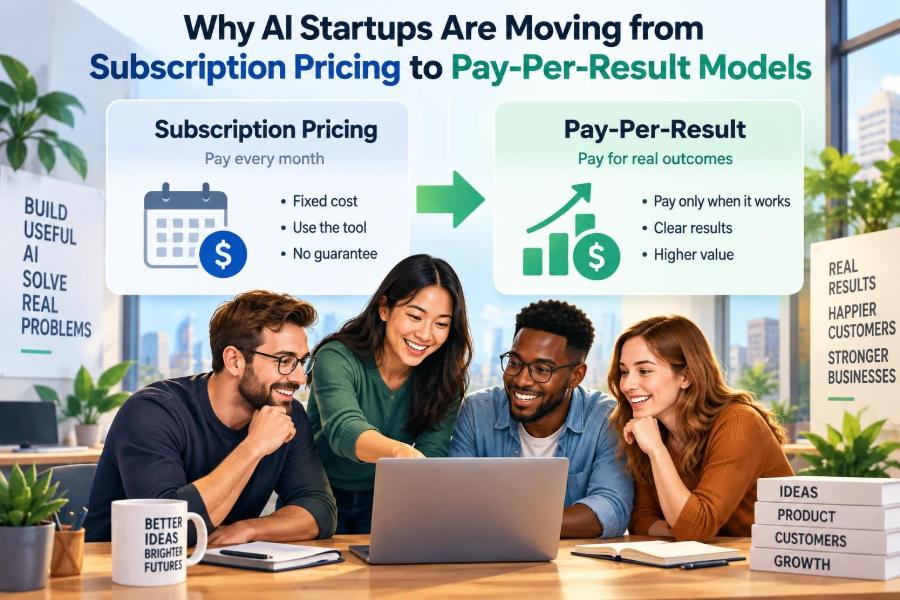

For years, the default AI startup price tag was simple: charge a monthly subscription, add usage tiers, and hope customers stay long enough for the economics to work. That model is still useful in plenty of cases. But it is becoming harder to sell when buyers can open a dozen AI tools that seem to do roughly the same thing.
Founders are responding by tying price to a result customers already value: a qualified meeting booked, an invoice collected, a support case resolved, a product listing approved, or a document processed correctly. Instead of asking a customer to pay for access, they ask to be paid when useful work is completed.
This opportunity suits founders who understand a narrow business workflow, can define a trustworthy outcome, and are willing to own more of the delivery. It is less suited to anyone hoping to launch a generic chatbot over a weekend and collect passive software revenue.
It matters now because AI has lowered the cost of producing work, while making software categories more crowded. Pay-per-result pricing can turn an AI product from another tool in a buyer’s stack into a practical partner with an easier-to-understand return on investment.
💰 1. The subscription promise is getting weaker
Subscription pricing asks customers to make a prediction: “Will this tool be valuable enough every month?” For a new AI vendor, that is a big ask. The buyer must believe the product works, fits their process, will be adopted by their team, and will continue producing value.
In a crowded market, a monthly seat fee can also make an AI product feel interchangeable. If competitors claim similar capabilities, buyers compare features, free plans, and discounts rather than business impact.
Where subscriptions still work
- The product is used frequently by many people.
- The value is broad but hard to isolate into one event, such as design collaboration or knowledge management.
- The customer needs predictable budgeting more than variable costs.
- The vendor cannot reliably control the final outcome.
The issue is not that subscriptions are dead. The issue is that they are often a poor first commercial story for an AI product whose value appears in discrete, measurable work.
🎯 2. Pay-per-result means charging for verified value
Pay-per-result means the customer pays when a pre-agreed business outcome occurs and passes a clear verification rule. It is not merely metered pricing with a more attractive label.
A usage charge might be “$0.02 per AI call.” An outcome charge might be “$45 for each sales meeting attended by a qualified prospect.” The customer cares about the second one because it maps to their existing goals.
Strong outcome examples
- Per eligible lead qualified and accepted by a sales team.
- Per appointment that attends and meets agreed criteria.
- Per recovered payment or resolved claim, often as a percentage of value.
- Per document extracted, reviewed, and accepted into a workflow.
- Per support ticket fully resolved without escalation.
- Per compliant product listing published and approved.
The outcome must be observable by both sides. If it depends on a customer’s private judgment after the fact, you have created an argument, not a pricing model.
🔍 3. Start with a painful, measurable workflow
The best result-priced AI startups do not begin with a model or an interface. They begin with a repetitive bottleneck that costs a customer money, time, missed revenue, or risk.
Look for work where the before-and-after can be measured. A workflow with a clear handoff is especially useful: a lead is accepted, a case is closed, a form is approved, or a payment lands.
Use this workflow test
- Frequency: Does this happen at least dozens of times per month?
- Pain: Is the current manual process slow, expensive, or error-prone?
- Value: Can the customer put a rough monetary value on a successful result?
- Data: Can you access the information needed to do the work responsibly?
- Verification: Can both parties confirm success without a long debate?
- Control: Can your product influence most of the outcome, not just one small step?
“Improve marketing” fails this test. “Turn inbound form submissions into sales-ready meetings that actually attend” is much closer to an outcome a buyer can evaluate.
🧭 4. Choose the right level of accountability
Founders often make one of two mistakes: charging for a weak proxy, or promising a final business result they cannot control. A good outcome sits between those extremes.
For example, an AI outbound assistant may influence prospecting and follow-up, but it cannot fully control whether a customer closes a sale. Charging a percentage of closed revenue may sound compelling, yet it exposes you to the buyer’s weak sales team, long sales cycle, and poor product-market fit.
| Pricing unit | Customer appeal | Founder risk | Best use |
|---|---|---|---|
| Per seat | Low to medium | Low | Daily team tools |
| Per task completed | Medium | Low to medium | Document and operations workflows |
| Per qualified outcome | High | Medium | Lead, booking, and support workflows |
| Percentage of recovered value | Very high | High | Collections, savings, and recovery work |
| Per closed sale | Very high | Very high | Only with strong control and attribution |
Begin with the earliest outcome that is valuable, visible, and substantially within your control. You can take on more commercial risk after your process is proven.
🧮 5. Build the unit economics before making the offer
A result-based offer can be easy to buy and hard to operate. Before quoting a price, calculate the cost of producing one accepted result, including AI usage, software, human review, customer support, onboarding, failures, and refunds.
Do not use only the cost of a model call. The model may be cheap while quality control, integrations, and exception handling consume your time.
A simple pricing calculation
Price per result = delivery cost per accepted result + target contribution margin
Delivery cost = AI and tools + human review + support + failure allowance
Suppose an approved document costs an estimated $4 in AI and tools, $6 in human review and support, and $2 in failure allowance. A $15 result fee leaves $3 before broader overhead. That may be too thin for a young company, even if it sounds profitable on a spreadsheet.
Estimate: early-stage delivery often costs more than expected because edge cases have not yet been automated. Keep a buffer and test with real customer data before committing to large volumes.
📏 6. Write an outcome definition nobody can misunderstand
Your contract, sales page, and internal dashboard should use the same definition of success. Vague language like “high-quality lead” or “successfully automated request” will eventually cause friction.
Define five things in writing
- Input: What work enters your system?
- Success: What exact event earns a charge?
- Exclusions: Which cases do not count?
- Verification: Who checks, using what system, and within what time window?
- Remedy: What happens if a result is disputed or reversed?
For a booking product, “qualified meeting” might require a prospect from an agreed company segment, a valid business email, an accepted calendar invitation, and attendance of at least 15 minutes. Put these rules in plain language before the pilot begins.
🤝 7. Sell a paid pilot, not a grand platform vision
Result-based pricing lowers the perceived risk, but it does not remove the need for trust. Most businesses will still want proof that you understand their workflow and can handle their data safely.
A paid pilot is the practical bridge. Limit it by time, volume, use case, and customer responsibility. A pilot should answer whether your result definition, delivery cost, and attribution rules work in the real world.
A practical pilot structure
- One workflow for one team or location.
- A 30- to 60-day period, depending on the business cycle.
- A modest setup fee to cover implementation.
- A result fee with a volume cap.
- A weekly review of quality, exceptions, and disputed outcomes.
- A clear conversion decision at the end.
Free pilots attract curiosity. Paid pilots attract customers with a real problem, although early exceptions are reasonable when the strategic learning value is high.
🧑💻 8. Start service-heavy and automate the repeatable parts
Many founders resist manual work because they want a pure software business from day one. That instinct can slow learning. Early manual review is often what makes an AI result reliable enough to sell.
Think of the first version as a software-enabled service. The customer buys an outcome, while you use automation, operating procedures, and human judgment behind the scenes to ensure quality.
What to automate first
- Data intake and routing.
- Draft creation and routine classification.
- Quality checks for predictable errors.
- Status updates and reporting.
- Common exception handling.
Keep humans in the loop for high-stakes decisions, uncertain cases, and customer-specific policies. Automation should remove repetitive effort, not hide unmanageable risk.
🛠️ 9. Build a lean operating stack
You do not need to train a proprietary model to test this business model. In the beginning, a dependable workflow matters more than technical novelty.
Estimated startup costs: a lean pilot can range from a few hundred to several thousand dollars per month for model access, workflow software, a database, monitoring, and contractor review. Costs vary widely with volume, security requirements, country, and the type of data handled.
Core tools and skills
- AI model APIs or established AI platforms for generation and classification.
- Workflow automation and integrations with the customer’s existing systems.
- A database and audit trail for every input, decision, and result.
- A simple customer dashboard or periodic report.
- Skills in process mapping, prompt and workflow design, customer discovery, sales, and quality assurance.
For regulated or sensitive work, add security review, access controls, retention rules, and professional advice early. Privacy, consumer protection, employment, tax, and sector-specific regulations vary by country and industry.
📣 10. Get your first customers with proof, not AI hype
Your first customers are unlikely to search for “pay-per-result AI.” They are looking for fewer no-shows, faster claims handling, cleaner data, more recovered payments, or a smaller backlog.
Choose one niche where you can speak its language. A focused offer to dental groups, freight brokers, property managers, or accounting firms will usually land better than a generic message to “small businesses.”
First-customer outreach steps
- Interview 15 to 20 potential buyers about one workflow before pitching.
- Identify their current cost, delay, error rate, and existing workaround.
- Create a one-page offer with one outcome, one definition, and one pilot scope.
- Send personalized outreach that names the operational problem, not your technology.
- Offer a short process review and show where measurement will happen.
- Ask for a paid, capped pilot with weekly reporting.
A useful message is: “We help property managers reduce overdue invoice follow-up by handling reminders and escalation, with a fee only on payments recovered through the agreed workflow.” It is specific, commercial, and testable.
📊 11. Track the metrics that keep outcome pricing honest
Revenue alone can mislead you. A result-priced business may grow sales while quietly losing money on complex accounts, reversals, or support demands.
Your weekly operator dashboard
- Input volume: eligible tasks received.
- Success rate: accepted results divided by eligible inputs.
- Cost per accepted result: total delivery cost divided by accepted results.
- Gross margin: revenue minus direct delivery costs.
- Time to result: how long customers wait for value.
- Dispute and reversal rate: results challenged, rejected, or later undone.
- Customer concentration: the share of revenue from your largest accounts.
- Retention and expansion: whether pilots convert and customers add volume.
Review metrics by customer, not only in aggregate. One unprofitable customer segment can be hidden by the average performance of an easier segment.
⚖️ 12. Protect yourself from attribution fights
If customers pay for outcomes, they will reasonably ask whether you caused the outcome. This is where many promising deals become messy.
Use source tags, timestamps, event logs, integration records, and agreed reporting windows. Where causation is uncertain, price the controlled milestone rather than the distant final result.
Example of better attribution
Instead of charging for every sale after your AI assistant emails a prospect, charge for a prospect who meets agreed qualification rules and attends a booked meeting. You can record that event objectively, while the final sale might depend on pricing, inventory, and the customer’s sales representative.
Set a short dispute period and a documented credit policy. Do not make customers hunt for answers, but do not allow undefined disputes to remain open indefinitely.
🚧 13. Know the common failure modes
Outcome pricing is powerful precisely because it shifts risk toward the vendor. That risk can become destructive when founders use it as a marketing trick instead of an operating discipline.
Watch for these mistakes
- Promising revenue: You may control activity but not the customer’s close rate or market demand.
- Ignoring bad inputs: Poor data and unqualified leads can make your economics collapse.
- Underpricing edge cases: A small percentage of hard work can consume most of your team’s time.
- Skipping a setup fee: Integrations and process design are real work.
- Using opaque AI decisions: Customers need a way to understand and correct important actions.
- Offering unlimited outcomes: Volume caps and fair-use boundaries matter during early learning.
When a customer’s systems or team create most of the failure, revise the scope instead of trying to solve every upstream problem for free.
🔒 14. Treat trust, privacy, and compliance as product features
A result-priced model can require deep access to customer systems, messages, documents, and payment information. That access may increase your ability to deliver outcomes, but it also raises your responsibility.
Use the minimum data needed, restrict access, maintain logs, and define deletion and retention practices. Be transparent about when AI is acting autonomously, when a human reviews work, and how customers can escalate a problem.
If you serve health, finance, legal, employment, or other regulated sectors, seek qualified local legal and compliance guidance. Rules on personal data, automated decisions, marketing consent, taxes, and contracts differ by jurisdiction; this is not an area to improvise.
🔄 15. Use hybrid pricing while you learn
You do not have to choose between subscriptions and results forever. A hybrid model often creates the healthiest early economics: a setup fee, a small platform minimum, and a per-result charge.
The minimum protects you against low-volume customers that require high-touch support. The result fee preserves the customer-friendly story that you earn more when useful work gets done.
| Model | Best for | Customer concern | Founder concern |
|---|---|---|---|
| Subscription only | Frequent product usage | “Will we use it enough?” | Churn and weak adoption |
| Result only | Clear, high-value events | Definition and reporting | Unpredictable volume and margin |
| Hybrid | Complex workflows and pilots | More terms to understand | Requires disciplined packaging |
Be simple in the customer-facing explanation. Complexity belongs in the operating agreement, not in a confusing sales pitch.
📈 16. Scale by narrowing before broadening
Scaling a result-priced AI startup does not mean accepting every use case. It means finding one repeatable outcome, documenting the playbook, and improving delivery until the economics hold across similar customers.
A sensible expansion path
- Serve one customer type with one defined workflow.
- Standardize onboarding, inputs, outcome rules, and reports.
- Automate the exceptions that appear most often.
- Hire or contract specialist review only where it protects quality.
- Expand to adjacent customer segments with the same underlying workflow.
- Add complementary outcomes only after the first one is reliably profitable.
A company that reliably processes one kind of business document may eventually handle several. But each new document type can introduce different rules, error patterns, and liability. Earn the right to broaden.
🧪 17. Run pricing experiments without confusing customers
You need evidence to find the right price, but constantly changing terms can damage trust. Test a small number of clear packages with comparable prospects.
For example, offer one group a setup fee plus a lower per-result price, and another a higher per-result price with no setup fee. Compare close rate, delivery margin, customer engagement, and renewal intent—not just initial enthusiasm.
Questions to ask after every pilot
- Did the customer understand exactly what they were buying?
- Did they see the outcome as valuable enough to continue?
- Which steps caused manual work or disputes?
- Would the unit economics survive at 10 times the volume?
- What did the customer ask for that could become a standard feature?
Do not discount yourself into an unsustainable contract just to win a logo. Early customers should teach you, but they should not permanently define a bad business model.
🗣️ 18. Position the business as accountability, not cheap automation
Customers are tired of vague claims about transformation. A pay-per-result offer gives you a sharper position: you are willing to be measured against work that matters.
That does not mean claiming certainty where none exists. Explain what you control, what the customer must provide, and what conditions affect results. Clear boundaries increase credibility.
A simple positioning formula
We help [specific customer] achieve [measurable operational result] by handling [defined workflow], and we charge when [verification event] occurs.
This statement forces useful decisions. It identifies the niche, the job, the outcome, the mechanism, and the commercial model in one sentence.
✅ 19. Your action plan for this week
Do not begin by rebuilding your whole product. Start by learning whether one customer segment will pay for one outcome you can credibly influence.
- Pick one workflow where AI can remove a measurable bottleneck.
- Interview five potential customers and ask how they define success today.
- Write a one-sentence outcome definition with exclusions and a verification method.
- Estimate your delivery cost for 20 successful outcomes, including human review.
- Create one paid pilot offer with a setup fee, a volume cap, and weekly reporting.
- Contact 20 relevant prospects with a problem-led message.
- Build a basic dashboard or spreadsheet that logs every input, result, dispute, and cost.
The aim is not to prove that AI can do everything. It is to prove that your business can deliver one valuable result reliably enough that both sides are happy to repeat the transaction.
The winning AI startups will not simply sell access to intelligence; they will earn trust by taking responsibility for outcomes they can measure and deliver. 💰🤝🚀