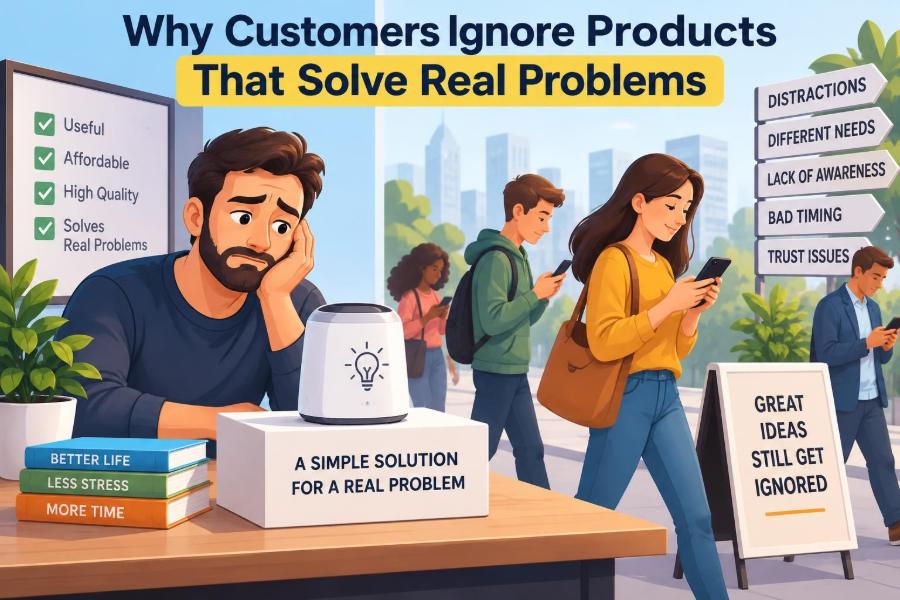

A painful customer problem is not automatically a business opportunity. Plenty of founders build useful products, get polite compliments, and then hear the sentence that quietly kills momentum: “This is great, but I probably wouldn’t pay for it.”
This topic matters to anyone creating a SaaS tool, local service, digital product, consulting offer, marketplace, or side hustle. It is especially useful if you have early interest but weak sales, low activation, or customers who keep choosing spreadsheets, old vendors, and workarounds.
The issue is rarely that customers are irrational or that your product has no value. More often, the problem is not urgent enough, the switch feels risky, the message is vague, or the buying process is harder than the pain.
Right now, buyers are overwhelmed with choices, tighter with budgets, and cautious about adding another tool or supplier. That makes clear positioning and low-friction adoption more valuable than an impressive feature list.
💡 1. A real problem is not always a buying problem
Founders often begin with a true observation: people waste time, make errors, feel frustrated, or use ugly workarounds. That is a legitimate problem, but it may not be a problem people will prioritize, budget for, or change behavior to solve.
A buying problem has three ingredients: it hurts enough, it happens often enough, and the buyer believes a solution will create a worthwhile outcome. Remove any one of those, and attention may never become a sale.
- A restaurant owner may dislike manually posting social content but still see it as optional.
- A finance manager may hate month-end reconciliation because it delays reporting and creates compliance risk.
- A freelancer may want better time tracking but avoid switching because their current spreadsheet is “good enough.”
Your job is not to prove that inconvenience exists. Your job is to identify the moment when ignoring it becomes more expensive than changing.
🔥 2. Start with urgency, not admiration
Customers can admire an idea without needing it. “That’s clever” is feedback about novelty; “Can I start this today?” is feedback about urgency.
Look for triggering events
Most purchases happen after a change: a new hire, missed deadline, lost customer, audit, price increase, expansion, regulation, or personal milestone. Find the event that makes the old way suddenly unacceptable.
- Instead of “help agencies manage projects,” try “help agency owners prevent client work from slipping when they hire their first project manager.”
- Instead of “help landlords organize maintenance,” try “help small landlords document repairs after a tenant dispute.”
- Instead of “help creators plan content,” try “help creators turn one launch into a two-week promotion schedule.”
Ask interviewees: “What happened the last time this became urgent?” Their story will reveal timing, stakes, decision-makers, and existing alternatives.
🧭 3. Identify the customer who actually feels the pain
The person using your product is not always the person paying for it. The person complaining is not always the person with authority to change the process.
For example, employees may struggle with scheduling, but an owner may only care about labor cost, absenteeism, and customer coverage. If you sell employee convenience to an owner, your message may be ignored even if the tool is useful.
Map the buying roles
| Role | Main concern | What your message should answer |
|---|---|---|
| User | Ease and time saved | Will this make my day simpler? |
| Champion | Career and team improvement | Will this make me look prepared? |
| Buyer | Cost, risk, and return | Why is this worth funding now? |
| Approver | Security, policy, and control | Can we adopt this safely? |
Small businesses may combine all four roles in one person. Larger organizations rarely do. Adapt your sales conversation to the role in front of you.
🎯 4. Narrow the audience until the message becomes obvious
“Small businesses” is not a market. Neither is “busy professionals” or “online sellers.” Broad labels hide different workflows, budgets, language, and urgency.
A narrow starting segment is not a limitation; it is a way to learn faster. You can expand after you reliably win one group.
Use a practical customer definition
Describe a first customer as: specific role + specific situation + specific costly outcome. For example: “Independent accounting firms with two to ten staff that lose document requests during tax-season onboarding.”
- What do they already pay for?
- What tool, person, or workaround do they use today?
- What does failure cost them in time, money, risk, or reputation?
- Where do they gather and whom do they trust?
If you cannot name ten plausible first customers, the segment is still too abstract.
🗣️ 5. Speak in outcomes, not product language
Customers do not wake up wanting dashboards, automations, AI features, or a “single source of truth.” They want fewer missed jobs, faster approvals, cleaner records, more bookings, or less stress.
Feature-heavy language makes buyers work to translate your offer. Outcome language makes relevance immediate.
Rewrite your homepage promise
| Weak message | Stronger message |
|---|---|
| AI-powered workflow platform | Turn customer requests into assigned jobs before they get lost in email |
| Analytics for e-commerce brands | See which products are draining your ad budget before you reorder |
| Modern CRM for consultants | Follow up with every qualified lead without maintaining a complicated CRM |
A strong message names the customer, the situation, and the result. It does not need to mention every capability.
⚖️ 6. Beat the status quo, not just competitors
Your biggest competitor is often not another startup. It is the spreadsheet, email inbox, sticky note, existing supplier, internal employee, or decision to do nothing.
People underestimate the cost of the status quo because it is familiar. Your sales process must make that hidden cost visible without shaming the customer.
Calculate the cost of inaction together
During discovery, ask about frequency and consequences. If a task takes five people 30 minutes each week, the issue may be annoying but not urgent. If it causes late invoices, chargebacks, compliance failures, or lost renewals, it may deserve a budget.
- “What happens when this is missed?”
- “How often does that happen?”
- “Who has to fix it?”
- “What would improve if this disappeared by next month?”
Use their words in your copy and proposals. Do not invent dramatic savings claims you cannot support.
🚪 7. Reduce the cost of switching
Even a clearly better product can lose if switching requires imports, retraining, new logins, disrupted routines, or political approval. Buyers evaluate transition pain, not only future value.
Make the first step smaller than the full commitment. Offer an assisted setup, import service, template, trial project, pilot group, or done-for-you migration.
Design a low-risk first win
- Start with one team, location, workflow, or customer segment.
- Promise one measurable outcome rather than a company-wide transformation.
- Keep existing tools in place initially when possible.
- Show the customer how to reverse the decision if it does not work.
For a service business, this could be a paid diagnostic or a one-week campaign sprint. For software, it might be a guided setup that produces value on day one.
🛡️ 8. Address perceived risk before the customer raises it
Customers ignore offers when the downside feels unclear. They may worry about data loss, hidden costs, unreliable support, poor quality, being locked into a contract, or looking foolish for choosing an unknown provider.
Early-stage founders cannot eliminate all risk, but they can make risk visible and manageable. Be specific about what happens during onboarding, who owns data, what support includes, and what the customer can expect.
- Use plain-language pricing and cancellation terms.
- Explain your boundaries instead of pretending you do everything.
- Show a simple implementation timeline.
- Offer references or proof only when you genuinely have permission to do so.
Trust grows through clarity and consistency, not exaggerated promises.
💵 9. Price the value, but respect the budget
Low pricing does not automatically make an offer easier to buy. A very cheap product can look unimportant, while a confusing price creates hesitation. The right price depends on value, alternatives, purchasing process, and your ability to deliver.
Ask what customers currently spend in money, labor, delays, and risk. Then test a price that is meaningfully smaller than the value created while still supporting a sustainable business.
Choose a simple starting model
| Model | Best when | Watch out for |
|---|---|---|
| One-time project fee | Outcome is defined and service-led | Scope creep |
| Monthly subscription | Value repeats each month | Low ongoing usage |
| Usage-based pricing | Customer value grows with volume | Unpredictable bills |
| Setup fee plus monthly fee | Onboarding requires real work | Too much initial friction |
Costs, taxes, payment rules, and consumer-protection regulations vary by country. Check local requirements before setting contracts, invoices, or subscription terms.
🧪 10. Validate behavior, not opinions
People are often sincere when they say they would use your product. But intention is cheap, especially in a friendly conversation. Behavior is stronger evidence.
Look for commitments: sharing data, booking time, introducing a colleague, completing an onboarding step, paying a deposit, signing a pilot agreement, or replacing a current workflow.
Run a small validation sequence
- Interview ten people in one narrow segment.
- Find repeated language around a recent, expensive problem.
- Create a simple offer describing the outcome and process.
- Ask for a paid pilot or a concrete next step.
- Record objections and revise the offer, not just the feature list.
Do not wait for perfect proof. But do not treat compliments, survey responses, social likes, or email opens as proof of demand either.
📦 11. Sell the result before building the full product
When customers ignore a polished product, founders often build more. That can deepen the mistake. Before expanding features, test whether a human-delivered version of the outcome is attractive.
A manual service can reveal the real workflow, required integrations, willingness to pay, and language customers use. It also keeps you close to the customer rather than hiding behind product development.
Examples of manual-first offers
- A reporting tool begins as a weekly analyst-created report.
- An onboarding platform begins as a consultant-led onboarding package.
- A lead-routing tool begins as a managed inbox and response service.
You are not trying to stay manual forever. You are learning which steps are valuable enough to standardize and automate.
📣 12. Put your offer where intent already exists
Great messaging cannot compensate for reaching people who are not thinking about the problem. Early distribution works best when you show up near an active trigger.
That might be a niche community, local event, industry newsletter, search query, partner referral, job posting, software marketplace, or direct introduction. Choose one or two channels first.
First-customer outreach plan
- Make a list of 30 highly relevant prospects.
- Research one recent signal: hiring, expansion, product launch, new location, or visible operational issue.
- Send a short message tied to that signal and one likely outcome.
- Ask for a brief conversation, not an immediate purchase.
- Follow up once with something useful: a checklist, observation, or relevant example.
Personal outreach is not infinitely scalable, but it is one of the fastest ways to learn what makes people respond.
📊 13. Track the funnel that exposes the real problem
“Customers are ignoring us” is too vague to fix. Measure where attention disappears, then investigate the friction at that point.
| Metric | What it may reveal | Question to ask |
|---|---|---|
| Reply rate | Targeting or opening message | Is this timely and specific? |
| Call-to-demo rate | Offer clarity | Do they understand the next step? |
| Demo-to-trial rate | Perceived relevance | Did we solve their priority problem? |
| Activation rate | Onboarding friction | Can they reach a first win quickly? |
| Paid conversion | Value or pricing mismatch | Is the result worth paying for? |
| Retention | Ongoing usefulness | Does the product remain part of work? |
For an early business, a small number of well-documented conversations can be more useful than a complicated analytics dashboard.
🧱 14. Avoid common founder mistakes
Building for the loudest request
The most vocal prospect may be an unusual case. Look for repeated patterns among people who can and will pay.
Confusing a feature request with a purchase signal
Customers may ask for a feature to be helpful, not because it would change their decision. Ask, “If we had that next week, would you move forward?”
Adding complexity to explain weak demand
More options, tiers, features, and jargon usually increase confusion. Make one offer easy to understand before creating a product catalog.
Discounting before diagnosing
A discount cannot fix a low-priority problem. Find out whether the objection is budget, timing, trust, setup effort, or unclear value.
🔄 15. Run a weekly customer-learning loop
Progress comes from repeated, disciplined learning rather than one dramatic pivot. Set aside time every week to talk to customers and change one thing based on what you hear.
- Review lost deals, churn, support questions, and stalled trials.
- Choose one assumption to test: audience, urgency, message, price, channel, or onboarding.
- Make one focused change.
- Run enough conversations or observations to learn something useful.
- Document the result and decide whether to keep, refine, or reject the change.
This keeps you from reacting emotionally to one rejection while ensuring you do not ignore repeated evidence.
🌱 16. Scale only after you can explain why people buy
Do not rush to automate acquisition before you understand your winning pattern. Scaling a vague offer usually amplifies wasted marketing spend and onboarding problems.
You are ready to expand when you can clearly describe the customer, trigger, promised outcome, sales objections, activation steps, and retention reason. That does not mean demand is guaranteed; it means you have a repeatable hypothesis worth investing in.
What scaling may look like
- Turn successful manual onboarding into templates and guided flows.
- Train a salesperson or contractor using recorded objections and clear qualification criteria.
- Create content around high-intent customer questions.
- Develop partnerships with trusted providers serving the same niche.
- Expand to an adjacent segment only after protecting service quality for the first one.
Grow at a pace your support, cash flow, and reputation can handle.
✅ 17. Your action plan for this week
Do not rewrite your entire product because customers seem indifferent. Start by getting closer to the decision.
- Day 1: Write a one-sentence definition of your narrowest plausible customer and their urgent trigger.
- Day 2: Contact five current, former, or potential customers for problem interviews.
- Day 3: List every workaround and alternative they use today.
- Day 4: Rewrite your offer around one concrete outcome and one specific situation.
- Day 5: Make a low-risk pilot, setup service, or first-win package.
- Day 6: Send ten targeted outreach messages or make ten direct asks.
- Day 7: Review responses and identify the single biggest point of friction.
Customers do not ignore products because problems do not matter; they ignore offers that do not feel urgent, clear, safe, and easier than staying where they are. Keep listening, make the first step smaller, and earn attention with a result people can recognize. 💡🚀