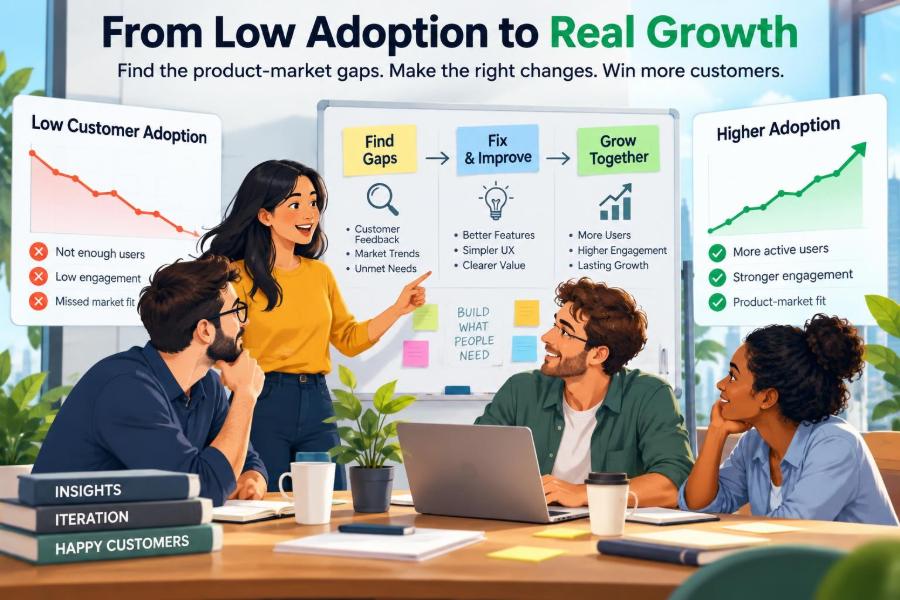

Low customer adoption is one of the most frustrating startup problems because it can look like a marketing failure when it is really a product-market gap. You may have built something polished, priced it thoughtfully, and launched it loudly—yet people still hesitate, try it once, or quietly disappear.
This problem is especially relevant for founders selling new software, services, marketplaces, apps, and digital products. It also affects local businesses introducing a new offer that customers do not yet understand or trust.
The opportunity is not necessarily to rebuild everything. Often, the fastest path forward is to identify the exact moment where the customer’s expected outcome and your actual experience diverge, then fix that gap with disciplined testing.
That matters now because attention is expensive and customer patience is limited. A startup that learns why people adopt—and why they do not—can spend less on noise and more on a product people are genuinely willing to use, recommend, and pay for.
🔍 1. Treat low adoption as a diagnosis problem
Do not begin with the assumption that you need more traffic. If the right people arrive but do not activate, return, or buy, increasing traffic mostly increases the cost of learning the same lesson.
Product-market fit is not a slogan or a launch date. It is evidence that a defined customer segment repeatedly gets meaningful value from your solution and would be disappointed to lose it.
- Acquisition problem: too few qualified people discover you.
- Activation problem: people sign up but do not reach an early win.
- Retention problem: they try it but do not form a habit or see repeat value.
- Monetization problem: value exists, but the offer, price, or buyer is wrong.
Your first job is to identify which problem is most responsible. Avoid trying to fix all four at once.
🧭 2. Define adoption in one observable behavior
“People are using it” is too vague to guide a team. Define adoption as a behavior that indicates a customer has received core value.
For a bookkeeping tool, adoption might be connecting a bank account and categorizing the first month of transactions. For a meal-prep service, it may be placing a second order. For a B2B workflow tool, it could be inviting a teammate and completing a shared task.
Write your adoption event
Use this sentence: A customer has adopted our product when they [specific action] within [time period] because it helps them [desired outcome].
- A freelancer creates and sends their first paid invoice within 24 hours.
- A shop owner imports inventory and completes a first stock count within seven days.
- A manager schedules the first team workflow and receives a useful completion report within 14 days.
This becomes the central event you improve before chasing broad engagement metrics.
📊 3. Build a simple adoption funnel
You do not need a sophisticated analytics stack to begin. A spreadsheet, product events, payment records, calendar notes, and a short survey can reveal a great deal.
| Stage | Question to answer | Useful metric | Likely issue |
|---|---|---|---|
| Discovery | Are the right people arriving? | Qualified visits or leads | Weak targeting or message |
| Sign-up | Do they believe the promise? | Visitor-to-sign-up rate | Confusing value proposition |
| Activation | Do they reach an early win? | Activation rate and time | Friction or unclear setup |
| Retention | Do they return for value? | Weekly or monthly retention | Weak ongoing usefulness |
| Revenue | Will they pay or renew? | Conversion and renewal rate | Low perceived value or wrong buyer |
Track cohorts, not only totals. A cohort is a group that started in the same week or came through the same channel. It helps you see whether changes are improving new customer behavior rather than hiding behind old users.
🎯 4. Narrow the customer before expanding the product
Many startups have low adoption because their target market is everyone who might eventually benefit. That group is too broad to message, research, or serve well.
Choose an initial segment with a painful, frequent problem and a recognizable context. “Small businesses” is a category. “Independent cafes with two to ten staff members that currently manage weekly rotas in chat messages” is a testable segment.
Use the urgent-job filter
- What is the customer trying to get done?
- What currently makes that job slow, stressful, costly, or risky?
- What triggers them to seek a solution now?
- What would they use instead if your product vanished?
- Who feels the pain, who uses the product, and who controls the budget?
A focused initial market is not a limitation. It gives you the chance to become unmistakably useful before you broaden your reach.
🗣️ 5. Conduct interviews that uncover behavior, not compliments
Founders often ask, “Would you use this?” Customers usually want to be encouraging, so their answer can be friendly but unreliable. Ask about actual past behavior instead.
Speak with active users, people who abandoned the product, people who almost bought, and qualified prospects who chose another option. Ten honest conversations can be more useful than hundreds of unstructured survey responses.
Questions worth asking
- “Tell me about the last time this problem happened.”
- “What did you do before looking for a solution?”
- “What was difficult, expensive, or annoying about that approach?”
- “What made you decide to try us?”
- “Where did you get stuck or lose confidence?”
- “What would have made this an obvious choice?”
Listen for repeated words, workarounds, fears, and moments of urgency. Do not defend your product during the conversation; your goal is to understand the customer’s reality.
🧩 6. Map the gap between promise and experience
A product-market gap commonly appears in one of four places: the customer does not understand the promise, cannot get to value quickly, receives less value than expected, or cannot justify the ongoing cost.
Map the journey from the ad, referral, or sales call through the first successful result. At each step, ask what the customer expects, what they must do, and what could make them hesitate.
| Customer expectation | Common gap | Practical fix to test |
|---|---|---|
| “This solves my problem.” | Generic positioning | Use a specific outcome and audience in the message |
| “This will be easy.” | Long setup or jargon | Remove fields, add templates, offer guided setup |
| “I will see value soon.” | Delayed first result | Deliver a useful output in the first session |
| “This is safe to try.” | Trust or switching risk | Show process, support, privacy, and migration help |
| “This is worth paying for.” | Value is invisible | Report time saved, risk reduced, or output improved |
⚡ 7. Design a faster time to first value
The first meaningful outcome should arrive before motivation fades. New customers are comparing your product to their existing habit, and existing habits require almost no new learning.
For a design tool, first value may be a usable template rather than a full project. For a consultant, it may be a clear diagnostic and next-step plan after the first session. For a marketplace, it may be a relevant match rather than an empty catalog.
Reduce first-session friction
- Ask only for information needed to create the first result.
- Use sensible defaults instead of a blank screen.
- Show one primary action, not seven competing features.
- Provide an example tailored to the customer’s role.
- Offer human onboarding for high-value or complex accounts.
Measure time to first value, the percentage who reach it, and the number of steps required. A shorter path is useful only if it produces a real outcome, not a shallow click.
🛠️ 8. Solve the painful workflow, not the feature request
Customers may ask for a feature because they are describing a workaround, not the underlying problem. If you build every requested feature literally, you can create a crowded product that still fails to solve the job.
Suppose users ask for more export formats. The deeper problem may be that they need to share results with a client who does not log in. The better solution might be a scheduled, branded summary rather than another export menu.
Use this sequence: request → context → desired outcome → constraint → smallest solution to test. It keeps development tied to customer value.
🧪 9. Run small experiments before major rebuilds
When adoption is weak, the instinct is to redesign the product. Large rebuilds feel productive but can consume months while preserving the wrong assumption.
Instead, write down the problem, your hypothesis, the change, the expected behavior, and the metric that will tell you whether it worked. Test one important assumption at a time where possible.
Example experiment
Problem: new users create an account but do not create a first campaign. Hypothesis: they are unsure what “good” looks like. Test: replace the blank dashboard with three role-specific campaign templates and a short guided prompt. Success signal: a higher share of qualified new users publishes a first campaign within two days.
Set a review date in advance. If the result is unclear, learn from it and adjust; do not declare victory based on a few encouraging comments.
📣 10. Fix the message when the product is being misunderstood
Sometimes the product is useful but attracts people with the wrong expectation. A vague promise such as “work smarter” may generate interest, but it does not tell customers whether the product is for them or why they should act.
Good positioning makes a trade-off. It tells a particular customer what outcome you help them achieve, in what situation, and why your approach differs from their current alternative.
A practical message formula
For [specific customer] who need to [job], [product] helps them [outcome] without [major pain of current alternative].
Test the message on landing pages, outreach emails, sales calls, onboarding screens, and product descriptions. When language from customer interviews appears in your message, it often feels clearer because it reflects the buyer’s own frame of reference.
🤝 11. Add service when self-serve adoption is not ready
Early-stage founders sometimes avoid manual work because they want a scalable business from day one. But a concierge approach can reveal what customers truly need and get them to value before automation exists.
You might import a customer’s data for them, conduct a setup call, create their first report, or personally match supply and demand in a marketplace. This is not a permanent substitute for product design, but it is a powerful learning tool.
- Charge when the outcome is valuable; free work can attract weak signals.
- Document every manual step and repeated question.
- Notice which steps customers value and which they never see.
- Automate only after a pattern repeats across suitable customers.
For some complex B2B offers, high-touch onboarding remains part of the business model. Price and staff it accordingly.
💳 12. Check whether pricing is blocking adoption
Pricing is not only a revenue decision; it signals risk, value, and who the product is for. A low price can make a serious business tool seem disposable, while a high price can create a proof burden your first experience does not meet.
Separate willingness to pay from ability to pay. A user may love the product but lack authority or budget. In that case, the real buyer may be their manager, client, or business owner.
Pricing questions to test
- Is the unit of pricing aligned with how value is created?
- Can a customer understand the likely cost before committing?
- Does the trial let them reach meaningful value?
- Is the paid upgrade triggered at a natural point?
- Are taxes, payment methods, refunds, and local consumer rules handled appropriately?
Costs, taxes, payment regulations, and subscription requirements vary by country. Get relevant legal and accounting advice before changing terms, collecting certain customer data, or selling across borders.
📈 13. Measure retention before celebrating sign-ups
Sign-ups can be useful, but retention is usually the clearer test of whether value persists. If users do not return, a better advertisement may only bring more people to the same disappointing experience.
Choose a retention rhythm that fits the job. A daily habit product should be examined differently from a monthly reporting tool or a seasonal service.
Core metrics to track
- Activation rate: percentage reaching the adoption event.
- Time to first value: time from entry to meaningful outcome.
- Retention: percentage of a cohort returning or completing the core action later.
- Conversion: percentage moving from trial, lead, or free use to payment.
- Churn: customers or revenue lost in a period.
- Qualitative reason codes: why users adopted, paused, or left.
Do not obsess over a single universal benchmark. Compare your current cohorts against your own past cohorts after a clearly defined change.
🚫 14. Avoid the common “fixes” that make things worse
Low adoption creates pressure, and pressure can lead to busywork. The following moves often delay the real learning.
- Adding features for every complaint: investigate the job before building.
- Discounting immediately: a lower price cannot fix unclear value or weak trust.
- Changing five things at once: you will not know what caused the outcome.
- Surveying only loyal users: talk to non-adopters and churned customers too.
- Blaming customers: confusion is feedback about the experience, even when users make mistakes.
- Scaling paid acquisition too early: improve activation and retention before increasing spend.
Be particularly cautious about vanity metrics such as impressions, raw downloads, or social followers when they are not connected to a customer reaching real value.
🧱 15. Create a weekly product-market gap review
Learning becomes more reliable when it is a routine rather than an occasional emergency. Reserve a short weekly meeting—even if the team is only you—to review evidence and decide the next test.
- Review the funnel and cohort movement from the previous week.
- Read support tickets, sales notes, cancellations, and interview summaries.
- Name the biggest observed customer obstacle in one sentence.
- Choose one hypothesis with meaningful potential impact.
- Define the smallest test and its success metric.
- Assign an owner and a date to review results.
Keep a decision log. Over time, it prevents the team from revisiting rejected ideas without new evidence and makes your learning visible to advisers, employees, and investors.
🌱 16. Scale only after the core experience repeats
Scaling means repeating a working system, not merely doing more activity. Before you add channels, hires, regions, or product lines, look for a segment where the message, onboarding path, and retention pattern work consistently enough to deserve investment.
Then expand carefully: one adjacent customer segment, one acquisition channel, or one workflow improvement at a time. Preserve the feedback loop that helped you discover fit in the first place.
Signs you may be ready to scale
- Customers can clearly describe the value in their own words.
- A meaningful share reaches first value without extensive rescue work.
- Retention is improving or stable across recent cohorts.
- Referrals, repeat purchases, or organic demand appear naturally.
- You understand the economics of serving and acquiring this segment.
None of these is a guarantee of success. They are signals that growth spending has a stronger foundation than hope.
✅ 17. Your action plan for this week
Keep the next seven days focused on evidence, not a giant roadmap.
- Day 1: write one precise definition of adoption for your product.
- Day 2: build a basic funnel from discovery to repeat use or payment.
- Days 3–4: interview five people across active users, drop-offs, and lost prospects.
- Day 5: identify the most repeated gap between customer expectation and experience.
- Day 6: design one small test that reduces friction or clarifies value.
- Day 7: set the metric, launch the test, and schedule a review date.
Do not try to find a perfect answer in a week. Try to replace one major assumption with direct customer evidence.
The solution to low customer adoption is rarely louder promotion; it is a sharper understanding of who needs your product, what outcome they expect, and what stops them from reaching it. Keep listening, test the smallest useful change, and let real behavior guide the next move. 🚀🔎