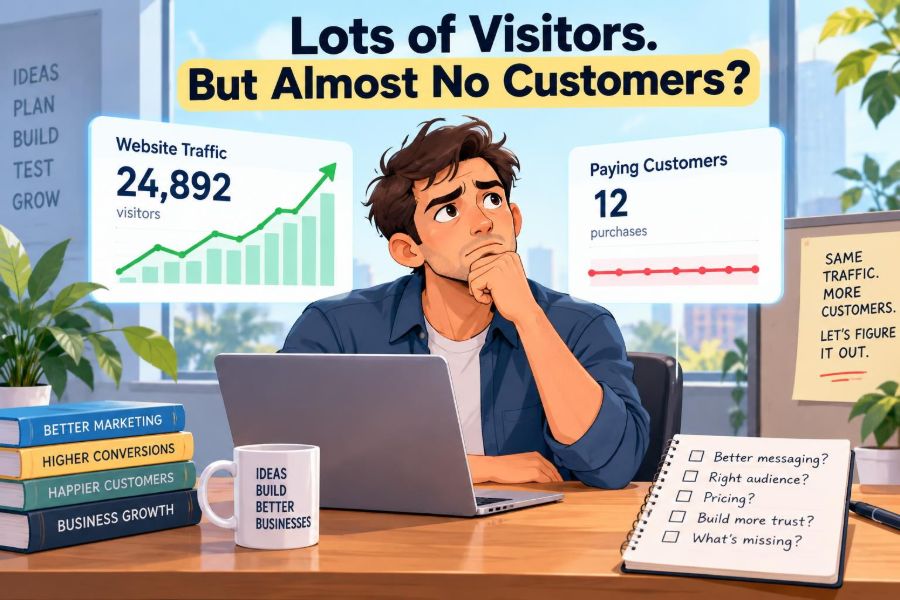

Traffic feels like proof that something is working. People are finding your site, reading your posts, watching your videos, or clicking your ads. Then you check revenue and see a much less exciting number: almost nobody has paid.
This problem is especially common for first-time founders, side-hustlers, creators, and small businesses that have learned to generate attention before they have learned to turn attention into a buying decision. It is not necessarily a sign that the business is bad. It is usually a sign that one part of the customer journey is broken, unclear, or aimed at the wrong person.
It matters now because attention is easier to measure than trust. Analytics dashboards make visits look like progress, while the harder work happens in customer conversations, offer design, pricing, checkout, onboarding, and retention.
The opportunity is to stop treating low conversion as a mystery. With a disciplined diagnosis, you can find the bottleneck, test a better message or offer, and build a business around customers who genuinely need what you sell.
🔍 1. Traffic Is Not the Same as Demand
A visitor is not automatically a prospect. Someone can land on your page because they were curious, researching a problem, comparing free tools, looking for a job, or searching for an answer they never intended to pay for.
The first question is not “How do I convert more traffic?” It is “Which visitors already have a reason to buy?” A startup can have thousands of readers and still have too few people with urgency, authority, and budget.
Step-by-step action
- List your top five traffic sources and top ten landing pages.
- For each, write the search query, post topic, ad message, or referral context that brought visitors in.
- Label each source as high, medium, or low buying intent.
- Compare that label with sign-ups, demos, trials, and purchases.
A search for “what is project management” is usually educational. A search for “project management software for construction teams pricing” is much closer to a commercial decision.
Metric to track
Track conversion rate by source and landing page, not just your sitewide conversion rate. Averages can hide the fact that one valuable page converts while a high-traffic article brings audiences who will never buy.
🎯 2. You May Be Solving a Problem That Is Not Painful Enough
People pay to remove expensive, stressful, risky, slow, or frustrating problems. They rarely pay just because a product is clever, polished, or mildly convenient.
A useful test is whether doing nothing has a meaningful cost. If the current workaround is a spreadsheet, an occasional annoyance, or a free tool that is “good enough,” customers may delay the purchase indefinitely.
Ask customers these questions
- What happens if you do not solve this in the next 30 days?
- How are you handling it today?
- What does the current approach cost in time, money, mistakes, or missed opportunities?
- Who feels the problem most strongly?
- What have you already tried or paid for?
Do not ask, “Would you use this?” Most people want to be encouraging. Ask about past behavior: “When did this last happen?” and “What did you do?” Past action is more useful than polite enthusiasm.
🧭 3. Your Message May Attract the Wrong Audience
Broad messaging can produce broad traffic. A headline such as “The smarter way to grow your business” sounds ambitious, but it gives a specific buyer no reason to believe the product is for them.
Strong positioning names a customer, a painful situation, and a valuable outcome. It helps the right visitor self-select quickly and makes the wrong visitor leave without consuming more of your time or ad budget.
Replace vague claims with specifics
| Weak message | Clearer alternative | Why it works |
|---|---|---|
| Automate your workflow | Turn completed client forms into invoices for small accounting firms | Names user, job, and result |
| Grow on social media | Plan weekly LinkedIn posts for B2B consultants in 30 minutes | Sets a concrete use case |
| Better customer support | Help ecommerce stores answer order-status questions without adding staff | Connects to a costly problem |
Keep the promise truthful. A precise promise does not mean guaranteeing outcomes you cannot control. It means explaining exactly what your product helps a customer do.
🧩 4. The Offer Is Not Clear Enough to Buy
Many founders explain features but never make an offer. A visitor may understand that your tool has dashboards, templates, integrations, or AI features, yet still not know what they receive, who it is for, what it costs, or what to do next.
An offer is the full commercial package: the customer, the job, the deliverable, the price, the purchase process, and the risk-reduction mechanism.
Build an offer sentence
Use this structure: “We help [specific customer] achieve [specific result] by [mechanism], starting at [price or pricing path].”
For example: “We help independent clinics reduce missed appointments with automated, customizable reminder sequences, starting with a monthly plan after a guided setup.” That is more actionable than “Modern patient communication.”
Common mistake
Hiding pricing or the next step because you fear losing leads. Some complex B2B sales require a conversation, but most buyers still need a price range, buying criteria, or a clear explanation of why a call is necessary.
💵 5. Price Can Create Friction at Either Extreme
Price is not merely a number. It signals quality, changes the approval process, and determines whether your economics can support acquisition, service, and support.
Too high for the perceived value and people hesitate. Too low and buyers may doubt the product, assume it is a hobby, or require more support than the revenue can fund.
Run a practical pricing check
- Compare price with the cost of the problem, not only with competing products.
- Ask whether the buyer can expense it personally or needs approval.
- Make monthly, annual, usage-based, and service components easy to understand.
- Calculate support time and payment fees before offering a low-cost plan.
- Test one variable at a time: price, package, billing period, or guarantee.
Taxes, payment processing costs, consumer rules, and invoicing requirements vary by country. Check the rules where you operate before changing billing terms or promotional claims.
🛒 6. Your Purchase Path Has Too Much Work
A motivated visitor can still abandon a purchase when the path contains surprises: a mandatory demo for a simple product, a long form, account creation before pricing, unclear payment options, or a checkout that fails on mobile.
Every extra step asks the buyer to spend attention and trust. Keep friction only when it helps qualify leads, prevents misuse, or is genuinely required for delivery.
Audit the path yourself
- Open your landing page on a phone using mobile data.
- Try to understand the offer in ten seconds.
- Attempt to buy, book, or start a trial without assistance.
- Write down every moment where you hesitate or need information.
- Watch a few real users attempt the same task, with permission.
Do not assume customers behave like you. Founders know where everything is and are unusually willing to tolerate product complexity.
Metrics to track
Measure landing-page-to-CTA clicks, form completion, checkout initiation, checkout completion, and payment success. A drop between two steps tells you where to investigate.
🤝 7. Visitors Do Not Yet Trust You Enough
Buying from a young company feels risky. Customers wonder whether the product works, whether support will exist next month, whether their data is safe, and whether the founder understands their situation.
You do not need famous logos or exaggerated testimonials to build trust. You need evidence, clarity, responsiveness, and a professional buying experience.
Earn trust honestly
- Show product screens, sample outputs, or a clear walkthrough.
- Explain who runs the business and why you understand the problem.
- Publish straightforward support, refund, privacy, and contact information where relevant.
- Use real customer feedback only with permission and context.
- State limitations instead of pretending the product does everything.
A small founder-led business can turn its size into an advantage: customers may value direct access, fast iteration, and help tailored to their workflow.
🧠 8. You Are Explaining Features Instead of Outcomes
Features describe what the product has. Outcomes describe why a customer should care. Buyers usually start with the outcome, then look for features as proof that it is achievable.
“AI-powered categorization” is a feature. “Sort 300 supplier receipts before month-end without manual data entry” is a job a buyer can recognize.
Translate features into value
| Feature | Customer consequence | Outcome-led wording |
|---|---|---|
| Automated reminders | Less manual chasing | Reduce the hours spent following up with clients |
| Shared dashboard | Fewer status meetings | Let your team see project status without another update call |
| Exportable reports | Faster reporting | Prepare a client-ready summary from current project data |
Be careful not to overclaim. If results depend on customer behavior, say what your product enables rather than promising a financial outcome.
🗣️ 9. You Have Not Talked to Enough Non-Buyers
Every lost deal contains information, but only if you ask. Founders often interview enthusiastic early users and avoid people who left, ignored a proposal, or canceled a trial. That creates a dangerously flattering view of the market.
Reach out with curiosity, not a sales pitch. A short, respectful request for feedback can uncover missing requirements, confusing language, bad timing, competitor advantages, or a target segment that cannot afford your offer.
Simple interview script
“Thanks for trying or considering the product. I am improving it and would value ten minutes to understand your decision. I am not calling to persuade you. What were you hoping to solve, what did you choose instead, and what made that option a better fit?”
Common mistake
Defending the product after each answer. Take notes. Patterns matter more than any individual opinion, and the customer may be right about the experience even if they describe the technical cause imperfectly.
📊 10. You Are Watching Vanity Metrics Instead of Funnel Metrics
Pageviews, followers, impressions, and email opens can help diagnose reach, but they do not prove commercial health. A smaller audience with a clear need can be much more valuable than a large audience looking for free education.
Build a simple funnel that mirrors your real buying process. Keep it simple enough to update weekly.
Core funnel formula
qualified visitors → meaningful actions → leads or trials → sales conversations → paid customers → retained customers
| Metric | What it reveals | Useful question |
|---|---|---|
| Qualified visitor rate | Traffic fit | Are the right people arriving? |
| CTA click rate | Message relevance | Do visitors want the next step? |
| Trial activation rate | Early product value | Do users reach the useful moment? |
| Lead-to-sale rate | Offer and sales fit | Do qualified prospects buy? |
| Retention and cancellation rate | Durable value | Do buyers keep receiving value? |
Define “qualified” based on your business. It could mean company size, problem severity, location, role, budget range, or a behavior that signals serious intent.
⚡ 11. The Product Takes Too Long to Deliver Its First Win
Customers do not buy software, consulting, or a service just to own it. They buy because they expect progress. If setup is difficult or the first useful result takes weeks, many trials and new customers will disappear before they experience value.
Identify the smallest meaningful outcome your product can deliver quickly. For a bookkeeping service, it may be a clean first report. For a scheduling app, it may be one appointment booked without back-and-forth messages.
Improve activation
- Define the one action that predicts a useful first experience.
- Remove optional setup steps before that action.
- Use templates, imports, examples, or concierge help to shorten time to value.
- Send onboarding messages based on user behavior, not a generic sequence alone.
- Contact high-fit trial users personally when practical.
Track time to first value and the percentage of new users who reach the activation event. A better onboarding experience can matter more than another top-of-funnel campaign.
📣 12. Your Call to Action Is Weak or Mismatched
A call to action should match the buyer’s readiness. Asking a stranger to “Buy now” may be too large a leap for a complex service. Asking a ready-to-buy visitor to “Join our newsletter” may waste the moment.
Choose one primary action per page. Too many equally weighted buttons create indecision.
Match the action to the offer
- Low-cost, simple product: start trial, buy now, view plans.
- Custom service: request a scope call, send project details, get an estimate.
- New category or long buying cycle: see a demo, calculate your current cost, get an implementation plan.
- Local business: book an appointment, request availability, call now.
Explain what happens after the click. “Book a 20-minute fit call; we will review your current workflow and tell you whether we can help” reduces uncertainty more effectively than “Contact us.”
🧪 13. You Are Changing Too Many Things at Once
When sales are slow, the temptation is to redesign the homepage, launch three channels, lower prices, add features, and rewrite emails all in one week. This creates motion, not learning.
Use small tests with a stated hypothesis. You may not achieve statistical certainty with a young startup, but you can make clearer decisions than random guessing.
Use a test log
Hypothesis: Clinic owners respond better to missed-appointment savings than to automation language.
Change: Replace the homepage headline and CTA on one landing page.
Metric: Qualified demo requests per 100 visitors.
Decision date: Review after enough relevant traffic or 14 days.
Document what changed, why, the audience, and the result. A failed test is useful if it rules out an assumption and points you toward a better question.
🧱 14. Sales, Marketing, and Product Are Sending Different Signals
Conversion suffers when an ad promises instant simplicity, the landing page describes enterprise complexity, the demo focuses on features, and onboarding asks the customer to do extensive work. Each stage should reinforce the same core promise.
Create a message map that everyone uses, even if “everyone” is currently just you and a freelancer.
Your one-page message map
- Ideal customer and buying trigger.
- Problem in the customer’s own words.
- Primary outcome and supporting proof.
- Three product capabilities that enable that outcome.
- Objections and truthful responses.
- Primary call to action.
Review your ads, sales deck, homepage, emails, and onboarding against this map. Consistency makes a young business feel more credible and easier to understand.
🔁 15. You May Be Losing Customers After the First Payment
Getting a first purchase is only part of the model. If customers cancel quickly, request refunds, fail to renew, or never buy again, you may be spending effort to fill a leaky bucket.
Early retention is also a conversion clue. It tells you whether the promise made before the sale matches the experience after it.
Review the customer lifecycle
- Why did they buy at that specific moment?
- What did they expect in the first week?
- What behavior shows they received value?
- What causes inactivity, disappointment, or cancellation?
- What upgrade, repeat purchase, or referral is genuinely useful next?
Track cohort retention, repeat purchase rate, refund reasons, cancellations, and support themes. Do not pressure unhappy customers to stay; learn why the product was not the right fit.
🧑🤝🧑 16. The Buyer, User, and Budget Holder May Be Different People
In many business markets, the person who uses the product is not the person who approves the purchase. A team member may love your tool while a manager sees no strategic value, or a finance owner may need security and cost information before approving it.
Map the buying group before assuming the product has no demand. A sale may stall because you have only persuaded one participant.
Prepare material for each role
- User: ease of use, time saved, daily workflow.
- Manager: team visibility, outcomes, implementation effort.
- Budget holder: cost, risk, expected value, contract terms.
- Technical or compliance reviewer: data handling, integrations, access controls where relevant.
Keep claims accurate. Security, privacy, accessibility, and consumer protections can carry legal obligations depending on your market and customer type.
🧰 17. A Practical Diagnosis Plan for This Week
You do not need a complete rebrand or a bigger advertising budget to begin. Start with evidence, prioritize one bottleneck, and speak with real people.
Day-by-day action plan
- Monday: Export the last 30 to 90 days of traffic and conversion data by source and landing page.
- Tuesday: Review your homepage and top pages against the offer sentence: customer, problem, outcome, mechanism, price path, and next step.
- Wednesday: Watch or perform five purchase-path audits on desktop and mobile.
- Thursday: Invite five customers, lost leads, or trial users to short feedback conversations.
- Friday: Choose one high-impact test, such as a sharper headline, simpler CTA, faster onboarding step, or clearer pricing explanation.
- Next week: Review the targeted metric and decide whether to keep, revise, or stop the test.
Resist the urge to fix everything. The best next move is usually the one that makes the customer’s decision simpler and gives you a cleaner signal about what they truly need.
Traffic becomes a business only when the right people see a credible offer, experience value quickly, and have an easy reason to pay. Keep listening, test with discipline, and let customer behavior—not vanity metrics—guide your next decision. 🚀📈