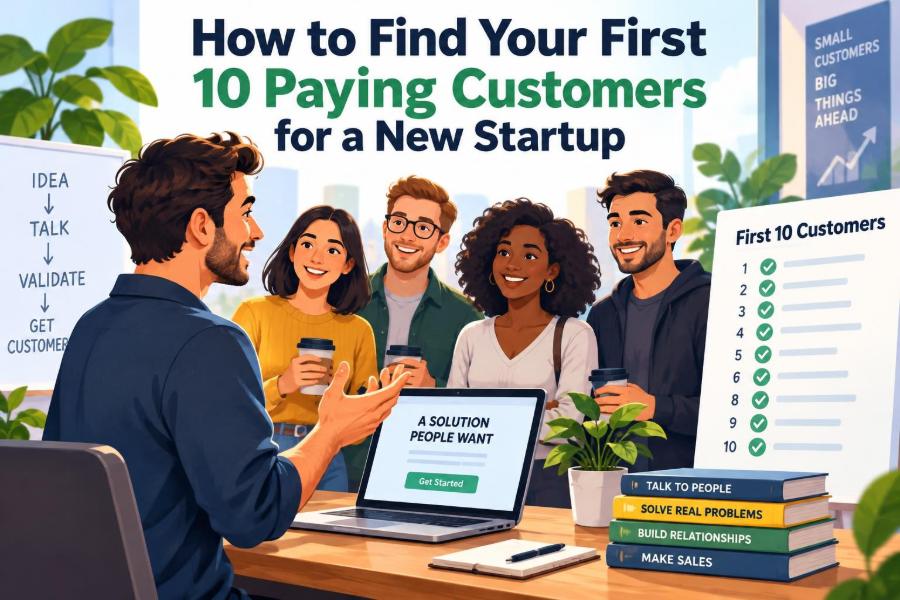

Your first 10 paying customers are not a marketing milestone to postpone until your product is perfect. They are the fastest way to learn whether you are solving a problem people will actually budget for, prioritize, and recommend.
This challenge suits founders with a rough prototype, a service offer, a no-code product, or even a clear idea backed by strong customer insight. You do not need a large audience, a polished brand, or a huge advertising budget. You need focused conversations and a useful offer.
It matters now because attention is expensive and generic outreach is easy to ignore. A small number of highly relevant prospects, approached with a specific message and a realistic promise, will teach you more than months of building in isolation.
The goal is not to trick 10 people into buying. The goal is to find 10 people with a painful enough problem, help them get a meaningful result, and build a repeatable path to the next 100.
🎯 1. Define what counts as a paying customer
Start by setting a strict definition. A paying customer is someone who has transferred money or signed a binding agreement to receive your product or service. Free trials, newsletter subscribers, encouraging friends, and social media likes are useful signals, but they are not sales.
Your first transaction can be smaller than your eventual price. It still needs to involve genuine payment, clear value, and a real customer decision.
- Count: a paid pilot, deposit, subscription, setup fee, paid workshop, or prepaid service package.
- Do not count: vague promises, “send me details,” free beta users, or discounts given with no commitment.
- Set a target: 10 customers within a defined period, such as 30, 60, or 90 days.
A precise target prevents a common trap: mistaking activity for validation.
🧭 2. Pick one narrow customer group first
Trying to sell to everyone creates fuzzy messaging. Choose one group whose problem is frequent, expensive, frustrating, or risky enough that solving it matters.
“Small businesses” is not a customer group. “Independent dental practices with two to five chairs that lose follow-up leads” is much closer to one.
Make your first segment specific
- Who are they by role, industry, business size, or life stage?
- What event makes the problem urgent?
- Where do they already gather online or offline?
- Who can authorize payment?
- What do they use today instead of your solution?
For example, a bookkeeping automation tool might begin with freelance designers who invoice international clients, rather than every self-employed person. A narrow starting point makes prospecting, language, and product decisions simpler.
🔍 3. Validate the problem before pitching the solution
Before you lead with your product, make sure the problem is real and costly. Speak with potential customers about their current workflow, not your clever idea.
A good discovery conversation is not a survey designed to earn compliments. It is a search for evidence: recent examples, existing spending, failed workarounds, and consequences of doing nothing.
Questions that reveal buying potential
- “Walk me through the last time this happened.”
- “What did it cost in time, money, missed opportunities, or stress?”
- “How do you handle it today?”
- “What have you already tried?”
- “Who decides whether to spend money on fixing this?”
- “If this were solved next month, what would improve?”
Listen for specifics. “It is annoying” is weak evidence. “We spend three hours every Friday reconciling this and still make mistakes” is much stronger.
🧩 4. Turn the problem into a small, concrete offer
Early customers rarely buy a broad vision. They buy a result they can understand. Package your offer around one painful job and one credible outcome.
Instead of saying, “We are an AI platform for operations,” say, “We organize incoming supplier invoices and produce a review-ready weekly list for small retailers.” The second statement tells a buyer what changes.
Use this offer formula
I help [specific customer] achieve [specific outcome] without [current pain or trade-off] through [simple mechanism].
Example: “I help independent consultants follow up with warm leads within one day without manually updating a spreadsheet, using a lightweight email and pipeline system.”
Do not promise results you cannot control. If outcomes depend on customer effort, say so plainly. Credibility is more valuable than dramatic claims.
💰 5. Price the first offer honestly
Charging something changes the conversation. It tests urgency, exposes objections, and ensures customers have a reason to engage. Free users can be helpful for research, but free feedback is often less reliable than paid commitment.
Your first price can reflect the unfinished nature of the product, as long as the customer understands what they are buying and receives useful value.
| Offer format | Typical effort for you | Customer commitment | Best use |
|---|---|---|---|
| Paid diagnostic or audit | High at first | Low to medium | Learning the problem deeply |
| Concierge service | High | Medium | Proving a workflow before software |
| Paid pilot | Medium | Medium to high | Testing a prototype with clear scope |
| Subscription product | Lower per customer after setup | Medium | Testing repeatable ongoing value |
State the price without apologizing. If you offer an early-adopter rate, explain what is included, how long it lasts, and what support or access the customer receives.
🛠️ 6. Build the minimum sales-ready version
You do not need every feature before selling. You need enough to demonstrate the core value and deliver what you promised. In many startups, the first version is partly manual behind the scenes.
For a software idea, this may be a clickable prototype plus manual onboarding. For a service, it may be a one-page scope, a payment process, and a repeatable delivery checklist.
Your minimum sales-ready kit
- A one-sentence value proposition.
- A short demo, sample output, or before-and-after example.
- A simple pricing and scope document.
- A way to take payment or issue an invoice.
- A basic onboarding form or call agenda.
- A written explanation of what you will not provide yet.
Keep customer data secure, especially if you work with financial, health, employee, or personal information. Privacy, consumer protection, tax, licensing, and payment rules vary by country and industry; get appropriate local advice as you grow.
📋 7. Make a list of 100 realistic prospects
Ten customers rarely come from contacting ten people. Build a prospect list large enough to absorb non-replies, poor timing, and mismatched needs. One hundred carefully chosen prospects is a useful starting point for many early-stage founders.
Prioritize people who fit your segment and have an observable reason to care. A prospect who recently hired, launched, complained publicly about a workflow, or changed systems may be more receptive than a random contact.
Track your pipeline simply
| Field | Why it matters |
|---|---|
| Name, company, role | Shows who can influence or approve a purchase |
| Relevant trigger | Gives you a legitimate reason to contact them |
| Source | Reveals which channels produce prospects |
| Status | Prevents forgotten follow-ups |
| Next action and date | Turns interest into a process |
| Notes and objections | Improves the product and message |
A spreadsheet is enough initially. The goal is disciplined follow-up, not buying complicated sales software.
🤝 8. Start with warm introductions
Your warm network is not only close friends and former colleagues. It includes clients, suppliers, classmates, online peers, community organizers, mentors, and people who know people in your target market.
Ask for introductions, not purchases. Make the request easy to forward and specific enough that the connector can judge whether it is relevant.
A simple introduction request
Hi [Name], I am testing a paid solution for [specific group] that helps with [problem]. I am looking to speak with 3-5 people who currently deal with this. Would anyone in your network be a relevant fit? No pressure to buy; I would value a short conversation and will be clear about what I am offering.
Respect the relationship. Do not pressure someone to send a mass message or make an introduction that could reflect poorly on them.
✉️ 9. Send cold outreach that earns a reply
Cold outreach can work when it is targeted, brief, and relevant. It fails when it is copied broadly, self-focused, or stuffed with vague claims.
Reference something real about the prospect’s work, then connect it to a problem you understand. Ask for a low-friction next step, usually a short conversation rather than an immediate purchase.
A practical cold message structure
- Personal context: one relevant observation.
- Problem: name a likely pain in plain language.
- Credibility: explain why you are exploring it or what you have built.
- Ask: request 15 minutes or offer a short, relevant demo.
Hi [Name], I noticed [specific, genuine observation]. I am working with [customer type] that struggle to [problem]. I have built a simple way to [outcome], and I am looking for a few early customers to test it with. Would a 15-minute conversation next week be useful, even if only to tell me how you handle it today?
Personalization should be truthful. Never pretend you are a fan, customer, or mutual contact when you are not.
🗣️ 10. Run sales conversations as problem-solving sessions
A sales call is not a performance. Your job is to understand fit, establish whether the problem is important, and decide together whether your offer is useful.
Spend more time listening than explaining. A helpful structure is discovery first, then a tailored demonstration, then a clear discussion of scope, price, and next steps.
A 30-minute call outline
- Confirm the purpose and agenda in two minutes.
- Ask about the current process and recent examples for 10 minutes.
- Clarify impact, priority, stakeholders, and budget for eight minutes.
- Show only the relevant part of your solution for seven minutes.
- Agree on a next step, including a decision date, in three minutes.
If there is no fit, say so. Early founders waste time trying to convert people whose problem is minor, whose budget is unavailable, or whose needs require a different product.
🧪 11. Sell pilots with a clear beginning and end
A paid pilot lowers the risk for both sides. The customer gets a contained test, and you get feedback from real use. But an undefined pilot can become unpaid custom work, so set boundaries before money changes hands.
Put these terms in writing
- The problem and outcome being tested.
- What you will deliver and what the customer must provide.
- Start date, end date, and check-in dates.
- Price, payment timing, and any refund policy.
- How success will be measured.
- What happens after the pilot: stop, extend, or convert to ongoing service.
For example, a two-week pilot might aim to reduce the time required to prepare a weekly report. You cannot guarantee a business result, but you can agree to measure time saved, completion rate, or error reduction.
🧠 12. Handle objections without becoming defensive
Objections are information. “Too expensive,” “not now,” and “we already use something” can mean a genuine mismatch, a missing decision-maker, weak urgency, or unclear value.
Do not rush to discount. First understand what the objection means.
Useful responses
- “It is too expensive.” “Compared with what alternative or budget are you weighing it against?”
- “We need to think about it.” “What specifically would you need to resolve before deciding?”
- “We already have a tool.” “What does that tool handle well, and where does it fall short?”
- “Not now.” “What would need to change for this to become a priority?”
Record repeated objections word for word. If five prospects say they do not trust setup time, your onboarding process or explanation may need work.
🔁 13. Follow up with value and a deadline
Many first sales happen after a thoughtful follow-up, not on the first call. People are busy, priorities shift, and messages get buried. Following up is professional when you are respectful and relevant.
Send a recap after each conversation. Include the problem they described, what you proposed, the price or pilot scope, and one clear next action.
Follow-up checklist
- Send the recap within 24 hours.
- Use the customer’s language, not generic marketing terms.
- Attach or include only material relevant to their decision.
- Ask for a specific response by a specific date.
- Follow up two to four times, then close the loop politely.
False scarcity damages trust. Only use a deadline when it is real, such as a limited pilot capacity or a scheduled onboarding window.
🌟 14. Deliver manually if that gets the result
Your first customers are buying an outcome, not your architecture diagram. If a manual step helps you deliver reliably while you learn, use it. This is often called a concierge approach.
Suppose you are building a reporting tool. In the beginning, you might collect files, clean data manually, and send the report yourself. That work reveals what should later be automated and what customers actually value.
Be transparent where it matters. Do not misrepresent a manual service as fully automated software, especially where security, reliability, or compliance is involved.
📈 15. Ask for referrals at the moment of value
A satisfied first customer can be your best source of the next customer because they understand the problem and can describe the value in credible language. Ask after you have delivered a meaningful win, not before.
Make the referral request precise: ask for one or two people facing the same issue. Offer a forwardable note, but never assume permission to use someone’s name or story publicly.
Referral request example
I am glad the pilot helped with [specific outcome]. Do you know one or two [type of person] who also deal with [problem]? If it is useful, I can send a two-sentence note you can forward. No obligation at all.
Customer testimonials require consent. Be especially careful with names, results, and sensitive business information.
📊 16. Track the numbers that improve your process
You do not need a complex dashboard. You do need to know where qualified prospects fall out of your process. Track counts weekly and look for bottlenecks.
| Metric | What it tells you | Possible action |
|---|---|---|
| Prospects contacted | Whether you have enough top-of-funnel activity | Build a better list or schedule outreach time |
| Reply rate | Whether targeting and message relevance are working | Improve the segment or first sentence |
| Calls booked | Whether your ask is compelling and low-friction | Clarify value and simplify scheduling |
| Qualified opportunities | Whether you are reaching people with real need | Tighten qualification criteria |
| Paid conversions | Whether offer, price, and trust align | Review objections and pilot design |
| Time to first value | How quickly customers see usefulness | Improve onboarding and delivery |
Small samples can be noisy. Do not overreact to one rejection or one sale. Look for repeated patterns across conversations.
⚠️ 17. Avoid the early-customer mistakes that slow you down
Founders often make first sales harder by hiding from conversations or overbuilding before asking for money. The remedy is usually simpler than it feels: talk to more qualified people and make a clearer offer.
- Building for months without selling: sell a pilot or service version sooner.
- Targeting anyone who will listen: narrow the segment until the pain is recognizable.
- Giving everything away free: charge for real value, even if modestly.
- Customizing endlessly: accept learning, but protect a repeatable core offer.
- Discounting at the first objection: diagnose the concern before changing price.
- Failing to follow up: create a routine and schedule next actions immediately.
- Ignoring retention: a customer who leaves quickly is not a stable foundation.
🧱 18. Turn 10 customers into a repeatable foundation
Once you reach 10 paying customers, pause long enough to extract the lesson. Which customers were easiest to close? Which saw value fastest? Which channel produced the strongest fit? The answers should shape your next product and marketing decisions.
Do not assume all revenue is equally valuable. A demanding customer who needs a unique workflow may teach you something useful, but ten such customers can trap you in an unscalable service business.
Review these questions
- What problem did paying customers describe most often?
- Which promise led to the most productive conversations?
- What did customers believe they were buying?
- Which onboarding step caused friction?
- What manual work can be standardized or automated?
- Would these customers renew, expand, or refer someone?
Use the answers to refine your ideal customer profile, pricing, onboarding, and product roadmap. That is how early sales become a business rather than a collection of one-off wins.
✅ 19. Your action plan for this week
Do not try to perfect every part of this process at once. Give yourself a small sequence of concrete tasks and complete them before adding more tools or features.
- Day 1: Write one narrow customer definition and one-sentence offer.
- Day 2: List 25 warm and realistic prospects, including possible introducers.
- Day 3: Send 10 introduction requests or personalized outreach messages.
- Day 4: Prepare a 15-minute discovery-call script and a simple pilot outline.
- Day 5: Hold conversations, take notes, and identify the exact words prospects use.
- Weekend: Follow up, adjust your offer based on evidence, and schedule next week’s outreach.
Expect some silence and rejection. That is normal data, not proof that your startup cannot work. Stay close to real customers, keep your promises modest and clear, and improve one part of the process each week.
Your first 10 paying customers come from solving one urgent problem for one reachable group, then doing the unglamorous work of asking, listening, following up, and delivering. 🚀🤝📈