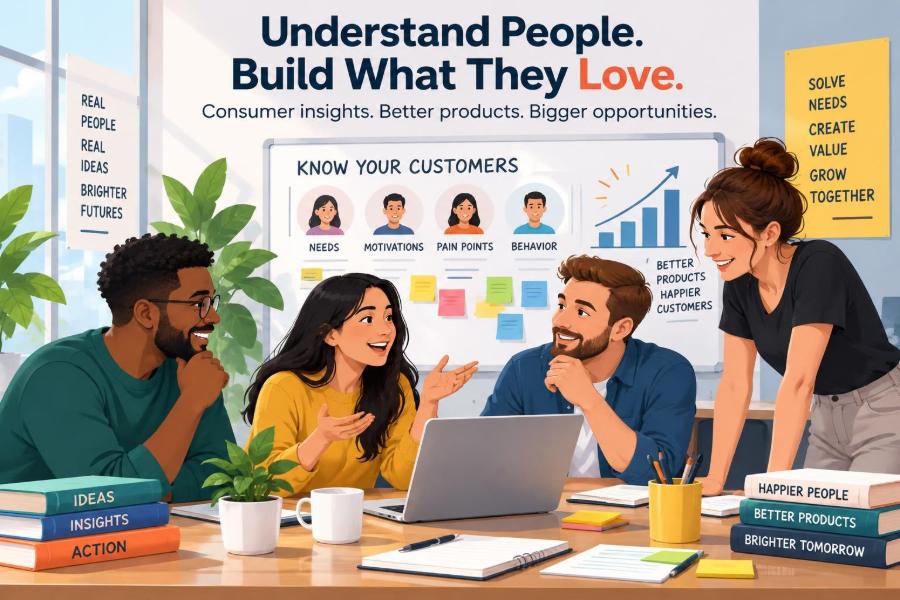

Most startup failures are not caused by a lack of effort. They happen because a team spends months building around an assumption that sounded sensible in a meeting but was never important enough in a customer’s real life.
That creates an unusually practical opportunity for founders willing to observe before they build. Consumer behavior is full of small signals: workarounds, abandoned carts, repeated complaints, awkward routines, and purchases people hesitate to explain.
This approach suits first-time founders, small-business owners, and side hustlers with limited budgets. You do not need a research department. You need access to a specific audience, respectful curiosity, and a habit of testing decisions before treating them as facts.
It matters now because customers have more choices, less patience, and sharper expectations shaped by the best products they use every day. A useful product does not merely add features; it reduces effort, uncertainty, delay, or social risk in a meaningful moment.
The goal is not to predict people perfectly. The goal is to replace vague opinions with evidence strong enough to build, sell, and improve with confidence.
🧭 1. Start With Behavior, Not a Brilliant-Sounding Idea
People are often poor at predicting what they will buy, but their recent actions reveal constraints and priorities. Ask about a concrete event, not an imagined future.
- Instead of: “Would you use a meal-planning app?”
- Ask: “Tell me about the last week you struggled to decide what to cook.”
- Then ask what they tried, what it cost, who was involved, and what frustrated them.
Step-by-step: choose one recurring situation, interview 10 people who experienced it recently, and map the sequence from trigger to outcome. Look for repeated friction rather than enthusiastic compliments.
A common mistake is treating “That sounds useful” as demand. Interest is cheap; a current workaround, a budget, or a willingness to make an introduction is much stronger evidence.
Track: number of people with the same problem, frequency of the problem, current spending, and the severity of consequences when it remains unresolved.
🔍 2. Look for Workarounds Hiding in Plain Sight
A workaround is an improvised solution: spreadsheets, screenshots, copied notes, manual reminders, group chats, or a person hired to chase a task. These are often better opportunity signals than a survey answer.
What to notice
- Files passed back and forth by email.
- Customers combining several tools to finish one job.
- People re-entering the same information.
- Repeated messages asking, “Did you see this?”
- Tasks handled only by one knowledgeable person.
For example, a neighborhood service business that tracks bookings in a notebook and payment messages in chat may not need “business software.” It may need one simple workflow that confirms appointments and reduces no-shows.
Common mistake: assuming the workaround means the problem is small. Often it means existing products are too expensive, too complex, or poorly matched to the user’s context.
Track: time spent on the workaround, error rate, tools involved, and whether the user actively dislikes the process.
🎯 3. Define a Narrow Job To Be Done
Customers do not buy a product because it has a category label. They “hire” it to make progress in a particular circumstance. A narrow job helps you avoid building for everyone and resonating with no one.
A useful format is: “When this situation happens, I want to make this progress, so I can reach this outcome.”
- Weak: “Freelancers need finance tools.”
- Stronger: “When a client asks for an invoice immediately after a project, a freelancer wants to send a professional version in minutes so they can get paid without looking disorganized.”
This framing exposes competing options, including doing nothing. It also tells you what your first product should accomplish.
Track: completion time for the job, success rate, emotional stakes, and the alternatives customers already use.
🧠 4. Separate Functional Needs From Emotional and Social Needs
Functional needs are visible: save time, organize information, lower cost. Emotional and social needs are often the real reason someone acts: feel capable, avoid embarrassment, reassure a partner, or look professional.
A bookkeeping tool may be functionally about categorizing expenses. For a solo founder, it may emotionally be about ending the Sunday-night dread of not knowing whether the business is healthy.
Questions that uncover deeper motives
- “What was frustrating about that situation?”
- “What happened if you did not solve it?”
- “How did you want to feel afterward?”
- “Who else noticed or was affected?”
Do not use emotional language as a trick. Use it to make a product clearer, calmer, and more respectful. A reassuring onboarding flow may be more valuable than another dashboard widget.
Track: hesitation points, words customers use to describe anxiety or pride, and referrals driven by identity or reputation.
⏰ 5. Find the Trigger Moment
Demand becomes actionable when you know what starts the search. A trigger might be a missed deadline, a new baby, a job change, a broken appliance, a tax notice, or an unexpectedly busy season.
Products with clear triggers are easier to market because you can appear where the need is already urgent. The message becomes relevant without requiring a customer to rethink their whole routine.
For a pet-care service, “pet owners” is broad. “People who just adopted a rescue dog and need a first-week routine” is a triggered moment with specific questions and urgency.
- Ask what happened immediately before they searched.
- Ask where they looked first.
- Ask how quickly they needed a solution.
- Ask what made them reject other choices.
Track: time from trigger to purchase, search terms or referral sources, and conversion rates by customer life event.
💸 6. Measure Pain in Time, Money, and Risk
Not every annoyance deserves a startup. Prioritize problems that cost customers something they can clearly recognize: money, time, lost opportunity, stress, compliance exposure, or damage to trust.
| Signal | What it suggests | Early test |
|---|---|---|
| Frequent manual task | Time cost | Offer a done-for-you pilot |
| Existing paid tool | Budget may exist | Ask what they would change or cancel |
| Missed deadlines or errors | Meaningful risk | Test a reminder or verification service |
| Strong emotional complaint | High frustration | Observe whether action follows the complaint |
Estimate the cost of the problem with the customer where possible. If a team loses two hours weekly to a process, do not automatically price against those hours; validate what the improvement is worth to them.
Common mistake: confusing a loud complaint with an expensive problem. The crucial question is whether people will change behavior to escape it.
🗣️ 7. Interview for Facts, Not Validation
Good customer interviews are conversations about the past. Your job is to understand a real decision, not persuade someone that your product idea is clever.
A simple interview structure
- Ask for the last time the problem occurred.
- Walk through the sequence in detail.
- Identify tools, people, money, and delays involved.
- Ask what they tried and why it fell short.
- Ask what would have made switching worthwhile.
Record notes with permission, or write them immediately afterward. Preserve exact phrases. Customers often give you the language for your positioning, landing page, and sales conversations.
Avoid leading questions such as “Would automatic reminders solve that?” Instead ask, “What have you tried to prevent this?” Let their answers reveal whether reminders are even the right solution.
Track: interview count, repeated themes, evidence of spending, and the number of people willing to take a next step.
👀 8. Watch What People Do in Context
Interviews tell you what people remember. Observation shows you the interruptions, shortcuts, and invisible steps they forget to mention. With consent, watch a customer complete the task your product hopes to improve.
For digital products, a screen-share session can be enough. For a local business idea, spend time at the checkout, front desk, workshop, or delivery handoff where friction actually occurs.
- Notice pauses and backtracking.
- Watch for information copied between systems.
- Identify moments when another person must approve or explain something.
- Ask why a step exists before assuming it should disappear.
Respect privacy and confidentiality. Do not collect sensitive data you do not need, and do not observe workplaces or customers without explicit permission.
Track: steps per task, time per step, error-prone handoffs, and the point where users abandon the process.
🧩 9. Map the Whole Decision Journey
Buying is rarely one event. A customer notices a problem, searches, compares, asks someone, delays, purchases, tries the product, and decides whether it becomes a habit. Each stage can kill a promising offer.
Build a basic journey map
- Trigger: What changed?
- Discovery: Where do they look?
- Evaluation: What alternatives do they compare?
- Purchase: What creates hesitation?
- First use: What must happen quickly?
- Retention: What brings them back?
A startup that only optimizes acquisition may gain visitors but lose them at setup. If your customer needs proof for a manager, a shareable summary may matter more than a more polished home screen.
Track: visitor-to-signup rate, signup-to-first-value time, trial-to-paid conversion, repeat use, cancellation reasons, and referral source.
🧪 10. Test the Promise Before Building the Product
A prototype does not need to be software. It can be a landing page, a manual concierge service, a clickable mockup, a pre-order offer, or a small paid workshop. Match the test to the biggest uncertainty.
| Test type | Best for learning | Cost estimate | Effort |
|---|---|---|---|
| Interview | Problem context and language | Low | Low to medium |
| Landing page | Message and demand | Low | Low |
| Concierge pilot | Whether the outcome matters | Low to medium | High |
| Clickable prototype | Usability and workflow | Low to medium | Medium |
| Pre-order | Purchase intent | Low | Medium |
Cost estimates: these depend on your country, tools, design needs, payment fees, taxes, and applicable consumer regulations. Start with the least expensive test that can disprove your riskiest assumption.
Track: qualified visitors, conversations booked, deposits or pre-orders, completion of a requested action, and what people expected to receive.
💳 11. Treat Payment as a Behavioral Signal
Payment is not the only evidence of value, but it is meaningful evidence. A customer who commits money, a deposit, or a signed pilot is making a different decision from someone who says they would use a product someday.
Be transparent when you sell early. State what exists, what is manual, delivery timing, refund terms, and any limits. Consumer-protection rules, taxes, invoicing obligations, and data rules vary by country, so check requirements before taking payments.
For business customers, a paid discovery project can validate both the problem and the buying process. For consumers, a low-risk pre-order or paid beta may be more appropriate.
Common mistake: forcing payment too early for a product that requires trust. Sometimes the better first commitment is a scheduled setup call or permission to run a pilot.
Track: willingness to pay, average order value, refund requests, sales-cycle length, and the objections that appear at checkout.
📦 12. Build the Smallest Complete Outcome
An MVP is not a smaller collection of features. It is the smallest reliable way to deliver the result customers came for. If your first user cannot reach a useful outcome, your product is incomplete regardless of how polished it looks.
Imagine a service for independent consultants who need follow-up after proposals. The first version may only help them send one well-timed follow-up sequence, not manage every client relationship.
Use this feature filter
- Does this directly create the promised outcome?
- Would users fail without it?
- Can a human or simple process handle it initially?
- What evidence says this is needed now?
Manual work is acceptable early if it helps you learn. It becomes a problem when you hide it, cannot deliver consistently, or keep doing it after the pattern is obvious enough to automate.
Track: time to first value, task completion, support requests, manual workload, and activation rate.
🪜 13. Reduce Switching Costs
Even a better product loses if moving feels risky or exhausting. Customers have habits, data, coworkers, and routines tied to existing alternatives. Your product must make the first step feel safe.
- Import a file or set up the first project for them.
- Offer templates based on their current workflow.
- Let them start with one team, client, or task.
- Explain what changes and what does not.
- Provide an easy export path to build trust.
For a local service, switching cost may be travel, uncertainty, or explaining needs again. A clear first-visit process and predictable communication can matter as much as price.
Track: setup completion, imported data or projects, first-week usage, reasons prospects stay with their old option, and churn in the first month.
🧲 14. Use Customer Language in Your Positioning
Founders often describe mechanisms when customers care about outcomes. “AI-powered workflow intelligence” may be technically accurate, but “stop chasing missing client approvals” is more concrete if that is the job people recognize.
Review interview notes and collect phrases that describe the moment before and after your product. Your best message usually names a painful situation, a specific outcome, and the audience it serves.
Simple positioning formula
For specific customers who need to make specific progress, our product helps them reach a clear outcome without the frustrating alternative.
Do not overpromise. If the product reduces effort but cannot eliminate a difficult process, say so. Clear expectations improve trust and reduce costly support and refunds.
Track: conversion by message, sales-call comprehension, objections caused by confusion, and customer language used in reviews or referrals.
📈 15. Watch Retention Before Chasing More Acquisition
Acquisition can hide a weak product temporarily. Retention tells you whether the product earns a place in someone’s routine. The right retention window depends on the job: daily tools, monthly services, and seasonal products behave differently.
Look beyond logins. A customer may log in frequently and still not get value. Define a meaningful action: sending an invoice, completing a booking, publishing a listing, or finishing a required report.
- Choose one activation event tied to value.
- Measure how many new users reach it.
- Check whether they repeat it in the natural usage cycle.
- Interview users who leave and users who stay.
Common mistake: calling every inactive customer “not the target market.” Sometimes the target is right but onboarding, timing, price, or product reliability is wrong.
Track: activation, repeat value actions, cohort retention, churn, expansion revenue, and cancellation reasons.
⚖️ 16. Price for Value, Context, and Simplicity
Price influences behavior. A low price can reduce hesitation, but it can also signal low quality, attract poor-fit customers, or make support unsustainable. A high price can work when the cost of the problem is high and proof is strong.
Start by understanding alternatives: direct competitors, manual effort, hiring someone, and doing nothing. Then test a few simple packages rather than building an elaborate pricing grid.
| Approach | Works best when | Watch out for |
|---|---|---|
| Monthly subscription | Value recurs regularly | Weak retention |
| Per transaction | Value follows usage | Unpredictable bills |
| Project fee | Outcome is finite | Scope creep |
| Tiered plans | Needs vary by size | Too much complexity |
State prices clearly where appropriate. Hidden pricing can create friction unless a tailored enterprise sale genuinely requires it. Taxes, payment processing costs, and pricing rules differ by location, so calculate your true margin carefully.
Track: conversion by price point, gross margin, discount requests, upgrades, refunds, and support cost per customer.
🤝 17. Design for Trust Before Growth
Consumers are increasingly careful about subscriptions, data access, delivery promises, and unexpected charges. Trust is not a legal page buried in a footer; it is the cumulative experience of clear terms, reliable delivery, and respectful communication.
- Explain what data you collect and why.
- Make cancellation and refunds understandable.
- Use realistic delivery estimates.
- Show who is behind the business when appropriate.
- Respond quickly when something goes wrong.
If you operate in regulated areas such as finance, health, employment, food, children’s products, or sensitive personal data, get qualified local legal and compliance advice. A compelling problem does not remove your responsibilities.
Track: support response time, chargebacks, refund reasons, complaint themes, consent rates, and customer sentiment after service recovery.
🔁 18. Create a Learning Loop, Not a One-Time Research Project
Customer behavior changes as your product, market, and audience change. Treat research as an operating habit. Every support conversation, lost deal, onboarding session, and cancellation contains a possible product decision.
A lightweight weekly cadence
- Review one funnel metric and one retention metric.
- Read five support or sales conversations.
- Speak with at least one current or former customer.
- Write down one assumption to test next.
- Assign an owner and deadline to the test.
Keep an assumption log with the belief, evidence, test, result, and decision. This prevents teams from repeatedly debating old opinions as if they were facts.
Track: experiments run, learning cycle time, decisions changed by evidence, and the share of roadmap items connected to observed customer needs.
🧱 19. Know Which Signals Can Mislead You
Behavioral evidence is powerful, not magical. A small sample can be biased, early adopters can be unusually tolerant, and a successful pilot can depend too heavily on your personal effort.
- Vanity metrics: likes, signups, and views without meaningful action.
- Selection bias: only interviewing friends or enthusiastic users.
- Courtesy bias: people being nice instead of candid.
- False urgency: a one-time event mistaken for a recurring market.
- Founder bias: hearing only evidence that supports the original idea.
Counter this by recruiting skeptics, asking for disconfirming evidence, and writing down what result would make you stop or change direction. A failed test is inexpensive if it prevents a year of building the wrong thing.
Track: source diversity, negative feedback rate, test outcomes that contradict assumptions, and repeated behavior across segments.
🚀 20. Turn Insights Into a Focused Growth System
Once you have evidence of a valuable outcome and repeat use, growth becomes more disciplined. Choose channels that match the trigger moment and customer behavior instead of copying whatever channel is fashionable.
If customers seek help during tax season, practical educational content and partnerships may fit. If they discover products through peers, referral loops and communities may be stronger. If they need confidence before purchasing, demonstrations and case-based proof may matter most.
Build from one repeatable path
- Identify the highest-intent source of new customers.
- Write one message tied to the trigger and outcome.
- Make onboarding deliver value quickly.
- Ask satisfied users for the next appropriate action: repeat purchase, referral, review, or upgrade.
- Improve the bottleneck before adding another channel.
Scaling too early magnifies confusion and poor unit economics. Growth is healthier when it follows a product customers understand, use, and choose to keep.
Track: customer acquisition cost, payback period, conversion by channel, retention by channel, referral rate, and contribution margin.
✅ 21. Your Action Plan for This Week
Do not try to master consumer behavior in one sprint. Run a small, honest learning cycle and let the next decision become clearer.
- Day 1: Write one narrow job-to-be-done statement.
- Day 2: List 20 people who recently faced that situation and invite 10 to talk.
- Days 3-4: Conduct at least five past-behavior interviews.
- Day 5: Highlight repeated triggers, workarounds, costs, and exact phrases.
- Day 6: Create one low-cost test: a service offer, prototype, or landing page.
- Day 7: Decide what evidence would justify building, revising, or stopping.
Keep your scope small enough that you can learn this week, not someday. The point is not to create a perfect plan; it is to make the next investment of time and money more informed.
The startups that build products people actually want are usually the ones that stay closest to what people already do, struggle with, and value. Listen carefully, test humbly, and let real behavior guide the work. 🚀🧭💬