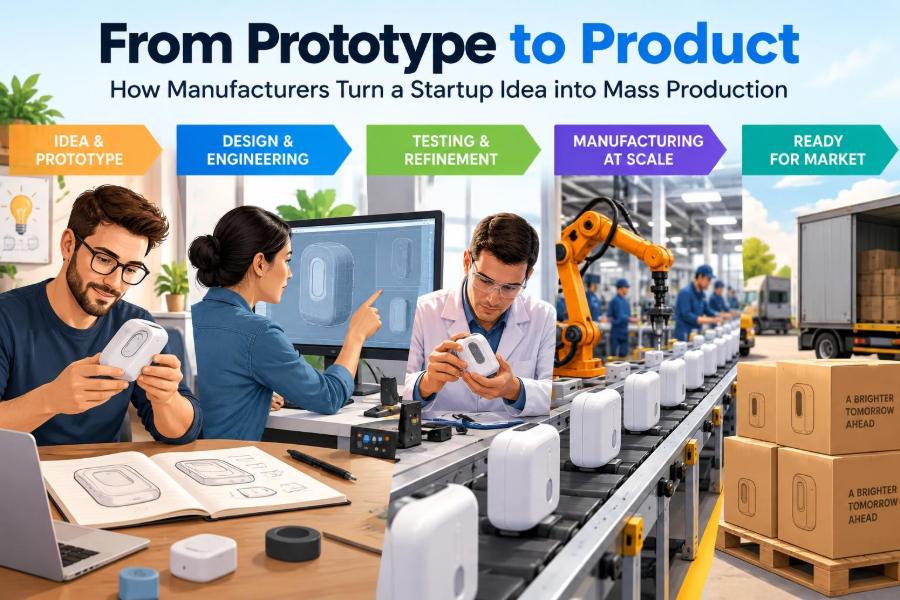

A working prototype is one of the most exciting milestones in a startup. It proves your idea can exist. But it is not yet proof that the idea can be made safely, repeatedly, profitably, and at a quality customers will accept.
The gap between a prototype and a production-ready product is where many founders lose time and cash. A hand-built sample may rely on expensive parts, improvised assembly, or the founder’s own patience. A factory needs clear instructions, reliable inputs, measurable quality standards, and a process that still works on a bad Tuesday with a new operator.
This journey suits founders building physical products: consumer goods, hardware, wearables, home products, industrial tools, packaging, and many other tangible businesses. It matters now because customers expect polished products, supply chains remain variable, and early manufacturing mistakes can tie up a small company’s entire budget.
The good news is that productization is not magic reserved for large companies. It is a disciplined series of decisions. If you learn what manufacturers need before you ask for a quote, you can move faster, negotiate more clearly, and protect your startup from costly surprises.
🧭 1. Understand the difference between a prototype and a product
A prototype answers, “Can this idea work?” A production-ready product answers, “Can we make this thousands of times with consistent cost, quality, and compliance?”
Your first prototype may be 3D printed, machined by a local shop, assembled with off-the-shelf components, or built by hand. That is normal. The manufacturer’s role is to turn that one-off object into a repeatable system.
- Prototype: validates function, user appeal, and early assumptions.
- Engineering sample: validates materials, tolerances, and manufacturability.
- Production sample: validates the actual factory process.
- Mass-production unit: meets agreed specifications at a repeatable unit cost.
Do not treat these as identical stages. Skipping them is usually not speed; it is moving uncertainty into a more expensive part of the project.
🎯 2. Define the commercial target before changing the design
Before an engineer optimizes anything, decide what business you are building. A premium product sold directly to enthusiasts has different cost and finish requirements than a value product sold through retailers.
Set a target product profile
Write a one-page brief that includes the customer, core job to be done, target retail price, target launch region, expected first-year volume, must-have features, and features you can remove if costs rise.
Work backward from price. Retailers and distributors often need room for their own margins, while direct-to-consumer brands must cover shipping, returns, support, marketing, and taxes. Your factory quote is only one part of the economic picture.
- What is the highest acceptable landed unit cost?
- Which three customer benefits cannot be compromised?
- What is the minimum order quantity you can responsibly fund?
- Which markets will you sell into first?
Costs, duties, taxes, certification requirements, and retailer margins vary by country and channel. Confirm your own numbers with suitable local manufacturing, legal, and tax advisers.
📝 3. Turn the idea into a product requirements document
Manufacturers cannot reliably produce a product based on a pitch deck, a sketch, or “something like this, but nicer.” They need a product requirements document, often called a PRD or specification.
Include what must be true
- Purpose, intended user, and use environment.
- Dimensions, weight limits, colors, finishes, and materials.
- Performance requirements, such as battery life, load capacity, or water resistance.
- Safety requirements and foreseeable misuse.
- Packaging, labeling, barcodes, manuals, and accessories.
- Acceptable defects and cosmetic standards.
Separate requirements into “must have,” “should have,” and “nice to have.” This makes trade-offs far easier when a supplier flags a cost, tooling, or technical constraint.
A useful requirement is measurable: “withstands a one-meter drop on a hard surface” is more useful than “durable.” “Charges from empty within three hours using the included cable” is better than “fast charging.”
🔍 4. Research the manufacturing process, not just the factory
The best supplier is not simply the one with the lowest quote. It is the one whose equipment, engineering experience, quality process, and commercial terms fit your product stage.
| Option | Best for | Typical trade-off | Founder effort |
|---|---|---|---|
| Local prototype shop | Fast iterations and small batches | Higher unit cost | Moderate |
| Specialist contract manufacturer | Complex or regulated products | Higher setup and management needs | High |
| Overseas factory | Established processes and larger volumes | Distance, logistics, and communication risk | High |
| Manufacturing broker or partner | First-time founders needing guidance | Added fee or margin | Lower |
Ask which process your product requires: injection molding, CNC machining, sheet metal fabrication, sewing, casting, PCB assembly, extrusion, thermoforming, or another method. Each process creates different design rules, tooling costs, lead times, and minimums.
🏭 5. Vet manufacturers like a long-term business partner
A production relationship can last years, so perform due diligence before sending deposits or confidential files. A polished website and quick reply are not enough evidence of capability.
Questions worth asking
- Have you made products with similar materials, complexity, and quality expectations?
- Which steps are performed in-house and which are subcontracted?
- What are your normal minimum order quantities and lead times?
- How do you inspect incoming materials and finished goods?
- Who owns and stores the tooling?
- Can you provide samples, process documentation, and references where appropriate?
- How are engineering changes approved and recorded?
Visit in person when the budget and project risk justify it. If travel is impractical, request a live video walkthrough, inspect samples independently, and use third-party quality inspection where needed.
Be wary of a factory that agrees to every request without questions. Experienced manufacturers challenge weak assumptions because they understand where production fails.
🛠️ 6. Design for manufacturing from the beginning
Design for manufacturing, or DFM, is the process of changing a design so it is easier, more consistent, and less expensive to produce. It is not merely cost cutting. Done well, it improves reliability and reduces defects.
A manufacturer may recommend fewer fasteners, a different wall thickness, a standard component, a larger tolerance, or a simpler surface finish. Your instinct may be to defend the original design. Instead, ask what customer value changes and what risk disappears.
Common DFM improvements
- Replace custom parts with proven standard components.
- Reduce the number of unique screws, materials, and colors.
- Design parts so they can only be assembled one way.
- Avoid features that require hand finishing or difficult alignment.
- Use draft angles and consistent wall thickness for molded parts.
- Make serviceable components accessible if repairs are part of your promise.
Keep a change log. Every design adjustment should show what changed, why it changed, who approved it, and which version is now valid.
📐 7. Replace vague expectations with drawings and tolerances
Factories need a shared technical language. That usually includes 2D drawings, 3D CAD files, bills of materials, color references, and assembly instructions.
Tolerances specify how much variation is acceptable. No process makes every part exactly identical. If a measurement matters for fit, safety, or performance, define its permitted range.
Overly tight tolerances increase cost because they require more precise tooling, slower production, or more rejected parts. Overly loose tolerances create rattles, leaks, poor fit, and inconsistent quality. Identify the dimensions that truly matter rather than applying precision everywhere.
🧱 8. Build a realistic bill of materials
The bill of materials, or BOM, is the structured list of every part, material, and subassembly required to make one finished unit. It becomes the backbone of sourcing, costing, inventory, and change control.
Your BOM should capture
- Part number and revision number.
- Description, material, finish, and quantity per unit.
- Approved supplier or acceptable alternatives.
- Target cost and lead time.
- Quality-critical characteristics.
Do not forget packaging, labels, instruction leaflets, batteries, cables, adhesives, protective films, and inserts. Small omissions can delay a shipment just as effectively as a missing main component.
For every critical part, ask whether there is a second source. You may not use one immediately, but understanding the dependency gives you negotiating power and contingency options.
💵 9. Calculate the true cost of making and selling one unit
Founders often focus on the factory’s unit price. The more useful number is landed cost: the total cost to get a sellable unit into your warehouse or fulfillment network.
| Cost category | Often included in a factory quote? | Why it matters |
|---|---|---|
| Materials and assembly | Usually | Base unit economics |
| Tooling and development | Sometimes separate | Upfront cash requirement |
| Testing and certification | Often separate | May be legally necessary |
| Packaging and labeling | Sometimes | Retail and shipping readiness |
| Freight, duty, and insurance | Usually separate | Can materially change margin |
| Inspection, storage, and returns | Usually separate | Protects cash-flow planning |
Estimate: early-stage development can range from a few thousand to far more than one hundred thousand in local currency depending on complexity, tooling, testing, order size, and region. Simple sewn or assembled goods may require modest samples and packaging work; custom electronics, molds, and regulated products can demand substantial capital before the first sale.
Build a downside budget, not just a hopeful one. Include rework, replacement samples, expedited shipping, exchange-rate movement, and a contingency reserve.
🧪 10. Test the product in the real world before locking it down
Lab tests and bench tests matter, but they are not the full story. Give representative units to people who match your target customer and watch what happens in realistic conditions.
Do not ask only, “Do you like it?” Ask participants to complete a task. Observe confusion, setup failures, comfort issues, breakage, cleaning problems, and moments when they reach for a competitor or workaround.
Run a structured test loop
- Write the assumptions you need to validate.
- Choose a small group of relevant testers.
- Set tasks and a testing period.
- Record feedback by severity and frequency.
- Fix the highest-impact issues first.
- Retest the revised design.
One vocal tester should not dictate a redesign. Look for repeated patterns, especially around safety, core function, and reasons a customer might return the product.
🛡️ 11. Plan compliance, safety, and intellectual property early
Regulations are not an administrative detail to handle after manufacturing. They may influence component selection, labels, documentation, testing, packaging, shipping, and product claims.
Requirements vary significantly by country and product category. Electronics, children’s products, food-contact items, cosmetics, medical-related products, batteries, wireless devices, and protective equipment often carry additional obligations.
- Identify the markets where you will first sell.
- List relevant safety, environmental, labeling, and import requirements.
- Budget for testing by suitable accredited labs where required.
- Review instructions, warnings, and marketing claims.
- Get qualified legal and regulatory advice for high-risk categories.
Use confidentiality agreements where appropriate, but do not rely on paperwork alone to protect an idea. Keep control of critical design files, document ownership of tooling, and consider patents, trademarks, and design protection with professional advice when the economics justify it.
🔧 12. Decide when custom tooling is worth the commitment
Tooling is the equipment used to make your parts consistently: molds, dies, jigs, fixtures, cutting tools, and test rigs. It often converts a handmade product into a scalable one, but it also creates an upfront commitment.
Before approving tooling, validate the customer need, finalize as much of the design as practical, and understand revision costs. Changing a 3D-printed part can be cheap. Changing hardened steel tooling can be slow and expensive.
Ask for tooling clarity
- What exactly does the tooling produce?
- What is the expected tool life and maintenance plan?
- Who legally owns it after payment?
- Where will it be stored and how can it be transferred?
- What changes can be made, at what cost?
- How many cavities or production cycles are planned?
Start with bridge methods when sensible: low-volume molding, machining, soft tooling, or partial manual assembly can help validate demand before you commit to full-scale equipment.
📦 13. Treat packaging as part of the product system
Packaging must protect the item, communicate what it is, meet labeling rules, fit shipping constraints, and create a credible first impression. It is both a cost center and a customer-experience tool.
Test the packaged product through the likely shipping journey. A beautiful box that scuffs, crushes, leaks, or adds unnecessary dimensional shipping cost is not doing its job.
Use simple packaging in early runs unless premium presentation is essential to the buying decision. Extra finishes, custom inserts, and multiple box sizes add vendors, lead times, and quality variables.
✅ 14. Build quality control into the process
Quality is not something you inspect into a product at the end. The strongest approach prevents defects through good design, clear work instructions, approved materials, operator training, and checks at important production points.
Create a quality plan
- Incoming inspection: confirm critical components meet specification.
- In-process checks: catch errors before more value is added.
- Final inspection: verify function, cosmetics, labeling, and packaging.
- Pre-shipment inspection: review a statistically sensible sample before release.
- Corrective action: document root causes and prevent recurrence.
Agree on defect definitions before production. A tiny mark may be acceptable on an internal part but unacceptable on a premium visible surface. Photos, approved samples, and written criteria prevent arguments later.
📊 15. Run a pilot production batch before scaling
A pilot batch is a controlled, limited production run using the intended factory process. It reveals problems that individual samples cannot: operator variation, supply delays, yield losses, packaging bottlenecks, and test-station constraints.
Think of the pilot as paid learning. Its goal is not merely to create inventory. Its goal is to prove that your process can deliver the product you promised.
Metrics to track in the pilot
- First-pass yield: units that pass without rework.
- Defect rate by defect type and production station.
- Actual cycle time compared with the quote.
- Material waste and rework cost.
- On-time delivery of each component.
- Units passing final functional and cosmetic inspection.
Do not increase volume until you understand the main failures and have evidence that the fixes work. A defect rate that feels manageable at 100 units can become a crisis at 10,000.
🚚 16. Plan logistics and inventory alongside production
Production completion is not the same as product availability. You still need freight, customs documentation, duty planning, warehousing, fulfillment, insurance, and a process for damaged or returned units.
Choose shipping mode based on margin, urgency, product size, and cash flow. Air freight is faster but usually more expensive; ocean, rail, road, or consolidated services may lower cost but require more planning. Rules for batteries, hazardous goods, and imports can add complexity.
Avoid ordering so much inventory that a small design improvement becomes impossible. At the same time, avoid ordering so little that repeated small runs erase your cost advantage. Your demand evidence should guide the first order, not optimism alone.
🤝 17. Negotiate terms that protect both sides
Manufacturers need deposits because they buy materials and reserve capacity. Startups need protection because product delays and defects can threaten survival. Good terms make responsibilities visible rather than assuming goodwill will solve everything.
Put these in writing
- Product specifications, approved samples, and revision control.
- Pricing, payment milestones, and currency.
- Tooling ownership and access.
- Lead times and shipment terms.
- Inspection rights and acceptance criteria.
- Defect remedies, rework responsibilities, and warranty handling.
- Confidentiality and ownership of design files.
Read terms carefully and use qualified legal counsel for contracts that materially affect your company. The cheapest quote can become the most expensive arrangement if the supplier is unclear about responsibility for failed goods.
📈 18. Scale through systems, not heroic founder effort
Early on, you may personally approve every sample, answer every supplier question, and inspect every box. That involvement is useful for learning. It is not a scalable operating model.
Create simple systems: a version-controlled document folder, approved vendor list, change-request process, quality dashboard, reorder model, and weekly supplier update. Your future operations hire, manufacturing partner, or cofounder should be able to understand the product without relying on your memory.
Track the numbers that signal operational health
- Landed cost per sellable unit.
- Gross margin by sales channel.
- First-pass yield and return rate.
- Production lead time and on-time delivery.
- Inventory weeks on hand and stockout frequency.
- Cash tied up in inventory and deposits.
- Customer complaints by root cause.
Scale one constraint at a time. You may need more tooling, alternate suppliers, better forecasting, a larger warehouse, or a stronger quality process. Growth becomes dangerous when volume rises faster than your ability to control it.
⚠️ 19. Avoid the mistakes that make manufacturing expensive
Most first-time founders do not fail because they lack passion. They fail because they underestimate complexity, lock in too early, or hide bad news from themselves until cash runs out.
- Choosing solely on price: compare capability, quality, communication, and total landed cost.
- Ordering before validation: use samples, pilots, and real customer feedback.
- Changing designs informally: every change needs a version and approval.
- Ignoring packaging and freight: these can damage margin and customer experience.
- Assuming certification later: requirements may force a redesign.
- Having one critical supplier: map dependencies and explore alternatives.
- Skipping contingency: delays and rework are common, not personal failures.
Be demanding about facts and respectful with partners. Clear expectations, quick decisions, and honest forecasts make you easier to work with, which matters when capacity is tight.
🗓️ 20. Your action plan for this week
You do not need to solve every manufacturing question today. You need to turn an exciting object into a documented, testable business project.
- Write a one-page target product profile with customer, price, channel, and first market.
- List every feature as must-have, should-have, or nice-to-have.
- Create a first product requirements document and BOM, even if incomplete.
- Identify three manufacturers or manufacturing partners suited to your process.
- Prepare ten focused questions about capability, lead times, tooling, and quality.
- Calculate a rough landed-cost model with a contingency line.
- Schedule product testing with at least a few people who resemble your intended customer.
Then choose the next uncertainty with the biggest financial consequence and resolve it first. That may be a safety requirement, a fragile component, a tooling quote, or proof that customers will pay your target price.
A manufacturer turns a prototype into a product through repeatable decisions, clear documentation, disciplined testing, and honest unit economics—not by simply making more of the first sample. Build those foundations now, and you give your startup a far better chance to scale without losing control. 🚀🛠️📦