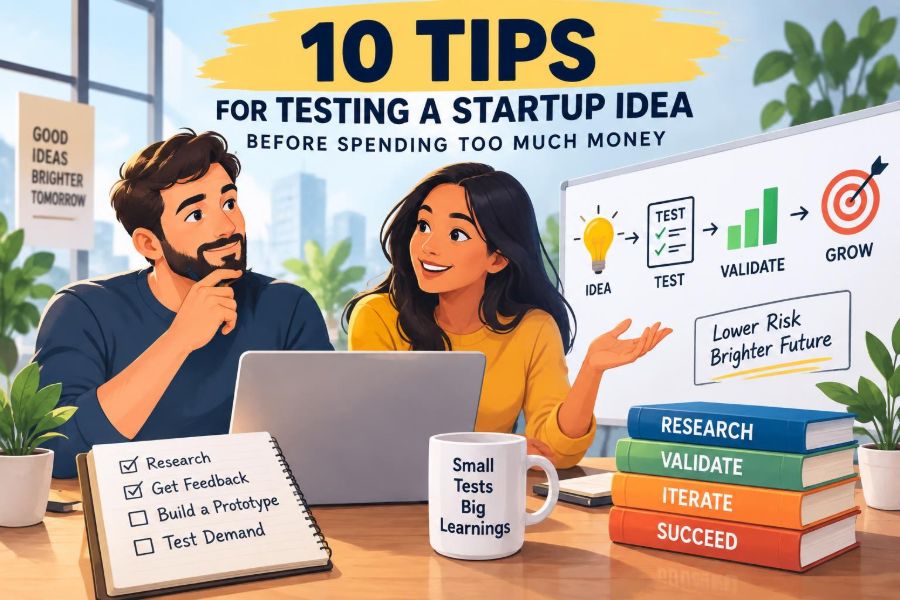

Most expensive startup mistakes happen before a company even exists. A founder falls in love with an idea, buys software, builds a polished website, hires help, and then discovers that the people they imagined serving do not feel the problem strongly enough to pay.
The good news is that early uncertainty is not a sign you are failing. It is exactly what you should expect when you are considering a new product, service, shop, app, or side hustle. Your job is not to predict the future perfectly; it is to reduce the biggest risks cheaply and quickly.
This approach suits aspiring founders with limited savings, small-business owners considering a new offer, and side hustlers who need evidence before giving up evenings or income. It also helps experienced operators avoid treating confidence as proof.
It matters especially now because basic tools make it easy to build almost anything. Distribution, attention, trust, and willingness to pay are still difficult. Test those things first, while changing direction is inexpensive.
🧭 1. Define the idea as a risky set of assumptions
An idea such as “an app for freelancers” is not a testable business. Turn it into a set of claims that could be true or false: who has a problem, how painful it is, what they do today, why your approach is better, and what they will pay.
Write your assumptions before you research. Otherwise, you will unconsciously interpret every encouraging comment as validation.
Start with an assumption map
- Customer: Independent designers managing five or more clients.
- Problem: They lose billable time chasing approvals and feedback.
- Current alternative: Email, shared documents, and project-management tools.
- Promise: A simpler approval workflow that reduces back-and-forth.
- Business model: Monthly subscription paid by the freelancer.
- Critical assumption: Enough designers will pay rather than tolerate their current process.
Circle the assumptions that could kill the idea. Usually these are problem severity, access to customers, willingness to pay, and the cost of delivering the solution.
🎯 2. Pick one narrow customer for the first test
Broad audiences produce vague feedback. “Small businesses” includes companies with different budgets, buying habits, regulations, and problems. Pick a specific early segment that you can reach and understand.
A narrow starting point does not permanently limit the company. It gives you a clear place to learn. You can expand once you know why a particular group buys.
Make the customer concrete
- Weak: people who want to eat healthier.
- Better: busy parents who want five weeknight dinners without meal planning.
- Weak: local retailers.
- Better: independent gift shops that reorder seasonal inventory from multiple small suppliers.
Describe the customer’s role, situation, recurring trigger, existing workflow, and ability to spend. If you cannot name where these people gather online or offline, customer acquisition may be harder than the product itself.
🔍 3. Research the existing alternatives before inventing one
Competition is often evidence that customers spend money on the problem. The real question is not “does anything similar exist?” but “what job is still frustrating, expensive, slow, or poorly served?”
Review competitors, substitutes, manual workarounds, agencies, spreadsheets, and the choice to do nothing. Read customer complaints carefully, but do not assume every complaint represents a profitable opportunity.
Build a simple alternative table
| Alternative | What customers like | What frustrates them | Your possible angle |
|---|---|---|---|
| Spreadsheet | Cheap and familiar | Manual, easy to break | Automate one repetitive step |
| Large software suite | Many features | Complex and costly | Offer a focused workflow |
| Hiring help | Flexible expertise | Expensive and inconsistent | Standardize a repeatable task |
| Doing nothing | No immediate spend | Lost time or missed sales | Make the cost of delay visible |
Do not try to beat established businesses on every feature. A better early position is usually a clearer audience, a faster result, or a more convenient delivery method.
🗣️ 4. Conduct problem interviews, not sales pitches
Talk to people in your target group before describing your solution. The purpose is to learn about their real behavior, not to collect compliments for your concept.
Ask about a recent, specific event. Past actions are more reliable than hypothetical opinions. Someone saying “I would use that” is weak evidence; someone showing you the spreadsheet they updated last night is much stronger.
Useful interview questions
- “Tell me about the last time this happened.”
- “What did you do next?”
- “How often does this occur?”
- “What does it cost in time, money, stress, or missed opportunity?”
- “What have you already tried?”
- “Who decides whether to buy a solution?”
- “What would need to change for this to become urgent?”
Aim for 10 to 20 honest conversations with people who genuinely fit your first segment. Take notes using their words. Avoid leading questions such as “Wouldn’t it be helpful if…”
🧪 5. Score the evidence instead of trusting enthusiasm
After every conversation, record what happened using the same simple system. This prevents the loudest interview or your own excitement from setting strategy.
Give more weight to behavior than polite positivity. A referral, a request for a demo, a deposit, or access to real workflow data matters far more than “great idea.”
Use an evidence ladder
| Signal | Strength | What it means |
|---|---|---|
| Likes or encouraging comments | Low | Interest may be social politeness |
| Detailed problem story | Moderate | The problem likely exists |
| Introduces you to a buyer | Strong | The issue has enough importance to share |
| Books time, gives data, or completes a task | Very strong | They are investing effort |
| Pays a deposit or signs an agreement | Strongest | There is financial commitment |
Track the number of interviews, repeated problem patterns, qualified leads, follow-up meetings, and paid commitments. These early metrics are imperfect, but they make learning visible.
💡 6. Write a one-sentence value proposition
Before building, explain the offer without jargon. A useful formula is: “We help specific customer achieve specific result without main pain or trade-off.”
For example: “We help independent designers collect client approvals in one place without chasing email threads.” This is not a slogan. It is a working hypothesis that helps you test messages.
Check for clarity
- Can the right customer recognize themselves immediately?
- Is the result concrete rather than “better productivity”?
- Does it distinguish your offer from a generic tool?
- Can you explain it in one breath?
If your pitch needs a long explanation, simplify the initial use case. Complexity can come later, after customers are receiving a clear benefit.
🛬 7. Build a landing page before building the product
A basic page can test whether strangers understand and care about your promise. It should state the customer problem, the desired outcome, how the offer works at a high level, an indicative price or pricing approach, and one clear next action.
The action might be joining a waitlist, requesting a call, applying for a pilot, or pre-ordering. Do not hide behind a page that only collects anonymous email addresses if a stronger commitment is possible.
Keep the page deliberately simple
- Lead with the customer outcome, not your technical method.
- Use language collected from interviews.
- Include a short form that qualifies the visitor.
- Ask one question about their current process.
- Thank every responder personally and quickly.
Estimated cost: $0 to $100 using a basic site builder, domain, and form tool. Costs vary by country, provider, and whether you already own a domain. The goal is learning, not visual perfection.
📣 8. Test demand in channels where customers already pay attention
A landing page without visitors tells you almost nothing. Choose one or two channels that match your customer: direct outreach, niche communities, local events, industry newsletters, search ads, partnerships, or content.
Start manually. You are learning which message earns attention and which people are worth pursuing, not trying to automate a marketing department.
Compare early acquisition tests
| Channel | Estimated cash cost | Effort | Best early use |
|---|---|---|---|
| Personal outreach | $0 to $50 | High | Interviews and first pilots |
| Niche communities | $0 to $100 | Medium | Testing language and trust |
| Small paid ads | $100 to $500 | Medium | Testing messages at modest scale |
| Local partnerships | $0 to $300 | High | Reaching hard-to-access buyers |
These are broad estimates, not promises. Advertising costs and platform policies change, and regulated industries may limit what you can claim or target.
💬 9. Ask for a real commitment early
The best test is not whether someone says your solution sounds useful. It is whether they will take a meaningful next step under clear terms.
Depending on the business, ask for a pilot fee, refundable deposit, letter of intent, pre-order, scheduled implementation session, or introduction to the budget holder. Be transparent about what exists today and what you are still testing.
Use an honest commitment script
“I am testing a small version of this service with five businesses. It will include these outcomes, cost this amount, and begin on this date. Would you like to reserve one of the spots?”
Never imply that a prototype is a finished product. Trust is an asset you cannot afford to spend during validation.
🛠️ 10. Deliver a concierge version of the solution
Before automating, provide the core outcome manually. This is often called a concierge MVP: the customer receives a real result, while you use spreadsheets, no-code tools, email, or your own labor behind the scenes.
For a meal-planning idea, create personalized plans manually. For a reporting product, prepare the first reports yourself. For a marketplace, match the first buyers and sellers by hand.
What manual delivery teaches you
- Which steps customers truly value.
- Where instructions break down.
- How much support the offer requires.
- What customers will pay for repeatedly.
- Which tasks should eventually be automated.
Estimated cost: often $0 to $300 in software and materials, plus your time. Your time is still a cost, so log it honestly. A service that requires eight hours to deliver but earns $50 has not validated a scalable model.
💰 11. Test pricing before polishing features
Price is part of the product. A price tells you what kind of customer you are attracting, whether the benefit feels valuable, and whether the economics might eventually support the business.
Offer a clear initial price range or package in conversations. You do not need a perfect pricing page, but you do need to discover whether the customer’s budget and urgency match your offer.
Try simple pricing experiments
- Offer a fixed-fee pilot with a defined outcome.
- Compare a self-service option with a higher-priced done-for-you option.
- Test monthly pricing against a project fee when the value is recurring.
- Ask what they currently spend in money or staff time on the problem.
Do not give everything away indefinitely because you are afraid to ask. Free users can be useful for usability feedback, but payment is a different and more important signal.
📊 12. Track a small set of decision-making metrics
Early-stage dashboards should create decisions, not theater. Choose metrics tied to the next uncertainty you need to resolve.
For example, if you are unsure about message-market fit, track qualified landing-page conversions. If you are unsure about retention, track whether pilot customers return or renew.
A practical validation scorecard
- Reach: How many qualified people saw the offer?
- Response: How many replied, clicked, or completed the form?
- Qualification: How many fit your target customer definition?
- Commitment: How many booked, deposited, pre-ordered, or paid?
- Delivery: How long and how much did it cost to fulfill?
- Retention: Did customers return, renew, or refer others?
Record the source of every lead. A hundred low-quality clicks are less useful than three conversations with buyers who have an urgent, expensive problem.
🧮 13. Calculate rough unit economics while the numbers are small
You do not need a full financial model to validate an idea, but you do need basic arithmetic. Estimate revenue per customer, direct fulfillment costs, customer acquisition cost, refunds, payment fees, and your delivery time.
For a subscription or repeat service, estimate how long a typical customer may stay. Treat all early numbers as assumptions, not forecasts.
Use a simple worksheet
Revenue per sale
- Direct materials, software, contractor, and payment costs
= Gross contribution before your time and overhead

Gross contribution
- Estimated cost to acquire that customer
= Contribution available for labor, overhead, and profit
If the economics look weak, that does not always mean the idea is bad. It may mean you need a higher-value segment, a better delivery model, a different price, or lower operating costs.
⚖️ 14. Check legal, tax, privacy, and safety constraints early
Validation does not exempt a business from rules. If you handle personal data, payments, food, health-related claims, financial information, children’s information, employment matters, or regulated products, investigate the requirements before accepting customers.
Rules vary by country, state, region, and industry. A local accountant, lawyer, insurer, or regulator can be worth consulting before you make promises you cannot legally keep.
Early compliance checklist
- What business registration or permits may apply?
- What taxes could apply to sales or income?
- What customer data will you collect and store?
- Do you need consent, contracts, disclaimers, or insurance?
- Are there advertising or professional-licensing restrictions?
Keep tests small, but do not use “just validating” as a reason to ignore customer safety or privacy.
🚦 15. Set pass, revise, and stop criteria in advance
Founders often keep building because they have already invested time. Avoid this trap by deciding what evidence would make you continue, change direction, or pause.
Your criteria should match the stage and business model. A local service may need three paying clients; a software tool may need several users who repeatedly complete a valuable task and agree to pay when the pilot ends.
Example decision rules
- Continue: several target customers describe the same urgent problem and at least a few pay for a pilot.
- Revise: customers engage but misunderstand the promise, resist the price, or need a different outcome.
- Pause: outreach consistently reaches the right people but few take a meaningful next step.
These are examples, not universal benchmarks. The point is to replace vague hope with a decision process.
🔄 16. Run short experiments, one variable at a time
Change one important thing per test when possible: customer segment, message, channel, offer structure, or price. If you change everything together, you will not know what caused the result.
Set a limited budget, time frame, audience, and success measure. At the end, write what you expected, what happened, and what you will test next.
Simple experiment format
Hypothesis: Independent designers will pay for faster client approvals.
Test: Offer a paid, manually managed two-week pilot to 30 qualified contacts.
Budget: $100 and five hours of outreach.
Success signal: Three paid pilots or clear evidence of a pricing objection.
Decision: Continue, revise the offer, or stop.
This discipline keeps a small test from quietly becoming a large, expensive project.
🧱 17. Avoid the most common validation traps
The biggest trap is building to escape uncomfortable conversations. Code, branding, and business cards feel productive because you control them. Customers do not.
Watch for these warning signs
- Interviewing only friends, family, and people who want to encourage you.
- Asking hypothetical questions instead of studying recent behavior.
- Counting social engagement as revenue validation.
- Offering an unclear free trial with no defined outcome.
- Ignoring fulfillment time because it is “temporary.”
- Lowering the price repeatedly instead of questioning the customer or problem.
- Buying expensive tools before a customer has paid.
Encouragement is pleasant, but it is not a business model. Seek disconfirming evidence with the same energy you seek positive signals.
🤝 18. Turn early customers into collaborators, not unpaid consultants
Your first customers can teach you quickly if you respect their time. Give them a clear pilot scope, simple onboarding, regular updates, and a direct way to share feedback.
Do not ask them to design your entire product. Observe their workflow, solve the agreed problem, and ask focused questions after they have experienced the result.
Ask after delivery
- What part created the most value?
- What felt confusing or unnecessary?
- What would make this worth renewing?
- Who else has this problem?
- May I ask for an introduction if you know a good fit?
A satisfied early customer is not guaranteed to become a referral source, but a clear outcome and professional follow-through make referrals more likely.
📈 19. Scale only the part that is already working
Once you have repeatable signs of demand, increase investment gradually. Add automation after you know which manual steps repeat. Increase marketing spend after you know a channel can produce qualified conversations at an acceptable cost.
Scaling a weak offer simply distributes the weakness faster. First look for a repeatable combination of customer, problem, promise, price, and acquisition channel.
Signs you may be ready for the next level
- Customers can clearly describe the value they received.
- Your delivery process has predictable steps and costs.
- New leads come from a channel you can repeat.
- Customers pay, renew, or refer without excessive persuasion.
- You know the next bottleneck: capacity, product, onboarding, or acquisition.
Then invest in the constraint that is genuinely slowing growth, rather than the tool that looks most impressive.
🗓️ 20. Your action plan for this week
You do not need a business plan with fifty pages to begin. You need one focused learning cycle.
- Write your customer, problem, current alternative, promised outcome, and proposed price in one page.
- List 30 people or places where your narrow target customer can be reached.
- Invite 10 qualified people to a short problem conversation.
- Build a plain landing page or one-page offer with a clear call to action.
- Offer a small, honest paid pilot or pre-order to the best-fit respondents.
- Track every response, commitment, delivery hour, and objection in one spreadsheet.
- Review the evidence at the end of the week and choose one next experiment.
Spend a fixed amount you can afford to lose on the first test. Protect cash for the moment when evidence tells you what deserves deeper investment.
The goal of early validation is not to prove that your startup will succeed; it is to earn the right to make the next small, informed bet. 🚀🧠💪