
Most startup ideas do not fail because founders tested them for too little time. They fail because founders tested them without a clear question, a clear deadline, or a clear definition of progress.
This is especially relevant for solo founders, side hustlers, small teams, and first-time business owners who cannot afford to spend a year building something customers may not want. You need enough time to learn, but not so much time that hope quietly turns into expensive denial.
The right testing period is not a universal number of weeks. It depends on buying frequency, sales cycles, price, customer urgency, and how quickly you can run meaningful experiments.
What matters now is disciplined validation. Cheap tools make it easier than ever to launch, measure, interview, and iterate, but those same tools can make it dangerously easy to keep polishing a weak idea. A good test helps you decide whether to scale, pivot, or stop with more confidence.
🧭 1. Start With the Real Decision You Need to Make
Before asking how long to test, decide what the test is supposed to prove. “See if people like it” is too vague to guide a founder.
A useful test answers a specific business question: will a defined customer pay for a defined solution through a realistic acquisition channel?
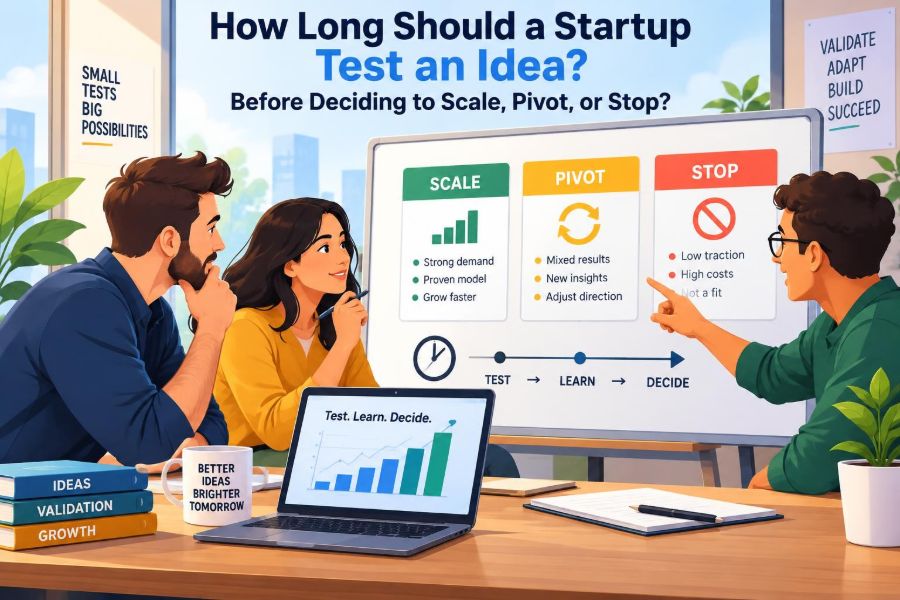
- Scale: demand is repeatable enough to invest more money, time, or hiring.
- Pivot: the problem is real, but your customer, offer, channel, or model is wrong.
- Stop: the evidence does not support continued investment, and better opportunities exist.
Write your decision in advance. For example: “After six weeks, I will continue only if I close five paid pilot customers at a price that can eventually support the business.”
⏱️ 2. Use a Time Box, Not an Open-Ended Experiment
For many early software, service, ecommerce, and digital-product ideas, a four-to-eight-week test is enough to learn something meaningful. It is not always enough to prove a large business, but it is usually enough to test urgency and willingness to pay.
Some ideas require longer. Enterprise software may need three to six months because procurement moves slowly. A local service can generate early signals in days. Regulated businesses, hardware, food, health, and property may require much longer preparation and compliance work.
| Business type | Useful first test window | Primary early signal | Reason to extend |
|---|---|---|---|
| Freelance or productized service | 2-4 weeks | Paid discovery call or deposit | Seasonal demand or limited outreach |
| Consumer digital product | 4-8 weeks | Purchase, pre-order, or active use | You need multiple traffic sources |
| B2B software | 6-12 weeks | Paid pilot or strong buying commitment | Long sales cycle with qualified buyers |
| Physical product | 8-16 weeks | Pre-orders or repeatable unit economics | Supplier, safety, or shipping validation |
| Regulated or capital-intensive business | 3-12 months | Feasible path to approval and paid demand | Permits, trials, financing, or partnerships |
The goal of a deadline is not to force a premature shutdown. It is to force an honest review instead of endlessly moving the finish line.
🎯 3. Define One Narrow Customer Before You Measure Anything
An idea cannot be validated by “everyone.” Broad audiences create vague messaging, weak feedback, and misleading averages.
Choose a starting segment with a visible problem, a way to reach them, and some ability to pay. “Independent accountants handling monthly bookkeeping for small retailers” is much more testable than “small businesses.”
Build a one-sentence test statement
Use this format: “We believe specific customer will pay specific price or commitment for specific outcome because they currently struggle with specific costly problem.”
Example: “We believe independent fitness coaches will pay a monthly fee for a client check-in system because chasing progress updates by message consumes hours each week.”
🔍 4. Validate the Problem Before You Build the Product
Problem interviews are the fastest way to avoid building from assumptions. Speak with people who match your target segment, ideally while the problem is fresh in their minds.
Do not ask, “Would you use this?” People are often kind, hypothetical, and wrong about their future behavior. Ask about what they already do.
- “Tell me about the last time this happened.”
- “What did you do to solve it?”
- “What did that cost in money, time, mistakes, or stress?”
- “What tools or alternatives have you tried?”
- “Who decides whether to spend money on this?”
Look for repeated stories, not compliments. If people describe the issue as annoying but do not spend time, money, or attention solving it, the pain may not be strong enough for a business.
💳 5. Treat Payment as a Stronger Signal Than Praise
Interest is useful. Payment is better. A paid pilot, deposit, pre-order, signed letter of intent, or committed implementation date tells you more than a hundred social-media likes.
You do not need to charge full market price on day one, but you should test whether people will exchange something valuable. If you give everything away, you may only prove that free things are attractive.
Useful commitment ladder
- They reply to an outreach message.
- They agree to an interview or demo.
- They introduce you to a decision-maker.
- They share data, time, or workflow access.
- They join a pilot with a defined start date.
- They pay a deposit or subscription.
- They renew or refer someone else.
Each step matters, but do not confuse the lower steps with product-market fit. Strong early businesses eventually reach the final steps.
🧪 6. Run the Smallest Test That Can Disprove You
Your first version should not aim to impress everyone. It should test the riskiest assumption with the least expense.
For a service, sell the result before building a process. For software, use a manual concierge workflow behind a simple landing page. For ecommerce, test a small batch or pre-order before committing to large inventory.
| Assumption | Low-cost test | Strong evidence |
|---|---|---|
| Customers have the problem | Ten focused interviews | Repeated recent, costly examples |
| They want your outcome | Simple offer page and calls | Qualified people request next steps |
| They will pay | Paid pilot or pre-order | Money collected or contract approved |
| You can deliver value | Manual prototype | Customer reaches desired outcome |
| You can acquire customers | One channel campaign | Economical, repeatable conversations or sales |
A test that could never change your mind is not a test. It is marketing activity disguised as validation.
📊 7. Choose Leading Metrics and Lagging Metrics
Revenue is the clearest outcome, but it can arrive late. Track leading metrics that show whether the path to revenue is improving.
Your dashboard should be short enough to review weekly. Avoid collecting data simply because a tool makes it available.
- Reach: qualified people contacted, visitors from a relevant source, or event attendees.
- Interest: replies, booked calls, waitlist sign-ups, or demo requests.
- Conversion: calls that become pilots, checkout conversion, or deposit rate.
- Activation: users completing the core first action.
- Retention: customers returning, renewing, or continuing to use the product.
- Economics: gross margin, delivery time, acquisition cost, and cash collected.
For an early test, a smaller number of high-quality conversations can beat a large number of low-intent website visits.
📈 8. Set Thresholds Before Seeing the Results
Founders are excellent at explaining disappointing numbers after the fact. Predefined thresholds protect you from that instinct.
Set a minimum signal, a promising signal, and a stop signal. These are not universal benchmarks; they should reflect your price, market, and channel.
Example for a productized B2B service
- Minimum: contact 80 well-matched prospects and book 10 conversations.
- Promising: three prospects accept a paid trial or deposit.
- Stop or rethink: fewer than three serious conversations after improving the message and offer once.
If your offer costs $500 per month, one paid customer is meaningful but not enough to scale. It may justify another test cycle, especially if the customer has a clear reason for buying and uses the service consistently.
🗓️ 9. Build a Four-Week Validation Sprint
A short sprint creates momentum and turns a fuzzy idea into a sequence of decisions. Adjust the pace for your industry, but preserve the order.
Week one: learn the language of the problem
Interview 8 to 15 target customers. Record exact phrases they use, current workarounds, budget clues, and moments when the problem becomes urgent.
Week two: make a clear offer
Create a simple offer: who it is for, the outcome, what is included, price, and one next step. Put it on a basic page or a concise sales message; do not spend days on branding.
Week three: ask for commitment
Reach out directly, run demos, and invite qualified prospects into a paid pilot, pre-order, or deposit-backed service. Deliver manually if needed.
Week four: review the evidence
Compare results with your thresholds. Identify whether the obstacle is demand, positioning, pricing, product value, or distribution, then decide the next experiment.
🗣️ 10. Get First Customers Through Direct, Respectful Outreach
Early-stage startups usually need conversations before they need scale. Personal outreach is not glamorous, but it produces learning faster than waiting for search traffic or a viral post.
Start with people already near the problem: former colleagues, communities, suppliers, professional groups, local business owners, or people who have publicly discussed the issue.
A practical outreach structure
Briefly name the problem, explain why you are reaching out, ask for a short conversation, and make it clear you are learning rather than forcing a sale. After you understand their situation, offer the pilot only if it genuinely fits.
Respect privacy rules and anti-spam laws in your country. Keep records of consent where required, and do not add people to marketing lists without permission.
🧱 11. Separate Product Risk From Channel Risk
A weak result does not automatically mean the idea is weak. Sometimes the offer is valuable but the way you reached people was poor.
Test one major variable at a time whenever possible. If you change the customer, price, message, features, and channel simultaneously, you will not know what caused the result.
- Product risk: customers do not care enough about the problem or outcome.
- Price risk: they value it, but the price does not match the perceived return.
- Channel risk: the right people are hard to reach through your chosen method.
- Trust risk: buyers need proof, security, credentials, or a lower-risk first step.
- Timing risk: the need is real, but not urgent right now.
One sales call can reveal several risks. A pattern across calls is what earns a strategic change.
💰 12. Test Unit Economics Earlier Than Feels Comfortable
Getting sales is not enough if every sale loses money or creates unsustainable work. Estimate the economics early, even if the numbers are rough.
For a service, include your delivery hours, contractor costs, software, payment fees, refunds, and support. For a physical product, include product cost, packaging, shipping, returns, marketplace fees, and customer acquisition. Costs, taxes, import duties, employment rules, and consumer regulations vary by country.
Use a simple calculation: gross margin = (revenue - direct costs) / revenue. Then ask whether the remaining margin can cover customer acquisition, overhead, and a fair return for your time.
A manual early version can be unprofitable if it is deliberately buying learning. Just do not mistake a temporary experiment for a scalable model.
🔄 13. Know What a Pivot Actually Means
A pivot is a focused change based on evidence, not a panicked reinvention every Friday. You keep what you have learned and alter the assumption most likely to unlock demand.
Common pivot types
- Customer pivot: the solution resonates more with a different segment.
- Problem pivot: customers care more about an adjacent pain you uncovered.
- Offer pivot: a done-for-you service works better than a self-serve tool.
- Pricing pivot: a one-time setup fee, pilot, or annual plan fits buying behavior better.
- Channel pivot: partnerships, local outreach, or referrals outperform paid advertising.
Make one pivot hypothesis and give it its own time box. “We will target agencies instead of freelancers for four weeks because agencies described a budget and a repeated workflow” is a real pivot plan.
🛑 14. Learn When Stopping Is the Smart Move
Stopping is not proof that you are incapable of building a business. It is how disciplined founders protect capital, attention, and confidence for a better opportunity.
Consider stopping when you have tested a clearly defined customer, problem, offer, and channel with genuine effort, yet buyers repeatedly show little urgency or willingness to commit. Stop sooner if the economics, legal requirements, safety concerns, or personal cost make the path unrealistic.
- You keep hearing “interesting” but never “how do I buy?”
- Prospects do not recognize the problem as important.
- Your only conversions come from friends doing you a favor.
- You need extreme discounts to create interest.
- Retention is poor even when customers initially try it.
- You no longer have a credible next hypothesis to test.
Document what you learned before moving on. That knowledge often becomes the starting advantage for your next idea.
🌱 15. Do Not Scale a Leak
Scaling means increasing spend, capacity, inventory, automation, hiring, or marketing because you have evidence that more input can create more valuable output. It is not simply working harder.
Before scaling, look for evidence of repeatability: customers understand the offer, some buy without heavy persuasion, delivery creates the promised result, and at least one acquisition path can be repeated.
Early scale checklist
- Customers can describe the value in their own words.
- You have a clear onboarding and delivery process.
- Margins survive realistic direct costs.
- Retention, repeat purchase, or referrals indicate ongoing value.
- You know which customer type converts best.
- You have cash discipline and a plan for taxes, contracts, and compliance.
Scale gradually. Double a channel budget, add a small inventory run, or hire limited contract support before making an irreversible commitment.
⚖️ 16. Use Qualitative Evidence and Numbers Together
Numbers show what happened. Customer conversations often explain why. You need both.
Suppose 200 visitors produce only two purchases. That could mean weak demand, but it could also mean the visitors were irrelevant, the offer was unclear, checkout was broken, or buyers needed more trust. Review session behavior and then talk to people who did and did not buy.
Likewise, do not let a handful of enthusiastic interviews override poor conversion and retention. Stories are signals; behavior is the stronger vote.
🚫 17. Avoid the Most Expensive Testing Mistakes
The most damaging mistakes are usually process mistakes, not a lack of intelligence or effort.
- Building before selling: weeks of features replace a day of customer conversations.
- Asking leading questions: “Wouldn’t this be helpful?” invites polite agreement.
- Using vanity metrics: followers and page views may not represent buyer intent.
- Testing with the wrong audience: friends are rarely a reliable market.
- Changing everything at once: you cannot learn what improved results.
- Ignoring retention: first purchases can hide a product that does not deliver.
- Waiting for certainty: early evidence is imperfect; decisions still need deadlines.
In particular, be cautious with paid ads. Ads can test messages and demand, but they can also consume a small budget quickly before you have a credible offer or a working conversion path.
🧠 18. Keep a Decision Log So Emotion Does Not Run the Company
Every week, write down your hypothesis, action, result, interpretation, and next decision. A simple spreadsheet or document is enough.
Hypothesis: Independent coaches will pay for automated client check-ins.
Test: 30 personal outreach messages and five demos.
Result: Eight replies, four calls, one paid pilot.
Learning: Follow-up burden is painful; reporting is less important.
Next test: Offer a paid concierge setup to coaches with 20+ clients.
This habit makes patterns visible. It also stops you from revising history to make every experiment sound more successful than it was.
🤝 19. Let Your Personal Runway Influence the Test Length
A founder with six months of savings and a founder working nights while supporting a family should not make identical bets. Your financial and emotional runway is part of the strategy.
Calculate how much money and time you can responsibly allocate to the experiment. Set a maximum test budget, including tools, samples, contractors, advertising, legal advice, and your own opportunity cost.
Do not take on debt, make tax assumptions, or ignore licenses and insurance simply to preserve an experiment. Seek qualified local advice for rules that affect your business type.
🏁 20. Make the Decision in a Structured Review
At the end of the time box, schedule a decision meeting with yourself, cofounder, advisor, or trusted operator. Review evidence, not mood.
- Did we reach the intended customer?
- Did they describe a frequent, expensive, or urgent problem?
- Did they commit time, money, data, or access?
- Did our solution produce a meaningful result?
- Can we see a plausible path to healthy economics?
- What is the single biggest remaining uncertainty?
Choose only one outcome: scale the validated element, run a defined pivot experiment, or stop. “Keep trying” is acceptable only when it means a specific new hypothesis, owner, budget, metric, and deadline.
✅ 21. Your Action Plan for This Week
Do not wait for a perfect plan. Use the next seven days to turn your idea into evidence.
- Write one test statement with a narrow customer, painful problem, offer, and commitment goal.
- Set a four-to-eight-week deadline and a maximum budget you can afford.
- List 30 people or businesses who genuinely match the customer profile.
- Schedule at least five problem interviews using open questions.
- Create a simple paid-pilot or pre-order offer, even if delivery will be manual.
- Choose three to five metrics and define your scale, pivot, and stop thresholds.
- Start a decision log before your first conversation.
The best test is not the longest one; it is the shortest honest experiment that gives you enough evidence to make the next decision wisely. Build carefully, listen closely, and let real customer behavior guide your courage. 🚀 📊 🤝