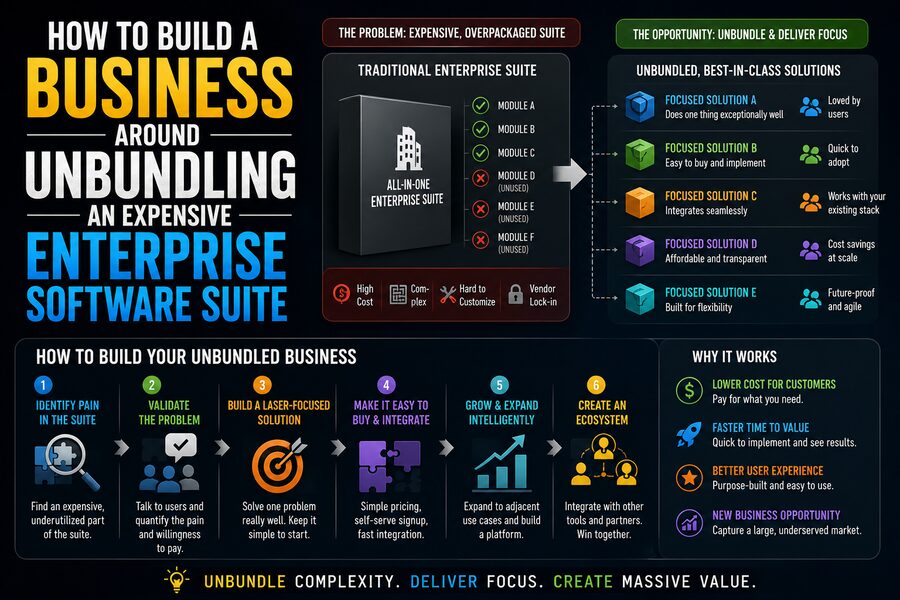

Enterprise software has a familiar pattern: a company begins with one useful product, adds more modules over time, acquires adjacent tools, and eventually becomes a massive software suite covering dozens of business functions. 🏢💻
For large organizations, buying the entire suite can make sense. One vendor provides procurement, analytics, workflow automation, reporting, permissions, integrations, compliance features, and support.
But many customers use only a fraction of what they are paying for.
A business might purchase an enterprise platform costing hundreds of thousands of dollars per year when it really needs only one narrow capability—perhaps contract approvals, expense reconciliation, customer onboarding, security reporting, inventory planning, or employee scheduling.
That gap creates an entrepreneurial opportunity:
Unbundle one valuable workflow from an expensive software suite and offer it as a simpler, faster, more focused product. ✂️🧩
This strategy has produced many successful software companies. Instead of competing feature-for-feature with a giant incumbent, a startup chooses one painful job, solves it exceptionally well, and gives customers a reason to buy only what they actually need.
The challenge is choosing the right feature to unbundle and turning it into a sustainable business rather than a lightweight tool that the incumbent can easily copy.
🔍 What Does “Unbundling” Enterprise Software Mean?
Unbundling means taking a capability that is normally packaged inside a larger software suite and turning it into a standalone product.
Imagine an enterprise platform containing:
- Financial reporting
- Procurement
- Vendor management
- Expense approvals
- Contract workflows
- Analytics
- Audit logs
- Budget planning
A startup might focus exclusively on vendor onboarding.
Instead of asking customers to purchase an entire procurement suite, it could provide:
Vendor onboarding only → easier setup → lower price → faster implementation
That is unbundling.
The startup is not initially trying to replace the entire incumbent.
It is trying to become dramatically better at one specific job. 🎯
💰 Why Expensive Enterprise Suites Create Opportunities
Large software suites are often expensive for understandable reasons.
They may include:
- Hundreds of features
- Global compliance support
- Complex permission systems
- Extensive integrations
- Enterprise-grade infrastructure
- Consulting services
- Dedicated account management
- Large support organizations
But this complexity can create weaknesses.
Customers may experience:
- Long implementation cycles
- Difficult user interfaces
- Expensive licensing
- Mandatory bundles
- Underused features
- Complex training
- Slow configuration
- Heavy administrative overhead
A focused startup can exploit those weaknesses.
If a company needs only one workflow, it may prefer a product that takes two hours to configure instead of six months. ⚡
🎯 Step 1: Identify a Painful Workflow, Not Just an Expensive Feature
A common mistake is looking at an enterprise suite and saying:
“This module costs $50,000. I’ll build a cheaper version.”
Price alone is not enough.
The better question is:
Which workflow creates enough pain that customers actively want an alternative?
Strong unbundling opportunities often involve workflows that are:
- Used frequently
- Business-critical
- Frustrating inside the incumbent suite
- Owned by a clear department
- Easy to budget for separately
- Measurable in financial impact
- Poorly served by existing alternatives
For example, a company may complain that its current software requires ten clicks and several manual exports to perform a weekly reconciliation process.
That is more interesting than a rarely used feature that merely looks overpriced.
The best startups unbundle pain, not just functionality. 🔥
🧑💼 Step 2: Find the Actual Buyer
Enterprise software can have several different stakeholders.
The person using the product may not be the person paying for it.
For example:
- Employees use the software.
- A department head approves the purchase.
- IT reviews security.
- Procurement negotiates the contract.
- Finance approves the budget.
- Legal reviews terms.
A successful unbundled product needs a clear economic buyer.
Suppose you build software for automating security questionnaires.
The daily user may be a security analyst, but the buyer could be the Chief Information Security Officer.
Understanding the buyer matters because your sales message must connect to something they care about:
- Saving money 💰
- Reducing risk 🛡️
- Increasing revenue 📈
- Accelerating work ⚡
- Reducing headcount pressure
- Improving compliance
- Avoiding costly errors
Without a clear buyer, even an excellent product may struggle to become a business.
🗣️ Step 3: Interview Customers Before Building
Enterprise founders should resist the temptation to immediately start coding.
Talk to potential customers first.
Instead of asking:
“Would you buy software that does X?”
ask about existing behavior:
- How do you currently handle this workflow?
- What software do you use?
- What parts are frustrating?
- How much time does it take?
- Who is involved?
- What happens when the process fails?
- Have you tried replacing it?
- What does the current solution cost?
- Who approves software purchases?
The most valuable evidence is not someone saying:
“That sounds useful.”
It is someone saying:
“We already spend $200,000 solving this badly.”
Existing spending demonstrates that the problem has economic value. 💵
🔎 Look for “Shadow Workflows”
One of the strongest signals for an unbundling opportunity is when customers already own expensive software but still rely on:
- Spreadsheets
- Slack or Teams messages
- Manual exports
- Consultants
- Scripts
- Shared documents
Imagine a corporation paying for a sophisticated enterprise suite but exporting data into Excel every Friday because the built-in reporting tool is too difficult.
That spreadsheet is revealing something important.
The customer’s real workflow exists outside the official system.
These shadow workflows are excellent places to look for startup opportunities. 📊
🧩 Step 4: Define the Smallest Valuable Product
Once you find a painful workflow, avoid rebuilding the entire suite.
Your first product should solve one complete job.
Suppose the incumbent platform handles the entire procurement lifecycle:
Request → Approval → Vendor Selection → Contract → Purchase Order → Invoice → Payment
Perhaps customers are especially frustrated by approval workflows.
Your startup might initially solve:
Purchase request → approval routing → audit trail
Nothing else.
The objective is not minimum functionality.
It is minimum complete value.
A customer should be able to solve a real business problem using the product immediately.
🚀 The Wedge Strategy
This narrow initial product is often called a wedge.
A wedge gives the startup an entry point into an organization.
For example:
Phase 1: Approval workflow
Then:
Phase 2: Vendor management
Then:
Phase 3: Spend analytics
Then:
Phase 4: Procurement automation
Eventually, the product may expand into a broader platform.
Interestingly, successful software markets sometimes follow a cycle:
Bundle → Unbundle → Rebundle
Large suites become too complex.
Startups unbundle individual workflows.
Successful startups later rebundle related workflows into a new generation of software platforms. 🔄
🏎️ Step 5: Compete on Speed and Simplicity
An enterprise incumbent may already have the feature you are building.
That does not necessarily mean you cannot compete.
The question is whether your version can be dramatically better.
Possible advantages include:
- Setup in hours instead of months
- Cleaner user experience
- Self-service onboarding
- Easier integrations
- Better automation
- Faster reporting
- API-first design
- More responsive support
- Transparent pricing
A startup rarely wins by being 10% cheaper.
It has a better chance if it is 10× easier to adopt or use.
Enterprise customers frequently tolerate expensive software because replacing it seems painful.
Your product must make switching—or adding a new specialized tool—feel easy. ⚡
🔌 Step 6: Integrate With the Incumbent Instead of Replacing It
One of the smartest strategies is to avoid demanding that customers replace their existing enterprise suite.
Instead, integrate with it.
Suppose a customer uses a major ERP system.
Your product could sit beside it:
Existing ERP ↔ Your Specialized Product
The ERP remains the system of record.
Your product provides a superior workflow.
This lowers adoption risk dramatically.
The customer does not need to migrate everything.
They simply add your tool for a specific function. 🔗
Over time, your product may become important enough that customers expand usage.
🏗️ Become a System of Action Before a System of Record
Enterprise software is often divided conceptually into two categories.
A system of record stores authoritative business data.
Examples include:
- Customer records
- Financial transactions
- Employee information
- Inventory
A system of action helps users perform workflows around that data.
Examples include:
- Approving requests
- Reviewing exceptions
- Coordinating tasks
- Generating recommendations
Replacing a system of record can be extremely difficult.
Starting as a system of action is often easier.
Your startup can integrate with the incumbent while making a painful workflow much better.
Later, as customers trust the product, it may gradually store more authoritative data.
💵 Step 7: Price Based on Value, Not Just Your Costs
Unbundling does not mean becoming the cheapest vendor.
Suppose an enterprise suite costs:
$300,000 per year
and your standalone product replaces only one workflow.
You might think:
“We’ll charge $5,000.”
But if your product saves the customer $200,000 in labor or prevents major compliance risks, $5,000 may be far too low.
Enterprise software should usually be priced according to value.
Common pricing models include:
- Per user
- Per transaction
- Per location
- Per workflow
- Per employee
- Usage-based pricing
- Flat annual contracts
The best pricing metric often grows alongside the customer’s realized value. 📈
📊 Quantify ROI
Enterprise buyers often need to justify purchases internally.
Make the financial case obvious.
Suppose your software saves:
20 employees × 5 hours/month × $60/hour
That equals:
$6,000/month
or:
$72,000/year
If your software costs $18,000 per year, the customer receives a straightforward productivity argument.
The more clearly you can demonstrate ROI, the easier sales conversations become.
Good enterprise products often sell a measurable outcome rather than merely a collection of features. 💰
🛡️ Step 8: Treat Security as a Product Feature
Enterprise customers care deeply about security.
Even a small startup may be asked about:
- Encryption
- Authentication
- Access controls
- Audit logs
- Data retention
- Backups
- Incident response
- Single sign-on
- Regulatory compliance
A startup that ignores these requirements may build a great product that large customers are unable to purchase.
Security should therefore be considered part of the product from early stages.
Features such as role-based access control, SSO, and audit histories may sound boring compared with AI or automation, but they can directly influence enterprise deals. 🔐
🏢 Step 9: Understand Enterprise Procurement
Selling to businesses involves more than convincing one enthusiastic user.
A deal may require approval from:
- IT
- Security
- Procurement
- Finance
- Legal
- Department leadership
The larger the customer, the more complex this process becomes.
Your startup needs to make purchasing easy.
That can mean preparing:
- Clear security documentation
- Standard contracts
- Data-processing terms
- Pricing sheets
- Implementation plans
- Support policies
Reducing buying friction can be as important as reducing product friction.
🎣 Land and Expand
One of the strongest enterprise growth strategies is land and expand.
Start with one team.
For example:
Marketing department → $15,000/year
Then expand:
Marketing + Sales → $40,000/year
Then:
Company-wide → $150,000/year
A narrow unbundled product naturally supports this model.
You can prove value in one department before asking the organization for a much larger commitment.
This reduces risk for both the startup and the customer.
📈 Watch for Expansion Signals
Customers often reveal what you should build next.
Suppose users repeatedly ask:
- “Can this also handle approvals?”
- “Can we invite our suppliers?”
- “Can you generate compliance reports?”
- “Can we manage renewals?”
- “Can finance use this too?”
Repeated adjacent requests can reveal the logical expansion path.
The safest expansion usually occurs into workflows that share:
- The same users
- The same buyer
- The same data
- The same integrations
This keeps customer acquisition efficient.
🧱 Build Defensibility Beyond One Feature
A major risk with unbundling is that the original feature may be easy to copy.
If the incumbent can rebuild your entire advantage in one quarter, your startup may struggle.
You therefore need to create defensibility over time.
Possible moats include:
🔗 Integration Depth
Connect deeply with customers’ existing systems.
More integrations increase switching costs and product utility.
📊 Proprietary Data
As customers use the product, you may accumulate valuable structured data that improves automation or analytics.
🔄 Workflow Embedding
If teams perform critical daily processes inside your software, replacing it becomes more disruptive.
🌐 Network Effects
Some products become more useful when customers invite suppliers, partners, clients, or employees.
🤖 Automation Intelligence
A system that learns workflows and automatically handles repetitive decisions can become more valuable with usage.
🏷️ Brand and Trust
For enterprise buyers, reputation can become a significant competitive advantage.
🧠 AI Can Create New Unbundling Opportunities
Artificial intelligence can make previously complex enterprise workflows much easier to automate.
Consider a suite where employees manually review:
- Contracts
- Support tickets
- Security documents
- Invoices
- Sales calls
- Compliance evidence
A focused startup might use AI to automate much of one workflow.
For example:
Upload contract → extract clauses → identify risks → suggest changes
Instead of rebuilding the entire legal management suite, the company initially solves one high-value task.
However, AI itself is rarely a durable moat.
The defensibility usually comes from:
- Workflow integration
- Proprietary context
- Customer data structures
- Feedback loops
- Distribution
🤖💼
⚠️ Avoid Building a “Feature Company”
A focused product can become too narrow.
Suppose your entire business solves one tiny task that customers consider worth only $10 per month.
Even excellent execution may not produce a large company.
A strong wedge should therefore lead toward a larger market.
Ask:
If we dominate this workflow, what can we logically sell next?
The initial feature should open a door.
It should not be the entire building.
🗺️ Map the Incumbent’s Suite
A practical exercise is to map the enterprise suite you want to unbundle.
List every major module.
Then score each one based on:
- Customer dissatisfaction
- Frequency of use
- Implementation difficulty
- Budget ownership
- Existing alternatives
- Integration requirements
- Potential willingness to pay
- Expansion opportunities
You may discover that the most obvious module is not the best opportunity.
Often the best startup idea hides in an unglamorous but painful workflow.
🔥 Look for Strong Buying Triggers
Enterprise software purchases often happen because something changes.
Triggers might include:
- A regulatory requirement
- Rapid company growth
- A failed audit
- A new executive
- A merger
- A major hiring wave
- Cost-cutting pressure
- A security incident
- Migration away from legacy software
If your product aligns with a predictable trigger, selling becomes easier.
Instead of persuading customers that a problem exists, you meet them when they are already searching for a solution.
📣 Distribution Matters as Much as Product
A brilliant enterprise tool with no distribution may never reach enough buyers.
Possible acquisition channels include:
- Founder-led outbound sales
- Industry communities
- Content marketing
- Search
- Partnerships
- Consultants
- Integration marketplaces
- Customer referrals
For specialized enterprise products, focused industry knowledge can be extremely powerful.
A startup serving dental groups, logistics operators, or manufacturing plants may grow faster by deeply understanding that vertical than by targeting every business.
🏭 Horizontal vs. Vertical Unbundling
You can unbundle software in two broad ways.
↔️ Horizontal Product
Solve the same workflow across many industries.
Example:
Expense approval automation for any company
The potential market is large, but competition may be intense.
🏢 Vertical Product
Solve a workflow specifically for one industry.
Example:
Expense and purchasing approvals for construction contractors
The market is narrower, but industry-specific workflows can create stronger differentiation.
Vertical software may also expand into adjacent industry functions over time.
🧮 Unit Economics Still Matter
Enterprise contracts can be large, but sales can also be expensive.
Track metrics such as:
- Customer acquisition cost
- Annual contract value
- Gross margin
- Sales cycle
- Churn
- Expansion revenue
- Payback period
Suppose acquiring a customer costs $25,000 while the annual contract is only $5,000.
That business may be difficult unless retention and expansion are exceptional.
A successful enterprise startup needs not only product-market fit but sustainable economics.
🚪 Make Switching Easy
One major barrier to unbundling is that customers already have data trapped inside the incumbent.
Make migration painless.
Useful features can include:
- CSV imports
- Automated data migration
- API connectors
- Prebuilt integrations
- Historical data import
- Guided setup
A startup that says:
“We can have your team running this week.”
has a major advantage over a platform requiring months of consulting.
⚖️ Know When to Cooperate and When to Compete
Initially, your product may complement the incumbent.
Later, it might expand into overlapping territory.
This relationship can evolve:
Stage 1: Integration partner
Stage 2: Preferred workflow layer
Stage 3: Replacement for several modules
Stage 4: New platform
This is a common path.
Starting with direct replacement of a giant suite may be unnecessarily difficult.
Entering through one painful workflow can be far more practical. 🚪
🧭 A Simple Example
Imagine a large human-resources suite costing $500,000 per year.
Customers use it for:
- Payroll
- Recruiting
- Performance reviews
- Scheduling
- Employee records
- Benefits
You discover that managers hate the scheduling module.
They still use spreadsheets every week.
Your startup builds:
Simple workforce scheduling software
It offers:
- Drag-and-drop schedules
- Employee notifications
- Shift swaps
- Mobile access
- Payroll export
You integrate with the existing HR suite rather than replacing it.
Customers adopt your product because setup takes days rather than months.
Later, they request:
- Time tracking
- Overtime management
- Labor forecasting
- Payroll validation
Your narrow scheduling tool gradually becomes a broader workforce management platform.
That is the unbundling strategy in action. 🌱➡️🏢
✅ Conclusion
Building a business around unbundling an expensive enterprise software suite starts with recognizing that customers often pay for broad platforms while remaining deeply dissatisfied with individual workflows.
The opportunity is not simply to create a cheaper copy.
The strongest strategy is to identify one frequent, painful, economically meaningful workflow and solve it dramatically better than the bundled alternative. 🎯
Start by interviewing users, finding shadow workflows in spreadsheets and email, and understanding who actually controls the budget. Build the smallest product that solves a complete business problem, then integrate with the incumbent rather than demanding immediate replacement.
From there, focus on faster implementation, measurable ROI, enterprise-grade security, easy procurement, and a land-and-expand sales strategy.
Over time, build defensibility through deep integrations, proprietary workflow data, automation, customer trust, and expansion into adjacent problems.
The long-term opportunity can become surprisingly large.
Today’s giant enterprise suites were often built by repeatedly bundling new capabilities together. Their complexity creates space for focused startups to separate those capabilities again.
The winning pattern is often:
Find the painful module → unbundle it → make it dramatically better → become embedded in the workflow → expand into adjacent problems → build the next platform. ✂️➡️🚀
That is how a small, focused product can enter a market dominated by billion-dollar enterprise vendors and eventually become a major software company of its own. 💼📈