
A customer sends back a pair of headphones because the fit was wrong. Another returns an online order after finding a duplicate gift. A retailer clears a shelf for a newer model, while a manufacturer receives a batch with minor cosmetic defects.
To most people, these products look like a cost of doing business: boxes moving backward, customer-service tickets, refunds, and warehouse clutter. But the item often still has economic value. The challenge is recovering that value before time, damage, and handling costs erase it.
This is the purpose of reverse logistics: designing the people, facilities, data, decisions, and transport flows that move goods from customers or sales channels back into useful circulation. Done poorly, it becomes an expensive afterthought. Done well, it can support margins, customer trust, sustainability goals, and entirely new business models.
For founders and operators, returns are not simply a warehouse problem. They are a network-design problem—and every handoff in that network affects the final outcome. 📦
🔄 1. What Reverse Logistics Actually Means
Forward logistics moves products from suppliers through distribution networks to customers. Reverse logistics manages goods traveling in the other direction after a sale, use period, delivery issue, or inventory decision.
The goal is not merely to bring an item back. It is to determine the best next use for that item: resale, repair, refurbishment, parts recovery, recycling, donation, supplier return, or responsible disposal.
Returns are the most visible part of reverse logistics, but the field is broader. It also includes recalled products, reusable packaging, trade-in programs, leased equipment, unsold inventory, and products reaching end of life.
🧭 2. Why “Backward” Flow Is More Complex
In a forward network, many identical products move toward predictable destinations. In a reverse network, incoming items vary in condition, reason for return, completeness, location, and potential value.
A warehouse may receive one unopened item, one item missing accessories, one with a minor defect, and one that cannot be resold safely. Each requires a different decision, even if all share the same stock-keeping unit.
This uncertainty makes reverse logistics a sorting and decision system, not just a transportation system. The network must reduce uncertainty quickly enough to preserve value.
📉 3. The Hidden Cost of Treating Returns as Waste
When a company treats all returned goods alike, it often sends usable inventory to liquidation, stores it too long, or pays for repeated handling without a recovery plan. Each choice can lower the eventual return.
Delay matters because products can lose value through seasonality, rapid model changes, packaging damage, or customer expectations. A fashion item after its season or an electronic device after a new release may be harder to resell.
Waste also hides operational learning. If return reasons are not captured and analyzed, product teams cannot see recurring fit, quality, listing, packaging, or fulfillment problems.
🎯 4. Start With a Clear Value-Recovery Hierarchy
Strong operations rank possible outcomes from highest to lowest value. This prevents teams from choosing the easiest path rather than the economically and operationally appropriate one.
- Restock: return an unopened or verified item to sellable inventory.
- Resell: sell an open-box or graded item through a suitable channel.
- Repair or refurbish: restore functionality and appearance where worthwhile.
- Harvest parts: recover components for service, repair, or remanufacturing.
- Recycle or dispose: handle materials responsibly when higher-value options are unavailable.
The right hierarchy depends on the product, regulations, brand promises, and economics. A medical device, a beauty product, and a desk chair cannot be evaluated by the same rules.
🧮 5. Calculate Recovery Value, Not Just Refund Cost
A return decision should consider the item’s expected recovery value after all relevant costs. Those costs can include return shipping, receiving, inspection, cleaning, repair, storage, repackaging, marketplace fees, and outbound shipping to the next buyer.
A simple operating idea is:
Expected recovery value = expected resale or material value − processing and channel costs
This is not a universal accounting formula. It is a practical way to compare options consistently. If a low-value product costs more to inspect and relist than it can recover, automation, consolidation, supplier agreements, or a different disposition path may be better.
🏷️ 6. Classify Returns at the Earliest Possible Point
The earlier the network learns why an item is coming back, the better it can plan. A return portal can collect structured information before the package moves, such as product condition, reason, photos, missing parts, and preferred return method.
Early classification helps route goods intelligently. An unopened item may go to a local fulfillment center, while a potentially defective device may need to go to a specialist inspection hub.
Customer-provided information is useful but not final. It should guide routing and staffing, while the physical inspection confirms the actual condition.
📍 7. Design the Return Entry Points
A reverse network begins where customers, stores, technicians, or business clients hand over a product. Entry points may include mail returns, retail counters, lockers, collection partners, field-service teams, or scheduled pickups.
Convenience improves the customer experience, but every entry point creates process variation. Operators need clear packaging rules, labels, scan events, and chain-of-custody procedures.
For startups, the key question is not “What is the most convenient option?” alone. It is “Which option balances customer ease with reliable, affordable recovery?”
🚚 8. Consolidation Makes Transport More Efficient
Individual returns can be expensive and environmentally inefficient when they travel one by one over long distances. Consolidation gathers items at local points before moving them in larger loads to processing facilities.
This approach can reduce touchpoints and make specialist processing more viable. However, consolidation adds waiting time, so it is not ideal for every product.
High-value, time-sensitive, or fast-depreciating goods may need quicker movement. Durable lower-value goods may tolerate a slower, consolidated flow.
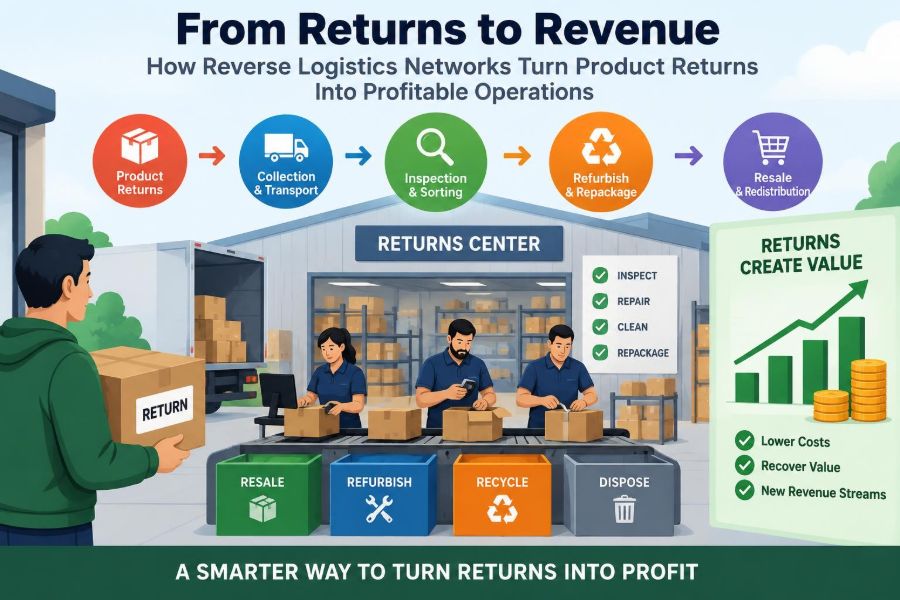
🔍 9. Inspection Is the Decision Gate
Inspection determines what a returned item really is—not what its original listing said it was. The process may verify identity, serial number, completeness, physical condition, functionality, safety status, and evidence of use.
A useful inspection design separates quick checks from deeper testing. A first-pass triage can rapidly identify obvious restock candidates, damaged goods, and items that need specialist review.
Consistency is crucial. Two inspectors should reach similar conclusions when they see the same item under the same policy.
🧪 10. Build Product-Specific Test Protocols
Generic inspection checklists are rarely enough. A return network needs protocols tied to product risks and customer expectations.
Examples of different checks
- Electronics may require power, battery, port, display, and account-lock checks.
- Apparel may require hygiene, odor, stain, tag, and wear checks.
- Furniture may require structural, hardware, surface, and assembly checks.
- Industrial equipment may require calibrated functional testing and service-history review.
Protocols should be simple enough to use at scale but detailed enough to protect buyers and the brand. Safety-related products deserve especially careful controls.
🗂️ 11. Grade Inventory Honestly
Grading converts inspection results into a saleable description. Common categories include new, open-box, like-new, refurbished, used, cosmetically imperfect, and parts-only, although names vary by business.
The important principle is truthful condition communication. A customer who knowingly buys a cosmetically imperfect product at an appropriate price may be satisfied; a customer surprised by that condition may create another return.
Grading also lets a company match products to channels. A pristine open-box item may suit the main store, while a repaired item may belong in a certified refurbished program.
🛠️ 12. Repair Only When It Creates Net Value
Repair sounds inherently sustainable, but it is not automatically the best operational choice. It requires diagnosis, labor, parts, quality assurance, warranty support, and a route to market.
Repair is strongest when the product has enough residual value, the fault is identifiable, parts are available, and the work can be standardized. Repeatable repairs can become an efficient capability rather than an improvised exception.
Startups should avoid assuming that every item deserves repair. The economically correct choice can be restocking, parts harvesting, recycling, or redesigning the product to make future repair easier.
♻️ 13. Refurbishment Is More Than Repair
Refurbishment generally involves preparing a used or returned product for resale at a defined condition standard. It may include repair, cleaning, replacement parts, software resets, cosmetic work, testing, and new packaging.
The difference matters because refurbishment needs a repeatable promise. Buyers should understand what has been checked, what condition they can expect, and what support applies after purchase.
A credible refurbishment program can open a lower-priced product tier without forcing a brand to pretend every returned item is new.
🧩 14. Parts Harvesting Extends Product Life
Some returned goods cannot be economically restored as whole products, yet contain valuable components. Motors, screens, housings, connectors, fasteners, and other usable parts may support repair operations.
Parts harvesting requires careful traceability. Teams need to know which parts are suitable for reuse, where they came from, how they were tested, and which products they fit.
This is especially useful for durable products with modular construction. It becomes much harder when products are glued, proprietary, poorly documented, or difficult to disassemble.
🧱 15. Product Design Determines Reverse-Flow Success
Many return costs are designed into products long before a customer places an order. Packaging that cannot be resealed, parts that cannot be replaced, and products with inaccessible serial numbers all make recovery harder.
Design teams can improve reverse logistics by considering modularity, durable packaging, easy disassembly, diagnostic features, standardized fasteners, replaceable wear parts, and clear identification.
This is often called design for circularity or design for recovery. It connects engineering decisions to after-sales economics. 🔧
🏭 16. Choose the Right Processing Network
Not every company needs its own returns center. Some can process goods in existing fulfillment facilities, use specialist repair partners, or work with third-party logistics providers.
The best model depends on volume, product complexity, geographic spread, sensitivity of customer data, and the need for quality control. Centralization creates specialist expertise; decentralization can reduce transport time and place recovered inventory closer to demand.
| Network approach | Useful when | Main trade-off |
|---|---|---|
| Centralized hub | Testing and repair need specialized staff or equipment | Longer inbound travel for some returns |
| Regional hubs | Volume is spread across large territories | More sites to manage and standardize |
| In-store processing | Items are simple to verify and stores have capacity | Training and consistency can be difficult |
| Specialist partner | Capabilities are technical or demand is variable | Less direct control over execution |
💻 17. Data Connects Every Handoff
A returned item should have a usable digital trail. At minimum, the operation needs to connect the return authorization, order, product identity, condition findings, disposition decision, and final recovery outcome.
Scans, serial-number records, photos, and status updates reduce ambiguity. They also help customer service answer a basic but important question: “Where is my return now?”
For higher-risk products, data handling includes privacy and security. Devices may contain personal information, so reset and data-erasure processes should be designed carefully and verified where appropriate.
📊 18. Measure the Metrics That Lead to Better Decisions
One number cannot describe a reverse operation. A low return rate may hide poor recovery, while strong recovery revenue may hide a frustrating customer experience.
A balanced operating dashboard can include
- Return reasons and their trends by product or sales channel.
- Time from return initiation to final disposition.
- Share of items restocked, resold, repaired, recycled, or disposed.
- Recovery value by product category and condition grade.
- Inspection accuracy, rework, and downstream customer complaints.
- Cost per return and cost by recovery path.
The goal is not measurement for its own sake. It is identifying where value leaks out and where a product or process change would matter most.
🧾 19. Return Reasons Are Product Research
Return codes often begin as administrative labels: wrong size, changed mind, arrived damaged, not as described, defective. But organized correctly, they become a feedback system for the whole business.
A pattern of “not as described” may signal weak photos or misleading product copy. Frequent damage may point to packaging or carrier handling. Repeated compatibility issues may indicate unclear setup information.
Operations teams should share this evidence with merchandising, design, quality, marketing, and customer-support teams. A return prevented is usually more valuable than a return processed perfectly.
🛍️ 20. Match Recovery Channels to Each Grade
Recovered inventory should not automatically return to the original sales channel. Different conditions call for different customer expectations, pricing structures, and merchandising approaches.
- Main retail channels may suit sealed or fully verified sellable items.
- Open-box channels can serve customers comfortable with minor packaging or handling differences.
- Refurbished programs can sell tested and restored products with clear condition definitions.
- Business-to-business buyers may value bulk lots, spare parts, or non-retail inventory.
- Material recyclers may be appropriate when product-level recovery is no longer feasible.
Channel separation protects the primary brand experience while still allowing the company to capture value from goods that do not meet “new” standards.
💬 21. Customer Experience Still Comes First
A company can build an efficient warehouse process and still lose customers through a confusing return journey. Policies, labels, instructions, refund timing, and status messages shape trust.
The customer should know what is eligible, what condition is required, where to hand off the item, and what happens next. Clear communication reduces support contacts and helps prevent incorrect returns.
A thoughtful policy does not have to be unlimited or overly generous. It has to be understandable, consistently applied, and aligned with the product and promise.
🛡️ 22. Control Fraud Without Punishing Honest Buyers
Returns can be exploited through empty-box claims, item swapping, use-and-return behavior, serial-number mismatches, or counterfeit substitutions. These risks require controls, especially for high-value and easily resold products.
Useful controls can include identity checks where appropriate, serial-number verification, weight scans, photo evidence, tamper-evident packaging, and review triggers for unusual patterns. The right level of control depends on risk.
Overly aggressive friction can damage legitimate customers. Good design targets suspicious signals while keeping routine returns straightforward for honest buyers.
🌍 23. Sustainability Requires Specific Choices
Reverse logistics can reduce waste and extend product use, but it should not be described as sustainable automatically. Extra transport, unnecessary processing, and poor recycling practices can weaken environmental benefits.
Better questions include: Can this product be used again safely? Can transport be consolidated? Can packaging be reused? Are materials separated effectively? Is disposal handled through responsible channels?
The strongest sustainability claims are tied to real operational actions, such as repairability, reuse, material recovery, and waste prevention—not vague labels. 🌱
🤝 24. Partner Contracts Shape the Network
Reverse networks often depend on carriers, retailers, repair firms, recyclers, marketplaces, and logistics providers. A weak contract can create unclear ownership, slow reporting, inconsistent grading, or disputes over who pays for defects.
Partners need shared definitions for condition, acceptance criteria, data access, service levels, liability, and final disposition. These details turn a collection of vendors into an operating network.
For a young company, start with a manageable partner model and document the process early. Informal arrangements become expensive when return volume rises.
🚀 25. Where Startups Can Build New Businesses
Reverse logistics creates opportunities beyond running a returns department. Founders can solve specific pain points for brands, retailers, or consumers.
Potential startup directions
- Software that routes returns based on value, condition, and location.
- Tools for inspection workflows, evidence capture, and inventory grading.
- Specialized repair and refurbishment services for a product category.
- Marketplaces for open-box, refurbished, surplus, or parts-only inventory.
- Reusable packaging systems with tracking and collection processes.
- Analytics that translate return reasons into product-improvement insights.
The best opportunity is often narrow at first. Solving one difficult product category or one costly workflow well can be more defensible than offering generic “returns management.”
🧪 26. Pilot the Network Before Scaling It
Reverse logistics should be tested as a set of assumptions. Pilot with a limited product range, region, return reason, or recovery channel, then study where time and value are lost.
Map every physical and digital step: customer request, label creation, carrier handoff, receiving, inspection, disposition, resale, and customer refund. Ask who owns each step and what information is missing at that moment.
Small experiments can reveal whether a proposed repair path is viable, whether customers understand grading, or whether local restocking beats central processing. Scale the repeatable parts, not the exceptions.
✨ 27. The Core Principle: Preserve Value Through Fast, Informed Decisions
The central idea of reverse logistics is simple: a returned product is not one thing. It is an uncertain asset whose value depends on condition, timing, handling, data, and the next destination chosen for it.
Profitable operations reduce that uncertainty early, use consistent inspection and grading, and route each item toward its highest realistic value. They also feed lessons from returns back into product design, merchandising, fulfillment, and customer communication.
The best reverse logistics networks do not merely move products backward; they move materials, information, and value forward into the next useful cycle. 📦🔄🌱