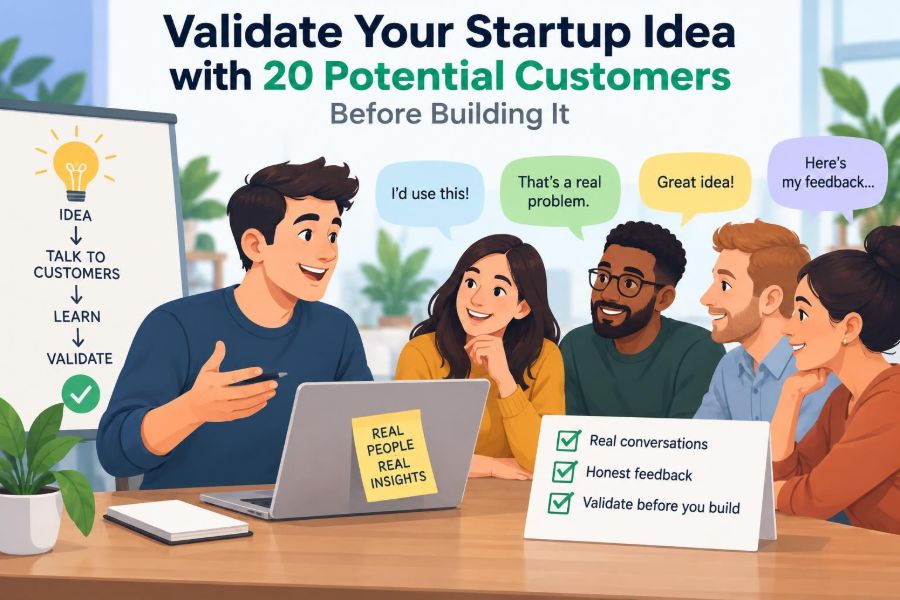

Most startup ideas do not fail because the founder cannot build them. They fail because the founder spends months building something that solves a weak, occasional, or already well-served problem.
Talking to 20 potential customers is not a magic number, and it is not market research theatre. It is a practical forcing function: enough conversations to reveal repeated patterns, challenge your assumptions, and give you a credible reason to either move forward, change direction, or stop.
This approach suits aspiring founders, consultants turning a service into software, side hustlers, and small-business owners considering a new offer. It is especially useful if you have limited money, limited technical capacity, or a tendency to polish before selling.
There has never been a cheaper time to make a prototype, landing page, or automation. That makes customer validation more important, not less. When building gets easy, choosing the right problem becomes your real advantage.
🧭 1. Define what “validated” actually means
Validation is not hearing, “That sounds cool.” It is collecting evidence that a specific group has a painful problem, actively tries to solve it, and may commit time, access, or money to a better solution.
Before you speak to anyone, set a standard for what you need to learn. This prevents you from treating polite encouragement as demand.
- Problem validation: people experience the problem often enough to care.
- Customer validation: you can identify who feels it most intensely.
- Solution validation: your proposed approach feels meaningfully better than current alternatives.
- Commercial validation: some people will take a concrete next step toward buying.
Your goal after 20 conversations is not certainty. Your goal is an informed decision backed by repeated evidence.
🎯 2. Start with one narrow customer hypothesis
“Small businesses” and “busy people” are not customer segments. A narrow starting point lets you compare like with like, spot patterns, and write an offer that sounds specific.
Use this sentence: I believe [specific customer] struggles with [specific situation] because [current method] is too [costly, slow, risky, or frustrating].
Example hypothesis
“I believe independent bookkeeping firms with two to ten employees struggle to collect missing client documents each month because follow-up happens manually across email and spreadsheets.”
This is much stronger than “I want to build an AI tool for accountants.” It names a buyer, a recurring moment, and an existing workaround.
- Choose a group you can realistically reach.
- Focus on one job, workflow, or expensive frustration.
- Avoid combining several customer types in the first 20 interviews.
- Write down what would prove your belief wrong.
🔍 3. Look for an existing painful workaround
A good early signal is not that customers have no solution. It is that they have a solution they dislike.
Spreadsheets, sticky notes, shared inboxes, copied templates, freelance help, and awkward integrations can all be evidence of a worthwhile problem. The workaround reveals both pain and behavior.
Ask yourself whether the problem costs the customer one or more of the following:
- Money: lost sales, wasted staff time, avoidable fees, or excess inventory.
- Time: repetitive coordination, data entry, searching, or reporting.
- Risk: missed deadlines, compliance mistakes, security concerns, or unhappy clients.
- Stress: uncertainty, poor visibility, awkward customer conversations, or constant interruptions.
If nobody has tried to solve the issue, it may be minor, rare, or not connected to a budget. That does not automatically kill the idea, but it should make you more skeptical.
📋 4. Create an interview scorecard before outreach
Do not rely on memory after a dozen calls. Build a simple scorecard in a spreadsheet or note database, with one row for each conversation.
Use the same core fields every time. This makes patterns visible and reduces the temptation to overvalue the most enthusiastic person.
| Signal | What to record | Why it matters |
|---|---|---|
| Problem frequency | Daily, weekly, monthly, rarely | Frequent problems create repeat demand |
| Current workaround | Tools, process, people involved | Shows behavior and competitors |
| Cost of problem | Time, money, risk, frustration | Supports pricing later |
| Buying authority | User, influencer, manager, owner | Identifies the real customer |
| Commitment | Introduction, pilot, deposit, pre-order | Stronger than positive feedback |
Add a short field called exact words used. Customer language will later improve your landing page, outreach, sales calls, and product positioning.
👥 5. Build a realistic list of 40 prospects
You need 20 completed conversations, not 20 names. Some people will ignore you, reschedule, or turn out not to match your segment. Start with at least 40 well-matched prospects.
Find them through your existing network, professional communities, local business groups, industry events, social platforms, directories, and people who know your target customers. Ask every helpful interviewee for one or two relevant introductions.
Prioritize access over prestige
Your first interviewees do not need to be famous founders or executives. A real operator who handles the workflow every week is often more useful than a senior person with little direct exposure.
- List people you already know in or near the market.
- Identify businesses that visibly fit your niche.
- Ask connectors for introductions, not broad endorsements.
- Track name, role, company type, contact method, and status.
Respect privacy rules and local anti-spam laws when contacting strangers. Regulations and enforcement vary by country, and a thoughtful, relevant personal message is better than bulk outreach.
✉️ 6. Send an invitation that does not feel like a pitch
Your first message should make the request easy to understand and easy to decline. Do not pretend you are not selling if you eventually hope to sell; just make clear that this conversation is for learning, not a product demo.
Hi [Name], I am researching how [specific customer type] handles [specific workflow]. I am not selling anything on this call. Would you be open to a 20-minute conversation about what currently works, what does not, and how you handle it? I can share a short summary of what I learn from the research.
Personalize the first line with a genuine reason they fit the research. Keep the request short, offer a few scheduling options, and send one polite follow-up if appropriate.
Do not offer large incentives that attract people with no real connection to the problem. A small thank-you can be reasonable, but relevance matters more than volume.
🗓️ 7. Run the interviews in a focused two-week sprint
Validation loses value when it drifts for months. Book conversations in a concentrated period so the market conditions, your memory, and your energy stay consistent.
A useful rhythm is to aim for two interviews on most weekdays. Immediately after each call, spend ten minutes completing your scorecard while details are fresh.
- Days 1-2: prepare your hypothesis, scorecard, and prospect list.
- Days 3-5: send outreach and book the first calls.
- Week 2: conduct interviews, follow up, and request introductions.
- End of sprint: review themes and test willingness to commit.
Use a phone call, video call, or in-person conversation. Text-only answers are useful for screening, but you will miss follow-up questions, emotion, and context.
🗣️ 8. Ask about the past, not hypothetical futures
The fastest way to get misleading feedback is to ask, “Would you use this?” People are naturally supportive, and they cannot reliably predict their future behavior.
Instead, ask for a recent, concrete example. Past behavior reveals urgency, alternatives, decision-making, and constraints.
Core interview questions
- “Walk me through the last time this happened.”
- “What triggered the problem?”
- “What did you do next?”
- “Which tools, people, or documents were involved?”
- “What was frustrating or expensive about that process?”
- “How often does this happen?”
- “What have you tried already?”
- “Who else is affected by this?”
- “Who decides whether to buy a solution?”
- “What would make fixing this a priority?”
Pause after each answer. Silence often produces the useful detail that a rushed founder would otherwise miss.
🤫 9. Do not pitch too early
For most of the interview, your job is to listen. If you introduce your concept too soon, people may begin responding to your enthusiasm instead of describing their reality.
Spend roughly 80% of the call learning about the existing workflow. In the final few minutes, you can test a concise concept if the problem appears real.
I am exploring a service that could [specific outcome] by [high-level mechanism]. Based on what you described, where would this fit or fail in your current process?
Then ask what would need to be true for them to try it. Keep the explanation high level; you are testing the value proposition, not conducting a feature-planning session.
💡 10. Listen for the language of urgency
Not every complaint is a startup opportunity. People complain about weather, inboxes, and meetings, but not every annoyance deserves a product.
Strong signals tend to include specifics: “We spend three hours every Friday on this,” “We lost a client because of that,” or “I have been trying to find a tool that does this.” Weak signals tend to be vague praise: “Interesting,” “I could see that being useful,” or “Maybe someday.”
- Strong: a recent example, a measurable consequence, an active search, or a request to see a solution.
- Medium: repeated frustration but no budget or priority yet.
- Weak: abstract approval without a personal story or next step.
Record negative feedback carefully. A clear “no” with a reason is more valuable than a friendly but ambiguous “maybe.”
💳 11. Test willingness to pay with a real commitment
Interest matters, but commitment matters more. You do not need to charge everyone immediately, but you should ask for a meaningful next step before declaring the idea validated.
The appropriate commitment depends on the product, audience, and sales cycle. For a business tool, it could be a pilot agreement, access to sample data, an introduction to the buyer, or a paid setup project.
| Validation step | Customer effort | Strength of signal |
|---|---|---|
| Likes the concept | Very low | Weak |
| Joins a waitlist | Low | Limited |
| Books a follow-up | Low to medium | Moderate |
| Shares workflow data or access | Medium | Strong |
| Signs a pilot or pays a deposit | High | Very strong |
Be transparent about what exists today. Never imply you have a finished product when you do not. Deposits, contracts, consumer rules, taxes, and refund obligations differ by country, so get appropriate local advice before taking money.
🧪 12. Offer a manual pilot before building software
A manual or concierge pilot lets you test the result customers want without committing to a full product. Behind the scenes, you may use spreadsheets, templates, no-code tools, or your own labor.
For example, instead of building automated document-chasing software, you could run the follow-up process for three bookkeeping firms manually. You would learn what messages work, which edge cases appear, and whether the time saved is valuable enough to pay for.
Keep the pilot bounded
- Define the customer, outcome, duration, and scope.
- Choose one workflow instead of solving every related problem.
- Set expectations about what is manual and what is experimental.
- Ask for feedback at the end of each week.
- Measure your delivery time as well as customer results.
The manual process is not a failure of ambition. It is a low-cost way to discover what should eventually be automated.
🧰 13. Use lightweight tools, not a polished product
During validation, use the simplest tools that allow you to schedule, learn, deliver a pilot, and collect commitments. You are buying insight, not building infrastructure.
Estimated startup costs: a validation sprint can cost roughly $0 to $300 if you use existing devices and free or low-cost software. A basic domain, scheduling tool, form, video meeting account, simple landing page, and small thank-you incentives may add costs. Prices, taxes, and available tools vary by country.
| Need | Lean option | What to avoid initially |
|---|---|---|
| Interview notes | Spreadsheet or document | Complex research platform |
| Landing page | One-page no-code site | Custom multi-page website |
| Pilot delivery | Manual service and simple automations | Full custom application |
| Payments | Invoice or approved payment provider | Building billing infrastructure |
Useful skills include customer interviewing, basic outreach, note-taking, sales conversations, and process design. You do not need to code to learn whether a problem is worth solving.
📊 14. Turn 20 conversations into a pattern map
After every five interviews, review what you have heard. Do not wait until the end, because early patterns can improve your later questions and expose flaws in your segment.
Group answers by problem, trigger, workaround, consequence, buyer, and commitment level. Look for repetition across people who resemble your intended early customer.
Questions for the review
- Did the same problem appear without you leading people toward it?
- Is there a predictable event that triggers the pain?
- Are customers using similar imperfect workarounds?
- Do the most affected people have budget or access to a buyer?
- Did several people take a meaningful next step?
Do not count all comments equally. One person with a severe, recurring, expensive problem may be a better initial customer than ten people with mild curiosity.
📏 15. Track leading metrics, not vanity metrics
A large social post reach or a long waitlist can feel encouraging, but neither proves customers will pay. Focus on actions that require relevance, trust, and effort.
- Outreach response rate: whether your segment and message are credible enough to start conversations.
- Qualified interview rate: how many calls reveal a real, relevant workflow.
- Problem frequency: how often the painful event occurs.
- Existing spend: money or staff time already devoted to solving it.
- Follow-up rate: how many qualified prospects agree to continue.
- Pilot or deposit rate: how many make a concrete commitment.
- Manual delivery time: whether a future solution can be delivered profitably.
There is no universal pass rate. Interpret the numbers alongside the quality of pain, access to buyers, your ability to serve the market, and the length of the sales cycle.
⚖️ 16. Decide: proceed, pivot, pause, or stop
The point of validation is not to defend your original idea. It is to make the next decision cheaper and more rational.
Proceed when
A clearly defined group repeatedly describes a painful, frequent problem, current alternatives are inadequate, and some people make meaningful commitments to a pilot or purchase conversation.
Pivot when
The problem is real but your initial customer is wrong, the trigger is different than expected, or customers care more about a related outcome. A pivot should preserve evidence, not simply chase a random new idea.
Pause or stop when
The pain is mild, infrequent, hard to reach, impossible to price fairly, or unsupported by behavior after honest attempts. Stopping early is not wasted effort; it is capital and attention saved for a better opportunity.
⚠️ 17. Avoid the validation traps that fool founders
Even experienced entrepreneurs can unintentionally collect only evidence that supports what they want to believe. Build a process that lets reality disagree with you.
- Talking only to friends: they may encourage you without being customers.
- Leading questions: “Wouldn’t it be great if…” invites agreement.
- Feature obsession: customers buy outcomes, not your roadmap.
- Interviewing mixed segments: different people create noisy conclusions.
- Ignoring competition: alternatives show how customers already decide.
- Equating sign-ups with sales: a name and email are not a contract.
- Building after one exciting call: wait for repeated patterns.
- Refusing to charge: free interest can hide weak commercial value.
Be particularly careful with AI, finance, health, employment, privacy, and regulated industries. Customer enthusiasm does not replace legal, security, compliance, or professional advice.
🧱 18. Build only the smallest next proof
Once you have evidence, resist the urge to build every feature customers mentioned. Your first version should solve the narrowest valuable job for the most motivated early users.
Write a one-sentence promise: For [customer], we help them achieve [specific outcome] when [trigger] without [current painful workaround].
Then choose the smallest proof that can test it. That might be a paid service, a clickable prototype, a spreadsheet workflow, a no-code automation, or a limited software feature.
- Build for one use case and one customer type.
- Keep a direct feedback channel with pilot customers.
- Set a review date before expanding scope.
- Charge where appropriate, even if the initial price is simple.
- Document repeated requests before turning them into features.
Scaling comes after repeatability. First prove you can reliably find a customer, solve an important problem, and deliver enough value to support a sustainable revenue model.
✅ 19. Your action plan for this week
Do not wait for a perfect brand name, co-founder, or product mockup. A focused week can give you more useful information than months of private brainstorming.
- Write one narrow customer-and-problem hypothesis.
- Create a scorecard with the five signals from this article.
- List 40 potential prospects and mark your warmest paths to each.
- Send ten personalized interview invitations on day one.
- Book and run at least five conversations this week.
- Write notes immediately after every call, including exact phrases.
- Ask the strongest-fit interviewees for a follow-up, introduction, or pilot commitment.
- Review the evidence on Friday and decide what you need to learn next.
Your startup idea earns the right to be built when real customers repeatedly show you that the problem matters and are willing to act, not merely applaud. 🚀🗣️📈