
Most startup ideas do not need a prototype, a co-founder, or months of planning before they deserve a first test. They need a clear promise, a believable offer, and a way for real people to respond.
A one-page landing page is one of the fastest ways to learn whether an idea has traction. It is especially useful for aspiring founders, consultants, creators, side hustlers, and small-business owners who have a customer problem in mind but are not yet sure it is worth building around.
This matters now because building software and content is cheaper than ever, while attention is still expensive. A simple page helps you test demand before you spend your savings, your nights, or your team’s goodwill on a product nobody has actively asked for.
The goal is not to fake a finished business. The goal is to make an honest invitation: explain the problem you plan to solve, show the first version of the offer, and give interested people a low-friction next step.
🧭 1. Define what a landing-page test can prove
A landing page cannot prove that you have a durable company. It can, however, tell you whether a specific group of people notices your message, understands the value, and is willing to take a meaningful action.
That action might be joining a waitlist, booking a call, requesting a quote, pre-ordering, or paying a small deposit. The stronger the action, the stronger the signal.
- Weak signal: a visitor scrolls or likes a social post.
- Useful signal: a visitor gives an email address after seeing a specific offer.
- Strong signal: a visitor books time, completes an application, or pays.
Decide in advance what you are testing. Otherwise, it is easy to interpret any click as validation.
🎯 2. Pick one customer and one painful job
Your first page should not speak to “small businesses,” “busy people,” or “everyone who wants to save time.” Broad markets create vague copy, and vague copy gets polite indifference.
Choose one customer group with a situation you can describe in plain language. Then name the job they are trying to get done.
A useful positioning formula
For [specific customer] who struggles with [specific situation], [offer] helps them achieve [desired outcome] without [common frustration].
For example: “For independent accountants who lose time chasing client documents, a guided client portal helps them collect tax paperwork without long email threads.” This is more testable than “an AI productivity tool for professionals.”
- Who feels the pain frequently?
- When does the pain become urgent?
- What do they do instead today?
- What does the problem cost them in time, money, risk, or stress?
🔎 3. Do ten quick problem conversations first
If possible, speak with ten potential customers before publishing the page. These conversations are not a sales pitch. They are research that makes your page sound like the customer rather than like a founder.
Ask about past behavior, not hypothetical enthusiasm. “How do you handle this today?” is more valuable than “Would you use an app for this?”
Questions worth asking
- Tell me about the last time this happened.
- What did you try to solve it?
- What was frustrating or expensive about that approach?
- Who else is involved in the decision?
- What would a better outcome look like?
Write down the exact phrases people use. If three people independently say “I am drowning in follow-up emails,” that phrase may belong in your headline.
Do not force a landing-page test if nobody can describe a real problem. That is a result, not a failure. Refine the audience or problem before you buy traffic.
📏 4. Set a measurable weekend hypothesis
A test without a threshold becomes an emotional referendum. Define a simple hypothesis that includes an audience, a message, a traffic source, a time frame, and a success measure.
Example: “By Sunday evening, I will invite 50 freelance designers from my network to a page offering a client-feedback service. If at least five request a call and two describe an active need, I will run a paid pilot next week.”
| Test goal | Best call to action | What it tells you |
|---|---|---|
| Check message resonance | Email waitlist | Whether the promise attracts attention |
| Learn customer details | Short application | Whether qualified people identify themselves |
| Test willingness to engage | Book a call | Whether the problem is important now |
| Test willingness to pay | Pre-order or deposit | Whether the offer has commercial potential |
There is no universal conversion benchmark. Traffic quality, price, trust, and audience familiarity vary too much. Compare versions of your own test, and follow up with people rather than treating a single percentage as a verdict.
🧱 5. Choose the simplest page-building route
Your landing page does not need custom code. The right tool is the one you can publish, edit, and connect to a form in a few hours.
| Route | Estimated cost | Effort | Best for |
|---|---|---|---|
| Website builder with template | Estimate: free to modest monthly fee | Low | Most first-time founders |
| Form-first page | Estimate: often free at first | Very low | Service and interview tests |
| No-code design tool plus form | Estimate: free to modest monthly fee | Medium | Founders who care about visual control |
| Hand-coded static page | Estimate: domain and hosting costs | Medium to high | People who already build websites |
Costs are estimates and depend on your country, currency, domain choice, payment processing, taxes, and plan features. Do not let a tool comparison consume your weekend.
✍️ 6. Write a headline that earns the next ten seconds
Your headline has one job: make the right visitor think, “This is for me, and I want to know more.” Cleverness is optional. Clarity is not.
A reliable headline structure
Get [valuable outcome] without [major obstacle].
Examples: “Collect client approvals without chasing email threads.” “Plan weekly meals around what is already in your kitchen.” “Turn messy site inspections into clear reports before you leave the property.”
Add a short subheading that explains who it is for and what form the offer takes. Avoid unsupported claims such as “the best,” “revolutionary,” or “guaranteed.”
- Use a customer outcome, not a feature list.
- Name the audience if it improves relevance.
- Remove jargon and internal product language.
- Read it aloud: if it sounds awkward, simplify it.
🧩 7. Build the page around one clear story
Good landing pages reduce questions in a logical order. A visitor should understand the offer without hunting through a navigation menu.
Your minimum page structure
- Hero: headline, subheading, and one call-to-action button.
- Problem: show that you understand the current frustration.
- Solution: explain what your offer does in practical terms.
- How it works: outline three simple steps.
- Offer: state what early customers receive.
- Trust: include honest credentials, process details, or pilot terms.
- Call to action: repeat the same next step.
Keep navigation minimal or remove it entirely. Every extra route gives a hesitant visitor another way to avoid deciding.
🛠️ 8. Show the offer before you build the product
You do not need a polished app screen to test an early idea. You do need to be specific about what happens after someone says yes.
For a software idea, show a simple workflow, a rough mockup, or a short description of the outcome. For a service idea, describe the deliverables, time frame, and what you will need from the customer.
Honest ways to present an early-stage offer
- “Join the first pilot group. We will set this up with you manually.”
- “Request early access and tell us how you handle this today.”
- “Reserve a founding-customer spot for the first assisted version.”
- “Book a 20-minute fit call before we open the beta.”
Never pretend that a manual process is automated. A concierge pilot is legitimate when you explain it clearly. In fact, doing the work manually often teaches you what software should eventually automate.
✅ 9. Pick a call to action that matches your evidence
“Sign up” is often too generic. Tell people exactly what they get and what will happen next.
For an unfamiliar idea, an application or call can work better than asking for money immediately. For a familiar service with a clear outcome, a paid deposit may be appropriate.
Stronger button language
- Request a pilot invitation
- See if your business is a fit
- Book a 15-minute setup call
- Join the early-access list
- Reserve a founding-member place
Use one primary action throughout the page. If you offer “Book a demo,” “Join the newsletter,” and “Download a guide” equally, you will make the data harder to interpret.
🧾 10. Design a form that qualifies without interrogating
A form is not just an email collector. It can help you identify whether respondents fit your target customer and whether their need is immediate.
Ask only what you will actually use. Each field creates friction, so earn the right to ask for it.
A practical early-access form
- Name and email address
- Role or business type
- One question about their current process
- One question about timing or urgency
- An optional field for a call request
For example, ask: “What do you use today to collect client documents?” The answers may be more valuable than the email count. You may discover that your audience is using a workaround you had not considered.
If you collect personal data, explain in plain language how you will use it. Follow applicable privacy, consumer-protection, marketing-consent, and data-handling rules in your country and the countries where your visitors live.
🤝 11. Add trust without manufacturing social proof
Early founders often worry that they have no testimonials, customer logos, or media mentions. Do not invent them. Fake proof can damage your reputation before your business has started.
Instead, use credible signals you can stand behind.
- Your relevant professional experience, stated accurately.
- A transparent explanation that the offer is in pilot stage.
- A clear description of what participants receive.
- Your real name or business identity and a contact method.
- Privacy, refund, or cancellation terms where relevant.
If you have interviewed people, do not turn casual remarks into testimonials without permission. Ask for approval, preserve the meaning, and identify them only as specifically as they agree to.
💳 12. Test price carefully, even before the full build
Interest and willingness to pay are different questions. A free waitlist can validate attention, but price conversations validate a business model.
You can list an indicative price, invite people to a paid pilot, or ask a direct question during a call. Be clear that terms may evolve as the product develops.
Three low-risk pricing tests
- Founding offer: offer a limited pilot price in exchange for feedback and flexibility.
- Deposit: accept a refundable or clearly explained reservation payment where legally appropriate.
- Price interview: describe the outcome and ask whether a stated price would be workable.
Payment rules, refunds, sales taxes, invoicing, and consumer regulations vary by location. If you take money, document what the buyer receives, when they receive it, and how cancellation works.
📈 13. Add lightweight tracking before launching
You do not need a complicated analytics stack. You do need enough information to know where visitors came from and what they did.
Track page visits, primary-button clicks, form starts, form completions, booked calls, and payments or deposits. Use privacy-conscious settings and comply with applicable cookie and consent requirements.
A simple measurement sheet
| Metric | Why it matters | What to investigate |
|---|---|---|
| Visitor source | Shows channel quality | Which audience sends relevant people? |
| Call-to-action clicks | Measures initial intent | Is the offer clear enough to explore? |
| Form completion rate | Measures friction and trust | Are you asking too much too soon? |
| Qualified responses | Measures customer fit | Do responders match your chosen segment? |
| Calls and payments | Measures real commitment | Does urgency survive a conversation? |
Record qualitative notes beside the numbers. A small number of highly qualified, urgent replies can matter more than many vague sign-ups.
📣 14. Get your first visitors manually
Your first traffic source should usually be people you can reach directly: former colleagues, niche groups where you participate responsibly, local businesses, professional communities, or a small email list.
Manual outreach is not glamorous, but it produces fast feedback. Send people to the page only when they plausibly match the audience.
A respectful outreach message
“I am testing an early service for independent accountants who spend too much time chasing client paperwork. I am not asking you to buy anything today. Could you take a look and tell me whether the problem feels familiar?”
Personalize messages and respect group rules. Do not spam strangers, scrape contacts, or post repeatedly in communities that prohibit promotion. One thoughtful conversation can be more useful than hundreds of untargeted visits.
💰 15. Use paid traffic only after the message is understandable
Paid ads can speed up learning, but they can also turn a fuzzy idea into an expensive blur. Start with direct outreach and organic communities whenever possible.
If you do use a small ad budget, treat it as research spending, not a growth strategy. Create one audience, one promise, and one call to action so you can interpret the result.
- Set a spending limit you can afford to lose.
- Run a short test rather than an open-ended campaign.
- Use different landing-page versions only when you can send enough relevant traffic to compare them.
- Pause if comments or replies reveal that people misunderstand the offer.
Advertising platforms and targeting options change frequently, and some industries have extra restrictions. Check the platform’s policies and relevant local advertising laws before publishing campaigns.
🧪 16. Run the weekend in focused blocks
A weekend constraint protects you from overbuilding. The point is a usable test, not a portfolio piece.
Saturday morning: customer and offer
- Choose one narrow audience and pain point.
- Write your hypothesis and success threshold.
- Draft the headline, subheading, and call to action.
Saturday afternoon: page and form
- Choose a template and remove unnecessary sections.
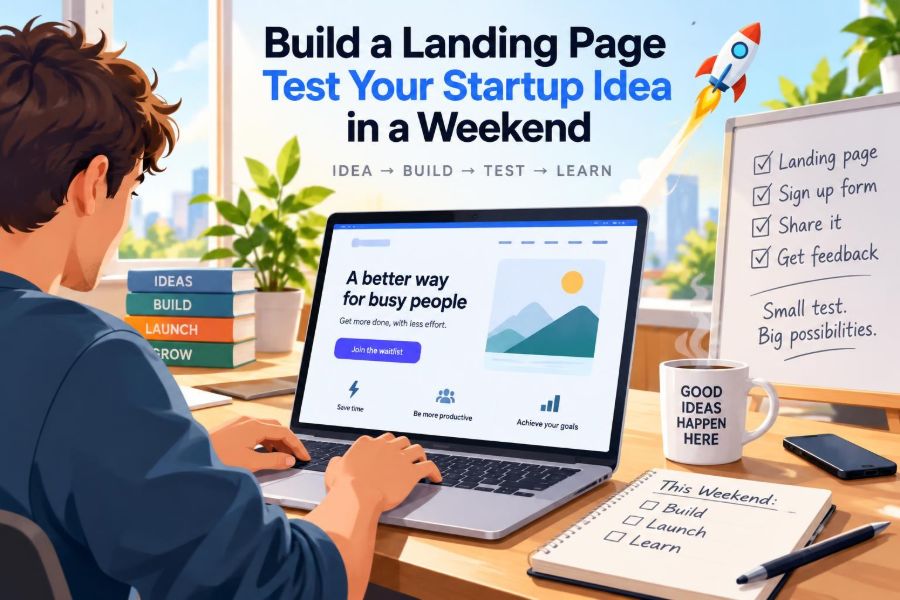
- Build the minimum page structure.
- Create the form, confirmation message, and response spreadsheet.
Sunday morning: quality check
- Read the page on a phone.
- Ask one target customer to explain the offer back to you.
- Test every button, form field, notification, and calendar step.
Sunday afternoon: distribution
- Send personal messages to relevant contacts.
- Publish one useful, non-spammy community post if allowed.
- Schedule time to respond promptly to every serious reply.
🚫 17. Avoid the common validation traps
The biggest risk is not a bad design choice. It is fooling yourself with weak evidence because you want the idea to work.
- Asking “Would you use this?” Ask about actual past behavior and current urgency instead.
- Targeting everyone. A narrow audience gives you interpretable feedback.
- Building features to explain the offer. Improve the message before building more product.
- Counting compliments as demand. “Cool idea” is not a commitment.
- Ignoring negative feedback. Confusion and rejection are data, especially when they repeat.
- Waiting for perfection. Polish the clarity, not every pixel.
Another trap is changing the customer, problem, price, and message all at once. When you revise, change one major variable where possible so you can learn what affected the response.
🗣️ 18. Follow up while the signal is fresh
Every qualified sign-up deserves a quick, human reply. Thank them, confirm what happens next, and ask for a short conversation if that is part of your test.
On calls, do not rush into a demo. You are still learning. Ask them to walk you through their existing process and identify the moment when the pain is sharpest.
What to capture after each conversation
- Their exact trigger for seeking a solution
- The current workaround and its cost
- The person who controls the budget
- The desired outcome and time frame
- Their reaction to your proposed offer and price
Send a short summary to the person afterward. This both verifies that you understood them and begins building the trust required for a pilot.
🔄 19. Decide whether to persist, pivot, or pause
At the end of the test, review your hypothesis with more discipline than emotion. Look at the numbers, the quality of responses, and the conversations together.
Persist when the target audience understands the offer, several people describe an urgent problem, and at least some take your intended next step. Your next move may be a manual pilot rather than a full build.
Pivot when people respond to the problem but not your proposed solution, audience, or price. A pivot might mean serving a narrower segment, changing the outcome, or reframing the offer around a more urgent use case.
Pause when outreach is targeted and the response remains weak, or when conversations show that the problem is not painful enough. Save your notes. A paused idea can become relevant later, but it should not consume unlimited effort now.
🌱 20. Scale only after repeatable evidence appears
One-page validation is the beginning of evidence, not permission to pour money into growth. Scale the next smallest thing that reduces uncertainty.
For a service, that may mean serving three paying pilot customers with a documented process. For software, it may mean building only the workflow those pilots repeatedly need. For a marketplace, it may mean validating one side of the market in one location first.
Signs you may be ready for the next stage
- People can explain the value to others without your help.
- Qualified leads arrive from a channel you can repeat.
- Customers accept a price or negotiate details rather than questioning the problem.
- You see recurring patterns in requests and delivery work.
- You know what to build, automate, or hire for next.
Keep measuring retention, referrals, delivery time, and margins as you grow. Revenue without healthy delivery or satisfied customers can create a larger problem rather than a stronger business.
📅 21. Your action plan for this week
Do not wait for a free weekend that feels perfectly calm. Put a small, concrete test on your calendar.
- Write one sentence naming your customer, pain, and outcome.
- Message five people who plausibly have that problem.
- Use their language to draft a page with one call to action.
- Publish it with a simple form and basic tracking.
- Invite 25 relevant people, personally where possible.
- Hold conversations with everyone who responds meaningfully.
- Choose one next experiment based on evidence, not enthusiasm.
You are not trying to prove that you are a founder in one weekend. You are practicing the habit that good founders repeat: putting a clear offer in front of real people, listening carefully, and adjusting before the costs become large.
A simple landing page will not build your whole company, but it can save you from building the wrong one. 🚀🧠📬