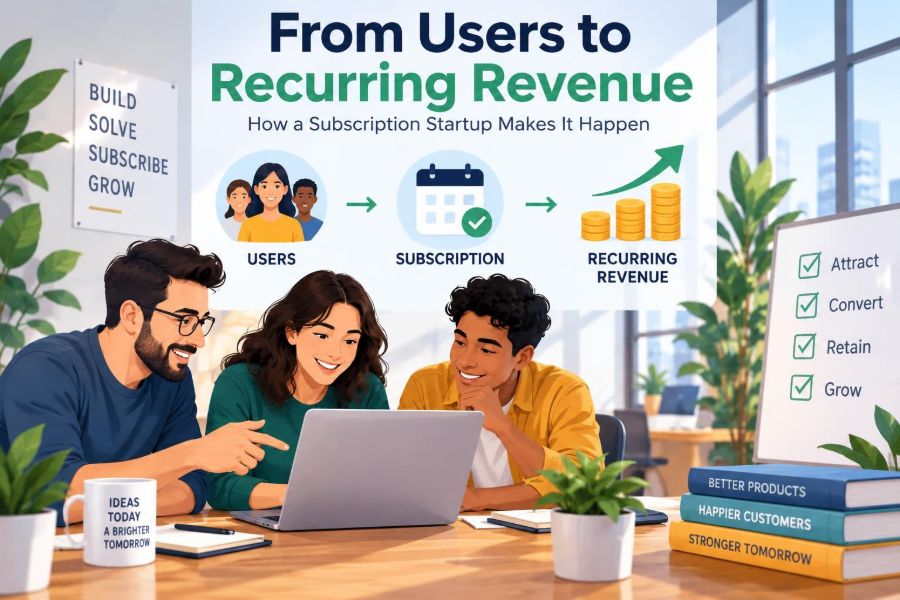

A subscription startup is not simply a business that charges monthly. It is a promise to solve a problem often enough, clearly enough, and reliably enough that customers choose to keep paying.
That makes subscriptions attractive for founders: recurring revenue can make planning, hiring, and product decisions less chaotic than relying entirely on one-off sales. But the model also raises the bar. Every renewal is a fresh vote of confidence.
This opportunity suits founders who understand a repeated customer workflow, whether that means managing appointments, producing compliance reports, ordering supplies, training a team, or getting a useful outcome from a niche community. It can work for software, services, physical products, and hybrid businesses.
It matters now because customers face constant overload. They do not want another dashboard, box, or membership to remember; they want a dependable system that removes work. The startups that win are usually specific, useful, and disciplined about retention.
🔍 1. Start With a Recurring Problem, Not a Recurring Invoice
The strongest subscription ideas begin with a problem that naturally returns. A customer may need to complete a task every week, monitor something every month, or maintain access to an ongoing benefit.
A one-time need can still be valuable, but forcing it into a subscription usually creates cancellations. Ask what happens in the customer’s world after the initial purchase.
Look for these recurring triggers
- Time-based: monthly reporting, payroll preparation, lessons, replenishment, maintenance, or renewals.
- Event-based: a new lead arrives, an employee joins, a client books, inventory falls, or a regulation changes.
- Progress-based: customers need ongoing coaching, accountability, content, data, or feedback to reach a goal.
- Risk-based: customers pay to avoid missed deadlines, errors, security issues, or equipment failure.
Write the problem in plain language: “Independent clinics need a simple way to remind patients and fill last-minute appointment gaps every week.” That is more useful than “an AI communications platform.”
🎯 2. Pick a Customer Narrow Enough to Reach
“Small businesses” is not a customer segment. It is a huge collection of people with different budgets, buying processes, and urgent needs.
Choose an initial niche with shared language, similar workflows, and places where you can find them. You can expand later, but early focus makes your product and marketing more credible.
A practical niche formula
Define your first market as role + business type + recurring job + context. For example: “bookkeepers serving local construction contractors who need monthly client document collection.”
- Can you name 50 potential customers or communities where they gather?
- Do they have a costly or frustrating repeated task?
- Does one person have authority to buy, or can you reach the decision-maker?
- Can the value be understood in one sentence?
If your answer is vague, narrow the segment before building. A smaller market that responds is more valuable than a giant market that ignores you.
🧭 3. Choose the Subscription Model That Matches the Job
Subscriptions come in several forms. The right model depends on what the customer is really buying: access, convenience, expertise, replenishment, or an outcome.
| Model | Best for | Customer value | Main challenge |
|---|---|---|---|
| Software access | Repeated digital workflows | Saves time or improves decisions | Onboarding and feature adoption |
| Product replenishment | Consumables and routine purchases | Convenience and availability | Margins, logistics, and churn |
| Membership | Communities, education, expertise | Access and ongoing progress | Keeping engagement high |
| Managed service | Specialist operational work | Work is done for the customer | Delivery capacity and margins |
| Hybrid | Complex jobs needing tools plus help | Guidance and execution | Operational complexity |
A hybrid model is often an excellent starting point. You can perform parts of the work manually while learning what to automate. Do not pretend a service is software, but do use the service to discover the software customers actually need.
🧪 4. Validate Demand Before Building the Full Product
Validation is not collecting compliments. It is seeing whether a real person will give time, data, a deposit, or money to solve the stated problem.
Interview prospects before you show your solution. Ask about their current process, the last time the problem happened, what it cost, and what they have already tried.
Questions that reveal buying reality
- “Walk me through the last time you did this task.”
- “What goes wrong when it is delayed or done badly?”
- “Who owns this problem, and who approves spending?”
- “What are you using today, including spreadsheets or contractors?”
- “Would you test a paid pilot if it handled this result?”
A practical test may be a landing page, a live concierge service, a paid workshop, or a simple prototype. Aim to secure a few paying pilot customers, not hundreds of email addresses.
🛠️ 5. Build the Smallest Valuable First Version
Your minimum viable product should deliver one meaningful outcome, not demonstrate every future feature. A product that helps a customer finish one recurring job is far more useful than a polished collection of unused tools.
For example, an operations subscription for small landlords might initially send maintenance reminders, collect issue reports, and produce a monthly summary. It does not need accounting, tenant screening, and a marketplace on day one.
Use a manual-to-automated path
- Deliver the result manually for early customers.
- Document each repeated step and exception.
- Automate the slowest, most predictable step.
- Keep human review where mistakes carry real costs.
- Repeat only when the demand is proven.
Useful early tools may include a website builder, payment processor, calendar, email platform, spreadsheet, database, forms, customer support inbox, and automation tool. Select tools for speed and reliability, not for an impressive technology stack.
💸 6. Price for Value, Costs, and Room to Learn
Pricing is an experiment, but it should not be random. Estimate the financial or practical value you create, understand your delivery cost, and set a price that can support improvement and customer support.
For a business customer, saved staff time, reduced errors, recovered revenue, and avoided risk can all support a recurring fee. For consumers, price usually depends more on convenience, habit, aspiration, and perceived alternatives.
Simple pricing options
- Flat monthly fee: easy to understand; useful for a clear, standard offer.
- Tiered plans: lets customers pay based on usage, team size, or feature needs.
- Per-user or per-location: aligns price with expansion, but can discourage adoption.
- Usage-based: fits variable consumption, but can make bills less predictable.
- Setup fee plus subscription: useful when onboarding requires real work.
Keep your first pricing page simple. Offer one core plan and, if needed, a higher-touch plan. Too many tiers make it harder to learn why people buy.
📊 7. Know the Basic Unit Economics
Recurring revenue is only healthy if each customer can become profitable over time. Revenue alone can hide expensive acquisition, heavy support requirements, refunds, or fulfillment costs.
Track these concepts from the beginning, even in a spreadsheet:
- Monthly recurring revenue (MRR): predictable subscription revenue expected each month.
- Average revenue per account: MRR divided by active paying accounts.
- Gross margin: revenue left after direct delivery costs, such as fulfillment, support labor, and hosting.
- Customer acquisition cost (CAC): sales and marketing spend divided by customers acquired in that period.
- Churn: customers or revenue lost during a period.
- Lifetime value (LTV): an estimate of gross profit generated before a typical customer leaves.
Early LTV calculations are uncertain because your data is limited. Use them as a warning system, not as a reason to manufacture optimistic spreadsheets.
🧾 8. Budget Honestly for the First Six Months
Your startup costs depend heavily on whether you sell software, a managed service, physical goods, or a membership. Keep fixed expenses low until customers demonstrate repeatable demand.
| Expense area | Lean estimate | What changes the cost |
|---|---|---|
| Domain, basic site, email | Estimated: low monthly cost | Design work, multiple tools, custom development |
| Prototype and operations tools | Estimated: low to moderate monthly cost | Team seats, data volume, automation, specialist software |
| Payments and legal setup | Estimated: variable | Country, entity type, transaction fees, accountant and legal advice |
| Customer acquisition tests | Estimated: small controlled budget | Channel competition, events, content production, sales labor |
| Physical inventory, if applicable | Estimated: moderate to high upfront cost | Minimum orders, shipping, storage, returns, packaging |
These are deliberately broad estimates because costs, taxes, payment fees, consumer rules, and licensing requirements vary by country and business type. Speak with qualified local legal and tax professionals before relying on a specific structure or pricing calculation.
🤝 9. Win the First Customers Through Direct Contact
Your first customers are usually earned, not algorithmically discovered. Personal outreach helps you learn the language of the market and reveals objections before you spend heavily on advertising.
Make a list of people who fit your niche. Contact them with a specific observation, a short description of the outcome you offer, and a low-pressure invitation to talk or try a pilot.
A useful early outreach approach
- Build a prospect list from your network, local directories, communities, and industry events.
- Research each prospect enough to make your note relevant.
- Lead with the recurring pain, not your product features.
- Offer a brief conversation or a tightly scoped pilot.
- Follow up politely with a useful observation, not repeated generic messages.
For a local-business service, visit businesses or join local professional groups. For a specialized software tool, demonstrate it in niche online communities, newsletters, webinars, or partner networks where the buyer already seeks help.
🧲 10. Design an Offer That Reduces Buying Risk
Customers hesitate when a subscription feels like another commitment with unclear payoff. Make the first decision easier without giving away so much that you attract people who will never value the product.
- Offer a guided setup so customers reach value faster.
- Use a defined pilot with a clear start, end, and success measure.
- Explain cancellation and billing terms in plain language.
- Provide a realistic guarantee only if you can operationally support it.
- Show exactly what is included, excluded, and required from the customer.
A free trial can work for simple, self-serve software. A paid pilot often works better for business products requiring onboarding, data migration, or human expertise.
✨ 11. Engineer the First Moment of Value
Retention begins before the first invoice renews. A customer who does not experience an early win may never form a habit around your product.
Define an activation event: the action or result that signals a customer has received genuine value. For a scheduling tool, it might be sending the first automated reminder. For a community, it might be attending a useful session and meeting a relevant peer.
Improve activation step by step
- Welcome customers with one clear next action.
- Ask only for data that is necessary at the start.
- Use templates, defaults, and examples to reduce blank-page anxiety.
- Notify customers when the product produces a result.
- Contact stalled customers personally while your customer count is small.
Measure the percentage of new customers who reach activation within a defined period. If that number is weak, adding acquisition spend will only fill a leaky bucket.
🔁 12. Treat Retention as the Main Product Strategy
Acquisition starts a relationship. Retention proves that the subscription deserves to exist. Customers renew when the value stays visible and the product remains dependable as their needs evolve.
Review cancellation reasons consistently. Do not dismiss departures as inevitable; categorize them and look for patterns in poor fit, pricing, onboarding, missing capabilities, support, and competition.
Retention habits worth building
- Send outcome-focused updates, not just feature announcements.
- Make progress or savings visible in a simple report.
- Prompt customers before an important task is due.
- Respond quickly when an issue blocks their work.
- Talk to both happy long-term customers and recent cancellations.
Do not try to retain customers through confusing cancellation steps or dark patterns. Clear cancellation is ethically better and gives honest feedback about whether your product earns renewal.
📈 13. Track a Small Metrics Dashboard Every Week
You do not need a complicated business intelligence system to make better decisions. Start with a simple weekly dashboard that connects customer behavior to revenue.
| Metric | What it tells you | Early response |
|---|---|---|
| New trials or leads | Top-of-funnel demand | Review channel and message quality |
| Activation rate | Whether new users reach value | Simplify setup and improve guidance |
| Trial-to-paid conversion | Whether initial value justifies payment | Check targeting, pricing, and offer clarity |
| Logo churn | Share of customers leaving | Interview cancellations and segment causes |
| Revenue churn | Revenue lost from cancellations or downgrades | Review account health and expansion opportunities |
| Support volume | Friction and delivery load | Fix recurring issues and improve documentation |
Look at trends by customer cohort when possible. If customers acquired in a certain month or from a certain channel churn faster, the issue may be your targeting rather than the product itself.
🗣️ 14. Build Feedback Loops Without Letting Every Request Drive the Roadmap
Customers know their pain better than you do, but each customer may ask for a solution tailored only to their workflow. Listen for the underlying job rather than treating every request as a feature order.
Record feedback with the customer type, frequency, severity, current workaround, and expected impact. Then prioritize patterns that help a valuable group of customers complete the core job.
A simple prioritization check
- Does this problem block activation, renewal, or expansion?
- How many target customers experience it?
- Does solving it strengthen our core promise?
- Can we test a simpler process before building a permanent feature?
- What maintenance, support, privacy, or security burden will it create?
Say no thoughtfully. A focused subscription product is easier to explain, sell, maintain, and improve.
⚠️ 15. Avoid Common Subscription Traps
The subscription model can create attractive vanity metrics. A growing customer count means little if people leave quickly, costs rise faster than revenue, or customers feel misled by the offer.
- Building too much: solve one frequent problem before expanding the product suite.
- Underpricing: low prices can attract demand that cannot support service, support, or growth.
- Ignoring involuntary churn: expired cards and failed payments need respectful recovery reminders.
- Measuring only sign-ups: track activation, engagement, renewals, and gross margin.
- Over-automating early: manual service often teaches you what the workflow really requires.
- Making cancellation difficult: this damages trust and obscures product problems.
For products handling personal data, payments, health information, employment data, or regulated advice, privacy, security, accessibility, and sector regulations may be material risks. Build appropriate safeguards and seek qualified advice rather than treating compliance as an afterthought.
🌱 16. Expand Revenue From Existing Customers Carefully
When customers consistently achieve results, expansion can be healthier than chasing endless new logos. Add revenue only where the extra purchase produces extra value.
Possible expansion paths include additional seats, locations, usage capacity, premium reporting, faster support, specialist services, or a related workflow. The best upgrades feel like a logical next step, not a surprise paywall.
Before adding an upsell
- Confirm that core customers are retaining at an acceptable level.
- Identify a recurring need among successful users.
- Test the offer in conversations before building it broadly.
- Price based on the incremental outcome and delivery cost.
- Ensure the core plan remains genuinely useful.
Expansion revenue can offset some revenue lost to churn, but it should never become an excuse to neglect customers who cannot or do not need to upgrade.
🏗️ 17. Scale the System, Not Just the Customer Count
Scaling means delivering the same promise to more customers without quality collapsing. The operational systems behind onboarding, support, billing, product reliability, and fulfillment matter as much as the growth channel.
Document recurring processes before delegating them. Create checklists for onboarding, issue escalation, quality checks, refunds, and customer communication. A process is not bureaucracy when it protects a consistent customer experience.
Signs you may be ready to scale
- Customers reach value through a repeatable onboarding path.
- Your target niche and message reliably produce qualified conversations.
- You understand the main churn reasons and are actively reducing them.
- Delivery has workable margins at current pricing.
- Support requests reveal patterns you can prevent or document.
Then add capacity deliberately: better automation, contractors, specialist hires, channel partnerships, or more focused paid acquisition. Test one growth investment at a time so you know what created the result.
🗓️ 18. Your Action Plan for This Week
Do not wait for a perfect business plan. Use this week to turn a broad subscription idea into evidence.
- Day 1: write one sentence describing a narrow customer and their repeating problem.
- Day 2: list 25 people or businesses that fit that description.
- Days 3-4: request and conduct five problem-focused customer conversations.
- Day 5: write a one-page offer with the outcome, process, price hypothesis, and pilot terms.
- Day 6: contact ten qualified prospects with a personal invitation to test the offer.
- Day 7: review what people actually said, change one assumption, and schedule the next set of conversations.
The first goal is not to create a giant subscription brand. It is to find a small group of people who repeatedly need an outcome and are willing to pay for a reliable way to get it.
A durable subscription startup earns recurring revenue by delivering recurring value, one retained customer at a time. 🚀🔁🌱