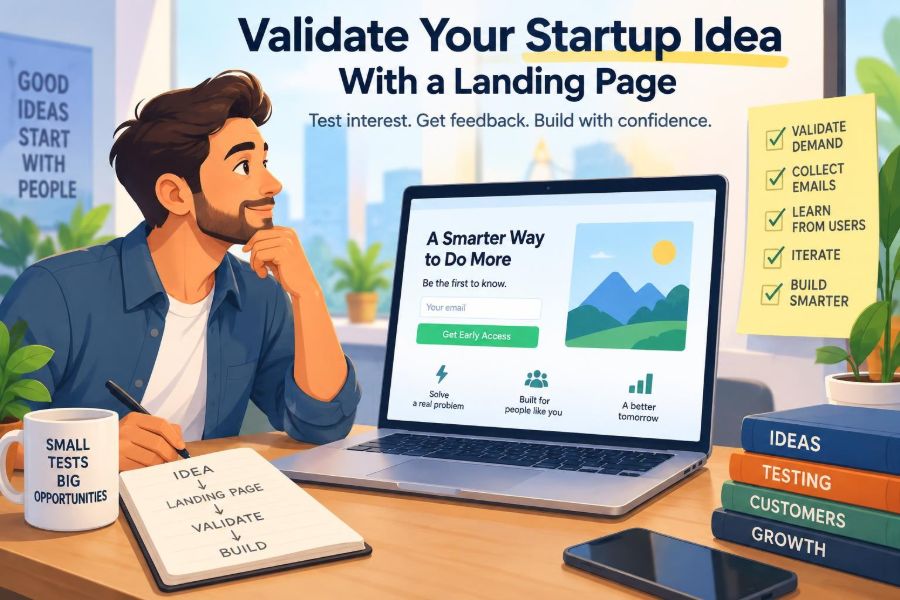

A landing page can be the cheapest honest test of whether strangers care about your startup idea. Before you hire developers, design a product, or spend months building features, you can present a clear promise and ask people to take a meaningful next step.
This approach suits founders with limited time or money, side hustlers who need evidence before committing evenings and weekends, and small-business owners considering a new service. It is especially useful when the problem seems obvious to you but has not yet been proven valuable to a specific customer.
Right now, building software is faster than ever. That is precisely why validation matters more: the biggest risk is often not whether you can build the product, but whether enough people will choose it, pay for it, and keep using it.
A landing page is not a magic income machine or a substitute for talking to customers. It is a focused experiment. Set it up well, drive relevant people to it, and let their behavior help you decide what to build, change, sell manually, or stop.
🧭 1. Define what you are validating
Do not start with colors, copy, or a website builder. Start by naming the uncertainty that could kill the idea.
Most early tests should validate one of these: whether a painful problem exists, whether your proposed outcome is appealing, whether a defined audience responds, or whether people will make a commitment.
- Weak question: “Do people like my idea?”
- Useful question: “Will independent accountants join a waitlist for a tool that chases missing client documents?”
- Stronger question: “Will they book a call or place a refundable deposit for that outcome?”
Write one hypothesis before you build: We believe [specific audience] will [specific action] because they want [valuable outcome]. That sentence keeps the experiment from becoming vague market research.
🎯 2. Pick one narrow customer segment
A page for “small businesses” is usually a page for nobody. Specificity helps people recognize themselves and helps you choose where to find them.
Start with a segment you can describe by job, context, and recurring problem. “Freelance designers managing five to twenty active client projects” is much more actionable than “creative professionals.”
Make the segment reachable
- They gather in identifiable communities, events, newsletters, or search results.
- You can reasonably contact at least 20 potential customers for conversations.
- The problem occurs often enough that a solution could be worth paying for.
- You understand their language well enough to write a credible first message.
A narrow initial segment does not limit the final business. It gives you a sharp place to learn. Expansion is easier after you know which promise converts.
🔍 3. Do problem interviews before buying traffic
Talk to people before sending them to a polished page. Interviews prevent you from testing clever wording for a problem that barely matters.
Ask about the customer’s real workflow, last frustrating incident, current workaround, time or money lost, and who approves spending. Avoid leading questions such as “Would you use an AI tool that fixes this?”
Questions that uncover evidence
- “Tell me about the last time this happened.”
- “What did you do instead?”
- “What was difficult, slow, or expensive about that?”
- “What have you already tried?”
- “Who would decide whether to pay for a solution?”
Take notes on exact phrases. Your visitors will respond more to their own language than to startup jargon. If nobody describes the problem as urgent, revise the audience, problem, or offer before creating ads.
🧪 4. Choose the right validation level
Not every landing page needs a payment button on day one. Match the ask to the maturity of the idea and the trust you have earned.
| Test type | Visitor action | Cost and effort | What it validates |
|---|---|---|---|
| Interest test | Email signup | Low | Message and audience attention |
| Intent test | Book a call or request access | Low to medium | Problem urgency and sales interest |
| Demand test | Pre-order, deposit, or paid pilot | Medium | Willingness to spend |
| Concierge test | Buy a manual service | Medium to high | Value delivery and retention potential |
Email addresses are useful, but they are a soft signal. A scheduled call, completed application, deposit, or paid pilot is usually stronger evidence because it costs the customer time, reputation, or money.
💡 5. Turn the idea into one clear offer
Your landing page is not an investor pitch deck. It needs one understandable offer: a customer, an outcome, a mechanism, and a reason to act now.
A practical formula is: Help [customer] achieve [outcome] without [major frustration]. For example: “Help boutique agencies collect client approvals in one place without chasing feedback across email threads.”
State what exists honestly
If the product is not built, say “Join the early-access list,” “Apply for a founding pilot,” or “Reserve a setup call.” Never imply that a working product exists when it does not.
Honesty protects your reputation and produces better data. People who sign up knowing it is early are more likely to become useful design partners.
✍️ 6. Write a page people can scan in seconds
Visitors should understand the audience, outcome, and next action without scrolling. Lead with clarity, not a clever name or technical description.
A reliable landing-page structure
- Headline: the primary outcome for a specific customer.
- Subheadline: how it works or what makes the outcome believable.
- Call to action: one clear next step.
- Problem section: recognizable frustrations and current workarounds.
- How it works: three simple steps, even if early delivery is partly manual.
- Offer details: pilot scope, expected timing, or starting price.
- Trust section: your relevant experience, transparent process, or early feedback with permission.
- FAQ: answer practical objections.
Use short sentences and concrete verbs. Replace “revolutionary workflow optimization” with “send approval requests, track replies, and see what is blocking a project.”
🖼️ 7. Show the future without faking the present
A simple product mockup can make an abstract promise easier to understand. It does not need to be a finished interface; it can be a labeled wireframe, a sample report, or a short visual walkthrough.
Label conceptual screens appropriately if necessary. A fake dashboard full of invented customer data or fabricated results may increase clicks briefly, but it damages trust when prospects discover the truth.
- Use annotated screenshots for a software concept.
- Use a sample deliverable for a service.
- Use a before-and-after workflow diagram for operational tools.
- Use a short demo video only if it explains rather than distracts.
People buy an improved situation, not a collection of features. Make the visible outcome the hero.
🧱 8. Build the minimum credible page
You do not need custom code to run a useful test. A page builder, form tool, calendar tool, and simple spreadsheet or customer tracker are enough for many first experiments.
Estimate: a basic setup can cost roughly $0 to $100 for a month if you use free tiers and a domain you already own. A domain, premium template, email service, paid form features, or advertising can raise that amount. Costs, payment fees, taxes, and privacy requirements vary by country.
Your minimum tool stack
- A landing-page builder or a simple hosted page.
- A form that records source, email, and one qualifying answer.
- An email inbox or lightweight email sequence.
- A calendar for high-intent conversations.
- Analytics that records visits and key conversion events.
- A spreadsheet to track leads, interviews, and follow-ups.
Set up the form and confirmation message before promoting the page. A broken signup path turns attention into wasted learning.
📣 9. Create one call to action, not five
Early-stage pages often lose visitors by offering a newsletter, a demo, a free guide, social follows, and a contact form at once. Every extra choice weakens the experiment.
Choose a single primary action based on your test. “Apply for a pilot” is better than “Learn more” because it tells both you and the visitor what happens next.
Match the button to the commitment
- Early learning: “Join early access.”
- Service validation: “Book a 20-minute fit call.”
- Paid pilot: “Apply for the founding cohort.”
- Pre-sale: “Reserve your place.”
Tell people what follows the click. For example, “We will reply within two business days with pilot details” reduces uncertainty and filters casual signups.
🧮 10. Decide your numbers before launch
You do not need universal benchmark conversion rates. Audience temperature, price, channel, and offer type can change results dramatically. Instead, define a small target that would justify the next step.
For example, you might decide that 100 relevant visitors, 10 qualified signups, and three conversations would be enough to continue interviewing. Or you may require two paid pilot commitments before investing in a prototype.
Track the funnel
| Metric | What it tells you | Useful diagnostic question |
|---|---|---|
| Relevant visitors | Whether distribution reaches the right people | Did the message reach the intended segment? |
| Page conversion rate | Whether the offer earns action | Is the promise specific and compelling? |
| Qualified lead rate | Whether signups fit your market | Are the right people responding? |
| Call booking rate | Depth of intent | Is the problem urgent enough for time commitment? |
| Payment or deposit rate | Commercial demand | Will customers spend to solve it? |
Record the source for every lead. Ten signups from a thoughtful niche community can teach you more than 100 untargeted clicks.
🌱 11. Get the first visitors manually
For the first test, personal outreach is often more valuable than advertising. You need learning, not vanity traffic.
Make a list of people who plausibly fit the segment. Contact them individually, explain the problem you are exploring, and ask for candid feedback rather than pretending you have launched a finished company.
A simple outreach approach
- Open with the context you share or the reason they fit the audience.
- Describe the problem in one sentence.
- Ask a small question or invite them to a short conversation.
- Send the page after they show interest, or use it as a concise explanation.
- Follow up once, politely, with no pressure.
You can also share useful observations in relevant communities, speak with peers at local events, post from a founder account, or ask interviewees for introductions. Follow each platform’s rules; spam will contaminate both your reputation and your results.
💸 12. Use paid traffic carefully
Paid ads can speed up learning when you know where the audience spends attention, but they can also produce shallow clicks. Do not use a large budget to compensate for an unclear offer.
Estimate: a small test budget might be $50 to $300, depending on the channel and market. Treat it as research spending, not proof of a scalable acquisition model. Click costs and advertising rules vary widely.
Run a controlled test
- Test one audience and one message at a time.
- Use a limited budget and a defined stopping point.
- Make the ad promise match the landing-page headline.
- Exclude irrelevant locations or audiences where possible.
- Review lead quality, not just cheap clicks.
If visitors click but do not convert, examine message match and offer clarity. If they convert but are unqualified, tighten targeting and add one screening question.
🗣️ 13. Follow up while the signal is fresh
A signup is the beginning of validation, not the end. Reply quickly and make it easy for interested people to tell you what they actually need.
Send a short confirmation that restates the problem, sets expectations, and asks one question such as, “What currently makes this process hardest?” For qualified leads, invite a brief call.
Listen for behavior, not compliments
Useful evidence includes an introduction to a buyer, sharing current documents or workflows, agreeing to a pilot, or discussing budget and implementation. “This is cool” is pleasant but weak.
Ask whether they would be willing to pay, but also ask what they pay for now, what a delay costs, and what would need to be true for them to switch. Specific trade-offs reveal more than hypothetical enthusiasm.
🔒 14. Handle trust, privacy, and payments properly
Even a small validation page creates responsibilities. Collect only information you need, explain what you will do with it, and secure access to the tools holding it.
If you collect payments, make refund terms, delivery timing, and the nature of the offer clear. A refundable deposit can be a useful demand signal, but only if you can administer refunds promptly and comply with applicable consumer, tax, payment, and data-protection rules.
- Do not collect sensitive information unless essential.
- Do not add people to unrelated marketing lists without permission.
- Do not publish customer names or feedback without consent.
- Keep records of commitments and promises you make.
- Seek local professional guidance for regulated industries.
Trust is not a legal footer alone. It is accurate language, realistic timelines, and respectful follow-through.
⚠️ 15. Avoid the common validation traps
The most dangerous mistake is treating a pretty page as proof. A landing page measures a specific response from a particular audience under particular conditions; it cannot answer every strategic question.
Watch for these traps
- Asking friends only: supportive people may not be representative buyers.
- Measuring page views alone: attention without action is rarely enough.
- Using vague calls to action: “Get started” hides the commitment.
- Overbuilding the page: weeks of design delay a one-day learning experiment.
- Changing everything at once: you will not know what improved the result.
- Ignoring negative feedback: objections often point to the real product requirement.
- Promising features too early: you may create obligations you cannot meet.
Also avoid declaring failure after a tiny sample. If the audience was wrong or the channel was weak, test a revised hypothesis before abandoning a problem that interviews show is real.
🔁 16. Turn results into a build, pivot, or pause decision
At the end of the test, review both numbers and conversations. Put results against the threshold you set before launch, then decide what the evidence supports.
Three sensible next moves
- Build a narrow prototype: when the right people show repeated, high-intent demand and you understand the first workflow.
- Run a concierge pilot: when demand is promising but you still need to learn how to deliver the outcome.
- Revise or pause: when qualified people do not see the problem as urgent, reject the value proposition, or will not make meaningful commitments.
Do not jump from a handful of emails to a full product roadmap. Build the smallest solution that can serve the strongest observed demand, then continue measuring activation, repeat use, retention, and willingness to pay.
📅 17. Your action plan for this week
Keep this first validation sprint deliberately small. The goal is not a perfect launch; it is a clear next decision.
- Day 1: Write your audience, problem, hypothesis, and success threshold.
- Day 2: Speak with three to five potential customers about their current workflow.
- Day 3: Draft one offer and one primary call to action using their language.
- Day 4: Publish a minimum credible page, form, confirmation message, and tracking.
- Day 5: Send personal outreach to at least 15 relevant people.
- Day 6: Follow up with responders and schedule conversations.
- Day 7: Review the funnel, objections, and next experiment.
A landing page will not remove startup risk, but it can replace expensive guessing with focused evidence before you build. 🚀🧪📈