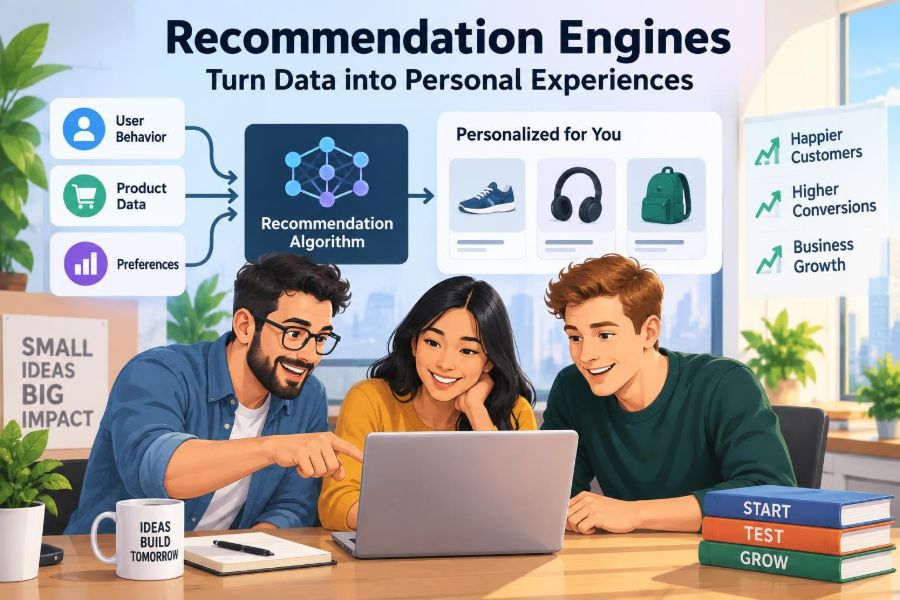

Personalization used to sound like an enterprise-only advantage: huge datasets, expensive data teams, and mysterious machine learning models. That is no longer true. A focused startup can use recommendation engines to make a small catalog feel more useful, a new product feel more relevant, and a customer journey feel less like a generic storefront.
This opportunity suits founders building ecommerce stores, marketplaces, media products, learning tools, SaaS platforms, local-service directories, and subscription businesses. If customers face too many choices, struggle to discover value, or return only occasionally, recommendations can reduce friction.
The important point is not to add artificial intelligence because it is fashionable. The goal is to help a person make a better next decision: which product to consider, which lesson to take, which seller to contact, or which feature to try.
Recommendation engines matter now because customers expect relevance, while lean startups need to get more value from every visit. Start simple, protect user trust, and earn the right to make smarter predictions as your data improves.
🧭 1. Start With the Customer Decision, Not the Algorithm
A recommendation engine is a system that ranks possible items for a person in a particular context. An item might be a product, article, video, service provider, course, template, or even an in-app action.
Before discussing algorithms, write one sentence that defines the decision you want to improve. For example: “Help first-time home-office shoppers find compatible products within their budget.”
Ask these questions first
- What choice currently feels difficult or time-consuming for the customer?
- Where does the choice happen: homepage, search results, cart, onboarding, email, or dashboard?
- What action represents value: purchase, booking, activation, completion, renewal, or return visit?
- What could make a recommendation feel intrusive, inaccurate, or unsafe?
A weak goal is “increase clicks.” A better goal is “help qualified buyers find relevant items without increasing returns.” Clicks are useful signals, but they are not the whole business outcome.
📦 2. Define Your Items, Users, and Events
Every recommendation system is built from three basic ingredients: items, users, and events. A small startup does not need a perfect data warehouse, but it does need consistent definitions.
| Ingredient | Examples | Why it matters |
|---|---|---|
| Items | Products, listings, lessons, features | These are the choices you will rank. |
| Users | Visitors, accounts, teams, subscribers | They provide preferences and context. |
| Events | Views, saves, purchases, completions | They reveal behavior and outcomes. |
| Context | Device, location, time, referral source | It can change what is useful right now. |
Track meaningful events with an item ID, user or anonymous session ID, timestamp, source surface, and event type. Also capture a few useful item attributes, such as category, price range, inventory status, topic, skill level, or compatibility.
Do not collect personal data merely because it might be useful someday. Collect only what has a clear product purpose, explain it appropriately, and follow applicable privacy, consent, and data-retention rules in the countries where you operate.
🌱 3. Begin With Rules Before Machine Learning
The most practical first recommendation engine is often a rules engine. It is transparent, fast to ship, and surprisingly effective when your catalog has sensible structure.
A simple first version
- On a product page, show items from the same category and price band.
- In a cart, show compatible accessories or replenishment items.
- For new users, show bestsellers within the selected interest or location.
- On a learning platform, suggest the next lesson in the same path.
- For a SaaS product, recommend a feature based on completed setup steps.
Use business rules as guardrails too. Never recommend out-of-stock products, unsuitable age-restricted items, duplicate purchases without a reason, or low-quality listings just because they have a high historical click rate.
Common mistake: calling a manually curated carousel “AI” and then neglecting it. Label the experience honestly, review it regularly, and measure whether it helps.
🏷️ 4. Use Content-Based Filtering When Item Details Matter
Content-based filtering recommends items that resemble what a user has viewed, saved, bought, or rated. It relies on item attributes rather than the behavior of other people.
For a specialty coffee store, relevant attributes could include roast level, origin, flavor notes, grind type, price, and subscription eligibility. For a B2B software marketplace, they might include industry, integrations, team size, compliance requirements, and use case.
How it works in plain language
Convert each item into a set of features. When someone engages with an item, calculate which other items share important features, then rank them by similarity and business constraints.
similarity score = shared useful features - mismatched features + freshness bonusYou do not need advanced math to begin. A weighted scoring model in your application database or analytics workflow can work well. Give more weight to fields that customers actually care about, not fields that are simply easy to store.
Best use cases
- Small or new catalogs with limited behavioral data
- High-consideration products where attributes explain relevance
- Catalogs with frequent new items
- Situations where you need to explain recommendations
Its limitation is narrowness. Someone who bought a beginner camera may also want a memory card, which is not “similar” to a camera. That is where other methods help.
👥 5. Add Collaborative Filtering When Behavior Accumulates
Collaborative filtering finds patterns across user behavior. Its basic intuition is familiar: people who behaved similarly in the past may value similar items next.
There are two common forms. User-based approaches seek people with similar histories. Item-based approaches find items that tend to be viewed, saved, or purchased by the same people.
For most early startups, item-to-item recommendations are easier to understand and operate. If people frequently buy a notebook and a particular pen together, that relationship can power a useful suggestion.
Use strong signals carefully
- Strong signals: purchase, booking, completion, repeat use, positive rating.
- Medium signals: save, add to cart, trial start, long dwell time.
- Weak signals: impression, brief click, accidental tap.
Do not treat every event equally. A click may show curiosity; a refund may indicate dissatisfaction. Your scoring should reflect that distinction.
❄️ 6. Solve the Cold-Start Problem Deliberately
Cold start is what happens when you have a new user, a new item, or both. Collaborative filtering cannot infer much from behavior that does not exist yet.
For new users
- Ask one to three optional preference questions during onboarding.
- Use stated needs, such as budget, goal, experience level, or category interest.
- Show popular and high-quality items, not merely the most clicked items.
- Use referral source or landing-page intent when it is clearly relevant.
For new items
- Require structured metadata at creation.
- Give suitable new items limited exploration exposure.
- Use editorial quality checks for marketplace listings.
- Place new inventory in content-based modules until behavior arrives.
Do not force a long quiz before delivering value. Ask only questions that materially improve the first session, and allow customers to skip them.
🧪 7. Combine Methods With a Hybrid Engine
The best startup systems are usually hybrid recommendation engines. They combine rules, content similarity, collaborative signals, popularity, and contextual constraints.
A hybrid approach is more resilient because every method has blind spots. Content methods handle new inventory. Collaborative methods reveal unexpected bundles. Rules protect customer experience and unit economics.
final score = relevance + behavior pattern + context + business value - risk penaltiesBusiness value should not dominate relevance. Promoting a high-margin item that does not fit the user may create a short-term conversion but lower trust, raise returns, and reduce lifetime value.
⚖️ 8. Rank for More Than Click-Through Rate
Recommendation engines rank candidates. The easiest ranking target is click-through rate, but optimizing only for clicks can create clickbait, repetitive results, or recommendations that people inspect and abandon.
Build a balanced scorecard
| Metric | What it reveals | Watch out for |
|---|---|---|
| Recommendation CTR | Whether placement attracts attention | Clicks without meaningful outcomes |
| Conversion after click | Whether suggested items fit intent | Small samples and delayed purchases |
| Revenue per session | Commercial impact | Discounting can distort it |
| Return or cancellation rate | Whether fit was genuinely good | Delayed feedback |
| Repeat engagement | Longer-term usefulness | Seasonality and product cycles |
| Catalog coverage | Whether exposure is overly concentrated | Forcing irrelevant variety |
Choose one primary metric and two or three safety metrics. A course platform might optimize lesson completion while guarding against drop-off and poor ratings. An ecommerce store might optimize contribution margin while monitoring returns and support contacts.
🔀 9. Balance Exploitation and Exploration
Exploitation means recommending what your system already believes will work. Exploration means deliberately testing promising alternatives so the system can learn.
If you only exploit, the same popular products get richer in data and everything else remains invisible. If you explore too aggressively, customers receive random-looking suggestions.
A sensible early approach
- Reserve a small portion of recommendation slots for eligible new or under-tested items.
- Apply strict quality and availability filters first.
- Measure outcomes separately for exploratory placements.
- Stop exposing items that repeatedly produce poor outcomes.
This is especially valuable for marketplaces. Without some exploration, new sellers may never get enough visibility to prove their value.
🪟 10. Match the Algorithm to the Surface
A person’s intent changes across the journey. One generic recommendation model everywhere usually produces mediocre results.
Useful placement examples
- Homepage: broad discovery based on interests, popularity, and recent activity.
- Search page: rank results by query relevance first; personalize gently after that.
- Product page: similar items, alternatives, complements, and recently viewed products.
- Cart: compatibility, bundles, replenishment, or service add-ons.
- Email: fewer, higher-confidence suggestions with frequency limits.
- In-app dashboard: next-best action based on the customer’s current stage.
Never let personalization hide a user’s ability to browse, search, filter, or choose directly. Recommendations should assist autonomy, not replace it.
🧹 11. Get Data Quality Right Before Chasing Complexity
Bad event data makes sophisticated models confidently wrong. Duplicate events, missing product IDs, bot traffic, stale inventory, and inconsistent categories can quietly damage results.
Weekly data hygiene checklist
- Verify that every recommendation impression is logged.
- Verify clicks and downstream outcomes are connected to the impression where possible.
- Remove internal testing and obvious automated traffic.
- Check inventory, pricing, eligibility, and item-status updates.
- Audit top recommended items for quality, diversity, and accuracy.
- Document changes to event definitions and ranking logic.
Start with a simple event dictionary. If “save,” “add to cart,” and “purchase” mean different things across devices or teams, your model will learn a distorted picture of intent.
🛠️ 12. Choose a Practical Technical Path
You have three realistic implementation paths. The right one depends on catalog complexity, traffic, developer capacity, and how central personalization is to your product.
| Approach | Estimated cost | Effort | Best for |
|---|---|---|---|
| Rules in your app or commerce platform | Low | Low | Early validation and small catalogs |
| Analytics plus managed recommendation tooling | Low to medium | Medium | Teams wanting faster iteration |
| Custom data pipeline and models | Medium to high | High | Core-product personalization at scale |
Estimated costs: a rules-based launch may mainly require founder or developer time. Managed tools can add recurring software costs, while custom systems require engineering, infrastructure, monitoring, and maintenance. Actual prices, labor costs, taxes, and vendor terms vary by country and provider.
Use tools that let you export data and understand the logic. A black box may be acceptable for a test, but it is risky if recommendations become central to revenue or customer experience.
🧑⚖️ 13. Design for Trust, Privacy, and Fairness
Personalization can feel helpful or unsettling depending on how it is implemented. Recommendations based on clear actions, such as “because you saved this topic,” are generally easier to understand than surprising inferences about sensitive traits.
Trust-building practices
- Provide clear privacy information and honor consent choices.
- Avoid using sensitive personal data unless you have a compelling, lawful reason and proper safeguards.
- Offer controls to reset, edit, or reduce personalization where appropriate.
- Use explanations carefully: “Similar to items you viewed” is more useful than vague claims.
- Test for unfair exposure patterns among sellers, creators, or customer groups.
Privacy and consumer-protection obligations vary across jurisdictions. If your product handles health, finance, children’s data, employment, housing, or other sensitive areas, obtain qualified legal and compliance advice before deploying personalized ranking.
📊 14. Test Changes Like a Founder, Not a Magician
Recommendation improvements should be tested against a baseline. Do not change the algorithm, placement, copy, and discount at the same time, then claim you know what worked.
A simple experiment process
- Write a hypothesis: “Showing compatible add-ons in the cart will increase completed orders without raising returns.”
- Choose a primary metric and guardrails before launch.
- Compare the new experience with the current one for a meaningful period.
- Review results by important segments, such as new versus returning customers.
- Document the decision: keep, revise, or remove.
Small traffic means noisy results. In that case, combine quantitative data with session reviews, customer interviews, support feedback, and direct usability observation. Do not overstate certainty from a handful of conversions.
🚨 15. Avoid the Most Expensive Early Mistakes
The expensive mistake is not choosing the wrong neural network. It is building complex infrastructure before proving that recommendations solve a visible customer problem.
- Over-personalizing too early: sparse data creates strange guesses. Use popularity and declared preferences as a foundation.
- Ignoring inventory and constraints: never recommend unavailable, incompatible, or unsuitable options.
- Optimizing vanity metrics: a high CTR can hide low conversion and poor satisfaction.
- Creating filter bubbles: repeatedly showing one narrow type of item limits discovery.
- Forgetting the merchant side: marketplace ranking can affect supplier trust and catalog health.
- Skipping monitoring: a model can degrade when catalog, seasonality, or customer behavior changes.
Keep a manual override. Founders need the ability to pause an unsafe module, suppress an item, or promote a time-sensitive category without waiting for a retraining cycle.
📈 16. Know When to Scale Beyond a Basic Engine
Scale your system when the current approach creates a measurable bottleneck, not because an advanced technique sounds impressive. Signs include a large and changing catalog, enough event volume to reveal patterns, multiple customer segments, and clear evidence that better ranking affects retention or margin.
What scaling usually adds
- Near-real-time event processing for recent behavior
- More robust candidate generation and ranking layers
- Feature stores or consistent reusable data definitions
- Automated model evaluation and drift monitoring
- Better experimentation infrastructure
- Dedicated ownership across product, engineering, data, and merchandising
As you grow, preserve the startup advantage: speed of learning. A simple model that your team can debug and improve is often more valuable than an opaque system that nobody confidently owns.
✅ 17. Your Action Plan for This Week
Do not begin by hiring a machine learning team. Begin by choosing one customer moment where relevance could remove friction.
- Pick one surface: product page, onboarding, cart, homepage, or dashboard.
- Define the desired customer outcome and one safety metric.
- List the item attributes and events you already have.
- Build a small rules-based module with inventory and quality filters.
- Log impressions, clicks, and the meaningful next action.
- Review ten real recommendation journeys yourself.
- Interview a few customers about whether the suggestions felt useful.
- Run one controlled improvement next week.
You are not trying to predict the entire customer perfectly. You are trying to make one next choice easier, more relevant, and more trustworthy.
The strongest recommendation engine is not the most complicated one; it is the one that consistently helps customers make better decisions while giving your startup clearer signals about what they value. 🚀🧠📈