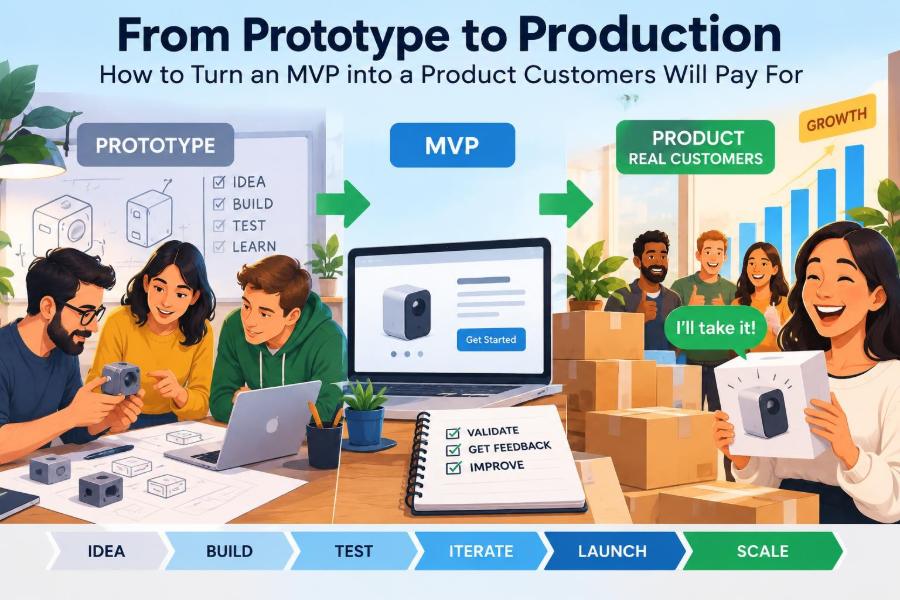

Your MVP is not supposed to be impressive. It is supposed to reduce uncertainty: whether a painful problem exists, whether your approach helps, and whether anyone will exchange money for the result.
That makes the jump from prototype to production one of the most important and misunderstood stages in a startup. Many founders keep building because the product is not “ready.” Others launch too broadly, learn nothing useful, and conclude that the idea failed.
This stage suits founders, side hustlers, agencies turning an internal tool into software, and small-business owners with a repeatable service idea. You do not need a huge team or a polished brand. You need a clear customer, a narrow promise, and a disciplined way to learn.
It matters now because customers have more choices and less patience than ever. A useful product that solves a specific job reliably can earn trust before a feature-heavy product that tries to serve everyone.
The goal is not simply to “launch.” The goal is to build a product and a business system that customers understand, use, renew, and recommend.
🧭 1. Define the Difference Between an MVP and a Product
An MVP tests a high-risk assumption with the smallest credible solution. A production product delivers a repeatable outcome reliably enough that a customer can confidently pay, adopt it, and depend on it.
That distinction matters because a prototype can be held together by manual work, founder support, and temporary shortcuts. Some shortcuts are smart early on; the problem begins when nobody decides which ones must be replaced before selling more widely.
- MVP question: “Will this customer try this solution?”
- Product question: “Will this customer pay, succeed, and come back?”
- Business question: “Can we deliver that value repeatedly at a sustainable cost?”
Do not wait for perfection. Instead, define the minimum level of reliability, support, privacy, billing, and onboarding needed for the customer you are asking to pay.
🎯 2. Choose One Paying Customer Segment First
“Small businesses,” “creators,” and “teams” are markets, not useful first segments. A strong early segment has a similar problem, buying process, budget range, and definition of success.
Start with a narrow customer statement
Try this format: We help [specific customer] who struggle with [expensive recurring problem] achieve [measurable or visible outcome] without [current frustration].
For example, “We help independent accounting firms collect missing client documents before month-end without chasing people across email.” That is more actionable than “AI workflow software for professionals.”
- List the customers who used your MVP most often.
- Identify who experienced the problem most urgently.
- Prioritize customers who can buy without a long procurement process.
- Choose one segment for the next 60 to 90 days.
Narrowing your focus does not permanently exclude everyone else. It gives you a coherent product, message, and sales conversation from which to expand later.
🔍 3. Turn Early Feedback Into Evidence
Early users are valuable, but compliments are not validation. “This is cool” and “I would use this” are weak signals unless they lead to active use, a referral, a signed commitment, or payment.
Ask questions about behavior
- What did you do before using this?
- What happened the last time this problem occurred?
- How much time, money, or risk did that create?
- Which part of the product did you return to without being prompted?
- What would make you stop using it?
- Would you pay for it now? If not, what is missing?
Write feedback in a simple research log. Record the customer type, exact language used, request, frequency, severity, and whether the issue blocks payment or retention. Patterns matter more than the loudest individual request.
🧮 4. Find Your Critical Assumptions
Every startup has assumptions about demand, behavior, pricing, delivery costs, and distribution. Your job is to identify the few that could break the business if wrong.
| Assumption | Simple test | Useful signal | Common trap |
|---|---|---|---|
| Problem is urgent | Customer interview and pilot offer | They describe a recent costly incident | Confusing interest with urgency |
| They will pay | Ask for a deposit or paid pilot | Money, contract, or clear buying process | Relying on survey answers |
| They can adopt it | Guided onboarding | They reach first value quickly | Assuming features equal usability |
| You can acquire them | Small outbound or content test | Qualified conversations at a viable effort | Scaling ads before message fit |
| Unit economics work | Track delivery and support time | Margin improves with repeatability | Ignoring founder labor |
Rank assumptions by impact and uncertainty. Test the riskiest one first, even if it is less fun than building the next feature.
💳 5. Ask for Money Earlier Than Feels Comfortable
Payment is not the only form of validation, but it is one of the clearest. It changes the conversation from vague interest to real priorities, budgets, objections, and expectations.
You can charge before every component is automated if you are transparent about what the customer receives. A paid pilot, implementation fee, concierge service, or discounted founding plan can all be legitimate first offers.
Offer a clear paid pilot
- Set a defined scope and timeframe.
- State the customer outcome you are working toward.
- Explain what is manual, experimental, or limited.
- Agree on check-in dates and success criteria.
- Ask what happens if the pilot succeeds: renewal, expansion, or case-study permission.
Never pressure someone into a purchase they do not understand. Trust lost during an early sale is expensive to recover.
💰 6. Build a First Pricing Model Around Value and Cost
Pricing is a learning tool, not just a number on a page. Your first price should be simple enough to explain, high enough to test willingness to pay, and grounded in the value and effort involved.
Consider the customer’s alternative: labor, agency fees, lost sales, delays, errors, or an existing software subscription. You do not need to capture all of that value, but you should understand the context.
| Model | Best when | Advantages | Watch for |
|---|---|---|---|
| Monthly subscription | Value recurs regularly | Predictable recurring revenue | Churn if usage is infrequent |
| Usage-based pricing | Value tracks activity volume | Price grows with customer use | Confusing bills and variable costs |
| One-time project fee | Outcome is a defined delivery | Easy to understand initially | Revenue resets after each project |
| Setup plus subscription | Onboarding requires real work | Funds implementation effort | Friction for smaller buyers |
Estimate, not a universal rule: early software and service-product costs can range from a few hundred to several thousand in local currency each month, depending on development, hosting, contractors, compliance, and support. Taxes, payment fees, employment rules, and regulations vary by country and industry.
🧱 7. Convert Feature Requests Into Jobs to Be Done
Customers often request features because they are describing a desired outcome in the language available to them. If you build every requested button, your product becomes a collection of exceptions.
Use a three-question filter
- What job is the customer trying to complete?
- What current workaround are they replacing?
- Would solving this help multiple customers in the chosen segment?
A request for “more export formats” may actually mean “I need to share this with a client without retyping data.” The better solution might be a client-ready report, an integration, or a simpler workflow.
Prioritize features that improve activation, core task completion, retention, or paid conversion. Keep a visible “not now” list so good ideas are not mistaken for urgent work.
⚙️ 8. Define Your Production-Ready Baseline
Production-ready does not mean enterprise-grade in every area. It means the product is dependable enough for the promises you are making to your first paying segment.
Create a practical readiness checklist
- The core workflow works consistently for normal use cases.
- Users can sign up, pay, and get help without founder improvisation.
- Important data is backed up and access is controlled.
- Errors are visible to your team and have an owner.
- You can explain how customer data is handled.
- Your terms, invoices, and tax treatment match local requirements.
- You have a basic plan for downtime, bugs, and refunds.
If you handle health, financial, children’s, employment, or sensitive personal data, get appropriate legal and security guidance. Do not assume a generic checklist meets sector-specific obligations.
🛠️ 9. Build the Smallest Reliable Technology Stack
Early founders can waste months debating tools. Pick technology that lets you ship, observe, secure, and change the product with the skills and budget you have.
Use managed services where they remove operational burden, but understand their pricing and data limits. Keep an inventory of accounts, credentials, integrations, and recurring costs from the beginning.
Tools to consider
- Product: a framework your team can maintain, version control, and a simple deployment process.
- Operations: issue tracking, shared documentation, customer support inbox, and status updates.
- Analytics: event tracking for the core user journey, not a dashboard full of vanity metrics.
- Finance: invoicing or payment processing, expense tracking, and an accountant familiar with your location.
Automate only after you understand the workflow. A manual process performed ten times teaches you far more than an automated process built around a guess.
🚪 10. Design Onboarding Around the First Win
A new customer does not care how elegant your architecture is. They care whether they can achieve a meaningful result quickly and with confidence.
Map the path from purchase to first value. For a scheduling tool, the first win could be publishing one booking page. For inventory software, it could be importing one product list and preventing one stock error.
Reduce onboarding friction step by step
- Welcome users with one sentence that restates the promised outcome.
- Ask only for information needed for the next action.
- Use sample data, templates, or a guided setup where helpful.
- Show visible progress and a clear finish line.
- Follow up personally when early customers stall.
Track where users stop. A confusing setup step is usually a higher priority than a sophisticated feature used only after activation.
📊 11. Track a Small Set of Decision-Making Metrics
Metrics should help you choose what to do next. At this stage, a handful of well-defined measures is more useful than dozens of charts.
- Qualified leads: prospects who fit your chosen segment and have the problem.
- Conversion rate: the share who move from conversation to trial, pilot, or purchase.
- Activation rate: the share who reach the defined first-win event.
- Retention: the share who keep using or renewing after a relevant period.
- Support burden: recurring issues, response time, and hours required per customer.
- Gross margin estimate: revenue minus direct delivery costs, including realistic support time.
Define every metric precisely. For example, “active user” should mean a behavior connected to value, not merely someone who logged in.
🗣️ 12. Build a Repeatable Customer Discovery Loop
Customer discovery does not end after the MVP. It becomes a habit that protects you from building based on internal opinions.
Talk to new buyers, successful users, customers who churn, and prospects who say no. Each group reveals a different part of the business.
Use a lightweight weekly rhythm
- Speak with three to five relevant people each week.
- Review support tickets and sales objections every Friday.
- Tag feedback by problem, segment, and workflow stage.
- Choose one product or messaging experiment for the following week.
- Share what you learned with everyone involved in product and sales.
Common mistake: asking customers to design your roadmap. Listen deeply to the problem, then take responsibility for the solution.
📣 13. Create a Message That Matches the Buyer’s Problem
Customers rarely wake up wanting your category label. They want a result: fewer missed appointments, faster proposals, cleaner handoffs, fewer compliance headaches, or a clearer view of cash flow.
Your homepage, sales email, demo, and onboarding should use the same basic message. If each says something different, prospects must do extra work to understand you.
A simple positioning structure
For [specific customer], [product] helps [achieve outcome] by [distinct approach], unlike [current alternative].
Keep claims specific and defensible. Avoid saying “revolutionary,” “all-in-one,” or “saves hours” unless you can explain for whom, during which task, and under what conditions.
🤝 14. Get Your First Customers Through Direct, Useful Outreach
At the beginning, direct outreach is often more useful than broad advertising. You learn the customer’s words, objections, decision process, and urgency while finding potential buyers.
Start with people you can reach ethically: former colleagues, professional communities, local businesses, industry groups, past clients, and warm introductions. Respect platform rules and privacy laws when contacting people.
Write outreach that earns a reply
- Reference a specific reason the person fits your target segment.
- Name the problem, not a long feature list.
- Ask for a short conversation or offer a narrow, relevant pilot.
- Make it easy to decline.
- Do not pretend you have a relationship you do not have.
A practical example: “I’m testing a tool that helps small accounting firms collect client documents before deadlines. Is this a workflow you handle? I’d value 15 minutes to understand your current process.”
🔄 15. Run Pilots That Can Become Long-Term Accounts
Pilots can become endless custom work if they lack boundaries. A good pilot has a buyer, a clear use case, a timeframe, success measures, and a planned decision at the end.
Agree on these details before starting
- Who owns the relationship on both sides?
- Which users and workflow are included?
- What will count as success?
- What support and implementation are included?
- What is the pilot price and payment schedule?
- What conversion offer follows a successful pilot?
Document feature requests separately from commitments. You can learn from custom needs without promising to build every one.
🧯 16. Handle Support, Bugs, and Trust Like Product Work
Support is not an interruption from product development. It is where you see the gap between what you intended and what customers actually experience.
Respond promptly, communicate plainly, and avoid hiding mistakes. If an incident affects users, say what happened, what you are doing, and what they should expect next. Do not speculate or promise a fix date you cannot meet.
Sort issues by impact
- Critical: data loss, payment failures, security concerns, or blocked core workflows.
- High: repeated failures affecting a meaningful customer group.
- Medium: confusing behavior with a workable alternative.
- Low: cosmetic or uncommon edge cases.
Track recurring tickets. Five customers asking the same question usually signals a product, onboarding, or messaging problem.
📉 17. Know When to Improve, Pivot, or Stop
Persistence is useful only when paired with honest interpretation. If customers are not paying or staying, more effort on the same assumption may not solve the issue.
Improve when customers get clear value but struggle with reliability, onboarding, or a narrow missing capability. Reposition when the product helps a different segment more strongly than your original audience. Pivot when the problem, customer, or delivery model is fundamentally wrong.
Warning signs worth investigating
- Users need repeated founder intervention to get value.
- Prospects praise the idea but consistently refuse a paid offer.
- Churn comes from a missing core outcome, not a minor feature gap.
- Acquisition requires too much effort relative to likely customer value.
- Costs rise faster than revenue as you add customers.
Set review dates and decision criteria before emotions take over. A small experiment with a defined learning goal is not failure.
📈 18. Scale What Is Repeatable, Not What Is Exciting
Scaling means increasing customers without proportionally increasing chaos, cost, and founder dependency. It is usually earned through repetition, not declared through ambition.
Before adding channels, hiring aggressively, or expanding features, look for a repeatable sequence: a specific customer hears a clear message, takes a defined action, gets value, pays, and stays.
Scale in a sensible order
- Improve retention and the core customer outcome.
- Document onboarding, support, and sales steps.
- Standardize the offer and reduce avoidable custom work.
- Test one acquisition channel at a time.
- Hire or automate only after the work is understood and measured.
Growth amplifies both strengths and weaknesses. If onboarding is confusing for ten customers, it will be more damaging for one hundred.
🧾 19. Put Basic Business Operations in Place
Operational basics may feel less exciting than product work, but they protect your time, cash flow, and customer trust. Keep records from day one rather than trying to reconstruct them later.
- Use written scopes, terms, and invoices.
- Track revenue, refunds, contractor costs, software costs, and tax obligations.
- Separate business and personal finances where possible.
- Define who can access customer data and financial accounts.
- Review contracts, privacy notices, and sector rules with qualified local professionals when needed.
Requirements differ significantly by country, legal structure, payment method, and industry. Treat online templates as starting points for questions, not guaranteed legal advice.
🗓️ 20. Your Action Plan for This Week
You do not need to solve every production problem in seven days. You do need to create movement toward a paid, repeatable outcome.
- Day 1: Write your one-sentence customer segment and promised outcome.
- Day 2: List your five riskiest assumptions and rank them.
- Day 3: Contact ten people who fit the segment and request conversations.
- Day 4: Define a paid pilot with scope, price, success measure, and end date.
- Day 5: Map the path to first value and remove one major friction point.
- Day 6: Set up a simple dashboard for leads, activation, retention, and support issues.
- Day 7: Review what you learned, choose one next experiment, and schedule it.
Keep the work close to customers. The clearest path from prototype to production is rarely more features; it is more evidence about the problem, the buyer, and the outcome they will pay to achieve.
A product becomes real when customers can reliably get value from it and willingly choose to pay again. Build toward that standard one focused experiment at a time. 🚀🛠️💬