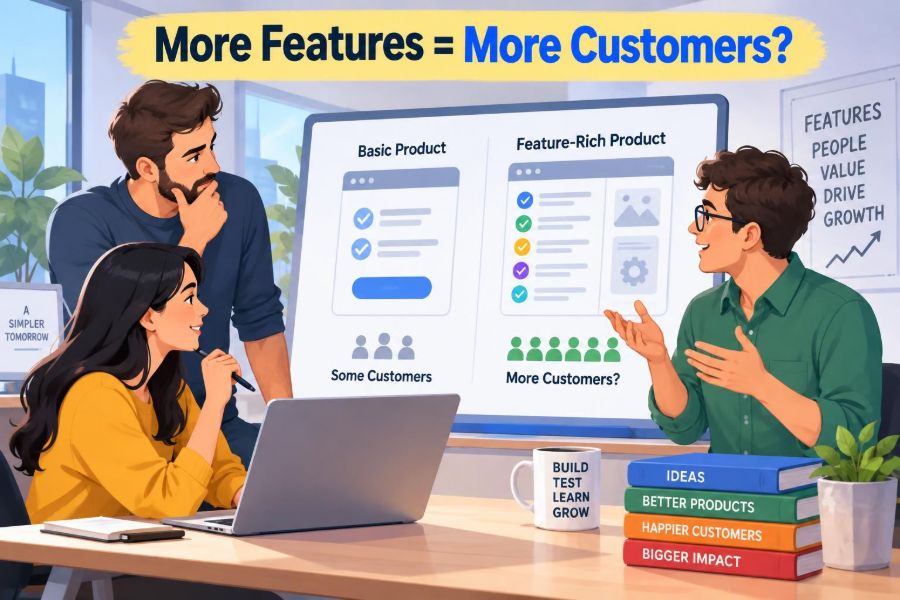

A longer feature list can feel like proof that your startup is becoming more valuable. You have listened to requests, shipped improvements, and can now show prospects a crowded product page full of possibilities. For founders, that momentum is intoxicating.
But customers do not buy effort. They buy a believable path from a frustrating problem to a better outcome. More features can help when they remove a meaningful barrier, make the core result easier to achieve, or fit a genuinely different customer segment. They hurt when they add confusion, setup work, cost, and support burden.
This question matters most for early-stage SaaS founders, productized service owners, app builders, and small businesses deciding what to build next. It also matters for solo founders, because every feature has an opportunity cost: time not spent talking to customers, improving onboarding, or selling.
Right now, customers have more software choices than ever and less patience for learning another complicated tool. The startup that makes a specific job feel simple often has a stronger advantage than the one with the longest checklist.
🧭 1. Start with the uncomfortable truth about feature counts
Features are inputs. Customer value, retention, referrals, and revenue are outcomes. A feature only deserves its place when it reliably improves one of those outcomes for a customer group you want to serve.
Many founders compare their product against an established competitor and see a gap-filled spreadsheet. They then build toward feature parity. That can be sensible in a mature market, but it is a dangerous default for a young company with limited cash and attention.
- Good reason to build: customers cannot complete the core job without it.
- Weak reason to build: a competitor has it and your team feels embarrassed.
- Warning sign: prospects ask what a feature means before they understand what your product does.
🎯 2. Define the one job customers hire you to do
Before adding anything, state the primary customer job in one sentence. A scheduling tool might help independent tutors fill available lesson slots without back-and-forth messages. That is clearer than “all-in-one operations software.”
Your best features make that job faster, safer, cheaper, or less stressful. Secondary jobs can matter later, but a startup usually wins attention by being memorable for one useful promise.
Use this simple test
When [specific customer] needs to [make progress], our product helps them [desired outcome] without [major pain or alternative].
If your team cannot agree on this sentence, more features will usually make the confusion worse rather than solve it.
🔍 3. Separate must-haves from nice-to-haves
A feature request is not automatically a feature requirement. Customers often describe a solution they recognize instead of the underlying problem. Your job is to investigate the problem before committing to their proposed answer.
| Feature type | Customer impact | Build priority | Typical example |
|---|---|---|---|
| Core enabler | Customer cannot get the promised outcome | High | Payment collection in an invoicing tool |
| Friction remover | Makes a frequent task noticeably easier | Usually high | Importing existing contacts |
| Trust builder | Reduces risk for a target buyer | Depends on segment | Activity logs for a team account |
| Delighter | Pleasant but not essential | Low initially | Extra themes or animations |
| Edge-case request | Helps very few customers | Validate carefully | A custom export format |
The distinction is not permanent. A trust builder may be essential for an enterprise buyer and irrelevant to a freelancer. Prioritization always depends on the market you are deliberately choosing.
🗣️ 4. Ask better questions before you build
“Would you use this?” produces polite optimism. Ask about past behavior instead. Talk to active users, recently churned users, prospects who said no, and people currently using a workaround.
- “Walk me through the last time this task went wrong.”
- “What did you try before, and what did it cost in time or money?”
- “Who else is affected when this is not solved?”
- “What would have to be true for you to switch or pay more?”
- “If this feature did not exist, what would you do instead?”
Listen for repetition, urgency, and consequences. Five vague requests are weaker evidence than two customers who repeatedly lose business, waste hours, or cannot meet a requirement without a solution.
📊 5. Score requests by evidence, not volume
Build a lightweight request scorecard so the loudest customer does not run your roadmap. The goal is not mathematical certainty. It is to make assumptions visible and comparable.
A practical scoring method
- Rate the problem severity from 1 to 5.
- Rate how often it occurs from 1 to 5.
- Rate confidence based on direct evidence from 1 to 5.
- Estimate reach: how many target customers will benefit.
- Estimate effort, including design, engineering, testing, documentation, and support.
A high-severity, high-frequency issue with strong evidence and modest effort is usually a better bet than a flashy feature requested by one large prospect. Keep the notes behind every score so the team can revisit its reasoning.
🧪 6. Validate the demand without a full build
You do not need to choose between ignoring a request and spending months building it. Test the commitment behind the request at the cheapest responsible level.
- Concierge test: deliver the result manually for a few customers.
- Clickable prototype: test whether people understand and want the workflow.
- Landing-page test: describe the outcome and collect qualified interest.
- Paid pilot: ask a customer to pay for early access or implementation.
- Wizard-of-Oz test: make an automated-looking process work behind the scenes temporarily.
Be transparent when something is manual or in development. Misleading people may produce a short-term signal, but it damages the trust a new business needs most.
🧱 7. Remember that every feature creates hidden work
Shipping code is only the first cost. Every feature creates decisions in navigation, permissions, billing, mobile layouts, performance, analytics, customer education, quality assurance, and support.
A simple integration can require token management, failure handling, privacy review, documentation, and ongoing maintenance when the other platform changes. Costs, taxes, data protection duties, and sector regulations vary by country, so obtain appropriate local professional advice when your product handles payments, health, employment, financial, or personal data.
Estimate the whole cost
Include build time, ongoing infrastructure, third-party tools, customer success time, and the cost of making the product harder to explain. A feature that takes one week to code may absorb months of operational attention.
🧠 8. Reduce cognitive load on the first screen
New users decide quickly whether a product feels manageable. If the first experience presents twelve modules, five setup choices, and unfamiliar language, many will leave before reaching value.
More capability does not require more visible complexity. Use progressive disclosure: show the next useful action first, then reveal advanced settings when a customer has context and a reason to use them.
- Lead with one primary action.
- Use customer language, not internal product labels.
- Offer sensible defaults instead of demanding configuration.
- Group rare settings behind an advanced area.
- Remove empty dashboards and irrelevant menu items for new users.
⚡ 9. Optimize for time to first value
A feature helps acquisition only if it helps a prospect believe they can succeed. For many startups, the strongest growth improvement is not another module; it is helping a new user experience the core outcome sooner.
For example, a social media planning tool should help a new customer schedule a useful first post quickly. It does not need to demonstrate every collaboration view, analytics filter, or approval rule on day one.
Map the path from signup to first meaningful result. Then remove steps, provide templates, import existing data, or offer a guided setup session. These changes often outperform a large feature launch because they make the existing promise real.
📈 10. Track the metrics that reveal whether features work
Feature launches can generate internal excitement while doing little for customers. Define success before release and measure behavior, not just clicks.
| Goal | Useful metric | Question to ask |
|---|---|---|
| Activation | Share reaching a key outcome | Do new users get value sooner? |
| Adoption | Eligible users completing the workflow | Is it solving a real routine? |
| Retention | Users returning over time | Does it create lasting value? |
| Revenue | Upgrades, expansion, or conversion | Will people pay for this outcome? |
| Quality | Error rate and support contacts | Did it introduce confusion or failure? |
Segment these numbers. A feature can be excellent for a high-value customer group while looking weak across everyone. Avoid celebrating vanity metrics such as a large number of page views with no evidence of completed work or retained customers.
💳 11. Use pricing to test actual value
Customers may praise a feature but refuse to change plans or renew because it is merely convenient. Payment is not the only sign of value, but it is a powerful one when the feature is tied to a commercial offer.
Consider including the feature in a higher tier, charging for usage that creates genuine cost, or packaging it as an optional add-on. Do not put basic usability behind a paywall simply to force upgrades. Customers need the core promise to work before premium options make sense.
Simple example
A freelancer invoice app might include invoice creation in its base plan and charge more for automated payment reminders, team permissions, or deeper reporting. The paid capability should save enough time, reduce enough risk, or create enough control to justify the price.
🧩 12. Build platforms only after a repeatable core exists
Integrations, APIs, plugins, and customization can expand a startup’s appeal. They can also turn a focused product into a difficult-to-support toolkit before the company has proven who it is for.
Build platform-like capabilities when customers repeatedly need to connect a stable core workflow to other tools, and when you can support the security and maintenance commitment. Do not build them just because “platform” sounds bigger than “product.”
- First prove one repeatable workflow.
- Identify the most common adjacent tools customers already use.
- Prioritize one reliable connection over many shallow ones.
- Document limits and ownership clearly.
- Measure whether integrations improve retention or sales cycles.
🚫 13. Avoid the common feature-bloat traps
The most expensive features are often built for emotional reasons: fear of losing a deal, fear of competitors, or fear that customers will think the product is too simple. Recognize these patterns early.
Trap one: the single-prospect roadmap
A large prospect requests a custom capability. Before agreeing, ask whether it can be generalized, whether they will pay enough to cover the full cost, and whether it pulls you away from your intended market.
Trap two: the hidden graveyard
Old features remain because deleting them feels risky. If usage is low and maintenance is high, communicate a deprecation plan, provide exports or alternatives, and remove clutter responsibly.
Trap three: settings as a substitute for decisions
Endless toggles make every customer responsible for product design. Strong defaults are often more valuable than limitless configuration.
🧭 14. Choose a strategy: depth, breadth, or focus
You do not need to reject more features forever. You need a deliberate reason for the kind of product you are building.
| Strategy | Best when | Main risk | Founder focus |
|---|---|---|---|
| Focused tool | One painful job is underserved | Market may be narrower | Exceptional simplicity and outcome |
| Deep specialist | A defined industry has complex needs | Over-customization | Domain expertise and trust |
| Broad suite | Customers strongly value consolidation | Complexity and slow execution | Coherent workflows across modules |
Early startups usually benefit from focus or depth. Breadth becomes more practical after you have distribution, a clear customer base, and the operational capacity to keep connected workflows dependable.
🔁 15. Turn feature requests into a disciplined roadmap
Create a single place where requests, customer interviews, usage data, and strategic notes live together. Review it on a regular rhythm rather than reacting to every message in real time.
- Collect the request and record the customer’s underlying problem.
- Tag customer type, plan, use case, and urgency.
- Look for repeated patterns across conversations and product data.
- Score likely impact, confidence, effort, and strategic fit.
- Test the strongest assumptions cheaply.
- Ship a narrow version, measure it, then improve or stop.
Tell customers what you heard without promising dates you cannot defend. A respectful “not now” is better than a vague promise that becomes silent disappointment.
🤝 16. Make customer feedback useful without becoming reactive
Customers are experts in their pain, not necessarily in your roadmap. Treat feedback as valuable evidence, then combine it with your product vision and economics.
Look especially closely at customers who renew, expand, refer others, or successfully use your product every week. Their behavior can reveal where durable value lives. Also study churned customers, but distinguish between a missing capability and a mismatch in price, timing, budget, or target market.
- Thank every thoughtful request.
- Ask for context, not just a vote.
- Share themes you are exploring.
- Do not let public upvotes replace direct conversations.
- Close the loop after a decision or release.
🛠️ 17. Know when a new feature is the right move
Yes, more features can attract more customers when they make your promise more complete for the people you want to serve. A missing payment option may unlock a market. A compliance control may enable larger teams. An import tool may make switching practical.
The right feature has a clear audience, a proven problem, a coherent place in the workflow, a realistic maintenance cost, and a measurable expected result. It strengthens what customers already understand about you instead of asking them to learn a new identity.
✅ 18. Your action plan for this week
Do not start by opening a ticket. Spend this week making the next decision more evidence-based.
- Day 1: write your one-sentence customer job and list every current feature.
- Day 2: mark which features enable the core job, remove friction, build trust, or create clutter.
- Days 3-4: interview five users or prospects about their most recent difficult workflow.
- Day 5: score your top three requests by severity, frequency, confidence, reach, and full effort.
- Day 6: design one low-cost validation test for the best candidate.
- Day 7: choose one metric that would prove the feature helped, and one condition that would make you stop.
The startup that earns trust is rarely the one with the most features; it is the one that makes an important customer problem feel easiest to solve. Build with evidence, protect simplicity, and let real customer outcomes—not a crowded roadmap—guide the next release. 🚀🧠📈