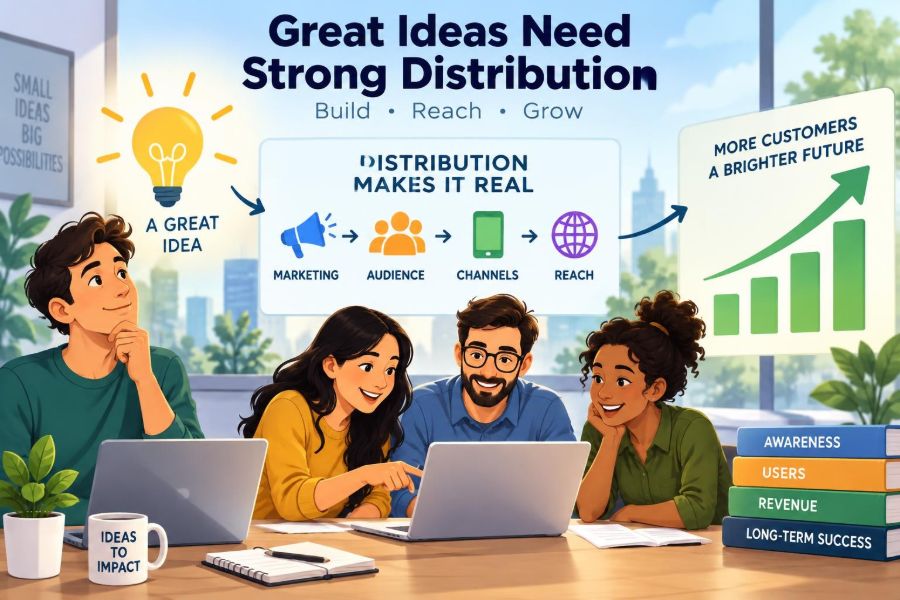

A good startup idea can solve a real problem, delight early users, and still go nowhere. That is not always a product failure. Often, it is a distribution failure: the right people never hear about the offer, do not trust it yet, or do not encounter it at the moment they need it.
This matters most for founders with limited time, money, and attention. If you are building a side hustle, launching a small service business, or testing software without a large audience, you cannot assume that “build it and they will come” will work. You need a repeatable path from obscurity to a customer conversation.
Distribution is not a dirty word for advertising, nor is it just posting constantly on social media. It is the practical system that puts your offer in front of a specific buyer, explains why it matters, earns enough trust, and makes taking the next step easy.
There has never been less friction to build a product, publish a website, or reach a global market. That convenience also means buyers face more choices than ever. A strong idea matters, but strong distribution is what gives that idea a fair chance to be chosen.
🧭 1. Understand the gap between a good idea and a viable business
An idea becomes a business only when people can consistently discover it, evaluate it, buy it, and recommend it. Product quality supports each stage, but it does not automatically create any of them.
Think of distribution as your route to market. It includes the channels you use, the message you carry, the sales process, your pricing presentation, partnerships, referrals, and customer retention.
- Good idea: “Freelancers need an easier way to track project scope.”
- Good product: A simple tool that makes scope tracking genuinely easier.
- Viable business: A clear way to repeatedly reach freelancers who have this problem and convert enough of them at a sustainable cost.
The final part is where many founders stall. They improve features while avoiding the uncomfortable work of finding, contacting, and learning from potential customers.
🔍 2. Start with a painfully specific customer
“Small businesses” is not a market you can efficiently distribute to. It is a huge collection of people with different budgets, habits, urgency levels, and buying processes.
Choose a narrow starting segment with a recognizable problem and a place where they already gather. For example, “independent bookkeeping firms with two to ten staff” is much more actionable than “finance professionals.”
Build a minimum customer profile
- What job are they trying to complete?
- What triggers them to seek a solution?
- What do they use or do instead today?
- Where do they ask peers for advice?
- Who approves the purchase, and what could stop it?
Start narrow because clarity improves every distribution decision. Your message becomes sharper, your prospect list becomes easier to build, and your first customer stories become more relevant.
🎯 3. Define the problem in language customers already use
Founders often describe the mechanism of their solution instead of the costly frustration it removes. Customers rarely wake up wanting “an AI-enabled workflow layer.” They may wake up late for work because invoices keep getting missed.
Listen for the words customers use in interviews, support threads, reviews, job posts, and communities. Use those phrases in your headline, outreach, and sales conversations without copying empty jargon.
A simple messaging formula
We help [specific customer] achieve [valuable outcome] without [painful trade-off].
For example: “We help independent designers get client approvals in one place without chasing feedback across email and chat.” It is not clever, but it is clear.
A useful test is whether a stranger can repeat what you do after one read. If they cannot, distribution will be more expensive because every channel must first overcome confusion.
🧪 4. Validate demand before you scale attention
Do not treat clicks, likes, or polite compliments as proof that you have demand. The strongest early signals involve a meaningful commitment: a detailed call, an introduction, a pilot agreement, a deposit, or a purchase.
Before spending heavily on promotion, run small tests that force a real choice. Offer a paid discovery session, a limited beta, a waitlist with a specific promise, or a manual service version of the product.
- Speak with potential customers one-to-one.
- Show a concise mock-up or outcome-based offer.
- Ask what they would need to switch or buy.
- Make a direct, respectful ask for payment or a next step.
- Record objections word for word.
Early rejection is useful data. It is far cheaper to alter your positioning after ten conversations than after building six months of features around an assumption.
📣 5. Choose one primary channel, not every channel
Most early teams do not lack marketing options; they lack focus. A company posting lightly on five platforms, running small ads, sending a newsletter, and attending random events usually learns very little from any of them.
Select one primary acquisition channel based on where your customers already pay attention and how urgently they need the solution. Add a second channel only after you have a repeatable process in the first.
| Channel | Best early use | Cost level | Effort level | What to track |
|---|---|---|---|---|
| Direct outreach | High-value, narrow B2B offers | Low cash | High | Reply and meeting rates |
| Content and search | Problems people actively research | Low to medium | High, slower | Qualified organic leads |
| Partnerships | Trust-driven niches | Low to medium | Medium | Introductions and conversions |
| Paid advertising | Offers with proven conversion economics | Medium to high | Medium | Cost per qualified customer |
| Communities and events | Relationship-based local or specialist markets | Low to medium | High | Conversations and follow-ups |
The best channel is not the trendiest one. It is the one you can reach consistently, learn from quickly, and afford to operate.
✉️ 6. Use direct outreach to learn faster
For many new B2B businesses, carefully targeted outreach is the fastest route to early revenue and honest feedback. It is not glamorous, but it puts you close to the buyer.
Build a short list of people who clearly fit your profile. Personalize the opening with a real observation, describe one relevant problem, and ask for a small next step rather than pitching a long demo immediately.
A practical outreach structure
- Show that you understand their context.
- Name a problem you believe they may face.
- State the outcome your offer can create.
- Ask whether they are open to a brief conversation.
Avoid misleading subject lines, automated spam, and exaggerated claims. Treat outreach as research with a commercial purpose. If messages do not get replies, improve the targeting and relevance before sending a larger volume.
Track delivery rate, positive reply rate, booked conversations, show-up rate, proposals sent, and deals won. These numbers reveal where the process is breaking.
🤝 7. Borrow trust through partnerships
New businesses have a trust problem. A partnership can shorten that gap when a credible person or organization already serves the audience you want to reach.
Potential partners include consultants, agencies, accountants, associations, software implementers, community organizers, educators, and complementary product providers. The right partner has an audience overlap and a reason to care about the result.
- Offer a useful workshop or guide for their audience.
- Create a referral arrangement with clear terms.
- Bundle a complementary service or product.
- Provide a special onboarding path for their members or clients.
- Share qualified leads only with consent and in line with privacy rules.
Make the partnership easy to explain and easy to execute. If the partner must learn a complicated pitch or risk their reputation on an untested offer, momentum will be slow.
🧲 8. Create an offer that is easy to say yes to
Distribution does not end when someone arrives on your site or agrees to a call. Your offer determines whether attention becomes action.
Early offers work best when they reduce uncertainty. Be explicit about who it is for, what is included, the expected timeline, the price or pricing logic, and what a customer needs to do next.
Reduce friction without making reckless promises
You might offer a short pilot, a fixed-scope first project, a cancellable monthly plan, or a guided setup. Do not offer unlimited work, vague “guarantees,” or a price so low that you cannot deliver well.
For a service, a defined starter package can be easier to buy than an open-ended retainer. For software, a guided trial can outperform a generic free account if the buyer needs help seeing value.
Track conversion by offer, not only by channel. A weak offer can make a promising channel appear ineffective.
🪜 9. Design a simple customer journey
People rarely move from first impression to purchase in one leap, especially when your product is new or expensive. Map the small commitments between awareness and payment.
A straightforward journey might be: useful post or referral, focused landing page, short diagnostic call, product demonstration, paid pilot, then ongoing plan. Not every business needs all those steps, but every step should have a purpose.
- Awareness: They recognize a relevant problem.
- Interest: They understand your point of view.
- Evaluation: They check fit, proof, price, and risk.
- Purchase: They complete a simple buying action.
- Success: They achieve an early valuable outcome.
Remove unnecessary forms, confusing package names, and delays in follow-up. The easier you make the next step, the more accurately you can judge actual demand.
🧾 10. Build proof before asking for scale
Customers want evidence that you can deliver, particularly if your business is unknown. Early proof does not require famous clients or polished case studies. It requires honest, specific signals.
With permission, document the starting problem, the work completed, and the result observed. If results are still emerging, share the process and what the customer valued rather than inventing dramatic outcomes.
Useful forms of proof
- Short customer testimonials with specific context.
- Before-and-after workflow examples.
- A product walkthrough showing a real use case.
- Transparent founder expertise and relevant experience.
- Clear policies for support, privacy, refunds, or service scope.
Never manufacture testimonials, imply endorsements that do not exist, or disclose customer information without permission. Trust gained slowly is still more durable than attention gained through misleading claims.
📚 11. Use content as a distribution asset, not a content treadmill
Content works when it helps a well-defined buyer solve a problem or make a decision. It fails when it is produced merely to satisfy a posting schedule.
Choose topics close to buying intent. A payroll consultant might publish a checklist for hiring a first employee, while a project-management tool might explain how to prevent scope creep. Both speak to problems that can lead naturally to an offer.
Turn one useful insight into several formats: an article, a concise email, a community answer, a short video script, and a sales-call resource. The goal is consistency of message, not endless originality.
Track qualified inquiries, email replies, demo requests, and assisted conversions. Views alone can be useful for awareness, but they are not enough to prove that content supports the business.
💬 12. Earn attention in communities without acting like a spammer
Industry groups, local networks, online forums, and professional communities can be excellent distribution environments because people already gather around shared problems. They can also punish obvious self-promotion.
Begin by observing the rules and repeated questions. Give clear, useful answers based on your experience. Mention your offer only when it directly helps and when the community’s guidelines allow it.
- Answer questions with practical detail.
- Share frameworks, templates, or lessons learned.
- Ask thoughtful questions that reveal market needs.
- Follow up privately only when invited or appropriate.
- Contribute regularly before asking for attention.
Your reputation is part of distribution. A helpful presence can generate introductions over time; a promotional one can close doors quickly.
💵 13. Know your acquisition economics early
You do not need a sophisticated finance team to understand whether a channel makes basic sense. You do need to know what you spend, what time is involved, and what comes back.
Estimate customer acquisition cost by adding direct spending and a reasonable value for the time required, then dividing by new customers from that activity. Compare it with gross profit, expected retention, and cash-flow timing.
For example, a founder may win a customer after several hours of outreach. That can be entirely sensible for a high-value service, but not for a low-priced product with little recurring revenue.
- Revenue per new customer
- Gross margin after delivery costs
- Acquisition cost in money and time
- Payback period
- Retention, repeat purchase, and churn
These are estimates, not universal rules. Costs, taxes, payment fees, employment obligations, and regulations vary by country and business model, so seek appropriate local financial and legal advice when needed.
📊 14. Track the funnel weekly, not just vanity metrics
A distribution system improves when you can identify the narrowest point. If plenty of people book calls but few buy, the issue may be qualification, pricing, proof, or the offer. If few people book calls, start with targeting and message relevance.
Keep a lightweight weekly scorecard
| Stage | Core metric | Question to ask |
|---|---|---|
| Reach | Relevant people contacted or reached | Did we reach the right audience? |
| Response | Replies, clicks, or sign-ups | Did the message create interest? |
| Conversation | Qualified meetings held | Are prospects a real fit? |
| Conversion | Customers or paid pilots | Is the offer compelling and clear? |
| Retention | Renewals, repeat use, referrals | Are we delivering ongoing value? |
Review numbers alongside notes from conversations. Quantitative data tells you where to look; customer language often tells you what to change.
🔄 15. Improve one constraint at a time
When growth is slow, it is tempting to redesign the brand, change the product, hire an agency, and open three new channels at once. That produces activity, not learning.
Choose one hypothesis for one stage of the funnel. For example: “A fixed-price onboarding package will increase proposal acceptance because buyers can understand the commitment.” Test it for a defined period, record the result, and decide what to do next.
- Identify the largest bottleneck.
- Write a specific explanation for it.
- Change one meaningful variable.
- Run enough relevant attempts to learn.
- Keep, revise, or discard the change.
This discipline prevents random marketing. It also protects your team from mistaking novelty for progress.
🛠️ 16. Build systems only after you find repeatability
Manual work is not always a flaw in the beginning. Personally onboarding customers, writing individual messages, and delivering a service by hand can reveal exactly what people value.
Systemize after you see a repeated pattern. Create a reusable sales script, onboarding checklist, proposal template, referral process, and simple customer relationship tracker. Use tools to reduce administrative friction, not to hide a weak value proposition.
Useful early tools
- A spreadsheet or simple CRM for leads and follow-ups.
- Calendar scheduling and video meeting software.
- Email software for thoughtful sequences and updates.
- Analytics that track key actions, not every possible click.
- Documentation for onboarding and delivery.
Do not buy an expensive stack just to look established. The tool should support a proven process, not become a substitute for one.
⚠️ 17. Avoid the distribution mistakes that waste the most time
The biggest errors are usually predictable. Recognizing them early can preserve scarce cash and founder energy.
- Waiting for perfection: You delay customer contact until the product feels complete.
- Marketing to everyone: Broad messaging gives no one a reason to care.
- Confusing attention with intent: Viral reach does not necessarily create buyers.
- Changing channels too quickly: You quit before gathering enough evidence.
- Ignoring follow-up: Many legitimate opportunities need more than one contact.
- Scaling paid ads too soon: You pay to amplify an unproven message or weak conversion path.
- Neglecting retention: You chase new customers while existing ones quietly leave.
None of these mistakes means your business is doomed. They simply create expensive blind spots. Fixing one can be more valuable than launching another feature.
🌱 18. Turn satisfied customers into your next distribution channel
The most durable growth often begins after the first sale. A customer who reaches a meaningful outcome can renew, expand, write a review, introduce you to peers, or become a reference.
Make customer success an intentional part of the business. Define the first result they should achieve, help them reach it quickly, check in at sensible intervals, and ask for feedback before asking for referrals.
When the moment is right, make referrals easy: explain who you help, provide a short description they can forward, and thank people appropriately. Avoid pressuring customers or offering incentives that conflict with rules in regulated industries.
Retention and referrals do not remove the need for acquisition, but they lower the pressure on every other channel. They are evidence that your distribution promise matches the delivered experience.
🗓️ 19. Your action plan for this week
You do not need a major launch to improve distribution. Pick a focused set of actions that creates real customer contact.
- Write a one-sentence description for one narrow customer segment.
- List 25 potential customers or five credible partners.
- Conduct five conversations using questions about current problems, alternatives, and buying triggers.
- Create one clear starter offer with scope, price logic, and next step.
- Send thoughtful outreach to the first ten qualified prospects.
- Set up a simple scorecard for replies, conversations, proposals, and sales.
- Review what you learned at the end of the week and choose one improvement.
Keep the work small enough to finish. The goal is not to manufacture momentum; it is to replace assumptions with evidence.
Great startup ideas deserve disciplined distribution, because customers cannot benefit from a solution they never discover, understand, or trust. Build the product, but build the path to the customer with the same care. 🚀📈🤝