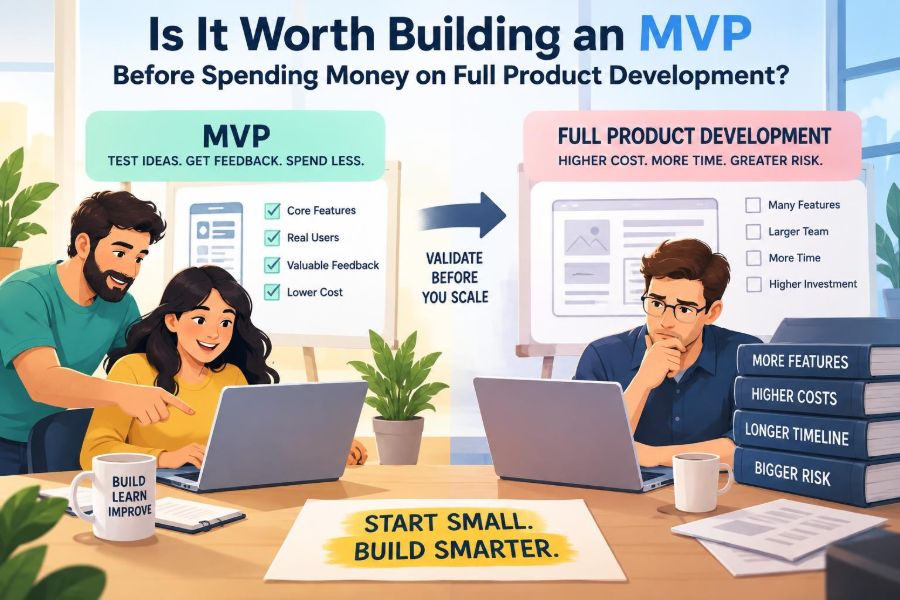

Most founders do not fail because they cannot imagine features. They fail because they spend months and a serious amount of cash building features that no one has committed to buying.
An MVP, or minimum viable product, is a disciplined way to reduce that risk. It suits first-time founders, bootstrappers, product teams with limited budgets, and established small businesses testing a new digital service.
This matters especially now because building software is faster and cheaper than it used to be, which creates a new problem: it is easy to build the wrong thing quickly. Customers still do not care how efficiently you wrote code if the result does not solve a painful problem.
Building an MVP is not automatically the right answer, and it is not an excuse to ship something careless. Used well, it helps you learn what is worth building before full product development turns your assumptions into expensive commitments.
🧭 1. Start with the real question
The question is not simply, “Should I build an MVP?” It is: what is the cheapest credible test that can reduce the biggest uncertainty in this business?
That uncertainty may be demand, willingness to pay, technical feasibility, customer acquisition, or whether users will return after trying the product. A downloadable prototype, paid consultation, concierge service, landing page, or small software release can each be an MVP in the right situation.
- If you do not know whether customers have the problem, test the problem first.
- If you know the problem but not whether they will pay, test an offer and price.
- If customers will pay but delivery is uncertain, test the workflow manually.
- If the workflow works, build the smallest product that automates the bottleneck.
💡 2. Define MVP accurately
An MVP is the smallest version of a product or service that delivers enough value to get meaningful customer feedback. “Meaningful” is important: compliments from friends are not meaningful feedback; use, payment, repeat behavior, and a clear refusal are.
It is not necessarily a stripped-down app. For a bookkeeping startup, the MVP could be a spreadsheet-supported monthly service. For a marketplace, it could be manually matching ten buyers and sellers. For a training platform, it could be one paid live workshop.
What an MVP is not
- Not a feature checklist: it solves one urgent job rather than offering a little of everything.
- Not a broken product: the core promise must work reliably enough to earn trust.
- Not a free survey: opinions matter less than behavior and payment.
- Not the final architecture: temporary manual work and imperfect systems are often sensible.
🎯 3. Choose one customer and one painful job
Broad target markets create broad MVPs. “Small businesses” is too broad; “independent dental clinics that lose appointment requests after hours” is something you can investigate.
Describe the customer’s job in plain language: “When a patient messages after closing, help the clinic capture the request and book a follow-up without staff checking another inbox.” That statement gives you a useful boundary for the first build.
A practical positioning template
For [specific customer] who struggle with [expensive or frustrating situation], we provide [outcome] without [current drawback].
Do not try to serve every segment at launch. A narrow starting point makes interviews, messaging, distribution, and product decisions much clearer.
🔎 4. Validate the problem before validating the solution
Talk to people who recently experienced the problem. Ask about their current process, the last time it happened, what it cost them, and what they have already tried. Avoid asking, “Would you use my app?” because people naturally want to be encouraging.
- List 20 to 30 people who plausibly match your customer profile.
- Invite them to a short learning conversation, not a sales pitch.
- Ask for specific stories and examples.
- Listen for repeated language, workarounds, urgency, and budget ownership.
- End by asking whether they would consider trying a proposed next step.
A strong signal is not universal enthusiasm. It is hearing a small group describe the same costly issue with urgency and agreeing to give time, data, access, or money to solve it.
💳 5. Test willingness to pay early
Free interest is cheap. Payment, a deposit, a letter of intent, or a scheduled pilot with a decision-maker is much more valuable evidence.
You do not need to charge a polished subscription on day one. You can offer a paid pilot, setup fee, refundable deposit, or founding-customer price. Be transparent about what is manual and what is still being developed.
Simple offer example
Instead of saying, “We are building AI admin software,” say: “We will handle and categorize your incoming customer requests for four weeks, send a daily priority list, and set up the workflow with you. The pilot costs [your tested price].”
If nobody buys after relevant conversations, do not immediately lower the price or add features. Find out whether the pain, buyer, timing, trust, or positioning is wrong.
🧪 6. Pick the right kind of MVP
The best format depends on what you need to learn. Start with the version that tests the risky assumption without creating unnecessary product debt.
| MVP type | Best for testing | Typical effort | Main limitation |
|---|---|---|---|
| Landing page and waitlist | Message and initial demand | Low | Does not prove retention |
| Clickable prototype | Usability and workflow | Low to medium | Does not deliver the outcome |
| Concierge service | Value, price, and process | Medium | Founder time does not scale |
| Wizard-of-Oz MVP | Experience before automation | Medium | Requires careful expectation setting |
| Single-feature product | Real usage and retention | Medium to high | Can still overbuild |
A “Wizard-of-Oz” MVP looks automated to the customer where appropriate, while a person completes work behind the scenes. Never misrepresent security, legal compliance, human review, or how customer data is handled.
🛠️ 7. Build only the critical path
The critical path is the shortest sequence from customer problem to promised outcome. Map it before choosing tools or hiring developers.
For example, a simple proposal-management product may need only: create proposal, add customer details, send it, track response. It does not need team roles, advanced branding, dozens of integrations, a mobile app, or complex reporting for its first test.
- Write the one outcome a customer should achieve.
- List every step required to achieve it.
- Remove, delay, or handle manually anything not essential.
- Set a maximum number of screens, workflows, or customer types.
- Define what “done” means before development starts.
💰 8. Set a learning budget, not just a build budget
Estimate what you can afford to lose while learning. The first MVP should have a capped budget, a clear deadline, and a decision point—not an open-ended development project.
Estimated costs vary widely by country, scope, technical requirements, and whether you use your own time. A landing page may cost very little using existing tools, while a secure regulated product can require substantial professional help from the beginning.
| Approach | Estimated cash cost | Time investment | What it can teach |
|---|---|---|---|
| Interviews plus simple offer page | Estimate: low, often under a modest monthly tools budget | 1 to 2 weeks | Problem language and interest |
| Manual paid pilot | Estimate: low to medium | 2 to 6 weeks | Value, pricing, delivery process |
| No-code workflow MVP | Estimate: low to medium | 2 to 8 weeks | Adoption and recurring use |
| Custom single-feature product | Estimate: medium to high | 1 to 4 months | Product behavior at greater scale |
Include design, hosting, software subscriptions, customer support, legal review, accounting, payment processing, and marketing experiments. Taxes, privacy rules, employment rules, and industry regulations vary by country and sector.
⚙️ 9. Use manual work as a strategic advantage
Founders sometimes feel embarrassed by manual operations. Early on, manual work can be a competitive research tool because it exposes every exception, objection, and point of confusion.
If you manually create reports for five customers, you will learn which parts they read, what data is missing, and where they are willing to wait. That is far better input for automation than a speculative feature roadmap.
Automate in this order
- Tasks customers repeatedly value.
- Tasks that consume significant internal time.
- Tasks with stable rules and few exceptions.
- Tasks where automation improves reliability, speed, or margins.
Do not automate a process you have not understood. You may simply build a faster way to deliver something customers do not value.
🧱 10. Protect quality where trust is at stake
“Minimum” never means careless with security, privacy, safety, money, or customer communications. If your product handles health information, financial decisions, children’s data, sensitive personal data, or regulated transactions, seek qualified legal, security, and compliance advice before testing.
Some businesses cannot responsibly begin with a rough public launch. In these cases, a private prototype, controlled pilot, simulation, or non-production test may be safer than an open MVP.
- Use clear consent and privacy notices.
- Collect only data necessary for the test.
- Control access to customer information.
- Create a support route for errors or urgent issues.
- Be honest about product limitations and human involvement.
📏 11. Decide the metrics before launch
Without a success definition, every result can be interpreted as good news. Choose a small set of measures tied to the assumption you are testing.
Useful early-stage metrics
- Qualified conversations: how many target customers completed a real discussion.
- Activation: how many users reached the first valuable outcome.
- Conversion: how many qualified prospects started a pilot or paid.
- Retention: how many return or continue after the first use period.
- Time to value: how long until the customer sees the promised benefit.
- Manual cost per customer: founder or team time required to deliver the result.
Do not obsess over vanity metrics such as raw page views or social likes. They can be useful diagnostics, but they do not demonstrate a sustainable business.
📣 12. Get first customers before the product feels finished
Early customers are not merely users; they are collaborators who help you discover whether a business exists. Start with direct, specific outreach to people in the niche you selected.
Use the problem language you heard in interviews. Explain the outcome, the scope of the pilot, what is still manual or limited, and the exact next step. A short personal message usually beats generic advertising at this stage.
First-customer channels to test
- Former colleagues, clients, and professional communities.
- Niche online groups where you contribute useful insight before pitching.
- Local businesses and industry events for location-based services.
- Partnerships with consultants who already serve your customer.
- Targeted outbound email or direct messages, done respectfully and lawfully.
Track the source of each conversation. Customer acquisition is part of the MVP: a product with no repeatable path to buyers is not fully validated.
🗣️ 13. Run pilots like structured experiments
A pilot should have a defined start, end, customer outcome, scope, price, and review date. Avoid vague arrangements where you provide unlimited work in exchange for uncertain feedback.
- Agree on the customer’s starting problem and desired result.
- Set up the smallest workable process.
- Observe use closely without constantly rescuing the experience.
- Check in at planned points and record exact feedback.
- Review results, renewal interest, and willingness to refer at the end.
Ask, “What would you do if this disappeared tomorrow?” The answer often reveals whether your product is a convenience, a useful tool, or a genuine must-have.
🔄 14. Learn from behavior, not feature requests alone
Customers will suggest features, and some suggestions will be excellent. But requests are inputs, not instructions. Look underneath them for the job, friction, or risk the person is trying to address.
If three customers ask for exports, they may not truly want exports. They may need to share results with a manager, meet a compliance requirement, or avoid typing data twice. Those needs could lead to very different product decisions.
After every customer interaction, record
- What they tried to accomplish.
- Where they hesitated, failed, or asked for help.
- What workaround they used.
- What they said they valued most.
- Whether their behavior changed after feedback.
Look for patterns across customers before building. One loud customer should not quietly become your entire roadmap.
🚫 15. Avoid the most common MVP mistakes
The classic mistake is building too much. It feels productive because a growing feature list is visible, but it postpones the uncomfortable work of asking customers to commit.
- Launching to everyone: choose a clear early adopter group.
- Giving everything away: test payment or a meaningful commitment.
- Measuring only acquisition: watch activation and retention.
- Ignoring onboarding: a small product still needs a clear first win.
- Taking feedback personally: rejection is evidence, not a verdict on you.
- Using “MVP” to excuse poor service: respect customers’ time and trust.
- Hiring a large team too early: keep learning loops short while the problem is uncertain.
🧮 16. Know when an MVP is not enough
There are cases where a thin public version is not appropriate. Hardware, medical products, safety-critical systems, enterprise security products, and heavily regulated financial services may need deeper validation, expert review, testing, insurance, and compliance before real customer use.
Even then, MVP thinking still applies. You can test customer demand, workflow assumptions, prototypes, procurement interest, and non-production demonstrations before committing to a full build.
The principle is not “release unfinished products.” The principle is reduce uncertainty in the safest, most economical credible way.
📈 17. Recognize signals that justify fuller development
Do not wait for perfect certainty; it never arrives. Move toward a stronger product investment when you have repeated evidence that the same core value works for a defined customer group.
Healthy signals include
- Customers pay or make concrete commitments without excessive persuasion.
- Several customers use the core workflow repeatedly.
- Retention or renewal is improving for the target segment.
- The same manual tasks recur and clearly limit your capacity.
- Your acquisition message consistently starts relevant conversations.
- You understand the core product requirements better than you did at the start.
At that point, write a focused product brief. State the validated customer, job, critical workflow, non-negotiable requirements, exclusions, budget, and metrics that justify the next investment.
🏗️ 18. Transition from MVP to a durable product
Full development should not mean adding every requested feature. It means improving reliability, usability, automation, security, support, and economics around the value customers already demonstrated.
Prioritize work that reduces friction in activation, improves repeat use, lowers delivery cost, and protects customer trust. Keep talking to users while building; a validated idea can still be implemented badly.
A sensible transition checklist
- Document the core workflow and its exceptions.
- Separate temporary manual steps from permanent service elements.
- Plan data handling, backups, access controls, and support.
- Estimate maintenance as well as initial development costs.
- Choose milestones that release value in stages.
- Keep a clear list of features deliberately postponed.
🧠 19. A practical decision framework
If you are unsure whether to build now, score your evidence honestly. You do not need a formal spreadsheet, but you do need to distinguish hope from proof.
| Question | Weak evidence | Stronger evidence |
|---|---|---|
| Is the problem real? | General agreement | Recent costly examples and existing workarounds |
| Will people pay? | “I would probably use it” | Paid pilot, deposit, or procurement step |
| Will they return? | One-time demo praise | Repeated use, renewal, or referral |
| Can you deliver it? | Unproven technical assumptions | Working manual or technical workflow |
| Can you reach buyers? | Large theoretical market | Repeatable conversations from identifiable channels |
When evidence is weak, run a smaller test. When evidence is strong across several rows, a fuller build becomes a business decision rather than a leap of faith.
✅ 20. Your action plan for this week
You do not need a pitch deck or a development agency to begin learning. Pick one focused experiment and complete it before planning the next quarter.
- Write one sentence describing your specific customer and painful job.
- List 20 people or businesses matching that profile.
- Schedule five conversations about their current process.
- Create one simple, honest offer for a paid or committed pilot.
- Set a maximum budget and deadline for your first test.
- Choose three metrics: commitment, first value, and repeat use.
- Review the evidence at week’s end and decide whether to continue, change direction, or stop.
Building an MVP before full product development is usually worth it because it buys learning at a fraction of the cost of being wrong. Treat it as a respectful experiment with real customers, not a shortcut around quality, and let evidence—not excitement—earn the next investment. 🚀🧪💬