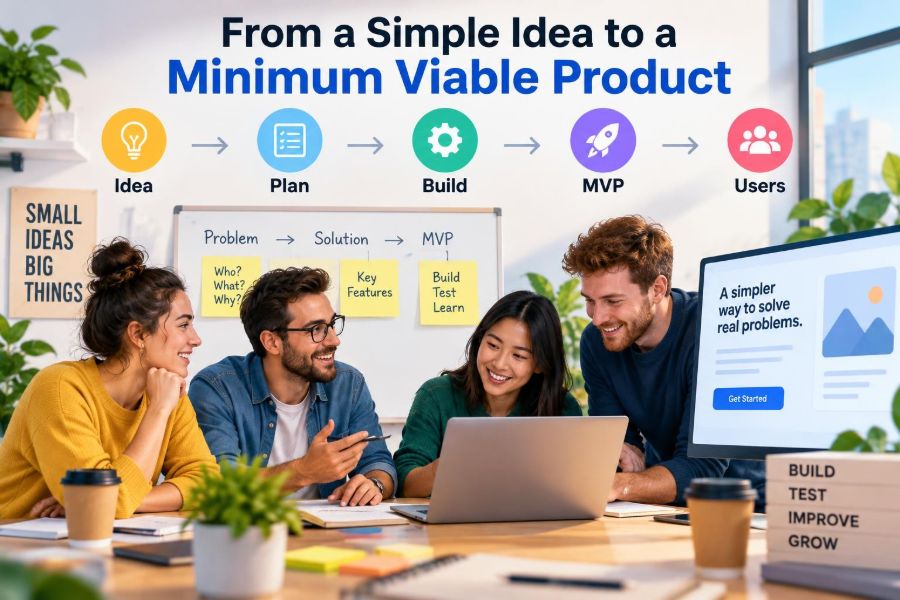

Most startup ideas do not fail because founders cannot build enough features. They fail because the founder spends months building before learning whether a specific group of people has a painful, frequent problem worth paying to solve.
A minimum viable product, or MVP, is your shortcut around that trap. It is not a cheap-looking first version of a finished company. It is the smallest credible test of your most important business assumption.
This process suits first-time founders, side hustlers, consultants turning expertise into products, and small-business owners exploring a new service. You do not need to be a developer, but you do need the willingness to talk to potential customers before hiding behind a screen.
It matters especially now because building tools are cheaper and faster than ever, while customers have less patience for vague products. The advantage is not simply shipping quickly; it is learning quickly enough to make better decisions with limited time and money.
🧭 1. Define What an MVP Actually Is
An MVP is the smallest version of an offer that lets you test whether customers will take meaningful action. That action might be paying, booking a call, uploading data, returning next week, or referring a colleague.
The word “viable” matters. A landing page with no way to deliver value may test interest, but it is not always an MVP. A useful MVP gives a real customer a real outcome, even if the process behind it is manual.
Three things an MVP is not
- Not a feature checklist: you do not need every setting, integration, or dashboard.
- Not an excuse for poor quality: the core promise must work reliably enough to earn trust.
- Not a permanent shortcut: manual work is acceptable at the testing stage, but should not become invisible chaos.
🎯 2. Start With a Painful, Narrow Problem
Broad ideas sound exciting but are difficult to validate. “A platform for freelancers” is a market category. “A tool that helps freelance designers collect overdue client feedback before a launch” is a problem you can investigate.
Choose a problem with a clear owner, a visible consequence, and a current workaround. If nobody is already trying to solve it with spreadsheets, email, reminders, contractors, or their own time, the pain may not be urgent.
A practical problem statement
Use this format: [specific customer] struggles to [complete a job] because [obstacle], which causes [cost or consequence].
For example: “Independent property managers struggle to keep maintenance requests organized because messages arrive through several channels, which causes delayed repairs and unhappy tenants.” This is specific enough to test without pretending you know the solution.
👤 3. Pick One Early Customer, Not Everyone
Your first customer segment should be small enough that you can describe where its members gather, what they do all day, and why they might trust you. Trying to serve everyone forces you to make generic decisions.
Early customers are often people with an unusually strong version of the problem. They may have high volume, little internal support, a deadline, or a financial reason to improve the current process.
Questions to narrow your audience
- Who experiences this problem at least weekly?
- Who has authority to choose or pay for a solution?
- Who is easiest for you to reach personally?
- Who has a workaround they openly dislike?
- Who benefits enough to tolerate an imperfect early product?
Start with one segment, such as “independent property managers with 50 to 200 units,” rather than “real-estate businesses.” You can expand later if the evidence supports it.
🔍 4. Separate Assumptions From Facts
Founders naturally fill gaps with assumptions: customers want automation, they will pay monthly, they will invite teammates, and they care about the feature you enjoy building. Write these beliefs down before they quietly become your strategy.
Then rank them by risk. The assumptions that could kill the business deserve testing first, not after your product is polished.
| Assumption | Simple test | Useful evidence |
|---|---|---|
| Customers feel the problem strongly | Problem interviews | Specific recent examples and current workarounds |
| They will pay | Ask for a paid pilot or deposit | Money, a signed commitment, or a clear purchasing process |
| You can reach them repeatedly | Run targeted outreach | Replies, calls, and a repeatable source of leads |
| Your solution improves outcomes | Concierge pilot | Faster work, fewer errors, or retained usage |
Compliments are not strong evidence. A customer saying “I would use this” is helpful only when followed by a concrete next step.
🗣️ 5. Run Customer Interviews Before Building
Talk with potential customers about their existing behavior, not your proposed product. Your goal is to understand the job they are trying to do and the moment it becomes difficult.
Aim for enough conversations to hear repeated patterns, not a magic number. Ten honest conversations within a tightly defined segment can teach more than a hundred broad survey responses.
A simple interview flow
- Ask them to describe the last time the problem happened.
- Ask what they did next, step by step.
- Ask what that workaround costs in time, money, risk, or frustration.
- Ask what they have tried already and why it did not work.
- Ask who would approve a purchase and what would need to be true to switch.
Listen for exact phrases. The language customers use to describe a problem can later improve your sales page, outreach, onboarding, and product labels.
🚫 6. Avoid Leading Questions
“Would you use an AI-powered dashboard that solves this?” invites polite agreement and teaches you very little. People are often generous with hypothetical praise because saying no feels awkward.
Instead, ask about past behavior. “How did you handle this last month?” is more useful than “Would this save you time?”
Common interview mistakes
- Pitching too early and turning research into a sales call.
- Accepting general complaints without asking for examples.
- Interviewing friends who are unlikely to be honest or representative.
- Hearing one enthusiastic opinion and treating it as market proof.
- Ignoring the buyer because you only spoke to the end user.
At the end, you can show a rough concept and ask for a next step. Keep the distinction clear: first learn about the problem, then test your solution.
🧪 7. Choose the Riskiest Thing to Test
Every idea has a central uncertainty. For a marketplace, it may be whether supply and demand can be matched in one local area. For a business software tool, it may be whether users will trust it with a workflow they currently manage manually.
Build your MVP around that uncertainty. Do not spend a month solving a technical challenge if your larger risk is whether anybody will buy.
Match the test to the risk
| If your biggest risk is… | Test this first | Do not start with… |
|---|---|---|
| Demand | Offer a paid pilot to a narrow audience | A full application |
| Ability to deliver results | Provide the service manually | Automation and integrations |
| Price sensitivity | Present clear price options in sales conversations | Free access with no conversion plan |
| Retention | Run a repeat-use pilot over several weeks | A one-time launch campaign |
| Technical feasibility | Build a narrow proof of concept | Branding and broad marketing |
🛠️ 8. Pick the Right MVP Format
Your MVP format should reduce time to learning, not prove that you can write code. Many valuable businesses begin as a service, spreadsheet, template, manual workflow, or simple prototype.
Concierge MVP
You personally deliver the promised outcome. A founder testing a meal-planning service might create plans by hand for five paying customers before building software.
Wizard-of-Oz MVP
The customer sees a simple product experience, but manual work happens behind the scenes. This is useful when automation is eventually important but unproven today.
Landing-page MVP
A focused page explains one benefit and asks visitors to join a waitlist, book a call, or apply for early access. It tests message-market fit, though not necessarily product value.
Prototype MVP
A clickable design, spreadsheet, or no-code workflow helps users complete a narrow task. Use it when interaction itself is the biggest question.
💸 9. Set a Learning Budget, Not Just a Build Budget
A responsible MVP budget includes money, time, and attention. Decide in advance what you can spend to reach a clear decision point, then avoid adding costs because they feel like progress.
Estimated costs vary widely by country, product type, taxes, regulations, and whether you use contractors. For many software or service MVPs, a lean first test can range from near-zero to a few thousand in local currency equivalent, especially if the founder does customer work personally.
| Approach | Estimated cash cost | Founder effort | Best for |
|---|---|---|---|
| Manual service test | Low | High | Testing a result before automation |
| Landing page and outreach | Low | Medium | Testing positioning and demand |
| No-code workflow | Low to moderate | Medium | Simple internal or customer-facing processes |
| Freelance-built prototype | Moderate to high | Medium | Testing an interaction requiring custom work |
| Custom application | High | High | Only after core demand is supported |
Keep business records from day one. Payment processing, data protection, consumer rules, insurance, tax registration, and industry licenses can apply even to a small pilot, depending on where you operate.
📝 10. Write a One-Page MVP Brief
A one-page brief prevents your MVP from expanding every time you have a new idea. It also makes conversations with collaborators, contractors, and early customers much clearer.
Your brief should include
- Customer: the exact initial segment.
- Problem: the costly situation they face now.
- Promise: one measurable or observable outcome.
- Core workflow: the minimum steps from start to result.
- Excluded features: what you deliberately will not build yet.
- Success signal: the action that proves meaningful interest.
- Decision date: when you will review results and choose the next move.
For example, your promise might be: “Help independent managers receive, sort, and follow up on maintenance requests within one working day.” That is easier to test than “modernize property management.”
✂️ 11. Ruthlessly Cut Features
For every feature, ask: “Can a customer receive the promised outcome without this?” If the answer is yes, remove it from version one.
Features often disguise founder anxiety. A dashboard can feel safer than calling customers. An account system can feel more legitimate than manually onboarding five people. But legitimacy comes from solving a real problem, not from building familiar software parts.
Keep only the core loop
- The customer provides the necessary input.
- Your MVP performs one valuable action.
- The customer receives a clear result.
- You learn whether they return, pay, or recommend it.
Everything else is optional until evidence says otherwise.
🏗️ 12. Build for Reliability at the Point of Value
“Minimal” does not mean careless. If your MVP handles payments, customer data, health information, financial decisions, or safety-related activity, your responsibilities are higher. Seek appropriate professional guidance where needed.
Focus quality on the moment your promise is delivered. A manual onboarding email can be plain. A calculation that determines a customer’s invoice must be accurate.
A practical quality checklist
- Can a new customer understand the first step without help?
- Does the core action work consistently?
- Is customer data collected and stored responsibly?
- Is there a human contact method when something goes wrong?
- Have you tested the workflow with someone unfamiliar with it?
📣 13. Get Your First Customers Through Direct Outreach
Your first customers are unlikely to appear because you posted once and waited. Direct, respectful outreach is usually faster because it gives you feedback as well as leads.
Start where your narrow audience already spends time: professional communities, local networks, industry events, former colleagues, niche newsletters, and relevant online discussions. Follow the rules of each space and do not spam people.
A simple outreach structure
Lead with a relevant observation, name the narrow problem, and make a low-pressure request. For example: “I am speaking with independent property managers about how they handle incoming maintenance requests. I am testing a simple service to reduce follow-up delays. Would you be open to a 15-minute conversation?”
At the earliest stage, a conversation is often a better goal than a sale. Once you understand their situation, offer a paid pilot only if your MVP genuinely fits.
💳 14. Ask for Commitment Earlier Than Feels Comfortable
Payment is not the only signal, but it is a powerful one. A paid pilot, deposit, signed letter of intent, scheduled implementation, or introduction to the buyer shows more than a casual waitlist signup.
Do not pressure people into buying something unfinished. Be transparent about what exists, what you will deliver manually, and what is still being tested.
Early pricing options
- Paid pilot: a limited-time test with defined outcomes and founder support.
- Setup fee plus service: useful when onboarding requires hands-on work.
- Per-result pricing: appropriate when the customer values a measurable completed task.
- Early-access subscription: suitable only when repeated usage is already plausible.
A low price can reduce friction, but free can attract people who have no urgent need. Your goal is not maximum signups; it is honest evidence about value and willingness to commit.
📊 15. Track a Few Metrics That Answer Real Questions
An MVP does not need a complicated analytics dashboard. Track a small set of numbers that tell you whether customers reached value and whether the experiment deserves another iteration.
| Metric | What it tells you | Simple way to track it |
|---|---|---|
| Qualified conversations | Whether you can reach the right audience | Spreadsheet or CRM notes |
| Activation | Whether customers complete the key first action | Manual event log |
| Time to value | How quickly the promise becomes real | Timestamp first input and first result |
| Repeat use | Whether the problem recurs and solution fits | Weekly customer activity review |
| Paid conversion | Whether value is strong enough to purchase | Offers made versus commitments received |
Add qualitative notes beside the numbers. If three customers stop using your MVP, the reason matters more than the fact that the number changed.
🔄 16. Run Short Learning Cycles
Set a short, focused cycle: perhaps one or two weeks for an outreach test, or several weeks for a recurring-workflow pilot. At the end, review what happened against the assumption you set out to test.
Use this loop: form a hypothesis, run the smallest test, collect evidence, decide what changes next. Resist the urge to change the audience, price, message, and product all at once. If everything changes, you cannot tell what caused the result.
Example hypothesis
“Independent property managers with more than 50 units will pay for a service that organizes maintenance requests because delayed follow-up is a weekly operational problem.” Your experiment should produce evidence for or against that statement, not just generate vague activity.
🧱 17. Learn From Negative Feedback Without Overreacting
Rejection is useful when it is specific. “We already use a system,” “the problem is not frequent enough,” and “I would need my maintenance team involved” are all clues about positioning, competition, buying process, or product scope.
One objection does not demand a pivot. Look for repeated patterns among people who match your target segment and genuinely have the problem.
Classify what you hear
- No problem: your segment or problem framing may be wrong.
- Problem, no urgency: the consequence may be too weak or timing may be poor.
- Urgency, no trust: improve proof, process, and credibility.
- Interest, no budget: test buyer, price, or revenue model.
- Interest, wrong workflow: simplify the product or adjust the delivery method.
🧭 18. Decide Whether to Persevere, Pivot, or Pause
After a defined test, make a decision deliberately. Founders often drift into endless building because choosing feels harder than coding. Your evidence will rarely be perfect, but it should be enough to choose the next small bet.
Persevere when
The target customers consistently describe the problem, some take meaningful action, and feedback points to improvements in execution rather than a missing need.
Pivot when
You see a stronger problem, buyer, use case, or business model emerging from the same research. A pivot is not abandoning learning; it is applying it.
Pause when
You cannot reach the audience, the problem lacks urgency, the economics look unsustainable, or the opportunity no longer fits your personal constraints. Pausing a weak test can protect resources for a better one.
📈 19. Scale the Proven Part, Not the Entire Company
Once a small group repeatedly gets value, pays, or reliably uses your MVP, identify the bottleneck. It may be lead generation, onboarding, delivery capacity, retention, or a manual task consuming too much founder time.
Scale one constraint at a time. If customers are not staying, more advertising only creates more churn. If manual delivery works but takes too long, automate the repeated step rather than rebuilding everything.
A sensible scaling sequence
- Document the successful customer workflow.
- Standardize onboarding and support.
- Automate repetitive internal tasks.
- Improve the product based on repeat customer requests.
- Test one repeatable acquisition channel.
- Hire or outsource only when demand and process justify it.
As you grow, review contracts, tax obligations, employment rules, privacy requirements, and any sector-specific regulations in your country. Operational maturity should catch up with customer traction.
✅ 20. Your Action Plan for This Week
You do not need a perfect business plan to start. You need a clear problem, a few conversations, and a small test that can teach you something important.
- Day 1: Write one narrow problem statement and list your five riskiest assumptions.
- Day 2: Identify 20 people who fit your first customer segment.
- Days 3-4: Request and conduct at least five problem interviews.
- Day 5: Review recurring language, workarounds, and objections.
- Day 6: Write a one-page MVP brief with one promise and one success signal.
- Day 7: Invite a small number of qualified people to a transparent pilot or next conversation.
The goal of an MVP is not to impress the market with how much you built; it is to earn the right to build more by learning what customers truly value. 🚀🧪📈