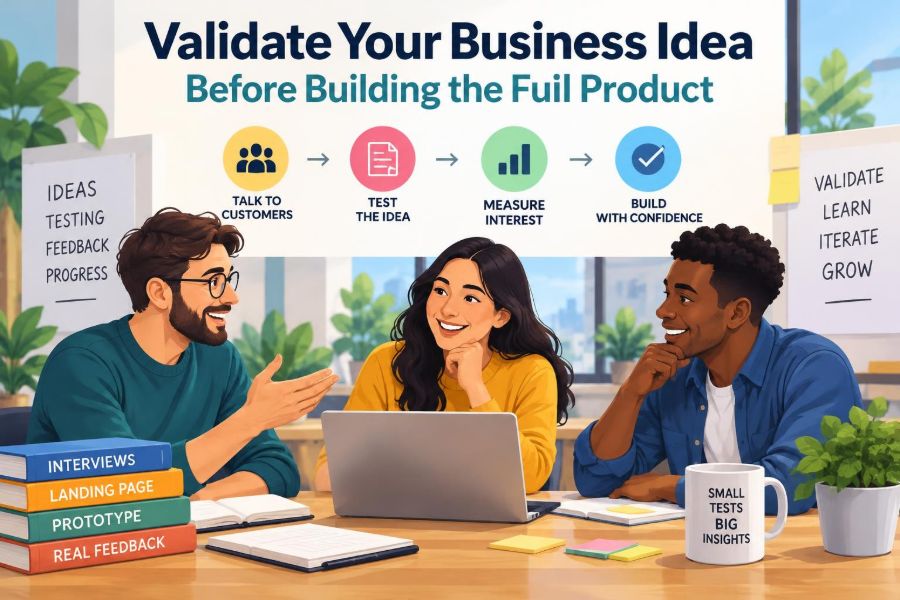

Most founders do not fail because they cannot build. They fail because they build something detailed, polished, and expensive before learning whether anyone urgently wants it.
That creates an avoidable trap: months of work become emotionally difficult to question. By launch day, feedback feels like rejection rather than useful information.
A smarter validation process is not about asking strangers whether they “like” your idea. It is about testing whether a specific customer will take a meaningful action: share a problem, give you time, join a waitlist, book a call, try a manual version, or pay.
This approach suits first-time founders, side hustlers, agencies turning a service into software, and small-business owners considering a new offer. It matters now because building tools are faster and cheaper than ever, which means the scarce resource is no longer code. It is clear evidence of demand.
🧭 1. Define Validation Before You Start
Validation is evidence that a defined group of people has a painful problem and will take action toward a solution. It is not applause, social-media likes, or compliments from people who want to be supportive.
Decide what evidence would change your mind before you begin. This prevents you from moving the goalposts after receiving weak signals.
Use an evidence ladder
| Signal | What it tells you | Strength | Typical cost |
|---|---|---|---|
| A person says the problem sounds useful | Your wording is understandable | Low | Free |
| A person describes their current workaround | The problem may be real | Medium | Free |
| A person gives contact details and agrees to a follow-up | There is interest | Medium | Free to low |
| A person books a demo or pilot | The problem has priority | High | Free to low |
| A person pays, deposits, or signs an agreement | There is commercial demand | Very high | Varies |
Start with a modest but specific threshold. For example: “I will continue if I interview 15 people in one niche and at least five agree to a pilot, including two who will pay a deposit.” The exact number varies by market and price point, but the commitment to a threshold matters.
🎯 2. Pick One Customer, Not Everyone
“Small businesses” is not a customer segment. Neither is “busy people” or “creators.” Broad markets produce vague messages and unusable feedback.
Choose a narrow initial segment with a shared workflow, language, and buying context. You can expand later, but you need a focused place to start.
Write a practical customer snapshot
- Role: Who feels the problem directly?
- Context: When and where does the problem happen?
- Trigger: What event makes them look for help now?
- Current method: How do they solve it today?
- Buyer: Who can approve and pay for a solution?
For example, replace “a scheduling tool for businesses” with “a no-show reduction service for independent beauty salons with two to 10 staff.” That statement gives you real places to look, concrete language to use, and a clearer initial offer.
🔥 3. Find a Problem With Consequences
Useful businesses often solve a problem that costs customers time, money, opportunities, confidence, or compliance effort. A mild annoyance can become a business, but it is harder to sell and retain.
Look for problems that occur frequently or become painful at a high-stakes moment. Repeated spreadsheet work, missed leads, delayed invoices, error-prone reporting, and complicated onboarding are better starting points than abstract “productivity” wishes.
Score the problem, not your excitement
- How often does it occur?
- What does it cost when it goes unresolved?
- Is someone actively seeking a workaround?
- Does solving it have a clear owner?
- Can the customer recognize improvement quickly?
Your personal enthusiasm is valuable fuel, but it does not replace customer urgency. A less glamorous problem with a buyer and a budget is often the stronger opportunity.
🕵️ 4. Research the Existing Workaround
If people have a serious problem, they usually do something about it already. They use a spreadsheet, a virtual assistant, a generic tool, a clumsy internal process, or simply accept a recurring loss.
Existing alternatives are good news. They show that behavior already exists. Your job is to understand why the current method is frustrating, expensive, risky, or incomplete.
Questions to investigate
- What tools or services are they using now?
- What do they like about the current approach?
- What takes too long or breaks most often?
- What have they already tried and abandoned?
- What would make switching feel risky?
Do not assume competitors prove your idea is too late. They may reveal an underserved niche, confusing pricing, weak onboarding, a service gap, or a different distribution route.
🗣️ 5. Run Problem Interviews, Not Pitch Meetings
The fastest early research method is a conversation about the customer’s past behavior. The goal is to learn what happened, not persuade them to endorse your solution.
Ask for examples from the last week or month. Specific stories are far more useful than opinions about a hypothetical future.
A simple interview flow
- Start with their role and normal workflow.
- Ask when the problem last happened.
- Explore what they did next and what it cost.
- Ask which tools, people, or processes were involved.
- Ask what they have already attempted to change.
- Only at the end, show a short concept and ask for a next step.
Try: “Tell me about the last time you had to chase an overdue invoice.” Avoid: “Would you use an AI tool that automatically chases invoices?” The first question reveals reality. The second invites politeness.
🚫 6. Recognize Weak Feedback Early
People often want to be encouraging. “That’s a great idea” can mean “I understand what you said,” not “I will buy it.” Treat praise as a reason to ask a better question.
Common misleading signals
- “I would definitely use that.”
- “My friend might need this.”
- “You should build an app for it.”
- “I would pay if it had feature X, Y, and Z.”
- “Keep me posted.”
Ask for commitment instead: “Would you spend 20 minutes next Tuesday testing this?” or “Would you join a paid pilot at this price?” A respectful no is much more valuable than a vague yes.
🧩 7. Turn the Insight Into a Testable Promise
After several interviews, summarize the recurring pattern in one sentence. This is your value proposition, not your product specification.
A useful structure is: “We help specific customer achieve measurable or meaningful outcome without current pain or trade-off.”
Example
“We help independent consultants turn call notes into client-ready follow-up plans without spending an hour formatting every meeting.” This is clearer than “an AI productivity platform.”
Make the promise narrow enough that someone can quickly decide whether it is for them. If it applies equally well to students, enterprises, and retirees, it is probably too broad for an initial test.
📄 8. Build a Landing Page Before a Product
A landing page tests whether your message earns attention outside a conversation. It does not need animations, a complete brand system, or a long feature list.
Use a no-code site builder, a simple form tool, or even a concise document with a booking form. Estimated startup cost: $0 to $100 for a domain, basic page, and form tools, depending on your country and chosen services.
Include only what supports a decision
- A headline naming the customer and outcome.
- A short explanation of the problem and your approach.
- Three concrete benefits, not 20 features.
- A clear call to action: apply, book, preorder, or join a pilot.
- A short qualification question to identify good prospects.
Be transparent if the product is not finished. You can say the service is in pilot or the first version is being developed. Misleading mockups may increase sign-ups briefly but damage trust when people discover the reality.
📣 9. Find Your First Test Audience Manually
Early validation does not require a huge audience. It requires access to people who closely match your initial customer profile.
Start where trust or relevance already exists: former colleagues, local groups, professional communities, niche newsletters, industry events, online forums where self-promotion is allowed, and direct outreach to well-matched prospects.
A practical outreach message
Keep it personal and research-focused: “Hi Sam, I am researching how small salon owners reduce last-minute cancellations. I noticed you run a team in this space. Could I ask you five questions in a 15-minute call? I am not selling anything on the call.”
When you have a clear offer, change the ask: “I am opening five pilot spots for a service that handles reminder and rebooking workflows. Would it be useful to see whether it fits your salon?”
Respect privacy rules, community guidelines, and anti-spam laws. Requirements for outreach, consent, data collection, and marketing vary by country.
🧪 10. Choose the Cheapest Honest Experiment
Your first experiment should test the biggest uncertainty with the least effort. Do not build a dashboard if you still do not know whether customers care about the outcome.
| Experiment | Best question answered | Effort | Evidence quality |
|---|---|---|---|
| Interviews | Is the problem real and understood? | Low | Medium |
| Landing page and outreach | Does the promise attract attention? | Low | Medium |
| Clickable prototype | Is the workflow understandable? | Medium | Medium |
| Concierge service | Will people pay for the outcome? | Medium | High |
| Preorder or paid pilot | Is there purchase intent now? | Medium | Very high |
“Honest” matters. Never pretend an automated feature exists when a person is manually doing the work unless the customer knows what they are buying. A manual backend is fine; deception is not.
🤝 11. Sell a Concierge Version First
A concierge MVP delivers the result manually before you automate it. This is one of the strongest tests for service businesses and software ideas alike because customers pay for an outcome, not your codebase.
For the consultant follow-up idea, you could collect meeting notes, use your own process to prepare a client-ready follow-up plan, and deliver it within 24 hours. The customer gets value now while you learn which steps are truly repeatable.
Skills and tools needed
- Customer interviewing and basic sales conversations.
- A repeatable operating checklist.
- Spreadsheets, forms, calendar scheduling, email, and secure file storage.
- Optional automation tools once a pattern is proven.
Estimated startup cost: $0 to $300 for basic software, payment processing, and small test campaigns. Your time is the largest cost, so track it carefully.
💳 12. Ask for Money Earlier Than Feels Comfortable
Payment is not the only form of validation, but it is the clearest commercial signal. Ask once a prospect understands the result, timeline, limits, and price.
You can sell a one-off paid trial, a discounted pilot, a refundable deposit, or a letter of intent for a future business purchase. Choose an arrangement that is appropriate for your market and legal setup.
How to frame an early offer
- State the specific outcome you will deliver.
- Explain what is manual or still being tested.
- Set a short pilot period and clear scope.
- Offer a simple cancellation or refund policy where appropriate.
- Ask for feedback and permission to measure results.
Do not hide behind free tests forever. Free users can be useful for usability feedback, but they often have different priorities from paying customers. Taxes, invoicing rules, consumer protections, and payment obligations vary by country, so check local requirements before collecting payments.
💰 13. Test Price as Part of the Idea
An idea is not validated if it attracts interest only at a price that cannot support the work. Pricing is a core assumption, not a detail to save for launch day.
Start with a simple price tied to the value and delivery effort. A manual service may need a higher price than future software because your labor is involved. That is normal.
Simple pricing tests
- Offer the same pilot to similar prospects at two reasonable price points.
- Ask prospects what budget they use for the current workaround.
- Compare the time you spend per customer with revenue collected.
- Offer a monthly option only if value recurs each month.
A low conversion rate does not automatically mean the idea is bad. The message, audience, timing, trust, scope, and price may all be wrong. Look for patterns across conversations rather than overreacting to one response.
📏 14. Track Behavior, Not Vanity Metrics
Views and likes can be useful diagnostics, but they are rarely decision metrics. Track the actions that move a stranger toward becoming a successful customer.
Keep a simple validation dashboard
- Number of qualified people contacted.
- Reply rate and interview booking rate.
- Interviews completed.
- Repeated problem mentions and current alternatives.
- Landing-page visitor-to-action conversion.
- Pilot offers made, accepted, and paid.
- Time required to deliver each pilot.
- Retention, repeat use, or referral intent after delivery.
Use a spreadsheet from day one. Add short notes after every conversation. The qualitative details often explain the numbers: a customer may decline because timing is poor, while still revealing a more urgent use case.
🔄 15. Learn Whether to Continue, Change, or Stop
Validation is not a ceremony that ends with a yes. It is a series of decisions. At the end of each test cycle, review the evidence against the threshold you set.
Three responsible choices
- Continue: The problem repeats, customers take meaningful action, and delivery produces value.
- Adjust: Interest exists but the customer segment, promise, channel, or price needs refinement.
- Stop: You repeatedly cannot find urgency or commitment after fair tests with the right audience.
Stopping is not failure. It is a cheap, disciplined decision that protects your time and lets you pursue a stronger opportunity. A founder who tests and abandons weak assumptions is building a valuable skill.
🛠️ 16. Build Only After You See Repeated Demand
Build the smallest product that removes the most repeated manual work or delivers the most important customer outcome. Your pilot process will show you what deserves engineering and what does not.
Do not automate exceptions too early. If every customer asks for a different workflow, you may have a high-touch service rather than a software product. That can still be a good business, but you should price and staff it accordingly.
Use this build order
- Standardize the outcome and customer onboarding.
- Document your manual steps.
- Identify the slowest, most frequent, lowest-judgment task.
- Automate or build that task first.
- Test the new version with current customers before adding features.
This sequence reduces waste because real usage, rather than imagined requirements, determines your roadmap.
⚠️ 17. Avoid the Most Common Validation Mistakes
Founders rarely fail validation because they lack a survey tool. They fail because they protect the original idea from evidence.
- Interviewing only friends: They are often too polite and may not match the buyer.
- Asking leading questions: “Wouldn’t this save time?” produces biased answers.
- Building before selling: Code can become an excuse to avoid uncomfortable customer conversations.
- Testing too many audiences: Mixed feedback hides patterns.
- Offering every feature: A broad promise makes it impossible to learn what drives demand.
- Ignoring delivery economics: Revenue is not enough if each customer requires unsustainable labor.
- Confusing attention with trust: A viral post may not reach people with authority to buy.
Correct these mistakes by narrowing the audience, shortening the test, and asking for a stronger commitment.
📈 18. Scale the Process, Not Just the Product
Once you have paying customers and a repeatable result, scale carefully. Your next challenge is proving that acquisition, delivery, retention, and support work beyond a handful of friendly early adopters.
Document the channel that produced your best customers. It might be targeted partnerships, local networks, content for a narrow profession, referrals, direct sales, or marketplace listings. One reliable channel is more useful than five random experiments.
Metrics to watch as you grow
- Customer acquisition cost, including your paid marketing and sales time.
- Conversion from qualified conversation to customer.
- Gross margin after delivery and support costs.
- Customer retention or repeat purchase rate.
- Time to first customer value.
- Referral rate and reasons customers leave.
Growth should make the business sturdier, not simply busier. If new customers create chaos, improve onboarding, pricing, operations, or product constraints before increasing spend.
✅ 19. Your Action Plan for This Week
You do not need a perfect business plan to begin. You need a clear customer, a testable assumption, and enough conversations to discover whether the problem deserves your effort.
- Day 1: Write one customer snapshot and one problem statement.
- Day 2: Make a list of 30 people or businesses that fit the profile.
- Day 3: Send 10 respectful interview requests.
- Day 4: Conduct at least three problem interviews and record exact phrases.
- Day 5: Draft a one-sentence promise and a basic landing page or pilot description.
- Day 6: Invite five qualified people to a call, trial, or paid pilot.
- Day 7: Review commitments, objections, and your next assumption to test.
Keep the cycle short. The purpose is not to prove you are right; it is to get closer to what customers will actually value and pay for.
The smartest first product is often not software at all—it is a small, honest experiment that earns real customer commitment before you invest deeply. 🚀🔍💡