
Most startup ideas do not fail because their founders cannot build. They fail because the founder builds too much before learning whether anyone will actually pay.
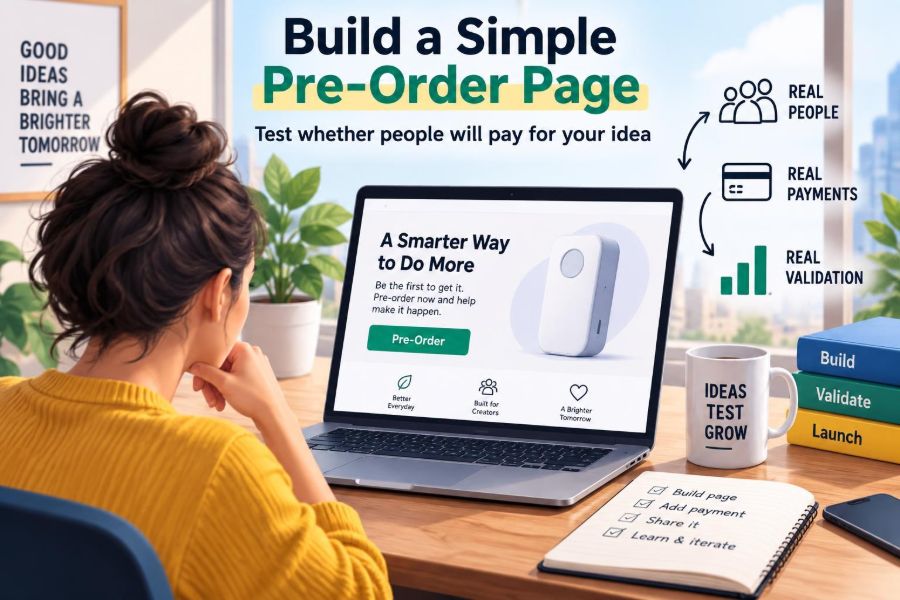
A simple pre-order page is one of the most practical ways to test demand without spending months creating a product, stocking inventory, or hiring a developer. It asks a more useful question than “Do people like this?”: “Will people commit money, or at least a meaningful signal, to this?”
This approach suits aspiring founders, makers, service providers, small retailers, and side hustlers with a clear offer but limited time or budget. It works especially well for products with a specific outcome, limited early access, or a launch date customers can understand.
It matters now because building tools are cheaper and faster than ever, while attention is still expensive. A focused page and a small traffic test can teach you more about an idea than a polished brand deck or a dozen encouraging conversations.
The goal is not to manufacture hype or take money for something you cannot deliver. The goal is to make a fair, transparent offer, collect evidence, and decide what deserves your next 100 hours.
🎯 1. Define What a Pre-Order Test Actually Proves
A pre-order page presents an offer before the full product is ready. A visitor can either pay a deposit, place a refundable reservation, join a waitlist, or leave their email to request early access.
Each action is a different level of evidence. An email address is useful. A card payment is much stronger. A refundable deposit sits in between and can be a sensible choice when your delivery timeline is still uncertain.
Use the right claim for the signal you collect
- Email signup: “People are interested enough to hear more.”
- Waitlist with a qualifying question: “People recognize the problem and may fit the target market.”
- Refundable deposit: “People have some intent and trust the offer enough to commit.”
- Paid pre-order: “Some people will pay at this price, under these conditions.”
Do not treat a large waitlist as proof of a business. It is a promising signal, not a contract. The useful result comes from comparing visitors, actions, conversations, and the cost of getting each person.
🧭 2. Choose an Idea That Is Suitable for Pre-Selling
Pre-orders work best when buyers can picture the outcome before the product exists. You need to explain the problem, the proposed solution, who it is for, and when it will be available in plain language.
A physical product, a cohort-based course, a specialized service package, a digital template library, a local event, or a niche software tool can all be tested this way. An idea that depends on years of research, complex regulation, or unknown technical feasibility needs more validation before taking payment.
Good candidates
- A desk organizer designed for people with small workspaces.
- A meal-planning membership for busy parents managing specific dietary needs.
- A bookkeeping setup service for freelance creatives.
- A scheduling tool for a narrow profession with repetitive admin work.
- A practical workshop with a clear date, topic, and outcome.
Red flags
- You cannot describe the core benefit in one sentence.
- You do not know what you can realistically deliver or when.
- The product needs safety approvals, licenses, or legal review before use.
- The promise depends on outcomes you cannot control, such as guaranteed investment returns or medical results.
If your idea is not ready for a pre-order, test the problem first with interviews, a manual concierge service, or a simple prototype.
🔎 3. Narrow Your Customer Before You Write a Word
A vague customer creates a vague page. “Small businesses” is not a customer segment; “independent fitness studios that lose trial leads after the first inquiry” is much closer.
Pick one early customer group. They should have a recognizable problem, an existing way of solving it, and a reason to act now.
Write a one-line customer definition
Use this formula: People who are [specific role or situation], struggling with [expensive or frustrating problem], and trying to achieve [desired outcome].
For example: “Remote workers in small apartments struggling to keep a work area tidy without packing everything away every evening.” This is more useful than “people who like organization.”
- Where do these people already spend time?
- What words do they use for the problem?
- What do they use today?
- What makes the current option inadequate?
- What event makes the problem urgent?
These answers become your page copy, your targeting, and your first outreach list.
🧪 4. Write a Testable Hypothesis
Before you build anything, define what you are testing and what result would make you continue. Otherwise, you can reinterpret every result as good news.
A basic hypothesis might be: “If we show a $39 early-bird pre-order for a compact desk organizer to remote workers in small apartments, at least 5 out of 200 qualified visitors will start checkout, and at least two will complete a purchase.”
The exact numbers depend on price, traffic quality, and how unfamiliar the offer is. You are not chasing a universal conversion benchmark. You are creating a decision rule before emotion gets involved.
Set three possible decisions
- Continue: enough qualified interest and payments to justify deeper work.
- Revise: people engage but do not buy, suggesting an issue with audience, message, price, or trust.
- Stop or pause: little response after a fair test with relevant traffic.
A weak result is not personal failure. It is cheaper feedback than an unsold batch of inventory.
💡 5. Shape One Offer, Not a Catalogue
Your first page should sell one clear offer. Multiple products, pricing tiers, and optional add-ons create confusion and make the results harder to interpret.
State what the buyer gets, who it helps, the early-bird price, and the expected delivery window. If the product is not final, say so directly.
A simple offer structure
- Product: a compact cable-management desk organizer.
- Outcome: a clear work surface in under two minutes.
- Early offer: first batch at $39 instead of the planned $49.
- Availability: limited to 50 early supporters.
- Delivery: estimated for a specific month, subject to production validation.
- Protection: full refund available before shipment.
Only use scarcity when it is real. A limited production run, a limited number of service slots, or a genuine early-bird batch is fair. A fake countdown timer harms trust and teaches you nothing useful.
💰 6. Price for Learning, Not Just for Attention
A free offer measures curiosity. A very cheap offer can measure bargain hunting. Your test price should be close enough to a sustainable price that a purchase means something.
You can provide an early-bird discount, but avoid making the test so inexpensive that it attracts people who would never buy later. A 10% to 25% early supporter discount is often easier to explain than a dramatic reduction.
| Test method | Customer commitment | Best use | Main limitation |
|---|---|---|---|
| Email waitlist | Low | Very early idea or audience building | Interest may not become payment |
| Refundable deposit | Medium | Physical products or uncertain timelines | Refund handling adds administration |
| Full pre-order | High | Clear offer with credible delivery plan | Creates a serious delivery obligation |
| Paid pilot service | High | Services and software concepts | May not scale in its manual form |
Calculate your rough economics before publishing. Include materials, manufacturing or fulfillment, payment fees, shipping, refunds, customer support, taxes, and your own time. Costs and tax obligations vary by country, product category, and sales location.
🧰 7. Pick a Lean Tool Stack
You do not need custom software to test an idea. Use a simple landing-page builder, a checkout tool, an email capture form, basic analytics, and a spreadsheet for tracking conversations.
The best stack is the one you can publish this week. Avoid spending days comparing platforms when a basic template can do the job.
| Item | Typical purpose | Estimated monthly cost | Effort |
|---|---|---|---|
| Domain name | Memorable web address | $10-$25 per year | Low |
| Landing-page tool | Build and publish page | $0-$30 | Low |
| Payment processor | Collect payment or deposits | Usually transaction fees | Low |
| Email tool | Confirm interest and follow up | $0-$25 | Low |
| Design assets or mockups | Make the concept understandable | $0-$100 | Medium |
| Small traffic test | Reach target customers | $50-$300 | Medium |
Estimated startup cost: roughly $60 to $450 for a basic test, excluding product development, inventory, and professional legal advice. You can spend less through direct outreach, but time is still a real cost.
🖼️ 8. Create a Credible Visual Without Faking a Finished Product
People need to understand what they are buying. A rough sketch may be enough for a service, while a physical product usually needs a clear mockup, render, prototype photo, or annotated diagram.
Never present a concept render as a factory-ready product photograph. Label it clearly as an illustration, prototype, or early design where needed.
Useful visual options
- A clean digital mockup showing the product in use.
- A photographed handmade prototype, even if it looks rough.
- A three-step diagram showing the customer journey.
- A short screen recording for a software workflow.
- A sample lesson, template, or deliverable for an information product.
The visual job is clarity, not perfection. Show scale, context, and the problem being solved. One honest, useful image beats a decorative collection of stock photos.
✍️ 9. Build the Page Around a Buying Decision
A pre-order page should answer the questions a careful buyer asks before they click. Do not bury the offer under your origin story.
Use this page order
- Headline: name the outcome for a specific customer.
- Subheadline: explain what the product is and why it is different.
- Primary visual: show the product or result in context.
- Call to action: pre-order, reserve, or join the pilot.
- Problem: show that you understand the current frustration.
- How it works: explain the offer in three simple steps.
- What is included: remove ambiguity.
- Price and timeline: state both plainly.
- Risk reversal: explain refund or cancellation terms.
- Questions: answer the predictable objections.
Keep one primary call to action. If the page says “Buy now,” “Book a call,” “Join our community,” and “Follow us,” visitors may choose none of them.
🗣️ 10. Use Copy That Sounds Like Your Customer
The easiest way to write better copy is to use language from real conversations. Interview potential customers before launch and listen for their exact frustrations, workarounds, and desired outcomes.
Instead of “an innovative productivity solution,” say what changes: “Keep your laptop, charger, and cables in one place so your kitchen table can become a dining table again.”
Headline examples
- For remote workers with limited space: “A calmer desk in two minutes, without a permanent office.”
- For freelance designers: “Get your bookkeeping system organized before tax season becomes a scramble.”
- For studio owners: “Follow up with every trial lead before they join another gym.”
Be specific about limitations too. If your product only fits certain device sizes, serves one region, or is for beginners, state it. The wrong customer is not a conversion you need.
🛡️ 11. Be Transparent About Timelines, Refunds, and Risk
Pre-orders ask customers to trust you before the final product exists. Treat that trust as seriously as you would treat their money.
State the estimated delivery date, what could change it, how you will update buyers, and how refunds work. Do not use “shipping soon” if you do not know when production can begin.
- Describe the offer as a pre-order or early-access purchase.
- Give an estimated delivery month or service start date.
- Explain whether customers can cancel and receive a refund.
- Include contact details or a clear customer-support route.
- Keep records of every promise made on the page.
Consumer protection, tax, privacy, payment, advertising, and product-safety rules vary by country and industry. Check the requirements relevant to your location and buyer location, especially for physical products, health-related claims, financial products, food, children’s goods, and regulated services.
📣 12. Find Your First 25 Qualified Visitors Manually
Before paying for traffic, put the page in front of people who closely match your customer definition. Manual outreach gives you better context than anonymous clicks.
Start with people you can reach respectfully: former colleagues, relevant online communities where promotion is allowed, local groups, newsletter contacts who opted in, professional associations, or customers of a related service.
A respectful outreach message
“I am testing an early version of a [product] for [specific group]. It is designed to help with [problem]. I am not asking you to buy unless it is genuinely useful, but could you take two minutes to look at the page and tell me what is unclear?”
Ask for feedback before asking for a sale. If someone is interested, let them decide without pressure. Do not scrape email addresses, spam groups, or pretend you have a relationship you do not have.
📢 13. Run a Small, Controlled Traffic Test
Paid traffic can help when you know where your customers are, but it cannot rescue an unclear offer. Begin with a limited budget you can afford to lose as research spending.
Test one audience, one main promise, and one page at a time. If you change everything at once, you will not know what caused the result.
Simple testing sequence
- Send direct outreach and organic traffic first.
- Collect questions and revise confusing sections.
- Create two headline variations around different benefits.
- Run small campaigns to a relevant audience.
- Review behavior after enough visits to spot patterns.
- Follow up with interested people and ask what held them back.
Estimated ad-test budget: $50 to $300 can be enough for an initial directional test, depending on your market and channel. Competitive audiences may cost more, and a small sample should never be treated as definitive market research.
📊 14. Track the Metrics That Tell You What Happened
Vanity metrics can make a weak test feel exciting. A large number of page views means little if visitors are not the right people or do not take the next step.
| Metric | What it indicates | Question to ask |
|---|---|---|
| Qualified visitors | Relevant reach | Did the right people see the page? |
| Call-to-action clicks | Initial purchase intent | Is the main offer compelling? |
| Checkout starts | Stronger intent | Are price and terms acceptable? |
| Completed orders or deposits | Demand signal | Will people commit financially? |
| Cost per lead or order | Acquisition feasibility | Could this become profitable? |
| Refund requests | Trust and expectation fit | Did customers understand the offer? |
| Feedback themes | Message and product gaps | What keeps repeating? |
Track the source of every meaningful action. A customer from a personal referral may behave very differently from someone who clicked a broad advertisement.
🧠 15. Interview Buyers and Non-Buyers
The checkout result tells you what happened. Conversations help explain why. Contact buyers to thank them, confirm expectations, and learn what made the offer worthwhile.
Also speak with people who visited, signed up, or started checkout but did not buy. Do not argue with their answer or lead them toward your preferred conclusion.
Questions worth asking
- What caught your attention first?
- What problem were you hoping this would solve?
- What do you use instead today?
- What almost stopped you from ordering?
- How did the price feel compared with alternatives?
- What would need to be true for you to buy?
- What would make you regret buying?
Look for repeated patterns, not isolated opinions. One person asking for a feature is a data point; five qualified people describing the same concern deserves attention.
🔧 16. Diagnose a Weak Result Before You Abandon the Idea
If few people buy, do not immediately conclude that the idea is worthless. First identify where the journey breaks.
- Few qualified visitors: your distribution or targeting needs work.
- Visitors leave quickly: the headline, visual, or audience match is weak.
- People click but do not start checkout: the offer may be unclear or insufficiently valuable.
- People start checkout but do not finish: investigate price, payment friction, delivery terms, and trust.
- People buy but later cancel: expectations and delivery confidence need improvement.
Revise one major element at a time. You might reposition from “organization tool” to “end-of-day desk reset,” target a narrower audience, show a better prototype, or offer a deposit rather than full payment.
🚫 17. Avoid the Common Pre-Order Page Mistakes
The biggest mistake is treating the page as a marketing costume rather than a learning system. Your goal is not to look bigger than you are; it is to learn quickly without damaging your reputation.
- Collecting payments without a plausible fulfillment plan.
- Using fake testimonials, fake scarcity, or misleading product images.
- Promising dates you have not researched.
- Sending cold spam instead of targeted, permission-based outreach.
- Ignoring refunds, taxes, shipping, and support costs.
- Changing audience, price, copy, and product all at once.
- Celebrating signups while avoiding conversations about payment.
- Continuing to spend on ads after clear evidence that the message is not landing.
Trust is an asset, especially for a small founder. Protect it from the first test onward.
📈 18. Decide Whether to Build, Pilot, or Pivot
At the end of the test, review both numbers and conversations. You are looking for evidence that a defined group has a real problem, understands your offer, and will exchange money under honest terms.
Build further when
- Qualified people purchase or place meaningful deposits.
- You can explain why they bought in clear language.
- Your rough unit economics have a path to viability.
- You can deliver the first version without unacceptable risk.
Run a manual pilot when
- Customers want the outcome but the product details are unclear.
- You need to learn the workflow before automating it.
- A service can deliver the value while you validate demand.
Pivot or pause when
- You cannot attract the intended audience at a reasonable effort or cost.
- Conversations reveal a different, more urgent problem.
- The economics do not work even with realistic assumptions.
- You cannot deliver responsibly within the promised constraints.
A pivot is not a reset to zero. You keep the audience knowledge, language, and distribution lessons you earned.
🗓️ 19. Your Action Plan for This Week
Do not turn this into a month-long branding project. Give yourself a short deadline and publish a useful first version.
- Day 1: define one customer, one problem, one offer, and one success threshold.
- Day 2: talk to five potential customers or review existing customer conversations.
- Day 3: create one honest mockup, prototype image, or sample deliverable.
- Day 4: write and publish the page with price, timeline, and refund terms.
- Day 5: send it personally to ten to twenty relevant people and ask for candid feedback.
- Day 6: fix the clearest confusion and begin a small, controlled traffic test if appropriate.
- Day 7: review actions, conversations, costs, and your next decision.
Keep a simple document with your hypothesis, screenshots of each page version, traffic sources, customer comments, orders, refunds, and lessons. That record will make your next test smarter.
A pre-order page will not guarantee a business, but it can replace expensive guessing with honest evidence about whether people will pay for your idea. Build the smallest fair test, listen closely, and let the market guide your next move. 🚀 🧭 💬