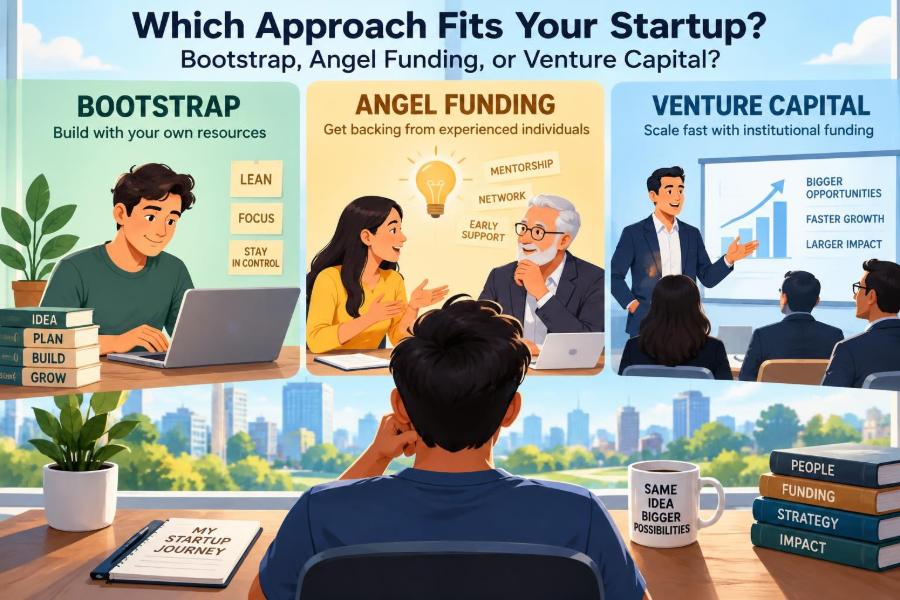

Most founders do not fail because they picked a bad funding label. They struggle because the money they choose quietly creates a business they did not mean to build: a high-growth company when they wanted freedom, a slow self-funded company when speed mattered, or a pitch-heavy startup before anyone had proved customers care.
Bootstrap, angel funding, and venture capital are not ranks on a startup ladder. They are different operating systems. Each changes your timeline, ownership, hiring plan, personal risk, decision-making, and definition of success.
This decision suits anyone with an early business idea, a side hustle gaining traction, or a small company wondering whether outside money would help. It matters especially now because building is cheaper in some areas, customers expect polished products quickly, and capital is never a substitute for a clear business model.
The useful question is not, “Which funding route sounds most impressive?” Ask, “What kind of company am I building, what evidence do I have, and what constraints am I willing to accept?” This guide will help you answer that honestly.
🧭 1. Start With the Company You Actually Want
Before comparing funding sources, define the destination. Funding is a tool for reaching a destination; it should not choose the destination for you.
A lifestyle business, a profitable local company, a durable software firm, and a category-defining technology company can all be excellent outcomes. They simply require different amounts of capital and different levels of growth pressure.
- Bootstrap is often strongest for companies that can reach customers early and grow from cash flow.
- Angel funding can fit a promising business that needs focused capital, expertise, or introductions before it can fund itself.
- Venture capital is usually designed for businesses pursuing very large, fast-growing markets where being early and well-funded matters.
Write a one-sentence outcome statement: “In five years, I want to own and run a profitable company with a small team,” or “I want to build a platform that can serve millions of users across several markets.” That sentence filters a surprising number of bad funding decisions.
🔎 2. Diagnose the Problem Before You Diagnose the Funding Gap
Founders often say they need money when they actually need customer insight, a narrower offer, a technical co-founder, or a better sales process. Capital can amplify a working system, but it can also help you waste money faster.
Ask these questions first
- Can you describe a painful customer problem in plain language?
- Have real potential customers confirmed that the problem is important?
- Is there a clear buyer with a budget or a realistic path to payment?
- Do you know what milestone money would unlock?
- Could a smaller, paid version of the offer test the core assumption?
For example, a founder building workflow software for accountants may believe they need $300,000 to build a full platform. But ten paid pilot customers using a manual concierge service might reveal which workflow deserves automation. The first problem is validation, not financing.
📊 3. Compare the Three Paths at a Glance
| Approach | Best fit | Main cost | Typical pace | Core pressure |
|---|---|---|---|---|
| Bootstrap | Early revenue is possible; owners want control | Personal time, savings, slower expansion | Customer-funded | Profitability and cash flow |
| Angel funding | Early traction plus a specific growth or build need | Equity, reporting, investor expectations | Selective acceleration | Milestones and credible progress |
| Venture capital | Large market, scalable model, need for rapid growth | Meaningful equity, governance, high expectations | Aggressive expansion | Outsized growth and eventual liquidity |
These are broad patterns, not rules. A bootstrapped business can grow quickly, and a venture-backed company can be careful with spending. Still, the incentives behind each source of money are real and should be understood before you accept it.
🌱 4. Understand What Bootstrapping Really Means
Bootstrapping means starting and growing primarily with your own resources, customer revenue, retained profit, and sometimes modest non-dilutive support. It does not mean refusing all help or doing every task yourself forever.
The central discipline is simple: make the business useful enough that customers help finance its next stage. That usually encourages focus, pricing discipline, and close contact with buyers.
What it is best for
- Service businesses, agencies, consulting practices, and local operations.
- Software products that can start with a focused niche or paid pilot.
- Commerce brands with manageable inventory cycles and healthy margins.
- Founders who value control and can tolerate a steadier pace.
Estimated startup costs: these can range from a few hundred for a simple service offer to tens of thousands for inventory, compliance, equipment, or product development. Costs, taxes, insurance, permits, and regulations vary substantially by country and industry.
🧰 5. Build a Bootstrap Plan That Does Not Rely on Heroics
Bootstrapping is not “work endlessly and hope.” Build a narrow plan around an offer customers can buy before the finished company exists.
- Choose one customer segment with a costly, frequent problem.
- Create the smallest credible paid offer, even if delivery is partly manual.
- Set a price that leaves room for labor, software, taxes, refunds, and profit.
- Sell directly to learn objections before spending heavily on marketing.
- Use the first revenue to improve the bottleneck, not to add vanity features.
A bookkeeping founder might begin with monthly cleanup for a particular type of freelancer, document the process, hire carefully, then turn the recurring patterns into templates or software. The work is less glamorous than launching a broad app, but it creates useful evidence.
Skills and tools to prioritize
- Customer interviews, basic sales, pricing, and cash-flow management.
- A simple website, invoicing system, spreadsheet, customer relationship manager, and analytics.
- Written processes so delivery does not depend entirely on the founder.
💵 6. Use Revenue as Your First Form of Financing
Customer money is valuable because it tests willingness to pay. A waiting list, compliments, and social engagement can be encouraging, but an invoice paid on time is stronger evidence.
Consider revenue models that support cash flow rather than delay it:
- Deposits or retainers for custom services and projects.
- Pre-orders when you can reliably explain the product and delivery timeline.
- Subscriptions for ongoing support, content, software, or replenishment.
- Paid pilots for business-to-business products that need proof before a larger rollout.
- Annual contracts where the customer receives a sensible incentive for paying earlier.
Be transparent about what is ready and when it will be delivered. Taking payment for a promise you cannot reasonably fulfill can damage trust and create legal or refund problems.
⚠️ 7. Know the Limits and Risks of Bootstrapping
Bootstrapping can become a virtue signal. It is not automatically wiser to grow slowly if competitors, platform shifts, regulation, or customer demand make speed strategically important.
Its common risks include founder burnout, underinvesting in security or compliance, taking too many low-margin clients, and confusing revenue with a repeatable business. Cash shortages can also push founders into poor pricing or desperate discounting.
Guardrails that help
- Separate personal and business finances from day one.
- Track a monthly cash forecast, not just the bank balance.
- Set a maximum amount of personal savings you can responsibly risk.
- Review whether each customer segment is profitable after delivery costs.
- Get professional accounting, legal, and tax advice when complexity rises.
Control is valuable only if you use it to make better decisions. Do not cling to full ownership of a company that lacks the resources to safely serve its customers.
😇 8. Learn What Angel Funding Is Designed to Do
Angel investors are individuals who invest their own money in early-stage companies, usually in exchange for equity or a convertible instrument. Some are former operators; others are experienced investors. Their check sizes, involvement, and expectations differ widely.
A good angel can provide more than cash: relevant feedback, hiring introductions, customer access, and calm perspective during difficult decisions. A poor fit can create distracting advice, misaligned expectations, or pressure without meaningful help.
Estimated raise and setup costs: fundraising itself can consume months of founder time. Legal documentation, incorporation, accounting, and investor administration add costs. The right amount is the amount needed to reach a specific value-creating milestone, plus a reasonable buffer, not the largest amount someone offers.
🎯 9. Raise From Angels Only for a Specific Milestone
“We need money to grow” is not a fundraising plan. Investors need to understand what their capital changes.
Better milestones sound like: build a compliant product prototype, convert pilot users into annual contracts, prove a customer acquisition channel, complete a critical certification, or hire a specialist who removes a genuine technical bottleneck.
Build a milestone budget
- List the outcome you must prove within the next 12 to 18 months.
- Break it into people, product, customer acquisition, operations, legal, and contingency costs.
- Remove expenses that do not advance the milestone.
- Define measurable proof that the milestone is complete.
- Calculate your runway using realistic monthly spending, not best-case assumptions.
If an angel investment does not meaningfully improve the odds of reaching a next milestone, dilution may not be worth it.
🤝 10. Find Angels Through Relevance, Not Just Wealth
The best early investor often understands your customer, industry, or operating challenge. A retail operator may be more helpful to a commerce startup than a wealthy person with no connection to the business.
Start building relationships before you are urgently fundraising. Ask for feedback on a specific problem, demonstrate that you listen, and keep people updated as you make progress.
A practical outreach sequence
- Create a short investor summary covering problem, customer, evidence, team, model, use of funds, and risks.
- Identify angels with credible relevance to your market or stage.
- Request a focused conversation, preferably through a warm introduction when appropriate.
- Show customer evidence and clear thinking rather than exaggerated projections.
- Follow up with meaningful progress, not repeated “just checking in” messages.
Never treat an angel as an ATM. You are inviting someone into a long relationship with information rights, opinions, and a stake in your outcome.
🗣️ 11. Pitch Angels With Evidence and Intellectual Honesty
A strong early pitch makes uncertainty visible without sounding helpless. Explain what you know, what you are testing, and why the next use of capital is rational.
- Problem: What is broken, for whom, and how costly is it?
- Solution: What do customers receive, and what is different about it?
- Proof: Paid users, pilots, retention signals, interviews, prototypes, or operational learning.
- Market: A credible route to enough customers, not an inflated global total.
- Economics: Pricing, margins, sales cycle, and assumptions still being tested.
- Use of funds: The milestone, timeline, and major spending categories.
Common mistakes include hiding churn, claiming competitors do not exist, using vague market numbers, and raising on enthusiasm alone. Sophisticated investors expect unknowns. They worry more when founders refuse to see them.
🧾 12. Protect the Relationship With Clear Terms
Money is only one part of a financing agreement. Ownership, voting rights, liquidation preferences, information rights, future fundraising mechanics, and board involvement can matter for years.
Do not sign documents you do not understand because the process feels exciting or urgent. Use a qualified lawyer familiar with startup financing in your jurisdiction, and involve an accountant where appropriate.
Questions to ask an angel investor
- What is your usual level of involvement after investing?
- Have you invested in companies at a similar stage?
- How do you approach follow-on rounds and difficult periods?
- What updates do you expect, and how often?
- Could I speak with founders you have previously backed?
References work both ways. You should assess an investor as carefully as they assess you.
🏗️ 13. Understand the Venture Capital Model
Venture capital firms invest pooled capital into companies that may produce very large outcomes. Because many investments will not return capital, the model generally looks for a small number of businesses capable of growing dramatically and producing a substantial exit through acquisition or public markets.
This means venture capital is not conventional business financing. It is a partnership designed around high uncertainty, scalability, and the possibility of exceptional returns.
VC can be appropriate for software, marketplaces, network businesses, deep technology, biotech, capital-intensive innovation, or other models where a large market opportunity and speed create a compelling case. It is often a poor fit for a stable business that could become profitable through patient execution.
🚦 14. Check Whether Your Business Is Truly VC-Fundable
Do not decide based on whether VCs are interested this month. Use a harder test: does the business need venture-scale capital, and could it plausibly produce venture-scale outcomes?
Signs VC may fit
- A very large addressable market with a credible way to reach it.
- A product that can scale faster than headcount and delivery costs.
- Strong growth, retention, or usage signals that improve with investment.
- Competitive dynamics where speed, data, distribution, or network effects matter.
- A team capable of recruiting and operating through rapid change.
Signs it may not fit
- Growth is fundamentally tied to adding employees one by one.
- Customers are profitable but the market is naturally limited.
- The founder wants to prioritize dividends, stability, or long-term family ownership.
- There is no credible path to liquidity on a venture timeline.
None of the second list makes a company bad. In many cases, it makes it a better candidate for bootstrapping, strategic partnerships, debt, grants, or other financing options.
📈 15. Prepare for VC Diligence Before You Start Pitching
VC fundraising often consumes attention at the exact moment customers need you. Prepare your materials so the process does not turn into frantic document hunting.
- A concise deck with the problem, insight, product, market, traction, business model, team, and funding plan.
- A financial model based on stated assumptions, with a cash runway view.
- Core customer metrics, contracts, cohort information, and pipeline details where relevant.
- Cap table, incorporation records, intellectual-property assignments, and material agreements.
- Clear security, privacy, regulatory, and employment practices appropriate to your stage.
Do not manufacture precision. A young company can responsibly say, “We have only six months of data, so this is a preliminary retention trend.” Clean records and honest assumptions are more useful than decorative spreadsheets.
🔥 16. Spend Venture Money Like It Is Temporary
VC money can make a startup look healthier than it is. A large bank balance is not product-market fit, and hiring quickly does not guarantee speed.
Create a spending plan around the few inputs most likely to create the next financing or profitability milestone. Review it monthly as new customer evidence appears.
Healthy uses of capital
- Hiring for proven bottlenecks in product, sales, customer success, or compliance.
- Building infrastructure required by real usage, reliability, or regulation.
- Testing repeatable acquisition channels with disciplined measurement.
- Entering a new market only after the existing motion shows evidence of repeatability.
Common errors include hiring ahead of a clear operating need, paying for broad awareness before conversion works, and building too many features for hypothetical customers. Cash creates options; protect those options.
📏 17. Track Metrics That Match Your Stage
The right metric is the one that tells you whether your next assumption is becoming true. Avoid copying dashboards from companies with different models.
| Stage | Useful metrics to track | What they reveal |
|---|---|---|
| Idea and validation | Interviews completed, pilot commitments, conversion to paid test | Problem urgency and willingness to pay |
| Early revenue | Monthly revenue, gross margin, cash runway, repeat purchase | Economic viability and cash discipline |
| Product growth | Activation, retention, churn, support volume, usage frequency | Whether customers receive continuing value |
| Scaling | Sales cycle, acquisition cost, payback period, expansion revenue | Whether growth can be repeated responsibly |
Metrics are conversations, not trophies. If retention is weak, spending more on acquisition may simply enlarge the leak.
🧮 18. Model Dilution, Runway, and Your Personal Risk
Every choice has a cost. Bootstrapping may dilute your savings and time; equity funding dilutes ownership and can limit future flexibility. Put the trade-offs on paper.
For a simple ownership check, use this idea: your ownership after a round = your ownership before the round × (1 - new investor ownership). Real cap tables can include option pools, convertibles, preferences, and multiple investors, so obtain professional advice before relying on a simplified calculation.
Also calculate runway: cash available ÷ average monthly net cash burn = estimated months of runway. Update it frequently. Revenue timing, taxes, payroll, inventory, and unexpected legal or technical costs can all change the answer.
Ask yourself what you can personally absorb. A founder with dependents, debt, immigration constraints, or limited savings may reasonably choose a less volatile route. That is risk management, not lack of ambition.
🔀 19. Consider Hybrid Routes and Alternatives
The choice is not always one route forever. Many companies bootstrap to early revenue, raise an angel round for a defined expansion, and later decide whether venture capital fits. Others use a mix of revenue, strategic partnerships, grants, loans, or pre-sales.
Alternatives deserve careful consideration, especially when equity is expensive:
- Grants may support research, innovation, community programs, or specific industries, but application processes can be slow and restrictive.
- Loans or lines of credit can preserve ownership but require repayment and may be dangerous without predictable cash flow.
- Revenue-based financing can align repayment with sales, but total costs and contract terms need close scrutiny.
- Strategic partners can provide distribution or expertise, though exclusivity and control provisions deserve legal review.
- Pre-sales validate demand but create delivery obligations immediately.
Choose the least expensive capital, in both financial and strategic terms, that can realistically get you to the next milestone.
🛑 20. Avoid the Funding Traps That Hurt Good Startups
Some mistakes appear across every path because they are emotional rather than financial. Founders raise to feel validated, avoid raising because they fear judgment, or spend to look successful.
- Raising before you can explain the customer problem and use of funds.
- Accepting money from misaligned investors because the offer arrived first.
- Underpricing to create artificial traction.
- Ignoring legal, tax, employment, privacy, or industry regulations.
- Using vanity metrics instead of retention, margin, cash flow, and conversion.
- Assuming the next round, major client, or viral launch will rescue weak fundamentals.
- Letting fundraising replace customer conversations.
The antidote is boring but powerful: maintain a cash forecast, talk to customers weekly, document decisions, and revisit your funding thesis as evidence changes.
✅ 21. Make the Decision With a Founder Scorecard
Give each statement a score from one to five, where one means “not true today” and five means “strongly true.” The result is not a formula, but it exposes the conversation you need to have.
- We can get paying customers without a large upfront product build.
- Our unit economics can become positive at a realistic scale.
- Speed is strategically essential in our market.
- Our market is large enough to support a venture-scale outcome.
- We have evidence of retention or repeat demand.
- We know exactly what a new investment would achieve.
- We are comfortable sharing ownership and governance.
- We can responsibly carry the personal risk of self-funding.
High scores on early revenue and control may point toward bootstrapping. Strong evidence plus a focused milestone may support angels. High scores on market size, scalable growth, urgency, and team capacity may support a VC conversation.
🗓️ 22. Your Action Plan for This Week
Do not spend the week endlessly reading about funding. Use it to create evidence and reduce uncertainty.
- Write your one-sentence company outcome and the next milestone that matters.
- Interview five target customers or re-contact five existing customers about their most expensive problem.
- Build a 12-month cash forecast with conservative revenue assumptions.
- List every expense required to reach your next milestone and cut nonessential items.
- Create a one-page summary of your offer, traction, risks, and funding need.
- Decide whether your immediate priority is selling, preparing for angels, or testing VC suitability.
- Schedule one conversation with a founder or operator who has used the path you are considering.
Keep the decision reversible where possible. You can usually delay a funding round more easily than you can undo poorly matched investors or months spent pursuing capital you did not need.
The best funding approach is the one that gives your startup enough fuel to reach its next real milestone without forcing you to build someone else’s version of success. Build evidence, protect your options, and let customers—not startup mythology—guide the next move. 🚀🌱💡