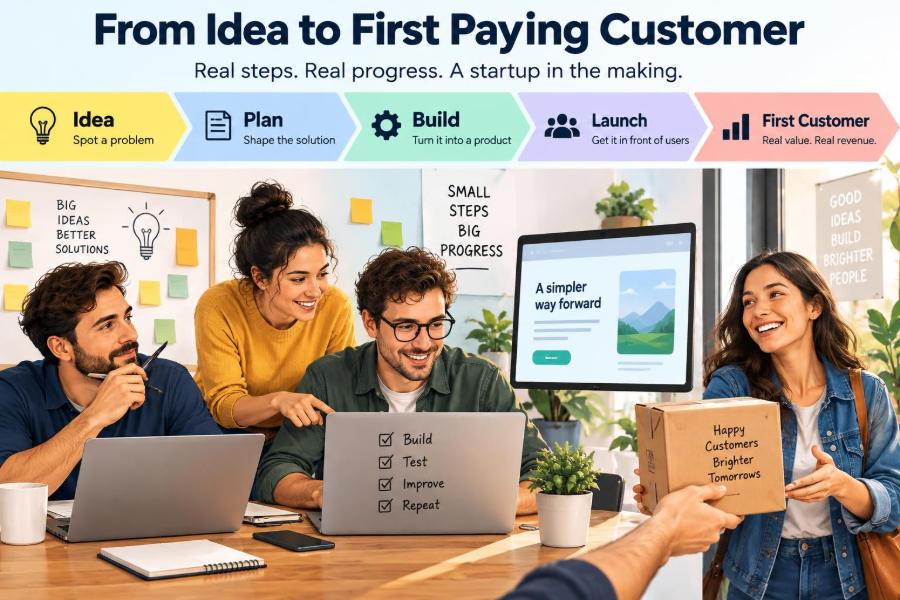

Most startup advice makes the journey look cleaner than it is. It usually begins with a person noticing an annoying, expensive, or slow problem, then spending weeks wondering whether anyone else cares enough to pay for a better answer.
This path suits people who can tolerate uncertainty and keep moving before everything feels ready. You do not need to be a brilliant inventor, a developer, or a natural salesperson, but you do need to be willing to talk to strangers, hear “no,” and revise your assumptions.
It matters now because small teams can test ideas faster than ever with no-code tools, online communities, freelance talent, and direct access to niche audiences. Those advantages do not remove the hard work; they simply make it cheaper to learn what is worth building.
A startup is not a pitch deck, a logo, or a launch post. It is a series of increasingly credible answers to one question: will a specific customer pay for this solution?
🧭 1. Start With a Problem, Not a Product
Your first useful idea is usually a problem you can describe in plain language. “An app for local businesses” is a product-shaped thought; “independent plumbers lose leads because they reply too slowly after jobs” is a problem worth investigating.
Look for problems with three qualities: they happen often, they cause a meaningful cost, and people already try to solve them somehow. Existing workarounds are encouraging because they show the pain is real.
Where to look
- Tasks you or colleagues repeat with spreadsheets, messages, or copy-and-paste.
- Industries where customers complain about delays, errors, or confusing processes.
- Services that are expensive because the work is still manual.
- Communities where people regularly ask for recommendations or templates.
Write the problem as: [specific customer] struggles to [job to be done] because [current obstacle], which costs them [time, money, risk, or frustration]. That sentence gives your research a useful starting point.
🔎 2. Choose a Narrow Customer Before You Choose Features
“Small businesses” and “creators” are markets, not customers. Early startups gain clarity by choosing a narrow group with a shared context, vocabulary, and urgent problem.
For example, “independent accountants who prepare tax returns for freelance consultants” is much easier to reach and understand than “financial professionals.” You can broaden later, but early focus makes your message, outreach, and product decisions sharper.
A practical customer profile
- Role: Who uses or buys the solution?
- Situation: What event makes the problem urgent?
- Current method: What do they use today?
- Buying power: Can they approve a purchase themselves?
- Access: Where can you speak with them?
A good first market is not necessarily the largest. It is one where you can get conversations quickly and where a small improvement has visible value.
🗣️ 3. Conduct Problem Interviews Before You Build
Customer interviews are not surveys asking whether people “would use” your idea. People are often polite, optimistic, and wrong about future behavior. Your goal is to learn about real past behavior.
Ask for a 20-minute conversation about their workflow, not permission to pitch them. Speak to people who fit your narrow profile, ideally ten to fifteen before making major product decisions.
Questions that reveal useful evidence
- “Tell me about the last time this happened.”
- “What did you do next?”
- “What was difficult, slow, or expensive about that?”
- “What tools or people did you use?”
- “What happens if the problem is not solved?”
- “Have you paid for anything to deal with it?”
Do not lead with, “Would you buy my tool?” Instead, listen for repetition: similar frustrations, similar triggers, and existing spending. Ask permission to follow up when you have a simple proposal.
📝 4. Turn Interview Notes Into a Testable Hypothesis
After each conversation, record exact phrases, the customer’s current process, and what they have already tried. Do not trust your memory; founders tend to remember praise and forget ambiguity.
Then make one hypothesis: We believe [customer] will pay [price range] for [outcome] because their current approach creates [specific cost]. This is not a fact. It is a claim your next actions must test.
Look for stronger and weaker signals
| Signal | What it means | Strength |
|---|---|---|
| “Interesting idea” | They may be being polite. | Weak |
| Shares a detailed recent problem | The pain likely exists. | Moderate |
| Introduces you to a buyer | They see relevance and want progress. | Strong |
| Agrees to a paid pilot or deposit | They are taking real risk with you. | Very strong |
One enthusiastic interview does not validate a market. Repeated behavior across the right people is more reliable than compliments from friends.
🎯 5. Define a Promise That Is Small Enough to Deliver
Your first offer should promise a clear outcome for a clear person, within a believable boundary. Avoid broad claims such as “transform your business” or “save everyone time.”
A better early promise might be: “We help wedding photographers send polished client proposals within one hour instead of rebuilding them from scratch.” It states the customer, job, and benefit without pretending to solve every business problem.
Use this offer formula
We help [customer] achieve [measurable or observable outcome] without [current painful workaround].
Keep the promise narrow enough that you can fulfill it manually at first. A narrow promise makes it easier for a prospect to decide, “Yes, that is exactly my problem.”
🧪 6. Test Demand With the Cheapest Honest Experiment
You do not need a finished product to test whether your offer attracts attention. You do need to be honest about what exists today and what you can deliver.
Your experiment should test the riskiest assumption first. If you are unsure people will pay, do not spend a month testing button colors on a website.
Useful early tests
- A one-page description with a call to book a conversation.
- A personal outreach message offering a limited paid pilot.
- A live workshop or consultation around the problem.
- A concierge service where you deliver the result manually.
- A clickable prototype shown during sales calls.
Never pretend a manual service is fully automated. Say that you are offering an early version with hands-on support. The right customers may appreciate the attention, and you will learn exactly what the product needs.
🛠️ 7. Build an MVP That Delivers the Core Outcome
An MVP, or minimum viable product, is not the smallest pile of features. It is the smallest reliable way to create the value you promised for an early customer.
For some startups, the MVP is software. For others, it is a spreadsheet, a template, a service workflow, or a combination of tools behind the scenes. Start with the delivery method that teaches you the most.
Ask these feature questions
- Does this feature directly help deliver the promised outcome?
- Will an early customer notice if it is missing?
- Can we do this manually until demand is proven?
- What could fail and damage customer trust?
Leave out dashboards, complex permissions, integrations, and customization unless they are essential to the first paid use case. The goal is learning and delivery, not architectural perfection.
💻 8. Select Tools Based on Speed, Not Startup Theater
Early-stage tools should reduce friction for you and customers. A simple landing page, calendar, payment processor, shared document, database, and email inbox can run a surprising amount of an early business.
Estimated early setup costs: a domain, basic software subscriptions, and simple payment or booking tools may range from very low monthly costs to a few hundred in your local currency, depending on your location and choices. Development, legal, insurance, taxes, and regulated-industry requirements can add substantially more.
| Approach | Relative cost | Speed | Best when |
|---|---|---|---|
| Manual service | Low | Fast | You need to learn the workflow. |
| No-code prototype | Low to moderate | Fast | The process is simple and repeatable. |
| Freelance build | Moderate to high | Moderate | The need is validated and scoped. |
| Custom product | High | Slower | You have evidence and technical capacity. |
Use tools that customers already understand where possible. Every unfamiliar login or workflow is another reason for a busy buyer to delay trying your offer.
💰 9. Set a First Price Before You Feel Ready
Pricing is part of validation. Free users can provide feedback, but a payment proves that the problem has priority against competing uses of a customer’s budget.
Start with a simple price that matches the value and delivery effort. If you provide a hands-on service, calculate the time required. If you sell software, consider the cost of the problem, alternatives, and ongoing support rather than only your hosting bill.
Simple early pricing models
- One-time setup fee: useful for implementation-heavy offers.
- Monthly subscription: useful when value recurs consistently.
- Project fee: useful for a defined service outcome.
- Paid pilot: useful when both sides are learning.
A discounted pilot can be sensible, but define its scope, length, and normal future price. Do not offer “free forever” in exchange for vague feedback. Taxes, invoicing rules, consumer protections, and payment regulations vary by country, so verify local requirements before collecting money.
📬 10. Create a Simple Pipeline for Finding Prospects
Your first customers rarely appear because you publish one launch post. Build a small, repeatable pipeline: identify likely prospects, contact them respectfully, start a conversation, make an offer, and follow up.
Begin where you have genuine access: former colleagues, professional groups, local businesses, niche online communities, referrals, or events. Do not spam broad lists with generic messages.
A respectful outreach structure
- Name a relevant observation about their work or situation.
- Describe the problem you are researching in one sentence.
- Ask for a short conversation or offer a specific relevant result.
- Make it easy to decline.
For example: “I am speaking with independent recruiters about the time lost coordinating candidate feedback. Is this something you handle often? If so, would you be open to a brief conversation next week?”
🤝 11. Sell the Pilot, Not the Dream
Early sales calls should be diagnostic. Let the prospect explain their context before you explain your solution. If there is no meaningful problem, trying to force a close creates a poor customer relationship.
When the fit is real, propose a small pilot with a concrete outcome, timeline, responsibilities, price, and review point. This lowers risk for both sides while keeping the work commercial.
Include these terms in a basic proposal
- The problem and desired outcome in the customer’s words.
- What you will deliver and what is outside scope.
- Timeline, communication rhythm, and customer responsibilities.
- Price, payment timing, and cancellation terms.
- How success will be reviewed at the end.
Use clear written agreements appropriate to your business and jurisdiction. For sensitive data, regulated work, or significant contracts, get qualified legal and accounting advice rather than relying on generic templates.
✅ 12. Make Onboarding Feel Safer Than Doing Nothing
Winning a sale is only the start. A new customer is evaluating whether they made a mistake, especially if your company is new. Your onboarding should make the next step obvious and reduce uncertainty quickly.
Send a welcome message immediately, restate the outcome, list what you need, and schedule the first milestone. Deliver a visible early win as soon as possible.
Your first-customer onboarding checklist
- Confirm the purchase and payment process.
- Explain the first three steps in plain language.
- Request only essential information.
- Set dates for check-ins and delivery.
- Share one direct way to get support.
Do not overwhelm customers with a long tutorial before they see value. Guide them through the smallest action that gets them closer to their desired result.
📏 13. Track Evidence, Not Vanity Metrics
Early metrics should help you decide what to change next. A large number of social impressions may feel encouraging, but it matters little if the right people do not book calls, start trials, or pay.
Keep a simple weekly scorecard. The point is not to create sophisticated reporting; it is to see where prospects disappear and whether customers receive value.
Early metrics worth tracking
| Metric | What it tells you | Useful question |
|---|---|---|
| Qualified conversations | Whether you can reach the right market. | Are we talking to real potential buyers? |
| Offer-to-sale rate | Whether the offer and price make sense. | Why do interested prospects hesitate? |
| Time to first value | How quickly customers benefit. | Where does onboarding stall? |
| Repeat use or renewal | Whether value continues. | Would customers miss us if we left? |
| Referral introductions | Whether trust and satisfaction are growing. | Who would recommend us and why? |
For a service, track delivery hours and gross margin too. Revenue that requires unsustainable founder effort is not yet a scalable business model.
🔄 14. Run a Weekly Learning Loop
Startups improve through short cycles: make an assumption, test it, review evidence, and choose the next focused action. Without a routine, founders can spend months building from instinct alone.
Set aside one hour every week to review customer conversations, sales activity, delivery problems, and product requests. Separate what customers said from what you infer.
Use this weekly review
- What did we expect to happen?
- What actually happened?
- What evidence surprised us?
- What is the single biggest bottleneck?
- What one experiment will we run next week?
Change one major variable at a time when possible. If you simultaneously change the audience, price, message, and product, you will not know what caused the result.
🧱 15. Learn Which Requests to Ignore
Every early customer request can sound urgent, particularly when you want to be helpful. Some requests reveal a valuable pattern; others would turn your startup into a custom agency for one account.
Ask whether the request supports your core promise and whether several target customers have the same need. If not, look for a manual workaround or politely say no.
A useful decision filter
- Does this solve a painful problem for our chosen customer segment?
- Have we heard it independently more than once?
- Will it improve retention, conversion, or delivery efficiency?
- Can we support it without creating long-term complexity?
Say yes to work that deepens your wedge. Say no, or “not yet,” to work that pulls you away from the reason customers chose you.
⚠️ 16. Expect the Uncomfortable Parts
Building a startup includes rejection, slow replies, technical mistakes, awkward sales calls, and periods when the next move is unclear. These experiences are normal, not proof that you are incapable.
The real danger is responding by hiding in low-risk tasks: redesigning your logo, changing tools, endlessly researching competitors, or adding features nobody requested.
Common mistakes and better replacements
- Mistake: Building for months before speaking to buyers. Replacement: Schedule interviews this week.
- Mistake: Charging nothing because pricing feels awkward. Replacement: Offer a clearly scoped paid pilot.
- Mistake: Chasing every market. Replacement: Commit to one reachable segment for a test period.
- Mistake: Treating polite interest as demand. Replacement: Ask for a meeting, introduction, deposit, or purchase.
Protect your finances and energy. Keep costs low, understand your personal runway, and consider a side-hustle approach until demand becomes more predictable.
📈 17. Scale Only After You Can Repeat the Result
Scale means doing more of what already works without quality collapsing. It does not mean hiring quickly, buying ads early, or adding every feature competitors have.
Look for a repeatable pattern: a defined customer segment, a message that earns responses, an offer that closes, an onboarding flow that works, and customers who receive enough value to stay or refer others.
What to standardize first
- Your ideal-customer qualification questions.
- Your sales call structure and proposal template.
- Your onboarding checklist and support responses.
- Your most repeated delivery steps.
- Your reporting on cost, time, and customer outcomes.
Then choose one growth channel to improve at a time, such as partner referrals, targeted content, outbound conversations, events, or paid acquisition. Paid marketing magnifies your economics; it does not repair a weak offer.
🌱 18. Build a Company You Can Keep Operating
The first paying customer is a major milestone, but it is the beginning of a responsibility. Keep listening, deliver what you promised, collect payments professionally, and make decisions that preserve trust.
As you grow, establish basic operating habits: separate business finances, keep records, handle customer data carefully, understand relevant tax obligations, and document recurring processes. The precise rules vary by country, industry, and business structure, so seek local professional guidance where needed.
Your advantage is not that you predicted everything on day one. It is that you stayed close enough to customers to learn faster than your assumptions could mislead you.
📅 19. Your Action Plan for This Week
Do not try to complete the entire startup journey in seven days. Complete the actions that create the next piece of evidence.
- Write one specific customer-and-problem statement.
- Make a list of twenty people or businesses who fit that customer profile.
- Invite at least five of them to short problem interviews.
- Conduct as many conversations as you can and record exact language.
- Draft a one-sentence offer based on what repeats.
- Choose one honest demand test: a paid pilot offer, booking page, or manual service.
- Set a date next week to review the evidence and decide the next experiment.
You do not need confidence before taking these steps. You gain confidence by seeing what happens when real customers respond.
Building a startup actually looks like repeated, practical contact with a real problem until a real person decides your solution is worth paying for. Keep the next step small, honest, and customer-facing. 🚀🤝🌱