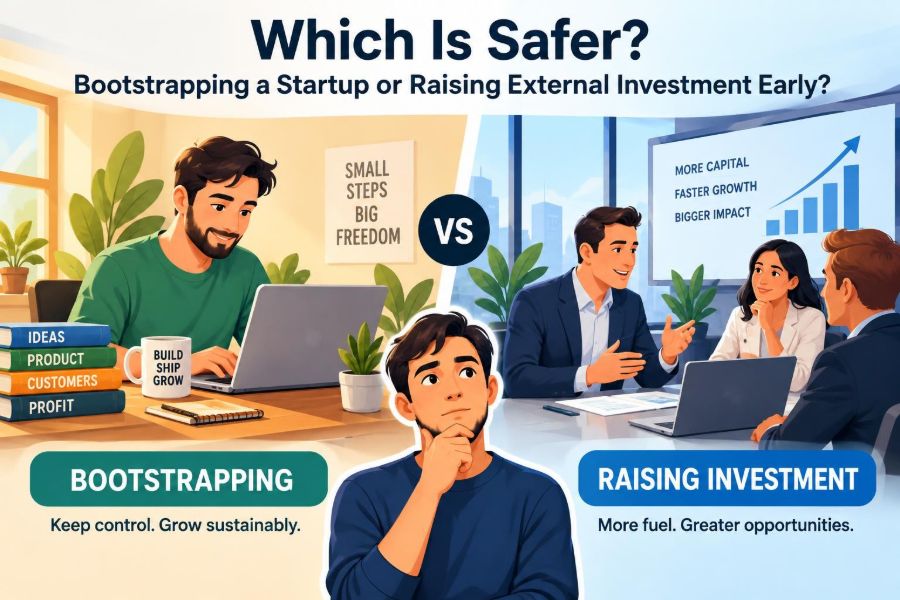

Choosing between bootstrapping and raising investment is one of the first decisions that can shape a startup’s future. It is also often framed badly: as if one path is bold and the other is cautious, or as if funding automatically makes a business more legitimate.
The real question is safer for what: protecting your ownership, reaching a market before competitors, limiting personal financial exposure, or building a durable business without running out of cash? Those are different kinds of safety, and they can point to different answers.
Bootstrapping tends to suit founders who can start small, sell early, and build with customers. Early external investment tends to suit businesses where speed, technology, regulation, inventory, or network effects create a real need for capital before meaningful revenue arrives.
This matters now because startup costs can be lower than ever for many software and service businesses, while capital remains selective and expensive in ways that are not always visible in the headline valuation. A thoughtful choice gives you more options; a reflexive choice can lock you into pressure you did not need.
🧭 1. Start With a More Useful Definition of “Safe”
Neither route is universally safer. Bootstrapping can protect you from dilution but expose your savings, income, and time. Investment can provide runway but create expectations that make a slower, profitable path difficult.
Assess safety across five dimensions rather than asking a single yes-or-no question.
- Financial safety: Can you pay bills and survive mistakes?
- Ownership safety: How much control and upside will you retain?
- Market safety: Can you reach customers before the opportunity changes?
- Operational safety: Can the business reliably deliver what it sells?
- Personal safety: Is the workload and stress sustainable for you?
A founder with a paid consulting skill and low overhead may be safer bootstrapping. A founder building regulated medical hardware may be safer raising capital, because trying to self-fund testing and compliance could be riskier than sharing ownership.
⚖️ 2. Compare the Two Paths Honestly
| Factor | Bootstrapping | Early external investment |
|---|---|---|
| Cash source | Founder savings, revenue, small loans | Angels, accelerators, venture funds, strategic investors |
| Ownership | Usually retained longer | Dilution begins early |
| Speed | Often constrained by cash flow | Can hire and build faster |
| Customer focus | Usually immediate and intense | Can be delayed if capital masks weak demand |
| Pressure | Personal financial and time pressure | Growth, reporting, and exit pressure |
| Best fit | Service, niche software, local, and steady-growth firms | Capital-intensive or winner-take-most markets |
The table is a starting point, not a verdict. A bootstrapped company can move quickly, and a funded company can operate carefully. The difference is that funding changes the default incentives around growth.
💵 3. Understand What Bootstrapping Really Means
Bootstrapping is not simply “spending no money.” It means using your own resources and customer-generated cash to control the pace and direction of the company.
Those resources may include savings, income from a job, pre-sales, consulting revenue, retained profits, a business credit line, or a small loan. Each source has a different risk profile.
Common bootstrap sources
- Personal savings: Flexible, but should have a clear loss limit.
- Side income: Slower, but can protect household finances.
- Customer deposits or pre-orders: Strong validation when delivery is realistic.
- Service work: Funds product development and teaches you customer pain.
- Profits: The healthiest source, though rarely immediate.
A sensible bootstrap plan does not treat every dollar you own as startup capital. Keep a separate personal emergency reserve and decide in advance how much you can afford to lose without creating a crisis.
🏦 4. Understand What External Investment Actually Buys
External investment buys more than money. At its best, it buys time, credibility, specialist support, hiring capacity, introductions, and the ability to attack a time-sensitive market.
It also sells a piece of your company and often commits you to a particular growth model. Investors generally need an outcome large enough to justify their risk, which may not match your preferred vision of a stable, profitable small business.
Early capital can include
- Friends and family: Flexible but emotionally delicate; document everything.
- Angel investors: Individuals who may bring practical experience and networks.
- Accelerators: Capital, education, and community in exchange for equity.
- Venture capital: Designed for businesses with potentially very large, scalable outcomes.
- Strategic investors: Industry partners that may offer distribution or expertise, with possible constraints.
Investment is not free cash. Even when no monthly repayment is due, you pay through equity, decision rights, reporting, future dilution, and higher expectations for growth.
🔍 5. Diagnose Your Business Model Before Choosing
Your business model should lead the funding decision. Do not choose a financing story first and then force the company to fit it.
Ask whether you can deliver a valuable first version manually, charge early, and use that revenue to improve. If yes, bootstrapping deserves serious consideration.
- Often bootstrap-friendly: Agencies, consultants, B2B services, vertical software, digital products, local services, education businesses, and niche marketplaces started city by city.
- Often capital-hungry: Biotech, hardware, deep technology, regulated financial products, manufacturing, asset-heavy logistics, and platforms needing scale before they are useful.
There are exceptions. A software business may need funding if enterprise buyers demand extensive security work before purchase. A hardware founder may reduce capital needs through prototypes, deposits, licensing, or contract manufacturing.
⏱️ 6. Test Whether Speed Is Truly Your Advantage
“We need to move fast” is sometimes true and sometimes a polished excuse to avoid selling. Speed matters most when a market has a short window, a network effect, a land-grab dynamic, or a technical race where being second has a meaningful cost.
Write down the consequence of moving slowly. Be specific: a competitor could capture a limited group of channel partners, a regulation could change, or customers could standardize on another platform.
If the answer is merely “someone else might copy our idea,” that is usually not enough. Ideas are copied constantly; execution, trust, distribution, and customer understanding are harder to copy.
🧪 7. Prove Demand Before Financing a Big Build
The safest money is usually money spent after you have learned what people will buy. Before raising a large round or draining savings, run a low-cost validation process.
- Choose one narrow customer group with a clear, expensive problem.
- Conduct conversations focused on their current workflow, budget, and urgency.
- Create a simple offer describing the outcome, not a list of features.
- Ask for a paid pilot, deposit, letter of intent, or a defined next step.
- Deliver manually where possible and document what repeats.
For example, instead of building a full scheduling platform for clinics, offer a paid workflow audit and a manual reminder service to three clinics. You may learn that missed appointments are not the main problem, or that integration is the real obstacle.
A promise of interest is weaker than payment. A signed contract can still fail to convert, but it is far more useful evidence than compliments from friends.
📊 8. Track the Numbers That Make the Decision Clearer
You do not need a complex finance department to make a grounded choice. You do need a simple model showing cash, demand, and the economics of serving a customer.
- Runway: Cash available divided by average monthly net cash burn.
- Monthly burn: Cash leaving the business minus cash received.
- Gross margin: Revenue left after direct delivery costs.
- Customer acquisition cost: Sales and marketing spend needed to win a customer.
- Payback period: Time required for gross profit to recover acquisition cost.
- Retention: How many customers continue or renew.
- Pipeline conversion: The percentage moving from conversation to paid customer.
Do not invent precision. Use ranges and update them monthly. The important question is whether each additional customer makes the business stronger or creates a larger cash hole.
🧮 9. Build Three Simple Cash Scenarios
Create a conservative, expected, and difficult-case forecast for the next 12 months. This exercise reveals whether you need capital, need to reduce scope, or merely need better sales discipline.
Starting cash
+ expected customer receipts
- payroll and contractor costs
- software, rent, inventory, and taxes
- founder pay
= ending cash
In the difficult case, assume sales close later, costs rise modestly, and a key customer does not renew. Do not assume disaster; assume ordinary friction.
Taxes, payroll obligations, loan rules, securities laws, and investor documentation vary by country and region. Speak with qualified local accounting and legal professionals before accepting money, issuing equity, or relying on tax assumptions.
🛠️ 10. Bootstrap Without Starving the Business
Bootstrapping is not a contest to endure the most pain. It is a discipline of spending only where an expense improves learning, delivery, or revenue.
A practical bootstrap operating system
- Sell one clear offer before developing multiple products.
- Use established tools rather than building internal systems too early.
- Keep fixed costs low and prefer flexible contractors where appropriate.
- Set a weekly sales target, not just a product roadmap.
- Charge enough to support delivery and learning.
- Review every recurring expense quarterly.
Common mistakes include underpricing to win early customers, delaying outreach until a product feels perfect, and treating founder labor as free forever. Your time has a cost even when it does not appear in a bank statement.
🎯 11. Raise Early Only for a Specific, Testable Use of Funds
“We need money to grow” is not a funding plan. A stronger case states exactly what capital will unlock, why customer revenue cannot fund it soon enough, and what milestone proves the money worked.
Good uses might include completing a regulated certification, building a required technical integration, funding inventory against signed purchase orders, or hiring a sales team after a repeatable sales motion is already visible.
- Weak use: Hire broadly because the team feels stretched.
- Better use: Hire two implementation specialists because signed customers are waiting and onboarding capacity limits recognized revenue.
- Weak use: Spend heavily on brand awareness without a conversion model.
- Better use: Test three measurable acquisition channels with a defined budget and payback target.
Every dollar should have a job, an owner, a deadline, and a success metric.
🤝 12. Choose Investors as Carefully as You Choose Co-Founders
An investor relationship can last longer than many jobs and partnerships. The wrong capital can be more damaging than no capital, especially if incentives, communication styles, or time horizons conflict.
Talk to founders who have worked with prospective investors, including founders whose companies struggled. Ask how the investor behaves during missed targets, difficult fundraising, and leadership disagreements.
Questions worth asking
- What types of companies and outcomes fit your fund or investment approach?
- How do you help between board meetings?
- What does good communication look like to you?
- How do you approach follow-on funding?
- What decisions do you expect to influence?
- Can I speak with founders from successful and unsuccessful investments?
Be transparent about your ambition. If you want to build a profitable, independent company, seek capital sources that genuinely support that path rather than hoping expectations will somehow align later.
🧾 13. Learn the Terms Before You Need Them
Founders often focus on valuation because it is visible and easy to compare. Terms can matter just as much, particularly when a company performs below expectations.
Learn the basics of dilution, liquidation preferences, voting rights, board control, pro rata rights, option pools, and conversion terms. You do not need to negotiate alone, but you do need enough understanding to ask intelligent questions.
Use an experienced startup lawyer in your jurisdiction before signing. This is not an area where generic internet templates reliably protect you, and regulations around offering securities can be strict.
A slightly lower valuation with straightforward, founder-aligned terms may be safer than a headline valuation that comes with restrictive obligations.
🚧 14. Recognize the Risks Unique to Each Route
Every route has failure modes. Naming them early lets you build safeguards instead of being surprised by them.
Bootstrapping risks
- Founder exhaustion from doing sales, delivery, and product work simultaneously.
- Underinvestment in quality, security, compliance, or support.
- Moving too slowly in a market where timing genuinely matters.
- Mixing business and personal finances until both become fragile.
- Accepting poor-fit customers just to create cash flow.
Investment risks
- Hiring ahead of validated demand and creating unsustainable burn.
- Chasing growth metrics that do not create durable economics.
- Losing strategic flexibility through investor expectations or governance rights.
- Raising repeatedly because the business never learns to convert capital into efficient growth.
- Confusing fundraising progress with customer progress.
The key safeguard is regular review. Monthly financial reviews and quarterly strategy reviews can catch drift before it becomes a crisis.
🪜 15. Consider the Middle Path: Funded by Customers First
The choice is not always all bootstrap or all venture capital. Many strong companies use staged financing: small founder funding, customer revenue, selective non-dilutive support, then outside equity only when a proven opportunity deserves acceleration.
Possible bridge options include paid pilots, annual contracts paid upfront, customer deposits, grants where available, revenue-based finance, equipment leasing, purchase-order finance, and carefully structured loans. Each has costs and eligibility requirements, so review the details carefully.
A hybrid path can preserve ownership while still reducing the risk of underfunding a genuine opportunity. The principle is simple: use the least expensive and least constraining capital that can responsibly achieve the next milestone.
🧠 16. Avoid the Most Common Decision Mistakes
Founders rarely make a poor financing decision because they lack intelligence. More often, they decide from fear, ego, urgency, or imitation.
- Copying visible founders: Their market, network, savings, and risk tolerance may be completely different.
- Raising to feel validated: Investor interest is not a substitute for customer demand.
- Bootstrapping out of pride: Refusing appropriate capital can constrain a business that has real evidence and urgency.
- Ignoring personal runway: A sound company plan can still fail if the founder cannot cover basic living costs.
- Waiting for certainty: You will not get it; use milestones to make the next decision smaller and safer.
Write down what would make you change your mind. For example, you might bootstrap until ten retained customers, then raise if demand exceeds onboarding capacity and the unit economics remain healthy.
🗺️ 17. Use a Milestone-Based Decision Framework
Instead of making one dramatic, permanent decision, set milestones that unlock the next financing choice. This turns uncertainty into a sequence of experiments.
- Define the customer, problem, and first paid offer.
- Set a maximum personal cash contribution and a date to reassess.
- Win a small number of paying customers or establish why that is impossible without capital.
- Measure delivery cost, retention signals, and sales cycle length.
- Identify the single constraint preventing the next level of growth.
- Choose the cheapest appropriate way to remove that constraint.
If the constraint is founder time, improve processes or raise prices before assuming you need a large round. If the constraint is a costly certification required for every sale, outside capital may be the responsible answer.
🗣️ 18. Communicate the Choice to Your Team and Customers
Financing affects more than the cap table. It influences hiring, product promises, deadlines, and how the company behaves under pressure.
Tell your team what the current strategy requires: efficient growth, careful cash management, aggressive market capture, or customer-funded expansion. You do not need to share every confidential detail, but people should understand the operating reality.
Customers do not need a fundraising announcement. They need reliable delivery. Avoid making promises based on money that has not reached your account or features that have not been built.
✅ 19. Your Action Plan for This Week
You do not need to settle the question forever this week. You need enough evidence to make the next decision responsibly.
- Day 1: List your personal monthly expenses, business expenses, available cash, and personal loss limit.
- Day 2: Create conservative, expected, and difficult-case 12-month cash forecasts.
- Day 3: Speak with five target customers about their current problem and budget.
- Day 4: Make one paid pilot or pre-sale offer.
- Day 5: Write the exact milestone that would justify outside capital.
- Day 6: Identify three funding sources that fit that milestone, including customer-funded options.
- Day 7: Review the evidence with a trusted founder, accountant, mentor, or legal adviser where needed.
The goal is not to look funded or scrappy. The safer path is the one that gives your specific business enough time, focus, and capital to reach real customer value without taking risks you do not understand. 🚀 🧭 💪