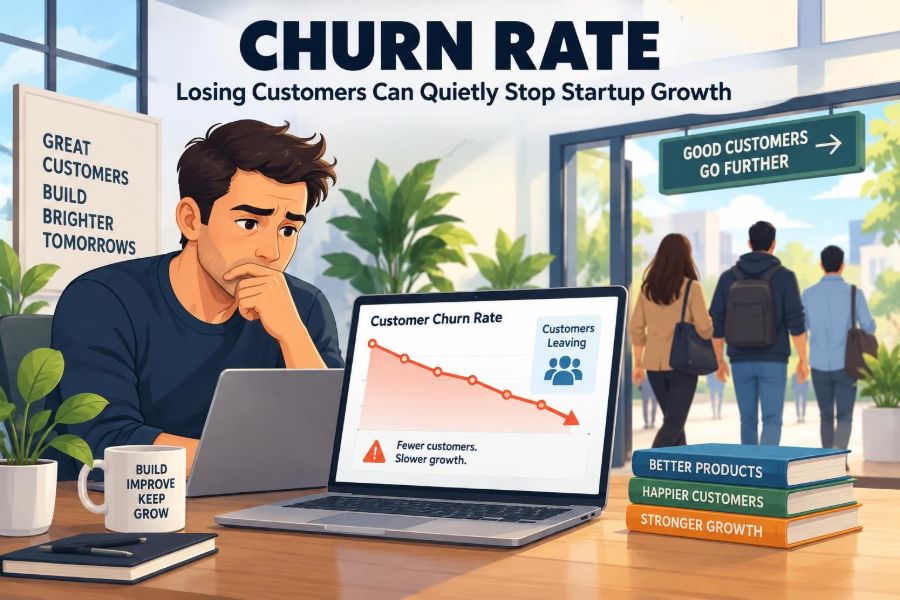

A startup can look busy, attract new sign-ups, and still be moving backward. The reason is often not a weak acquisition channel or a lack of ambition. It is that customers are leaving almost as quickly as they arrive.
Churn rate is the measure of customers or revenue you lose in a period. It sounds like a finance-dashboard detail, but it is really a product, service, pricing, and trust signal rolled into one.
This topic suits subscription founders, SaaS builders, agencies with retainers, memberships, e-commerce brands with repeat buyers, and local businesses that depend on regular customers. If your business needs customers to return, renew, reorder, or refer friends, churn deserves attention.
It matters especially now because customer acquisition is rarely effortless. When attention is expensive and buyers have many alternatives, keeping a hard-won customer is often more valuable than chasing another cold lead.
📉 1. Understand What Churn Rate Actually Means
Churn is the rate at which customers stop doing business with you over a defined period. In a subscription product, it may mean cancellations. In a shop or marketplace, it may mean customers who have not bought again within a reasonable repeat-purchase window.
The definition must fit your model. A monthly software tool can identify a cancellation immediately; a business selling winter coats may need a much longer window before calling someone churned.
- Customer churn: the percentage of customers lost.
- Revenue churn: the percentage of recurring revenue lost.
- Voluntary churn: a customer chooses to leave.
- Involuntary churn: payment fails, a card expires, or billing breaks.
Do not treat every inactive buyer as churned without context. First decide what a healthy return cycle looks like for your product, then use that definition consistently.
🧮 2. Use the Basic Customer Churn Formula
For a simple monthly customer churn calculation, divide customers lost during the month by customers at the start of the month, then multiply by 100.
Customer churn rate = (Customers lost during period / Customers at start of period) x 100Imagine you begin April with 200 paying customers. During April, 12 cancel. Your monthly customer churn is 6%.
(12 / 200) x 100 = 6%Do not put customers acquired during the month into the starting-customer denominator. Doing so can make retention look better than it is and hides the experience of your existing customer base.
Simple tracking habit
- Record starting active customers on the first day of each month.
- Record cancellations, failed payments, and reactivations separately.
- Calculate churn at the same cadence every month.
- Add a short note explaining any unusual change.
💵 3. Measure Revenue Churn Too
Customer counts do not tell the full story when plans have different prices. Losing one large account can hurt more than losing several low-priced customers, while upgrades from loyal customers can offset some lost revenue.
Gross revenue churn = (Recurring revenue lost from cancellations and downgrades / Starting recurring revenue) x 100Gross revenue churn excludes expansion revenue. It answers a clean question: how much existing recurring revenue did the business lose before upgrades helped?
Net revenue churn includes upgrades and expansion. It can be lower than gross churn, and may even be negative if existing customers expand faster than others cancel. That is useful, but it should never become an excuse to ignore a poor cancellation experience.
| Metric | Best for | What it can reveal |
|---|---|---|
| Customer churn | All recurring businesses | Whether people are leaving |
| Gross revenue churn | Businesses with varied plans | Revenue at risk without upgrades |
| Net revenue churn | Expansion-driven SaaS or services | Whether growth within accounts offsets losses |
| Repeat purchase rate | E-commerce and local retail | Whether buyers come back |
🔍 4. Define “Active” Before You Build a Dashboard
Metrics become misleading when the underlying definition is fuzzy. An “active user” is not always a paying customer, and a logged-in user is not necessarily receiving value.
Choose an activity that reflects real value. For example, a bookkeeping app might use “reconciled a transaction,” a scheduling tool might use “published an appointment,” and a community might use “participated in a useful discussion.”
Questions to settle with your team
- What action shows that a customer got the promised outcome?
- How long can a customer go without that action before risk increases?
- Which customers are paused rather than gone?
- How will annual subscribers be counted?
Write these rules down. A modest, consistent metric is more useful than a sophisticated number that changes definition every quarter.
🧭 5. Find the Moment Customers First Lose Momentum
Most churn does not begin on the cancellation screen. It begins when a customer fails to reach an early milestone, encounters confusion, or decides the effort is not worth the expected benefit.
Map the customer journey from purchase to renewal. Look for the earliest point where successful customers and departing customers behave differently.
- List the first five actions a new customer should take.
- Identify the action most strongly connected to long-term use.
- Measure how many new customers reach it in their first days or weeks.
- Interview people who did not reach it.
- Remove one barrier, then measure again.
A project-management product, for instance, may discover that customers who invite one teammate are far more likely to stay than those who create a workspace and stop. The immediate job is not “send more emails.” It is making the first invitation feel obvious and safe.
🗂️ 6. Segment Churn Instead of Staring at One Average
An overall churn rate is a smoke alarm. Segments help you locate the fire. Break losses down into groups that could reasonably have different experiences.
- Acquisition channel or campaign
- Plan, price point, or contract length
- Customer type, industry, or use case
- Country or region, where relevant
- Tenure: first month, first quarter, long-term
- Device, product version, or onboarding path
- Support tickets or reported issue category
Be cautious with tiny samples. If only four customers came from a channel, one cancellation creates a dramatic percentage but may not show a real pattern. Combine quantitative signals with conversations before making a major product change.
🗣️ 7. Ask Why People Leave, Then Listen Beyond the Survey
A cancellation survey is worth having, but it is not the whole truth. Customers may choose the quickest option, avoid criticism, or leave before they can describe the actual problem.
Use a short cancellation survey
- I no longer need this.
- It is too expensive for the value I get.
- I found a better alternative.
- The product was difficult to use.
- A feature or integration was missing.
- I had a support or reliability issue.
- Other, with an optional text field.
Follow up with a small, respectful sample of former customers. Ask what job they hired your product to do, what they expected to happen, when confidence dropped, and what they use now. Do not argue, sell, or treat the call as a rescue mission.
Support tickets, sales call notes, reviews, refund reasons, and lost-deal notes can reveal the same themes. Put recurring feedback in one place and tag it consistently.
🧱 8. Fix the Most Common Causes Before Adding More Features
Churn often comes from a gap between a customer’s expected outcome and their actual experience. More features may widen that gap if they add complexity without improving the core result.
| Likely cause | Practical response | Metric to watch |
|---|---|---|
| Slow time to value | Improve setup and templates | Activation rate |
| Confusing product | Simplify key workflow and guidance | Task completion |
| Weak perceived value | Show outcomes and usage clearly | Renewal rate |
| Missing capability | Validate demand before building | Churn reason frequency |
| Poor support | Improve response and ownership | Resolution time and satisfaction |
| Price mismatch | Test packaging or lower-friction tiers | Downgrades and cancellations |
Prioritize problems by frequency, severity, and strategic fit. A request from one large customer may matter, but building a custom detour that confuses everyone else can create more churn later.
🚪 9. Build an Onboarding Experience That Produces One Win
Onboarding is not a product tour. It is the process of helping a customer achieve an early, meaningful result.
Define one “first win” for each major customer segment. For a freelancer invoicing tool, that might be sending the first professional invoice. For a meal-prep membership, it might be preparing the first week of meals without feeling overwhelmed.
A practical onboarding sequence
- Ask only for information needed to personalize the first steps.
- Present one clear next action, not ten menus.
- Use a template, import, example, or concierge setup to reduce blank-page anxiety.
- Confirm the customer’s progress in plain language.
- Offer help at a point where people commonly stall.
Track completion at every step. If a setup checklist has seven items and most people quit at item three, the solution may be to remove, delay, or automate item three—not to add more reminder emails.
🤝 10. Treat Customer Support as Retention Work
Support is often where a customer decides whether your company is dependable. A fast but vague answer can be less helpful than a slower response that takes ownership and solves the real problem.
Make it easy to contact a human when stakes are high. For a small business, this may simply mean a monitored email address, a clear reply-time expectation, and a process for escalating urgent issues.
- Acknowledge the issue and its impact.
- Explain the next action and realistic timing.
- Give customers a workaround where possible.
- Close the loop after the fix.
- Tag the issue so product patterns are visible.
Do not measure support only by ticket closure speed. Track repeat contacts, reopened tickets, common issue categories, and whether customers with unresolved cases churn at a higher rate.
💳 11. Reduce Involuntary Churn Without Making Billing Annoying
Some customers did not intend to leave. Their payment method failed, an invoice went unnoticed, or an annual renewal surprised the person responsible for finance.
These are operational problems, and they are often easier to improve than product dissatisfaction. Use clear receipts, advance renewal notices, secure payment update flows, and polite reminders after a failed payment.
Do not use manipulative obstacles. Make cancellation possible, explain billing terms clearly, and follow consumer-protection, tax, privacy, and payment rules that apply in your country and customer markets. Regulations vary, especially for subscriptions and automatic renewals.
🎯 12. Price for a Sustainable Customer Relationship
Pricing can cause churn when the cost feels disconnected from value, when a customer outgrows the plan, or when the first bill arrives before they have seen a result. Underpricing can also hurt retention if it prevents you from providing reliable support and product improvement.
Test packaging carefully. A lower-priced tier, annual option, usage-based component, or service add-on can help certain segments, but not every cancellation is a pricing problem.
Before changing prices, check
- Do churned customers actually mention affordability?
- Are they using the features that justify the current price?
- Does a lower price improve retention enough to preserve margin?
- Would clearer positioning solve a value-perception problem?
- Will pricing changes be fair and understandable to existing customers?
Track downgrade rate, cancellation rate by plan, support load, refunds, and gross margin. Costs, taxes, currency conversion, and invoicing requirements vary by country, so get appropriate accounting and legal advice for your situation.
📊 13. Track a Small Retention Dashboard Every Week
Early-stage founders do not need an elaborate business-intelligence system. A spreadsheet can be enough if it is accurate and reviewed regularly.
Choose a few metrics that connect to customer value and commercial health. Review trends, not just a single week that may be noisy.
- Logo churn: customers lost as a percentage of starting customers.
- Gross revenue churn: recurring revenue lost before expansion.
- Renewal rate: customers who renew when eligible.
- Activation rate: new customers reaching the first win.
- Usage frequency: meaningful activity over time.
- Support trends: issue volume, repeat issues, and resolution quality.
- Reactivation rate: former customers who return.
For non-subscription businesses, substitute measures such as repeat purchase rate, time between purchases, customer lifetime spending, and percentage of buyers returning within your expected purchase cycle.
🧪 14. Run Retention Experiments Like a Careful Founder
A retention idea is a hypothesis, not a victory. “Customers leave because setup is overwhelming” is a useful hypothesis. “Let’s redesign everything” is an expensive reaction.
Use this simple experiment format
Problem: New customers do not reach the first win.
Hypothesis: A guided template will increase first-week completion.
Change: Show a relevant template immediately after sign-up.
Success measure: Increase completion without increasing support requests.
Review date: Evaluate after enough customers have used the flow.
Change one important variable at a time when possible. Keep a record of what changed, who saw it, and what happened. Small teams often lose learning because a product tweak, pricing change, and new email sequence launch in the same week.
Be especially wary of retention tactics that lift clicks but create resentment. The goal is durable customer value, not merely postponing a cancellation.
⚠️ 15. Avoid the Most Expensive Churn Mistakes
The biggest retention errors are usually management habits, not missing software. They make it harder to see reality and slower to respond to customers.
- Celebrating sign-ups while ignoring exits: acquisition can mask a leaking base.
- Using one average for everyone: segment by customer type and tenure.
- Only asking current customers: former customers often explain what changed.
- Building every requested feature: protect the core experience.
- Offering discounts before understanding the problem: a cheaper confusing product is still confusing.
- Making cancellation difficult: this damages trust and can create compliance risks.
- Waiting for a quarterly review: early warning signs deserve a weekly look.
Another common mistake is taking churn personally. Some customers will leave because their circumstances, budgets, or needs change. Your job is not to eliminate every departure. It is to learn which departures are preventable and improve the business without losing focus.
📈 16. Balance Retention With Acquisition
Retention and acquisition are not competing departments in a small startup. Better retention gives your marketing a stronger base because each new customer has more time to produce revenue, feedback, referrals, and proof that the product works.
At the same time, do not freeze acquisition until churn is perfect. You need enough new customers to test your positioning and learn whether improvements work across real demand.
A useful operating rhythm is to reserve time every week for both: talk to prospects to understand expectations, and talk to customers or former customers to understand delivery. The gap between those two conversations is where many churn problems live.
🛠️ 17. Choose Tools That Match Your Stage
Use the lightest toolset that gives you trustworthy answers. A complex analytics stack cannot compensate for unclear product events or a team that never reviews the data.
| Stage | Useful setup | Primary focus |
|---|---|---|
| Very early | Spreadsheet, payment records, inbox tags | Talk to customers and define churn |
| Early traction | Product analytics, CRM, survey tool | Activation and segment patterns |
| Growing team | Retention cohorts, support reporting, billing recovery | Repeatable operating processes |
Make sure your tools handle consent, data security, and privacy obligations appropriately. Customer data rules vary by location and industry, so do not collect more personal information than you genuinely need.
🗓️ 18. Your Action Plan for This Week
Do not wait for a perfect dashboard. A focused week can give you a much clearer view of whether churn is quietly limiting your growth.
- Write your precise definition of an active customer and a churned customer.
- Calculate last month’s customer churn using starting customers and customers lost.
- Calculate lost recurring revenue if your model has recurring payments.
- Segment recent cancellations by plan, tenure, and stated reason.
- Read ten support conversations and five cancellation notes.
- Contact a few former customers with a short, respectful learning request.
- Choose one onboarding or support friction point to improve next week.
- Add churn, activation, and renewal metrics to a weekly founder review.
Growth becomes more durable when you treat every preventable departure as a chance to make the customer experience clearer, more useful, and more trustworthy. You will not stop every customer from leaving, but you can build a business that earns more reasons for the right customers to stay. 🚀📉🤝