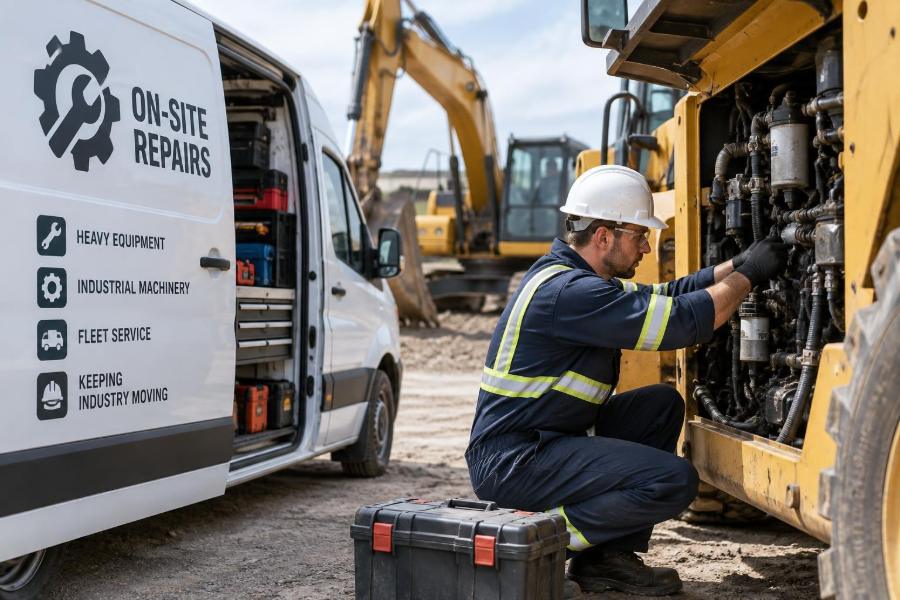

Industrial equipment rarely fails at a convenient time. A stopped forklift, compressor, conveyor, generator, pump, or compact excavator can idle a crew, delay shipments, and create expensive safety risks. That urgency creates an opening for a business that brings qualified repair capacity directly to the customer: a mobile industrial equipment repair network.
This is not simply a one-van mechanic business. The scalable version combines local field technicians, a disciplined dispatch system, parts sourcing, safety procedures, and predictable service agreements. Your product is restored uptime, not labor hours alone.
Define the business model before buying a service van
A mobile repair network dispatches technicians to diagnose, maintain, and repair equipment at factories, warehouses, construction sites, farms, utilities, recycling yards, and logistics facilities. Start with a narrow equipment category and service radius. Generalists can win early jobs, but specialization makes pricing, inventory, hiring, and marketing much easier.
Choose a focused entry point
- Material-handling equipment: forklifts, pallet jacks, dock equipment, and reach trucks.
- Power equipment: generators, air compressors, pressure washers, and light towers.
- Fluid-power systems: hydraulic hoses, cylinders, pumps, and fittings.
- Construction equipment: compact loaders, excavators, skid steers, and telehandlers.
- Plant maintenance: motors, pumps, conveyors, gearboxes, and basic controls.
- Cold-chain and facility equipment: only if you have the appropriate technical certifications and compliance knowledge.
A strong starting niche has frequent breakdowns, costly downtime, fragmented local service, and equipment that can be repaired on site. Interview operations managers, rental companies, fleet owners, and maintenance supervisors before committing. Ask what regularly fails, how long current vendors take to arrive, and what an hour of downtime costs them.
Validate demand with paid pilot customers
Do not build a large technician roster based on assumptions. Secure three to five pilot customers first. Offer a clearly defined service arrangement: priority response within a stated area, transparent call-out fees, standard labor rates, and preventive-maintenance visits.
Your initial customer profile should be organizations with multiple assets, repeat repair needs, and a decision-maker who feels downtime directly. A warehouse with 20 forklifts or a contractor with a small fleet is usually more valuable than a one-off homeowner-style customer.
Questions to use in discovery calls
- Which assets cause the most unplanned downtime?
- Who handles repairs now, and where does that process fail?
- How often do you wait more than one business day for service?
- Do you have in-house maintenance staff, and what work do they outsource?
- Would scheduled inspections reduce disruptions?
- What documentation, site training, insurance, or vendor onboarding is required?
Convert the feedback into an offer. For example, a forklift-focused network might sell a monthly fleet inspection plan plus emergency repair response. A hydraulics business might prioritize same-day hose replacement while charging separately for fittings, travel, and labor.
Build the economics around uptime and routing
Mobile service businesses can look profitable on paper while losing money through excessive travel, unpaid diagnostic time, emergency parts runs, and callbacks. Price every service call to cover technician compensation, vehicle costs, tools, insurance, dispatch overhead, and a margin for unbillable hours.
| Revenue component | Purpose | Typical pricing logic |
|---|---|---|
| Dispatch or call-out fee | Covers mobilization and initial travel | Flat fee by service zone or urgency |
| Diagnostic fee | Protects paid troubleshooting time | Minimum billable time, often credited only under defined conditions |
| Labor | Compensates repair work | Hourly rate with higher after-hours and emergency rates |
| Parts and consumables | Recovers material cost and sourcing effort | Cost plus a consistent margin |
| Preventive-maintenance plan | Creates recurring revenue | Monthly or quarterly price per asset or site |
| Priority-response agreement | Monetizes availability | Retainer plus reduced or agreed call-out terms |
Track utilization closely. A technician may be paid for eight hours but only produce five to six billable hours after travel, paperwork, parts collection, and site access. Design routes by territory, cluster preventive visits, and set minimum charges for distant locations. In the early stage, it is often wiser to serve a compact geography exceptionally well than to accept every distant emergency.
Start with a lean operating setup
You can launch with one experienced lead technician, one properly equipped service vehicle, a dispatcher-founder, and vetted specialist subcontractors. Keep capital focused on equipment that shortens repair time and reduces repeat visits.
Core launch assets
- A reliable service van or truck with organized storage and secure parts bins.
- Equipment-specific diagnostic tools, multimeters, pressure gauges, lifting aids, and calibrated hand tools.
- Safety equipment, lockout/tagout supplies, spill kits, fire extinguishers, and appropriate personal protective equipment.
- A field-service system for scheduling, work orders, estimates, photos, signatures, invoices, and asset histories.
- Business insurance appropriate to field work, vehicles, tools, errors, and site requirements.
- Supplier accounts with local parts distributors, original equipment channels, and reliable aftermarket vendors.
Do not overstock parts indiscriminately. Carry fast-moving consumables and common failure items for your niche, then use supplier relationships for the long tail. Every part sitting in a van is cash that is not earning a return.
Create a technician network without sacrificing quality
The network model becomes valuable when customers can call one number while you coordinate multiple qualified field resources. However, industrial repair is trust-sensitive. A poor diagnosis, unsafe procedure, or missed appointment can cost a customer far more than the invoice amount.
Use a tiered talent model
- Lead technicians: experienced employees or long-term contractors who handle complex diagnostics, customer communication, and quality reviews.
- Field technicians: qualified mechanics assigned by equipment type and territory.
- Specialists: electrical, controls, welding, refrigeration, machining, or manufacturer-certified partners used when needed.
- Apprentices or assistants: trained support staff who improve capacity on maintenance routes and routine work.
Verify licenses, certifications, driving records, insurance status, references, and practical competence where applicable. Standardize job documentation: arrival time, asset identification, fault description, safety steps, diagnostic readings, parts used, before-and-after photos, customer sign-off, and recommended follow-up. This documentation protects both the customer and your business while creating a valuable equipment history.
Make safety and compliance part of the product
Industrial clients will often require vendor onboarding before a technician can enter a site. Requirements can include safety orientation, drug and alcohol policies, personal protective equipment, insurance certificates, hazardous-material procedures, background checks, and proof of technical qualifications. Treat this as a sales advantage rather than administrative friction.
Build a written safety program with job hazard assessments, incident reporting, vehicle safety rules, lockout/tagout procedures, hot-work controls, confined-space escalation rules, and stop-work authority. Technicians should know when a repair falls outside their training or site authorization. Declining unsafe work is cheaper than a serious incident.
Design a dispatch process customers can trust
Fast response only matters if the customer receives clear communication. A simple, repeatable dispatch workflow can outperform a larger but disorganized competitor.
- Capture the asset type, model, serial number, location, fault symptoms, safety concerns, and site contact.
- Triage remotely using photos, video, fault codes, and a short operator interview.
- Confirm the service window, minimum charges, authorization process, and expected diagnostic scope.
- Assign the nearest qualified technician with the right tools and likely parts.
- Send arrival updates and communicate immediately if conditions change.
- Document findings, present an estimate for additional work, and obtain approval before proceeding.
- Close the work order with service notes, photos, invoice details, and maintenance recommendations.
Measure first-time fix rate, response time, repeat failures, average invoice value, technician utilization, quote approval rate, and customer retention. These indicators reveal whether you have a marketing problem, a dispatch problem, a parts problem, or a technical-quality problem.
Sell service agreements, not just emergency repairs
Emergency calls bring in leads, but recurring service agreements make the company predictable. Preventive maintenance helps customers avoid failures, lets you schedule work efficiently, and gives technicians repeated exposure to the same equipment fleet.
Simple agreement options
- Inspection plan: scheduled asset checks, reports, and repair recommendations.
- Maintenance plan: inspections plus defined routine service tasks and consumables.
- Priority plan: faster response targets, dedicated dispatch access, and agreed pricing terms.
- Fleet management plan: asset records, maintenance calendars, compliance documentation, and repair analytics.
Be precise about what is included, excluded, and subject to parts availability. Avoid promising impossible response times across a wide territory. A credible four-hour target in a defined zone is more valuable than a vague claim of 24/7 service.
Find customers through operational channels
Your best prospects are usually not browsing for a generic repair company. Reach them where operations, maintenance, and fleet decisions are made. Build a concise sales message around avoided downtime, transparent communication, and equipment expertise.
- Contact facility managers, maintenance managers, warehouse operators, fleet supervisors, and equipment rental businesses directly.
- Develop referral relationships with equipment dealers that do not cover every territory or after-hours request.
- Partner with rental yards, industrial parts suppliers, safety consultants, and fleet-management providers.
- Use local search listings and service-area pages organized around specific equipment categories.
- Publish useful maintenance checklists and failure-prevention guidance for your target niche.
- Ask satisfied pilot customers for introductions to peer operators in nearby industrial parks.
Early sales should be founder-led. Listen for the customer’s language: lost loads, missed production targets, idle operators, compliance exposure, or delayed deliveries. Use that language in proposals rather than leading with a generic statement about quality service.
Plan the first 90 days
| Period | Primary objective | Key actions |
|---|---|---|
| Days 1–30 | Validate the niche | Interview prospects, choose one equipment focus, map competitors, establish suppliers, and secure pilot commitments. |
| Days 31–60 | Build operating readiness | Set up legal, insurance, safety documents, field-service software, pricing, work-order templates, and a lean van inventory. |
| Days 61–90 | Deliver and refine | Complete pilot jobs, track unit economics, gather testimonials, sell maintenance agreements, and recruit one additional qualified resource only when demand supports it. |
Common mistakes to avoid
- Trying to repair everything: specialization produces faster diagnosis and better margins.
- Underpricing travel and diagnosis: field work has real non-wrench-time costs.
- Taking distant jobs without zone pricing: long travel destroys technician utilization.
- Hiring before dispatch volume exists: idle skilled labor is expensive.
- Relying on verbal approvals: use written estimates and signed work orders.
- Ignoring site safety requirements: one compliance failure can end a valuable account.
- Failing to document repairs: asset history is essential for repeat business and dispute prevention.
The path to scale
Once one territory has repeatable demand, expand by adding density before distance. Add technicians within the same service area, standardize inventory kits, document repair playbooks, and assign a dedicated dispatcher. Then replicate the model in an adjacent territory or equipment vertical.
The long-term opportunity is a trusted uptime platform for underserved industrial operators. Customers do not want to coordinate five repair vendors, chase updates, and explain the same equipment history repeatedly. If your network can provide qualified technicians, clear communication, fast documentation, and reliable preventive maintenance, it becomes much harder to replace than a typical repair shop.
Start small, narrow the niche, price for real field costs, and earn recurring agreements one fleet at a time. In industrial repair, reliability is not a slogan. It is the business model.