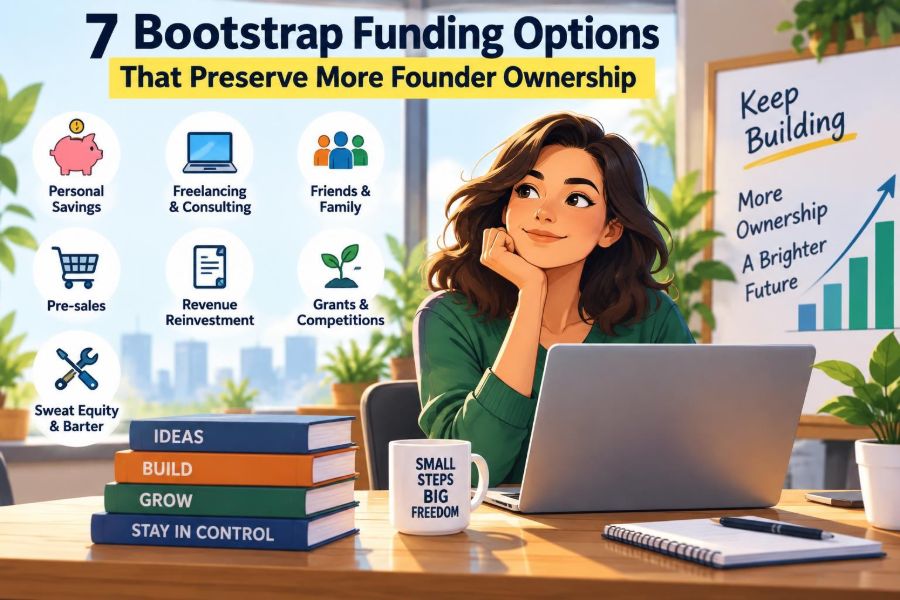

Most founders do not need a dramatic fundraising story. They need enough cash to test a real customer problem, deliver a useful first version, and survive the gap between doing the work and getting paid.
That makes bootstrap funding especially useful for consultants, service businesses, software founders with a narrow initial niche, makers, local operators, and side hustlers who can start small. It is less about refusing outside capital forever and more about choosing money that does not immediately dilute your ownership or dictate your timeline.
This matters now because capital is rarely free, even when it arrives as equity. Investors can bring expertise and networks, but they also bring expectations for growth, reporting, and eventual returns. If your business can create cash early, preserving optionality may be more valuable than chasing the largest possible round.
The goal is not to starve a promising company. The goal is to fund the next proof point with the least expensive form of capital available, then make the next decision from a stronger position.
🧭 1. Start with the ownership question, not the money question
Before comparing funding sources, define what you are actually trying to buy. “We need money” is vague; “we need $8,000 to build a paid pilot and cover two months of contractor work” is a decision you can evaluate.
Founder ownership is affected by more than equity. Personal guarantees, high-interest debt, customer obligations, and restrictions on future decisions can all reduce your practical freedom.
- Ask: What milestone will this money unlock?
- Ask: Can customer revenue fund part of that milestone?
- Ask: What happens if sales arrive three months late?
- Ask: What control, repayment, or obligation does this money create?
📊 2. Compare the seven options before you commit
Every option trades speed, risk, and flexibility differently. These are broad estimates only; costs, lending terms, taxes, and regulations vary by country, credit profile, and business type.
| Option | Typical cash available | Ownership dilution | Main trade-off | Best early use |
|---|---|---|---|---|
| Customer pre-sales | Small to medium | None | Delivery obligation | Validate demand |
| Service revenue | Small to medium | None | Founder time | Fund product learning |
| Bootstrapped savings | Small to medium | None | Personal financial risk | Initial setup |
| Friends and family loan | Small to medium | Usually none | Relationship risk | Defined short runway |
| Grants and competitions | Small to large | Usually none | Slow, restricted process | Eligible innovation |
| Revenue-based financing | Medium | None | Future cash-flow pressure | Established revenue |
| Debt and credit | Small to medium | None | Repayment and interest | Predictable returns |
🧾 3. Option one: customer pre-sales
A pre-sale means customers pay before your full product exists or before a future batch is delivered. You are using demand, not dilution, to finance production, development, or delivery.
Who it suits
This works well for product launches, cohorts, workshops, memberships, templates, custom software implementations, and B2B pilots. Your best targets are customers who already feel the problem and can understand a clear outcome.
Estimated startup cost
Estimate: $50 to $1,000. You may need a simple landing page, payment processing, a prototype, sample materials, and modest outreach. Avoid building a polished platform before people commit.
Skills and tools
- Customer interviewing and direct sales
- A clear offer, scope, delivery date, and refund policy
- Simple invoicing, payment collection, and project tracking
- A basic page, presentation, or product mock-up
Get first customers and manage risk
Speak to 20 people in one narrow target group. Offer a founding-customer package: a specific result, an early price, limited availability, and a realistic delivery window.
The mistake is selling promises you cannot fulfill. Ring-fence the money, communicate delays early, and do not spend pre-sale cash as though it is profit.
🛠️ 4. Make pre-sales credible enough to buy
People do not pay early because your idea sounds exciting. They pay because the offer reduces a costly problem and the delivery plan feels believable.
- Write one sentence identifying the customer, problem, and outcome.
- Show a demo, mock-up, curriculum outline, or sample deliverable.
- Set a capacity limit based on what you can genuinely deliver.
- Take payment or signed pilot commitments, not just email interest.
- Document feedback and use it to improve the next offer.
For example, instead of pre-selling “an AI platform for restaurants,” sell a 30-day pilot that helps five independent restaurants reduce unanswered booking inquiries. The narrower promise is easier to trust, price, and deliver.
Track: conversations held, proposal-to-payment conversion, average order value, refund rate, on-time delivery rate, and gross margin per order.
🤝 5. Option two: sell a service before building the product
Service revenue is often the most underappreciated bootstrap fund. You solve the problem manually first, get paid to learn the workflow, and later turn repeated steps into a product, system, or hireable process.
What it is and who buys
A future software founder might offer reporting setup for agencies. A marketplace founder might run matching manually. A commerce founder might provide sourcing or fulfillment consulting before buying inventory.
Target customers should be close to the market you eventually want to serve. Do not take unrelated freelance work merely because it pays well if it teaches you nothing about your intended business.
Estimated startup cost
Estimate: $0 to $2,000. Costs may include a domain, professional email, insurance where required, software subscriptions, a portfolio, and specialist contractor support.
Revenue model, scaling, and risk
Charge a fixed project fee, monthly retainer, implementation fee, or paid diagnostic. Price for the value and scope of the outcome, not simply for your hours.
The risk is building yourself a demanding job. Standardize discovery, delivery, and reporting; raise prices when demand exceeds capacity; and turn recurring requests into templates, training, software, or a small team.
🔁 6. Convert client work into a repeatable asset
Your service business becomes a funding engine when every engagement produces reusable knowledge. Treat each project as structured research rather than a one-off rescue mission.
- Create a repeatable onboarding questionnaire.
- Record the steps that appear in every engagement.
- Identify which tasks customers will pay to avoid.
- Build internal templates before building customer-facing software.
- Ask for referrals only after delivering a measurable result.
A useful rule: do not automate a process you have not performed enough times to understand. Manual delivery reveals exceptions, buying triggers, and the language customers use when they describe value.
Track: effective hourly rate, client acquisition cost, repeat revenue, referral rate, delivery hours per project, and the percentage of work handled by a documented process.
🏦 7. Option three: use personal savings with a hard limit
Personal savings preserve ownership and move quickly. They can be appropriate for a low-cost test, professional setup, prototype, or temporary runway while you validate paid demand.
They are not automatically “safe” because there is no lender. Your savings represent rent, emergencies, family responsibilities, and future choices. Set a maximum loss before you spend the first dollar.
Estimated startup cost
Estimate: whatever you can lose without endangering essentials. For many founders, that may be a few hundred or a few thousand dollars, not a full year of living expenses.
A sensible approach
- Separate business money from personal day-to-day money.
- Fund one milestone at a time, such as ten paid customers.
- Keep an emergency reserve untouched.
- Review spending weekly against actual learning or revenue.
- Stop if evidence contradicts your assumptions.
Do not confuse sacrifice with strategy. A lean test is useful; exposing your household to avoidable hardship is not.
🧮 8. Build a bootstrap budget that tells the truth
Create a simple 90-day cash plan. List the money you have, expected receipts by date, unavoidable expenses, and a downside scenario in which sales take twice as long as expected.
Starting cash
+ customer deposits expected
+ service revenue expected
- essential business costs
- tax reserve
- debt repayments
= cash remaining each week
Separate three categories: costs that create demand, costs required to deliver, and costs that merely make the business feel more official. The third category is where early budgets often leak.
Track: weekly cash balance, monthly burn, months of runway, accounts receivable, tax reserve, and cash collected rather than invoices sent.
👥 9. Option four: friends and family loans, handled professionally
People close to you may offer support before a bank or customer does. A loan can preserve equity, but informal money becomes expensive if unclear expectations damage an important relationship.
Who it suits
This can fit a business with a defined use of funds and plausible repayment path: equipment that enables confirmed contracts, initial inventory tied to purchase orders, or a short bridge before signed client work begins.
Estimated startup cost
Estimate: $100 to $1,000 in setup and advice. Costs depend on whether you use a lawyer, accountant, formal agreement, and local filing requirements.
Rules that protect everyone
- Use a written agreement with amount, interest if any, repayment dates, and what happens if the business fails.
- Explain that repayment is not guaranteed.
- Never pressure someone to lend money they cannot afford to lose.
- Provide updates on a regular schedule, including bad news.
- Consider whether a gift is more honest than a disguised investment or loan.
Get local legal and tax advice where appropriate. Securities, consumer lending, and tax rules can apply even to small arrangements.
🎯 10. Option five: grants, prizes, and non-dilutive programs
Grants, competitions, incubator stipends, research support, and local enterprise programs can provide non-dilutive capital. They are particularly relevant for climate, health, education, research, manufacturing, community, export, or regional-development businesses.
What to expect
Funding may be restricted to a project, require matching funds, reimburse costs after you spend them, or involve reporting. It should support your business plan, not become the business plan.
Estimated startup cost
Estimate: $0 to $3,000. The cash cost can be low, but the time cost is often substantial. Budget for applications, documentation, compliance, and possibly specialist help.
How to improve your odds
- Check eligibility before writing anything.
- Match your proposal to the program’s stated outcome.
- Use a specific budget and measurable milestones.
- Apply only where the timing fits your operating plan.
- Keep copies of invoices, payroll records, and project evidence.
Track: application hours, applications submitted, funding awarded, restricted versus unrestricted cash, reporting deadlines, and project outcomes.
📉 11. Option six: revenue-based financing after revenue exists
Revenue-based financing provides cash that is repaid as a percentage of future revenue or through a fixed repayment arrangement. It usually avoids equity dilution, but it is not cheap money and can pull cash out precisely when you need it to grow.
Who it suits
It may fit a business with stable sales, healthy gross margins, reliable payment processing data, and a proven use for capital. Examples include inventory purchases with known sell-through or marketing spend with repeatable economics.
Estimated startup cost
Estimate: financing fees vary widely and may be significant. Read the total repayment amount, payment mechanics, fees, and any minimum payment terms rather than focusing only on the amount advanced.
Risks and scaling
Do not use it to paper over a weak offer or unpredictable unit economics. Model a slow-sales month before accepting an advance, and protect cash for payroll, suppliers, taxes, and customer service.
Scale only after you can show that each additional dollar deployed produces a sensible contribution margin and does not create operational bottlenecks.
💳 12. Option seven: debt, credit lines, and equipment finance
Loans, credit cards, credit lines, invoice finance, and equipment finance preserve equity but create fixed obligations. They work best when borrowed money buys an asset or activity with a reasonably predictable return.
Good and bad uses
Potentially sensible uses include equipment for contracted work, inventory linked to demonstrated demand, or short-term working capital against dependable invoices. Riskier uses include speculative advertising, untested products, and routine payroll without clear incoming cash.
Estimated startup cost
Estimate: interest, origination fees, account fees, and potentially collateral or personal guarantees. Terms differ substantially by lender and jurisdiction.
Before you sign
- Calculate the total repayment, not just the monthly payment.
- Check whether rates can change.
- Understand collateral, covenants, and personal guarantees.
- Model a 30% to 50% sales shortfall.
- Compare the cost with negotiating better supplier terms or customer deposits.
Seek qualified local financial or legal advice for material borrowing decisions. Debt is a tool, not proof that a business model works.
🧱 13. Stack funding in the right order
The strongest bootstrap plan often combines several sources, each used for the job it handles best. Start with the capital closest to customer value, then move outward only when the business has earned more certainty.
- Use interviews and a low-cost prototype to test the problem.
- Use pre-sales or service work to prove willingness to pay.
- Use profits to improve delivery and retention.
- Use grants where they align with work you already need to do.
- Use financing only for repeatable, measurable growth or working capital.
For example, a founder could sell paid audits, use that revenue to build a lightweight tool, pre-sell a team plan to existing clients, and later finance inventory or marketing only after demand is repeatable.
⚖️ 14. Know when preserving ownership is the wrong priority
Bootstrap funding is not morally superior to equity. Some businesses require substantial capital before revenue is possible, such as regulated technology, capital-intensive infrastructure, or long research cycles.
Outside equity may also be appropriate when speed creates a real strategic advantage and you have evidence that additional capital can be deployed effectively. The point is to understand the trade, not to cling to ownership at any cost.
A useful question is: would this money let us reach a milestone that materially improves our odds, or would it simply delay a difficult conversation with the market?
🚨 15. Avoid the bootstrap traps that quietly break companies
Bootstrap businesses fail from cash pressure as often as from lack of ambition. The following mistakes are common because they feel productive in the moment.
- Underpricing: low prices attract interest but may not fund quality delivery.
- Taking deposits without capacity: growth can turn into refunds and reputational damage.
- Using expensive debt for experimentation: uncertain learning should be funded cheaply.
- Ignoring tax: collected cash may include money you owe later.
- Mixing personal and business finances: this hides whether the business is viable.
- Waiting too long to collect: an invoice is not cash in the bank.
- Confusing busywork with validation: branding and features do not equal paid demand.
📈 16. Use a small dashboard to make funding decisions
You do not need a complex finance team to operate responsibly. Review a simple dashboard every week and make capital decisions from trends rather than optimism.
| Metric | Why it matters | Warning sign |
|---|---|---|
| Cash runway | Shows time available to adapt | Falling without a clear sales plan |
| Cash collected | Measures actual liquidity | Invoices grow but bank balance does not |
| Gross margin | Shows what remains after delivery costs | New sales create little cash |
| Customer acquisition cost | Tests growth efficiency | Cost rises faster than customer value |
| Retention or repeat rate | Signals durable value | Customers do not return or renew |
| Receivables age | Exposes collection risk | Customers consistently pay late |
Make one operating decision from the dashboard each week: collect an overdue invoice, pause a low-margin offer, raise a price, reduce a tool cost, or ask three customers for referrals.
🗣️ 17. Talk about money clearly with customers and partners
Funding gets easier when your commercial terms are clear. Put price, scope, timing, payment schedule, cancellation terms, and ownership of work in writing before work begins.
For a service project, consider a deposit before kickoff and milestone payments for longer work. For a pre-sale, state exactly what is included, when it will ship or begin, and what happens if you cannot deliver.
Clear terms are not a sign of distrust. They are how small businesses protect customer relationships while managing cash flow.
✅ 18. Your action plan for this week
Do not try to evaluate every source at once. Choose the cheapest credible path to one revenue-producing milestone.
- Day 1: Write the next milestone and its exact cash requirement.
- Day 2: Create a 90-day cash forecast with a conservative sales scenario.
- Day 3: Draft one narrow pre-sale or paid-service offer.
- Day 4: Contact ten potential customers for conversations, not generic feedback.
- Day 5: Ask for a paid pilot, deposit, or signed commitment.
- Day 6: Research one relevant grant and one financing alternative, including full terms.
- Day 7: Review what customers actually said and revise your plan.
The best bootstrap funding is the money that helps you learn from customers, deliver well, and keep enough control to make the next smart decision. Build patiently, protect your cash, and let real demand earn you more options. 💰🌱🚀