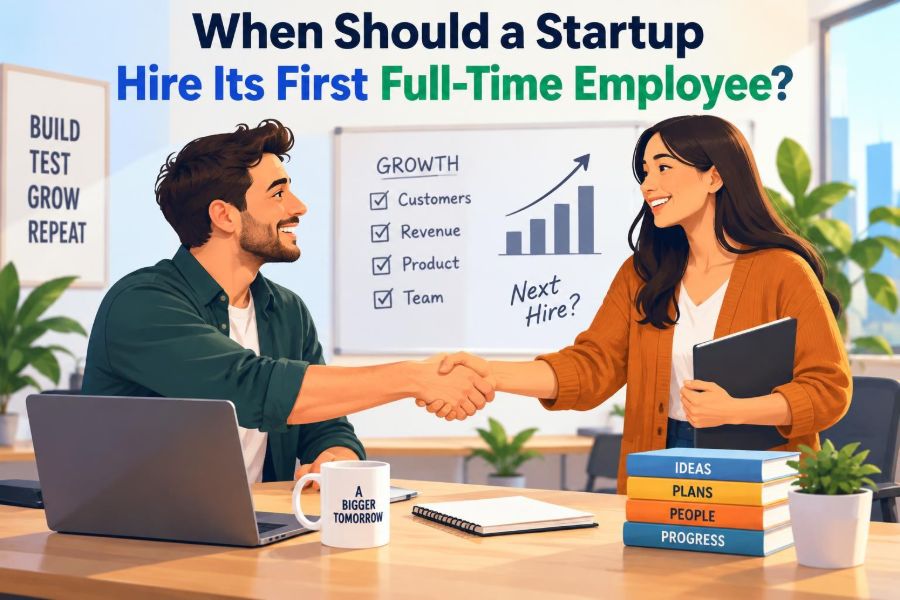

The first full-time hire is one of the most exciting decisions a founder can make. It can turn a one-person operation into a real team, create capacity for growth, and give customers a better experience.
It is also one of the easiest places to get ahead of yourself. A salary is not just a monthly payment: it is a commitment to payroll, management, equipment, compliance, and a person who is trusting your business with their livelihood.
This decision suits founders who have moved beyond experimenting and are seeing repeatable demand, recurring work, or a clear bottleneck they cannot solve alone. It matters especially now because lean tools, contractors, automation, and remote talent give startups more choices than simply hiring as soon as they feel busy.
The goal is not to stay solo forever or to hire the moment your calendar fills up. The goal is to hire when a specific role can reliably create more value than it costs, while giving your company a stronger foundation for the next stage.
🧭 1. Start With the Real Question
Do not ask, “Can I afford to hire someone this month?” Ask, “Can this role pay for itself or protect revenue over the next 6 to 12 months?”
A temporary cash surplus can disappear after a slow sales month, a late-paying customer, a refund, or a tax bill. A sound hiring decision depends on a durable business case, not relief from a stressful week.
- What valuable work is consistently not getting done?
- What revenue is delayed or lost because you lack capacity?
- Which tasks must stay with the founder, and which can be owned by someone else?
- Can you describe the role’s result in one clear sentence?
For example: “This customer success hire will onboard every new client within five business days and reduce preventable churn.” That is much stronger than “I need help.”
📈 2. Look for Repeatable Demand, Not Just Busyness
Founders often confuse being overwhelmed with having enough demand for an employee. You can be busy with product tweaks, one-off requests, admin, and low-value activity without having predictable revenue.
Hire when the workload is repeated often enough that one person can own a defined process. A freelance designer with three unusual projects may need flexible contractor support. The same designer with a stable stream of monthly retainers may have a case for a full-time production designer.
Signs demand is becoming repeatable
- You have a consistent pipeline rather than relying on one lucky deal.
- Customers buy the same service, plan, or package repeatedly.
- You can forecast work at least several months ahead with reasonable confidence.
- You are turning away profitable work because of a genuine capacity constraint.
- Delivery steps are documented or can be documented.
Seasonal businesses should be particularly cautious. A busy quarter may justify a temporary worker or contractor before it justifies a permanent role.
💵 3. Calculate the Fully Loaded Cost
The salary on an offer letter is only the most visible expense. Your actual cost includes employer taxes, mandatory contributions, benefits, insurance, recruiting time, a computer, software, management time, and sometimes office or coworking costs.
Estimate: in many markets, a sensible planning range is salary plus 20% to 40% for employment-related costs. The true figure can be lower or significantly higher depending on country, benefits, location, and employment structure. Confirm requirements with a local accountant, payroll provider, or employment adviser.
| Cost item | Example planning approach | Why it matters |
|---|---|---|
| Base pay | Monthly gross salary | The fixed core commitment |
| Employer costs | Estimate 20%–40% of salary | Taxes, contributions, insurance, benefits |
| Equipment and software | One-time setup plus monthly tools | Required for productive work |
| Recruiting and onboarding | Time plus any agency or posting fees | Often overlooked cash and effort |
| Management capacity | Founder hours each week | New hires need direction before leverage |
Build your budget around the loaded cost, not the advertised salary. If you cannot explain where that money will come from each month, you are not ready yet.
🏦 4. Build a Hiring Runway Before You Sign
A strong rule is to ensure you can carry the hire through normal volatility, not only your best-case forecast. Many founders aim to have several months of the role’s full cost in cash, alongside a separate buffer for the rest of the business.
The right runway depends on your revenue stability. A startup with annual contracts and low churn can operate differently from a project-based studio paid after delivery.
A practical cash stress test
- List your current monthly revenue and essential monthly expenses.
- Add the full loaded monthly cost of the proposed role.
- Model a slower period: fewer sales, a delayed invoice, or a lost client.
- Check whether payroll still clears without relying on debt or panic selling.
- Decide what trigger would make you pause hiring or reduce other spending.
This is not pessimism. It is how you protect both the company and the person you want to hire.
🎯 5. Hire for a Bottleneck, Not a Job Title
Your first employee should usually attack the constraint that most limits growth or customer retention. That might be fulfillment, sales follow-up, implementation, support, operations, or product development.
Do not begin with a title copied from a larger company. “Head of Growth” sounds impressive, but a young company may really need someone to qualify leads, send proposals, and follow up reliably.
| Bottleneck | Potential first role | Result to own |
|---|---|---|
| Founder cannot deliver client work fast enough | Operations or delivery specialist | More projects completed at consistent quality |
| Leads wait too long for replies | Sales development or account coordinator | Faster follow-up and more qualified conversations |
| Customers struggle after purchase | Customer success or implementation specialist | Better onboarding and retention |
| Founder is buried in repetitive admin | Operations assistant | Reliable systems and recovered founder time |
| Product releases are the core constraint | Product engineer or technical builder | Faster, higher-quality product improvements |
Choose one primary outcome. A first employee can be versatile, but they cannot be accountable for every outcome at once.
🧪 6. Validate the Role With a Smaller Commitment
Before creating a permanent position, test whether the work and the economics are real. A contractor, freelancer, part-time employee, temporary hire, or fixed-term project can reveal what the role should actually be.
This is especially useful when you have never managed the function before. You may think you need a full-time marketer, then discover that your real issue is unclear positioning and inconsistent sales follow-up.
Use a trial thoughtfully
- Set a defined scope, duration, budget, and success measure.
- Give the person access to the information needed to succeed.
- Review output and economics weekly, not only at the end.
- Follow local rules on worker classification, contracts, and benefits.
- Do not use “trial” as a way to avoid paying people fairly.
A successful test gives you a sharper job description, better process documentation, and evidence that the role deserves a full-time seat.
📝 7. Write the Role Around Outcomes
A vague role attracts vague candidates and produces vague performance. Before posting anything, write a one-page role scorecard.
Start with the mission: why the role exists. Then define the three to five outcomes that matter in the first 90 days and the core responsibilities required to achieve them.
Simple first-hire scorecard
- Mission: the business problem this person solves.
- 90-day outcomes: observable results, not activities.
- Responsibilities: recurring work they will own.
- Skills: must-have abilities versus trainable preferences.
- Tools: systems they will use, such as a CRM, help desk, spreadsheet, or code repository.
- Decision rights: what they can decide without founder approval.
“Send 50 emails a day” is an activity. “Respond to qualified inbound leads within one business day and keep the CRM accurate” is closer to an outcome.
🧠 8. Separate Must-Have Skills From Nice-to-Haves
First hires rarely arrive as perfect, all-purpose operators. Trying to find a senior strategist, expert executor, industry specialist, culture fit, and bargain salary candidate in one person usually leads to a long, unproductive search.
Identify the few capabilities you cannot teach quickly. For a bookkeeping-heavy operations role, accuracy and familiarity with your required financial workflow may be essential. For a junior sales role, coachability, communication, and follow-through may matter more than years of experience.
- Mark each requirement as essential, valuable, or trainable.
- Remove inflated credential requirements that do not predict performance.
- Decide whether you need an experienced builder or a promising learner with guidance.
- Match compensation to the responsibility and local market.
Be honest about what the job is. A candidate who expects strategy but receives repetitive support work will not stay engaged for long.
🔎 9. Source Candidates Where Trust Already Exists
Your first hire does not need to come from the largest possible applicant pool. It needs to come from a thoughtful process that reaches people who understand the work and can be assessed fairly.
Start with trusted professional contacts, former colleagues, relevant communities, specialist job boards, and referrals. A referral is useful information, not a substitute for interviews and reference checks.
How to get better applicants
- Share the company stage, work reality, compensation range where appropriate, and expected location or time zone.
- Explain the customer problem and why the role matters.
- Describe a typical week, including less glamorous tasks.
- Use a short application question tied to the actual work.
- Respond promptly and respectfully to candidates.
A clear job description filters out poor fits and signals that you run the business with care.
🧩 10. Interview for Evidence, Not Charm
First-hire interviews can become emotional because founders want someone they enjoy talking to. Rapport matters, but it should not override evidence that a candidate can perform the work.
Use structured questions: ask every serious candidate the same core questions and score answers against your role scorecard. Ask for specific past situations, actions, and results rather than general claims.
Useful interview questions
- “Tell me about a time you inherited a messy process. What did you do first?”
- “Walk me through how you prioritize when three customers need help at once.”
- “What would you want to understand in your first two weeks here?”
- “Show me an example of how you would approach this realistic work scenario.”
A small paid work sample can be more predictive than another conversational interview when legal and practical in your location. Keep it relevant, compensate candidates fairly, and avoid asking for work you will use commercially without an agreement.
⚖️ 11. Get Employment Basics Right Early
Employment law is not an administrative detail to solve later. Contracts, payroll registration, tax withholding, mandatory benefits, working-time rules, leave, data protection, and termination requirements vary widely by country and sometimes by region.
Use qualified local help before making an offer. A payroll provider, accountant, employment lawyer, or reputable employer-of-record service may cost money, but mistakes can be more expensive and damaging.
- Use a clear written contract.
- Confirm employee versus contractor classification rules.
- Set up compliant payroll and recordkeeping.
- Define confidentiality, intellectual property, and data-access expectations.
- Learn required leave, benefits, workplace, and safety obligations.
Do not copy an employment agreement from the internet and assume it works in your jurisdiction.
🤝 12. Make a Clear Offer and Set Expectations
A good offer describes more than compensation. It should make the working relationship understandable from day one: role, reporting line, location expectations, schedule, probation terms where lawful, benefits, start date, and how performance will be reviewed.
If you offer equity, explain it carefully and avoid treating it as a replacement for fair cash compensation. Equity has legal, tax, and valuation implications, and it may never become liquid or valuable.
Be direct about uncertainty too. Early-stage work can change. The right candidate does not need false certainty, but they do deserve an honest picture of the business and the risks.
🚀 13. Treat Onboarding as a Revenue-Protecting System
Hiring is only the beginning. A first employee without context, priorities, systems, and feedback may create more founder work than they remove.
Prepare before their first day. Set up accounts, equipment, tool access, customer background, process documents, and a simple plan for the first month.
A practical 30-day onboarding plan
- Week 1: explain the company, customer, offer, tools, and immediate workflows.
- Week 2: complete supervised real work and document questions.
- Week 3: own a limited process with daily or frequent check-ins.
- Week 4: review results, remove blockers, and agree on the next 60 days.
Give context, not just tasks. When people understand why customers buy and what can go wrong, they make better decisions without waiting for permission.
📊 14. Track Leading and Lagging Metrics
You do not need a corporate dashboard, but you do need a way to know whether the hire is solving the intended problem. Choose a handful of metrics tied directly to the role.
| Role type | Leading metrics | Lagging metrics |
|---|---|---|
| Sales support | Speed to lead, follow-up completion, qualified meetings | Conversion rate, new revenue |
| Customer success | Onboarding completion, response time, account check-ins | Retention, expansion, churn |
| Operations | Process completion, error rate, turnaround time | Delivery margin, customer satisfaction |
| Product or engineering | Cycle time, critical issues resolved, releases | Adoption, reliability, customer outcomes |
Metrics should guide conversations, not become a surveillance system. Quality, judgment, collaboration, and customer trust matter alongside the numbers.
🗓️ 15. Create a Simple Management Rhythm
A first employee needs access to the founder, especially while the business is still changing quickly. If you are too busy to answer questions, prioritize work, and give feedback, delay the hire or reduce the role’s scope.
Set a weekly one-to-one meeting. Review wins, priorities, blockers, customer insights, and support needed. Keep it short and consistent.
- Share the company’s current goals and cash-conscious priorities.
- Agree on the top three outcomes for the week.
- Give feedback close to the work, not months later.
- Ask what is unclear or unnecessarily difficult.
- Document key decisions and evolving processes.
Management is not micromanagement. It is creating clarity, accountability, and support.
🚧 16. Avoid the Most Common First-Hire Mistakes
Most costly hiring errors begin before the offer is made. They come from unclear priorities, rushed decisions, or using a person to solve a problem that has not been diagnosed.
Mistakes to watch for
- Hiring because competitors have teams: your economics and timing are different.
- Hiring a generalist for an undefined mess: define the first problem they will own.
- Using a hire to avoid selling: founders should not outsource customer understanding too early.
- Underpaying and overloading: “startup” is not permission to be unrealistic.
- Skipping onboarding: confusion is expensive for everyone.
- Waiting too long to address poor fit: give clear feedback, support improvement, and follow lawful processes.
It is better to admit that the role needs redesign than to silently hope a capable person will fix structural confusion.
🔄 17. Know When a Contractor Is the Better Choice
Full-time employment is powerful when you have durable, core work and need deep ownership. It is not automatically the best option for specialist, uncertain, temporary, or highly variable work.
| Situation | Often better option | Reason |
|---|---|---|
| One-time legal, design, or technical need | Specialist contractor | Access expertise without a permanent role |
| Uncertain demand | Part-time or project-based support | Tests workload and economics |
| Stable, central recurring workflow | Full-time employee | Ownership and continuity matter |
| Short seasonal surge | Temporary staffing | Matches capacity to the season |
Follow classification rules wherever you operate. Calling someone a contractor does not make them one if the real working arrangement meets the legal test for employment.
🌱 18. Scale the System, Not Just the Headcount
Your first hire should help make the business less dependent on founder memory and heroic effort. Ask them to document recurring processes, flag customer friction, and improve handoffs as they learn.
That does not mean dumping process design on a new employee. It means turning repeated work into a shared operating system: checklists, templates, documented tools, quality standards, and clear ownership.
When the next hiring decision arrives, you will have better data. You will know what work exists, what it costs, where the bottleneck moved, and whether another employee is truly the best answer.
✅ 19. Your Action Plan for This Week
Do not spend this week browsing job titles. Spend it proving the need and preparing the role.
- Write down every task consuming your time for five working days.
- Circle the repeated tasks that directly affect revenue, delivery, or retention.
- Identify the single biggest bottleneck and write its ideal outcome.
- Calculate the full monthly cost of a potential hire using a conservative estimate.
- Run a six-month cash stress test with slower revenue assumptions.
- Decide whether to test the work with a contractor, part-time arrangement, or full-time role.
- Draft a one-page scorecard before speaking to candidates.
The right first hire is not the person who makes you feel like a bigger company; it is the person who helps your business serve customers, protect cash, and grow with more consistency. Build the role carefully, support the person well, and let the decision be earned by the business. 🚀🤝📈