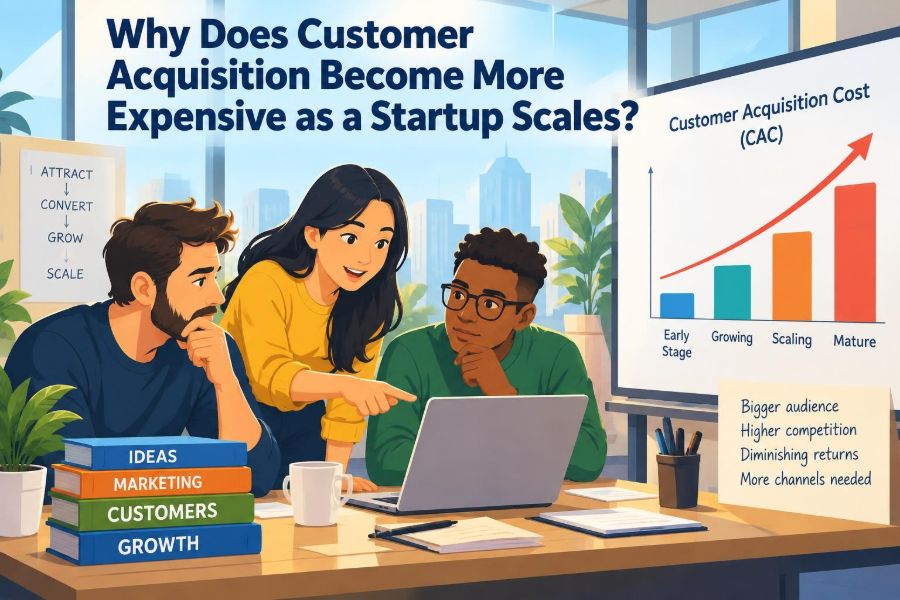

At the beginning, acquiring customers can feel surprisingly easy. You know the problem intimately, your first buyers are often people in your network, and every new conversation teaches you exactly what to say. Then growth arrives, and the same playbook starts producing weaker results.
This problem matters for founders, small-business owners, and side hustlers moving from a handful of loyal customers to a repeatable growth engine. It is especially relevant if you sell online, rely on paid ads, have a sales team, or are preparing to raise money based on growth targets.
Higher acquisition costs do not automatically mean your business is failing. They often mean you have exhausted the easiest audience, entered a more competitive market, or built operations that are not yet ready for the next stage.
The useful question is not, “How do I keep customer acquisition costs permanently low?” It is, “Can I understand why costs rise, protect profitable channels, and build a business that can afford to acquire the right customers?”
📈 1. Understand what customer acquisition cost really measures
Customer acquisition cost (CAC) is the total cost required to win a new paying customer. It should include more than advertising spend if you want a decision-making number.
A simple version is:
CAC = total sales and marketing costs / number of new customers acquiredDepending on your business, costs can include ad spend, agency fees, marketing software, sales commissions, salaries, events, content production, promotional discounts, and creative work. A founder’s unpaid time may not appear in the accounting records, but it is still a real constraint.
A simple example
If you spend $8,000 on ads, $2,000 on freelance creative, and $5,000 on sales support to win 100 customers, your blended CAC is $150. That number becomes useful only when you compare it with gross margin, retention, and the value those customers generate over time.
- Paid CAC: cost from a specific paid channel, such as search ads.
- Blended CAC: all acquisition spending divided by all new customers.
- Marginal CAC: the cost to acquire the next group of customers as spending increases.
Many startups celebrate a low blended CAC while their marginal CAC is rising quickly. The second number is usually the warning signal.
🎯 2. The first customers are not representative of the market
Your earliest users tend to be unusually motivated. They may know you, already trust your expertise, actively feel the pain you solve, or enjoy trying new products. They do not behave like the wider market.
That creates a common illusion: the business appears to have found a cheap, unlimited acquisition channel. In reality, it may have found a small cluster of highly qualified early adopters.
What to do
- Tag your first 50 to 100 customers by source, industry, use case, and relationship to your business.
- Ask what triggered them to buy now rather than later.
- Compare their behavior with customers acquired six months later.
- Build campaigns around the shared problem, not the fact that they were early adopters.
If your first users came from personal referrals, do not assume cold ads will convert at the same rate. Treat the shift as a new acquisition problem requiring a new message and budget.
🧲 3. Every channel has a finite pool of easy prospects
Marketing channels get harder as you use them. The first email to your warm list, the most obvious keyword, the best affiliate, and the most active community can all produce efficient early results. Eventually, you reach people who are less aware, less urgent, or less suited to your offer.
This is known as audience saturation. It is not a reason to abandon a channel; it is a reason to stop expecting linear performance.
| Channel stage | Typical audience | Likely CAC pattern | Founder response |
|---|---|---|---|
| Early | Warm and high intent | Low and stable | Document what works |
| Growing | Adjacent, qualified prospects | Gradually rising | Improve conversion and creative |
| Saturated | Broad or repeated audience | High and volatile | Refresh, segment, or diversify |
Watch frequency in paid campaigns, unsubscribe rates in email, and declining conversion rates from the same audience. These are signs that your message has been seen too often or has reached beyond its best-fit market.
🏷️ 4. Competition raises the price of attention
As a market proves valuable, more businesses compete for the same attention. They bid on similar keywords, sponsor the same creators, contact the same decision-makers, and offer similar discounts.
Ad platforms reward relevance, but they still operate as auctions. If more advertisers want the same high-intent buyer, costs can rise even when your ads are well made. Sales outreach gets harder too when prospects receive a crowded inbox full of comparable claims.
Do not compete only on volume
A smaller startup rarely wins a spending contest against a larger competitor. Instead, improve specificity: serve a narrower role, industry, workflow, geography, or moment of need.
- Replace “accounting software for small businesses” with a clearer segment and use case.
- Publish proof that addresses one buyer’s objection directly.
- Create landing pages for high-value niches rather than one generic page.
- Offer a distinctive onboarding experience that competitors cannot easily copy.
Specific positioning can lower waste because fewer unqualified people click, book calls, or start trials.
🔍 5. Scaling exposes weak targeting
When budgets are tiny, targeting mistakes can be hidden by luck. A few ideal customers may click, and results look healthy. When you increase spend, loose targeting brings in people who are curious but unlikely to buy or stay.
The answer is not always more narrow targeting. An audience can become so narrow that delivery is expensive and learning slows. The goal is a clear ideal customer profile paired with messaging that screens out poor fits.
Build a practical ideal customer profile
- Who has the problem often enough to pay for a solution?
- Who feels the cost of doing nothing?
- Who can approve the purchase?
- Who gets value quickly after onboarding?
- Who remains profitable after support and service costs?
Review these answers using actual customer data, not aspiration. A segment that generates many sign-ups but cancels quickly is not a cheap acquisition win.
🗣️ 6. Your message stops matching the next audience
Founders often keep the original pitch too long. Early adopters may understand product language, tolerate imperfections, and respond to vision. Mainstream buyers usually want clarity, proof, lower perceived risk, and a direct explanation of the outcome.
As you scale, the cost of a vague message compounds. You pay for clicks from people who misunderstand the offer, sales calls with poor-fit prospects, and onboarding for customers who expected something else.
Use the message-match check
For each major campaign, make sure the ad, landing page, sales call, pricing page, and onboarding promise tell the same story. If an ad promises speed but setup takes weeks, acquisition may look successful while retention collapses.
Test one variable at a time: the customer segment, their problem, the promised result, the proof, or the call to action. Avoid changing everything at once, because you will not know what caused the result.
💸 7. Discounts can make acquisition look cheaper than it is
Discounts, free trials, coupons, and launch offers can start conversations. But they can also attract customers who value the deal more than the product. If they leave when the promotion ends, your real CAC is much higher than the dashboard suggests.
Calculate payback period: how long it takes to recover acquisition cost from gross profit, not revenue.
CAC payback months = CAC / monthly gross profit per customerIf CAC is $200 and monthly gross profit per active customer is $40, payback is roughly five months before considering churn. If many customers leave in month two, the channel is not healthy even if it produces impressive sign-up numbers.
Better alternatives to blanket discounts
- Offer a useful implementation package to qualified buyers.
- Provide a time-limited bonus that increases product adoption.
- Use a lower-risk pilot with a clear success criterion.
- Charge enough to qualify serious customers, especially in service businesses.
🧾 8. Sales complexity increases as deal size grows
A startup may begin with self-serve purchases, then pursue larger accounts to grow faster. That can be strategically sensible, but enterprise or mid-market selling usually raises CAC. More stakeholders, security reviews, procurement steps, demos, custom requests, and longer buying cycles all add cost.
Do not compare a $30 self-serve monthly subscription with a large annual contract using only cost per closed customer. Compare economics, sales effort, implementation workload, retention likelihood, and time to cash.
| Sales motion | Typical effort | Cash timing | Main risk |
|---|---|---|---|
| Self-serve | Low per customer | Fast | High churn or low conversion |
| Sales-assisted | Moderate | Medium | Unqualified demo volume |
| Enterprise | High | Slow | Long cycles and customization |
Track CAC separately by motion. A blended number can conceal a profitable self-serve engine or an expensive enterprise experiment.
🧮 9. Measure the economics that make CAC sustainable
CAC is not a score to minimize at all costs. A business that refuses to spend may miss profitable growth. The objective is to acquire customers at a cost that your margins, retention, and cash position can support.
Lifetime value (LTV) is an estimate of the gross profit a customer produces over their relationship with you. It is inherently uncertain, especially for a young company, so use conservative assumptions.
Core metrics to track every month
- CAC by channel: not just blended CAC.
- Conversion rate: visitor to lead, lead to opportunity, and opportunity to customer.
- Gross margin: revenue after direct delivery costs.
- Retention and churn: who stays, leaves, expands, or reduces usage.
- CAC payback: months required to recover acquisition spending.
- Contribution margin: what remains after variable costs and acquisition.
Be careful with LTV:CAC ratios based on a few months of data. They can be directional, but they are not a license to overspend.
🛠️ 10. Fix conversion before adding more traffic
When acquisition gets expensive, many teams buy more traffic. Often the faster win is to convert a larger share of the traffic they already have. A better landing page, a clearer demo, faster follow-up, or easier checkout can reduce effective CAC without finding a new channel.
A step-by-step conversion audit
- Map the journey from first impression to first successful product outcome.
- Identify the largest drop-off point using analytics and customer interviews.
- Watch real users attempt the key action, where appropriate and with consent.
- Write down the top five questions prospects ask before buying.
- Test the smallest change that answers one question or removes one friction point.
- Measure conversion quality, not just conversion quantity.
For example, if demo attendance is low, reminders and calendar clarity may matter more than increasing ad spend. If trial users do not activate, improve the first-session experience before expanding the campaign.
🌱 11. Retention is an acquisition strategy
Keeping good customers does not replace acquisition, but it changes the economics dramatically. Customers who receive ongoing value are more likely to renew, buy more, leave reviews, and refer peers. Each outcome makes future growth less dependent on paid attention.
Retention starts with expectation-setting. The customer should understand what success looks like, what they need to do, and how quickly they can realistically see value.
Focus on the first value moment
Find the action or outcome strongly associated with customers staying. For one product it may be inviting a teammate; for a local service, it may be completing a first appointment; for a consultant, it may be receiving an actionable deliverable.
- Make that action obvious in onboarding.
- Remove unnecessary setup steps.
- Use human support for high-value accounts.
- Contact customers who stall before reaching it.
A retained customer is not “free,” because service costs remain. Still, durable retention gives you more room to invest in acquisition responsibly.
🤝 12. Build referrals and partnerships deliberately
Word of mouth is powerful, but hoping for it is not a strategy. Make it easier for happy customers and trusted partners to introduce you to people with the same problem.
Referral programs work best when the product has delivered clear value and the request is simple. A complicated reward structure can create confusion or attract low-quality leads.
Practical partnership ideas
- Partner with consultants who serve your ideal customer but do not offer your product.
- Run educational workshops with complementary service providers.
- Create a co-branded resource solving a shared customer problem.
- Give partners a short qualification guide and transparent referral process.
Track referred customers separately. Their CAC, conversion rate, deal size, and retention may differ substantially from paid acquisition. Follow local rules on referral fees, disclosures, privacy, and industry-specific regulations.
📚 13. Content lowers uncertainty, not necessarily CAC overnight
Useful content can create long-term demand, establish credibility, and support sales conversations. It is not free: writing, research, design, distribution, and maintenance take time or money. It also usually works more slowly than a paid campaign.
Use content to answer costly questions before a prospect reaches your sales team. This can improve lead quality and reduce sales effort even if you cannot assign every future sale to one article.
Create content from real buying friction
Ask your sales and support teams for repeated questions, objections, and misunderstandings. Turn those into practical guides, comparison frameworks, checklists, and examples. Do not publish generic content just because a keyword has search volume.
Measure assisted outcomes: qualified leads, demo readiness, sales-cycle length, newsletter replies, and returning visitors. Avoid claiming content “works” solely because page views increased.
🧪 14. Run growth experiments with a budget and a stopping rule
Scaling requires experiments, but uncontrolled experimentation becomes expensive noise. Give each test a hypothesis, a fixed budget, a measurement window, and a decision rule before launch.
Example experiment brief
- Hypothesis: operations managers at small logistics firms respond better to a compliance-risk message than a time-saving message.
- Audience: a defined segment, excluding existing customers.
- Test: two message variants with the same offer and landing page structure.
- Success signal: qualified demo requests and downstream conversion, not clicks alone.
- Stopping rule: pause if lead quality drops below the agreed threshold or spend reaches the cap.
Document failures. A channel that does not work for one segment may still work later with a better offer, creative approach, or timing. The lesson is valuable only if your team can find it again.
🚫 15. Avoid the most expensive scaling mistakes
Rising CAC is often worsened by management decisions made under pressure. The temptation is to demand more leads, broaden targeting, or hire aggressively before the model is understood.
- Optimizing for cheap leads: low-cost leads can become expensive customers if few convert.
- Ignoring churn: paying to refill a leaking bucket makes growth look busier, not healthier.
- Mixing channel data: blended reporting hides where the problem actually sits.
- Scaling before repeatability: adding budget magnifies an unclear message and weak onboarding.
- Counting revenue instead of gross profit: high-revenue customers can be unprofitable to serve.
- Changing too many variables: you lose the ability to learn from tests.
Also avoid copying another company’s CAC benchmark without context. Pricing, margins, contract length, market maturity, taxes, labor costs, and regulations vary by country and business model.
🧭 16. Choose the right response when CAC rises
Not every increase requires cutting spend. Diagnose the cause first. If auction prices rose but conversion and retention remain strong, a higher CAC may still be acceptable. If conversion fell after a messaging change, fix the funnel before expanding reach.
| What changed? | Likely issue | First response |
|---|---|---|
| Cost per click rose | Competition or audience saturation | Test creative, segments, and adjacent channels |
| Clicks are stable, conversions fell | Message or landing-page mismatch | Audit offer and funnel friction |
| Customers buy but churn quickly | Poor fit or weak onboarding | Tighten qualification and improve activation |
| Sales cycles lengthen | Complexity or weak urgency | Review stakeholders, proof, and follow-up |
Make decisions on cohorts whenever possible. A customer acquired this month should be compared with similar customers from earlier periods at the same stage of their journey.
📅 17. Your action plan for this week
You do not need a massive analytics team to begin. Start by making your acquisition economics visible and choosing one bottleneck to improve.
- Calculate blended CAC for the last 90 days, including meaningful sales and marketing costs.
- Break it down by your top three acquisition sources.
- Review which source brings customers with the best early retention and gross margin.
- Interview five recent buyers and five people who did not buy.
- Identify one major message mismatch or funnel drop-off.
- Run one focused test with a budget cap and a written success measure.
- Set a monthly review for CAC, payback, retention, and channel quality.
Keep the goal modest: learn what makes the next customer more or less expensive. That knowledge is more valuable than a flashy dashboard full of disconnected numbers.
Customer acquisition becomes more expensive as you scale because growth moves you beyond the easiest buyers—but disciplined targeting, stronger retention, and honest unit economics can keep that cost productive. 🚀📊🤝