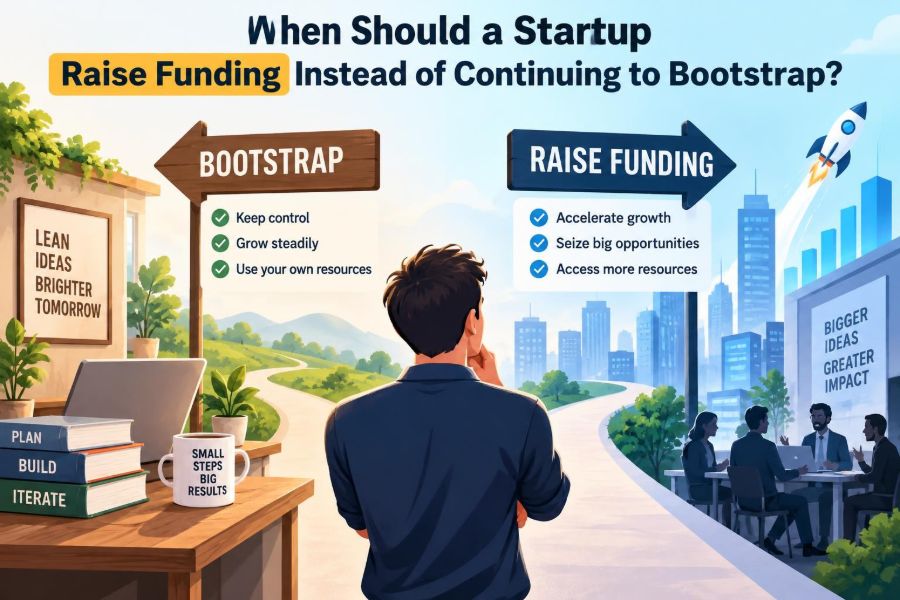

Bootstrapping is often the smartest default for a startup. It keeps you close to customers, forces difficult prioritization, and lets you build without handing away ownership before you understand what the business can become.
But “bootstrap forever” is not automatically disciplined, and funding is not automatically reckless. At a certain point, moving too slowly can cost you a market, exhaust the founding team, or leave a proven opportunity underbuilt.
This question matters most for founders with early customer traction, a clear path to growth, and more demand or opportunity than their current cash flow can support. It also matters for small-business owners deciding whether a loan, grant, angel round, or revenue-based option is better than reinvesting every spare dollar.
The goal is not to raise because fundraising looks like progress. The goal is to choose capital when it can produce a better outcome than continued bootstrapping, while preserving enough control and resilience to build the company you actually want.
🧭 1. Start With the Real Question: What Is Capital Supposed to Change?
Before comparing term sheets or opening a loan application, define the job the money must do. “We need to grow” is too vague to guide a high-stakes decision.
A useful funding case connects capital to a specific constraint: hiring a needed role, meeting contracted demand, building a required product capability, buying inventory, expanding a proven acquisition channel, or reaching a critical regulatory milestone.
Ask these questions first
- What opportunity are we unable to capture with current resources?
- What will the money buy in the next 12 to 18 months?
- What measurable result should that spending create?
- Could customer revenue, preorders, partnerships, or a smaller financing option solve it instead?
- What happens if the funding does not arrive?
If your answer is mainly “we want to feel safer,” pause. Capital can extend runway, but it does not fix unclear positioning, weak retention, or an unprofitable sales process.
📊 2. Know the Difference Between a Funding Need and a Funding Want
A funding need exists when a credible opportunity requires upfront resources and the likely return justifies the cost of capital. A funding want often appears as a desire for validation, prestige, or permission to take the business seriously.
For example, a software company with paying customers and a repeatable sales motion may need funding to hire account executives before a competitor occupies its niche. A founder with a prototype but no evidence that customers will pay may simply want funding to postpone customer conversations.
| Situation | Usually a need or want? | Better first response |
|---|---|---|
| Signed demand exceeds delivery capacity | Potential need | Model hiring, tools, or working-capital requirements |
| Ads lose money on every customer | Usually a want | Improve offer, retention, and unit economics first |
| Large inventory order unlocks reliable margins | Potential need | Explore purchase-order, loan, or supplier financing |
| Founder wants a bigger team to move faster | Often a want | Identify the one bottleneck and test a contractor hire |
| New regulation requires certification before launch | Potential need | Estimate milestone cost and non-dilutive options |
🔥 3. Raise When Demand Is Proven but Capacity Is the Bottleneck
One of the healthiest reasons to raise is that customers are already telling you, through actions rather than compliments, that they want more than you can currently provide.
Evidence may include a growing waitlist that converts, recurring customers requesting expansion, signed contracts you cannot fulfill quickly enough, or a sales pipeline backed by a repeatable process.
Step-by-step test
- Document demand from the last three to six months.
- Separate real commitments from vague interest.
- Calculate what people, equipment, inventory, or product work would unlock delivery.
- Estimate gross margin after scaling that capacity.
- Raise only enough to relieve the proven bottleneck and create a useful buffer.
Common mistake: treating a one-off large customer request as a scalable market. Confirm that at least part of the demand is repeatable or strategically valuable before changing the company’s capital structure.
Metrics to track
- Qualified pipeline and conversion rate
- Backlog or waitlist conversion
- Time from sale to delivery
- Capacity utilization
- Gross margin by customer or product line
🧪 4. Do Not Raise to Find Product-Market Fit
Early funding can help in sectors with unusually high research, manufacturing, or compliance costs. But for most software, service, marketplace, and digital-product startups, a large round is a poor substitute for learning what customers truly need.
Before product-market fit, your job is to test a narrow problem, speak with buyers, charge where possible, and revise quickly. A bigger bank account can make it easier to build features nobody requested.
Use a low-cost validation path
- Sell a manual version of the service.
- Create a paid pilot with a specific outcome and timeframe.
- Use a landing page, demo, or prototype to test demand.
- Ask for deposits, letters of intent, or implementation commitments where appropriate.
- Track whether users return, pay, refer, or expand.
Raising before validation may still be rational for deep technology, healthcare, biotech, hardware, or regulated industries. In those cases, explain the milestone clearly: what technical, clinical, regulatory, or manufacturing proof the capital will produce.
⏱️ 5. Consider Funding When Speed Has Strategic Value
Speed matters when a market window is real, not merely imagined. A platform shift, regulatory deadline, distribution partnership, or visible land grab can make a well-timed investment more valuable than maximizing ownership at all costs.
Still, urgency is easy to invent. “Competitors might move faster” is not enough. Identify exactly what faster execution allows you to secure.
Good signs that speed matters
- You can win exclusive or difficult-to-replace distribution.
- Customers are actively choosing vendors now.
- A market change creates a temporary advantage for early entrants.
- Your product improves with scale through data, network effects, or operational density.
- Competitors with capital are demonstrably taking customers you could serve.
Common mistake: increasing burn before proving that spending actually increases speed. Hire in stages and set decision checkpoints after each major investment.
💵 6. Understand Your Unit Economics Before You Scale Spending
Funding magnifies the business you already have. If each new customer creates healthy contribution margin and stays long enough, capital may accelerate a sound engine. If each new customer creates a deeper loss without a credible path to improvement, funding can magnify the problem.
Keep the math simple at first. You need to know what it costs to acquire and serve a customer, what they pay, how long they stay, and when cash returns to the business.
Core calculations
- Gross margin: revenue minus direct delivery costs.
- Customer acquisition cost: sales and marketing spend divided by new customers acquired in that period.
- Payback period: time needed for gross profit from a customer to recover acquisition cost.
- Retention: percentage of customers or revenue that remains over time.
- Burn multiple: net cash burned relative to net new recurring revenue, where relevant.
Do not force false precision. Use conservative assumptions, update them monthly, and distinguish collected cash from booked revenue.
🏦 7. Match the Type of Capital to the Type of Business
Not every startup should pursue venture capital. Venture funding generally fits businesses that can plausibly grow very large, quickly, and with outsized returns. A durable local business, agency, ecommerce brand, or cash-flowing software company may be better served by loans, customer financing, angel capital, or steady reinvestment.
| Capital source | Best fit | Main trade-off |
|---|---|---|
| Bootstrapping | Early validation and profitable growth | Slower expansion and founder cash pressure |
| Angel equity | Early high-growth companies needing expertise and risk capital | Dilution and investor expectations |
| Venture capital | Large, scalable markets with a credible rapid-growth path | High growth pressure and meaningful dilution |
| Bank or small-business loan | Predictable cash flow, equipment, inventory, or established operations | Repayment obligations and possible guarantees |
| Revenue-based financing | Companies with recurring or predictable revenue | Can be expensive and reduce future cash flow |
| Customer prepayments | Custom work, subscriptions, inventory, or B2B implementations | Delivery obligations and scope discipline |
Costs, tax treatment, securities rules, lending terms, and investor protections vary by country. Use qualified legal and financial advice before signing financing documents.
🛠️ 8. Build a Milestone-Based Funding Plan
The strongest fundraising story is not “give us money and we will grow.” It is “this capital gets us from a known point to a valuable, measurable next proof point.”
That proof point might be a working product, a regulatory approval, repeatable customer acquisition, a revenue target, a manufacturing run, or a defined level of retention.
Create a one-page use-of-funds plan
- Starting cash and monthly burn
- Amount sought and expected closing timeline
- Three to five spending categories
- Milestones tied to each category
- Base-case and downside-case runway
- Specific triggers to cut spending if assumptions fail
Keep the plan operational. “Marketing” is not a milestone; “run three tested acquisition channels, reach a defined payback target, and retain the channel that works” is much more useful.
🧮 9. Calculate Runway Without Fooling Yourself
Runway is how long your available cash can support the business at its expected net monthly burn. It is one of the clearest signals of whether you can negotiate from strength or desperation.
Use a conservative cash forecast that includes payroll, contractors, taxes, software, rent, insurance, debt payments, refunds, inventory deposits, and realistic payment delays. Do not assume every invoice arrives on time.
A simple example
If the business has 180,000 in available cash and expects to burn 15,000 per month, the simple calculation is 180000 / 15000 = 12 months. But if a planned hire, annual software bill, or seasonal revenue dip is likely, model those events separately.
Most founders should begin fundraising well before the last few months of runway. Fundraising takes time, distracts leadership, and can take longer than expected.
🧠 10. Assess Whether You Are Ready for Investor Pressure
Outside equity does more than provide money. It adds reporting expectations, governance, future fundraising pressure, and a group of people whose desired outcome may differ from yours.
That is not inherently bad. Good investors can help with recruiting, customer introductions, strategy, and pattern recognition. But a founder should enter the relationship with open eyes.
Discuss these questions with cofounders
- Do we want to pursue a high-growth, potentially high-risk outcome?
- How much ownership and control are we willing to trade?
- What board structure are we comfortable with?
- What happens if growth is slower than the plan?
- Would we still be proud to run this business without a large exit?
Common mistake: accepting money from an investor whose portfolio, timeline, or style does not fit the company. References work both ways; speak with founders who have worked with that investor.
🧑🤝🧑 11. Make Sure the Founding Team Can Absorb Growth
Money cannot create management capacity overnight. A sudden increase in headcount, customers, vendors, and product complexity can break a team that previously worked well in a small room.
Before raising, identify who owns product, sales, customer success, finance, and hiring. These roles can overlap early, but they cannot remain invisible.
Prepare the operating foundation
- Write down the company’s top priorities for the next two quarters.
- Define who makes which decisions.
- Create a basic hiring scorecard for the first key roles.
- Set a weekly metric review.
- Document customer feedback and product requests in one place.
Hiring too fast is a common post-funding mistake. Start with roles that remove the clearest bottleneck, rather than building an impressive-looking org chart.
🔍 12. Compare Funding With the Bootstrap Alternatives
The choice is rarely between raising a large round and doing nothing. Creative financing can reduce dilution, preserve flexibility, and prove customer commitment.
Alternatives worth testing
- Increase prices for high-value customer segments.
- Ask enterprise customers for implementation fees or annual prepayment.
- Negotiate longer supplier terms or smaller inventory batches.
- Use contractors before permanent hires.
- Launch a higher-margin service that funds product development.
- Apply for grants where the business genuinely qualifies.
- Explore equipment leasing or purchase-order financing for physical businesses.
These options are not free. Prepayments create delivery commitments, debt creates repayment risk, and consulting can distract from the product. Compare each option against the precise problem you need to solve.
⚖️ 13. Treat Dilution as a Strategic Cost, Not a Badge of Honor
Dilution is the reduction in your ownership percentage when new shares are issued. It can be absolutely worthwhile if the capital materially increases the value and probability of the company.
It is costly when founders give up ownership to cover avoidable inefficiency or to chase growth that has not been validated. Focus on the value created, not only the percentage retained.
Before agreeing to equity financing
- Understand valuation, ownership after the round, and expected future dilution.
- Review liquidation preferences, voting rights, option-pool changes, and board rights.
- Ask what future milestones investors expect before another round.
- Model a few possible outcomes with your adviser.
- Use a lawyer experienced in startup financings in your jurisdiction.
Terms matter as much as headline valuation. A high valuation with restrictive terms can create problems later.
📣 14. Raise From Evidence, Not From a Perfect Slide Deck
A clear deck helps, but investors, lenders, and strategic partners ultimately want evidence. The best evidence differs by business, yet it usually includes customer behavior, market understanding, credible economics, and a team capable of execution.
Prepare your proof package
- Customer interviews and a concise explanation of the problem
- Revenue, retention, pipeline, or pilot data
- A product demo or a clear description of operational delivery
- A simple financial model and cash forecast
- A realistic use-of-funds plan
- Key risks and how you plan to reduce them
Do not hide bad news. Explain churn, losses, delays, or failed experiments plainly, then show what changed. Mature backers generally know that early businesses are messy.
🚫 15. Recognize the Warning Signs That You Should Keep Bootstrapping
Continuing to bootstrap is often the better choice when capital would only make an uncertain business more expensive. It can give you the time to learn, improve margins, and retain leverage for a later decision.
Pause fundraising if these are true
- You cannot explain why customers choose you and stay.
- Your sales process depends entirely on the founder’s personal network.
- New customers have weak or negative contribution margins with no tested fix.
- You lack a specific use for the money beyond “growth.”
- You are raising primarily because cash is nearly gone.
- Cofounders disagree fundamentally about the company’s ambition.
- Debt payments would endanger essential operations during a modest downturn.
A short period of focused bootstrapping can be a strategic reset, not a failure. Reduce burn, speak to customers, simplify the offer, and restore the evidence needed for a better decision.
🧯 16. Avoid These Common Funding Mistakes
Founders often make financing mistakes because they treat it as a one-time event instead of an operating decision that shapes years of work.
Mistakes to avoid
- Raising too much: encourages undisciplined spending and raises future expectations.
- Raising too little: leaves no room for delays and forces another distracting round too soon.
- Hiring ahead of proof: creates fixed costs before a channel or product is reliable.
- Ignoring cash collections: booked revenue does not pay payroll.
- Choosing money over fit: the wrong partner can make future decisions harder.
- Stopping customer conversations: fundraising must not become an excuse to lose market contact.
Set an internal rule: every major expense after funding needs an owner, a hypothesis, a budget, and a metric that tells you whether to continue.
📈 17. Track the Metrics That Tell You Whether Funding Is Working
After raising, the important question changes from “did we close?” to “is this capital creating the promised progress?” Review a small scorecard every week or month.
Core operating metrics
- Cash balance, monthly burn, and runway
- Revenue growth and cash collected
- Gross margin and contribution margin
- New customer acquisition cost and payback period
- Retention, churn, repeat purchases, or expansion revenue
- Sales cycle length and pipeline conversion
- Product usage, activation, or delivery quality
- Hiring progress and output from critical roles
Use leading metrics as well as lagging ones. For instance, qualified demos and trial activation can warn you about future revenue changes before the income statement does.
🗺️ 18. Make the Decision With a Simple Founder Framework
You do not need perfect certainty. You need a disciplined answer to whether external capital makes the company more likely to achieve a worthwhile outcome than careful bootstrapping does.
Use this decision checklist
- State the bottleneck in one sentence.
- Prove it with customer, revenue, operational, or technical evidence.
- List at least three ways to solve it, including bootstrapping.
- Model the cost, risk, and likely outcome of each option.
- Choose the capital type that best matches the business and milestone.
- Set a funding amount, runway target, and spending checkpoints.
- Get legal, tax, and financial guidance appropriate to your country.
- Decide what you will do if the round, loan, or grant does not happen.
The best financing decision usually feels less glamorous than people expect. It is a practical choice, backed by customer evidence and clear math, that gives the business enough resources to reach its next meaningful milestone.
✅ 19. Your Action Plan for This Week
Do not begin by emailing investors. Begin by turning the question into a decision document.
- Day 1: write down your single biggest growth constraint.
- Day 2: review customer evidence and separate facts from assumptions.
- Day 3: build a 12-month cash forecast with a downside scenario.
- Day 4: compare bootstrapping, customer financing, debt, and equity.
- Day 5: define the milestone capital would help you reach.
- Day 6: discuss ambition, ownership, and risk with cofounders or trusted advisers.
- Day 7: choose one next move: improve the business first, test an alternative, or begin a focused financing process.
Raise funding when it turns proven demand and a clear plan into durable progress—not when it merely delays the hard work of building a business customers value. 🚀💡📊