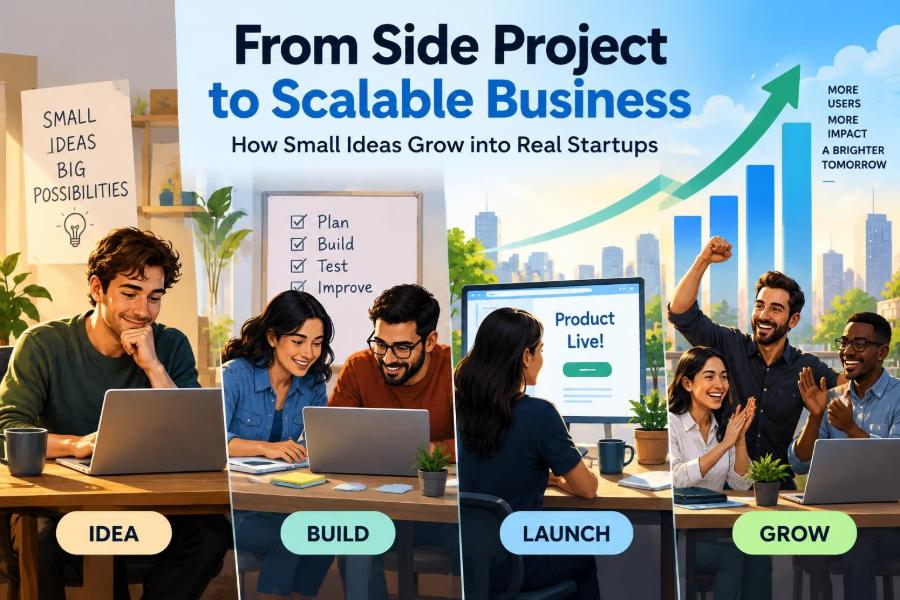

Most startups do not begin with a grand vision, a huge funding round, or a perfectly polished app. They begin with a small frustration: a task people hate doing, a customer group that feels ignored, or a service that is harder to buy than it should be.
A side project is a sensible place to start if you have limited time, limited cash, and a willingness to learn in public. It suits employees, freelancers, students, creators, and small-business owners who want to test an opportunity without making a reckless all-or-nothing bet.
The opportunity matters now because building tools, reaching customers, and taking payments are more accessible than ever. But accessibility also means more noise. The winners are rarely the people with the fanciest idea; they are the people who solve a specific problem, speak to real customers, and keep improving their offer.
Growing a side project into a real startup is not about “hustling” until you burn out. It is about reducing uncertainty one practical step at a time: prove the problem, sell a simple solution, deliver it well, and build repeatable systems around what works.
💡 1. Start With a Painful, Specific Problem
A useful startup idea is usually a problem with consequences. It costs someone time, money, missed opportunities, stress, or reputation. “People might enjoy this” is weaker than “independent clinics lose bookings because appointment follow-ups are inconsistent.”
Look for problems you can describe in one sentence, for one defined group of people. Narrow is not a weakness at the beginning; it makes customer research, messaging, and product decisions much easier.
- Notice repetitive work in your job or industry.
- Read complaints in communities where your likely customers gather.
- Ask service businesses what they still manage in spreadsheets, email, or messaging apps.
- List tasks people outsource because they are annoying or risky.
Common mistake: starting with technology or a trendy market before identifying the person with the urgent problem.
🎯 2. Choose a Customer You Can Actually Reach
“Small businesses” and “busy parents” are markets, not customer profiles. Your first customer group should be small enough that you know where to find them and what language they use.
For example, instead of building for all local retailers, begin with independent bicycle shops that offer repairs. Instead of helping every creator, help newsletter writers who sell paid sponsorships.
Build a first-customer profile
- Role: Who makes the buying decision?
- Situation: What has changed or become difficult for them?
- Current workaround: How do they solve it today?
- Trigger: What makes them actively look for a solution?
- Budget: What is the cost of doing nothing?
Being able to contact 30 plausible buyers this month is more valuable than claiming a market of millions.
🗣️ 3. Talk to Customers Before You Build
Conversations are not a formality. They are how you learn whether the problem is real, frequent, and worth paying to solve. Aim for conversations with people who match your profile, not friends who want to be supportive.
Ask about past behavior rather than future intentions. People are often optimistic about what they would buy, while their recent actions reveal their actual priorities.
Useful interview questions
- “Tell me about the last time this happened.”
- “What did you do to solve it?”
- “What did that cost in time, money, or lost business?”
- “What have you already tried?”
- “Who else is involved in choosing a solution?”
Do not lead with “Would you use my app?” If the person has never felt the problem strongly enough to seek a workaround, a polished product will not create urgency by itself.
🔎 4. Validate Demand With a Small Commitment
Compliments are not validation. A small commitment is. That may be a pre-order, a paid pilot, a signed letter of intent, a booked consultation, an introduction to a decision-maker, or permission to run a test using real data.
You do not need hundreds of customers to learn something useful. A few people who pay, renew, or actively use a rough solution can teach you far more than a large survey.
| Validation method | Cost estimate | Effort | Strength of signal |
|---|---|---|---|
| Customer interviews | Low | Medium | Useful for understanding pain |
| Simple landing page | Low | Low | Useful for testing messaging |
| Paid pilot | Low to medium | High | Strong evidence of willingness to pay |
| Pre-order or deposit | Low | Medium | Strong, but requires clear delivery terms |
Important: be transparent about what exists today and when you expect to deliver. Do not take money for promises you cannot responsibly fulfill.
🧩 5. Define the Smallest Valuable Offer
Your first version should solve one meaningful job from beginning to end. It should not attempt to reproduce every feature of established competitors.
If you are building a bookkeeping service, the minimum valuable offer may be “monthly reconciled books for freelance designers,” not an all-in-one finance platform. If you are building software, it may begin as a manual service behind a simple interface.
Use the “one outcome” test
Complete this sentence: “We help this customer achieve this outcome without this painful alternative.” If the sentence becomes vague, make the offer smaller.
- Choose one customer type.
- Choose one core workflow.
- Define one measurable result.
- Exclude features that do not support that result.
🛠️ 6. Build the Cheapest Credible Version
A minimum viable product is not necessarily an app. It is the smallest credible way to deliver and test the promise. A spreadsheet, template, no-code workflow, concierge service, or manually produced report can be a better first product than custom code.
Estimated startup costs: a service-first test can often begin with modest spending on a domain, basic software, payment processing, and outreach. A custom software build can cost far more and carries more risk before demand is proven. Costs vary widely by country, tools, contractor rates, taxes, and regulatory requirements.
Pick your starting format
- Manual service: best when learning the workflow matters most.
- Template or digital product: best for a repeatable, low-complexity need.
- No-code prototype: best for testing a simple customer journey.
- Custom software: best after repeated evidence that automation will create leverage.
Keep a record of every manual step. Those notes become your future product requirements and operating playbook.
💰 7. Price Before You Feel Ready
Pricing is part of validation. Free users can be helpful for feedback, but they do not necessarily prove that your business solves an important enough problem. Ask for payment early, even if your first price is modest.
Price against value and alternatives, not only your own effort. If you save a business several hours each week, reduce expensive errors, or help them win more work, your price can reflect a portion of that value.
Simple early pricing options
- One-time fee: useful for audits, setup services, templates, or defined projects.
- Monthly subscription: useful when value continues and usage is recurring.
- Usage-based pricing: useful when customer volume varies meaningfully.
- Retainer plus setup fee: useful for hands-on business services.
Do not hide behind “I need more users before I price.” A real price reveals objections, budget constraints, and the true value of the outcome.
📣 8. Get Your First Customers Through Direct Outreach
Early customer acquisition is often unglamorous. It means identifying a small list of relevant people, writing personal messages, asking for conversations, and following up with care.
Start where trust already exists: former colleagues, industry groups, local businesses, niche online communities, professional associations, and people referred by interview participants. Do not spam strangers with generic sales pitches.
A practical outreach sequence
- Identify 25 people who closely fit your customer profile.
- Write a short, personal note focused on their situation.
- Ask for a 15-minute research conversation, not an immediate purchase.
- Share your offer only after understanding their workflow.
- Follow up with a clear next step and an honest timeline.
Track replies, calls booked, proposals sent, and conversions. Direct outreach gives fast feedback on both your message and your market.
✍️ 9. Make Your Message Easy to Understand
Customers should not need a demo to understand what you do. Lead with the problem and outcome, then explain how your solution works.
Compare “an AI-powered business operations platform” with “we turn customer support emails into a weekly list of product issues for small online stores.” The second version gives a buyer something concrete to evaluate.
Write a simple positioning statement
For [specific customer] who struggle with [specific problem], [product or service] helps them [specific outcome] by [simple mechanism].
Use customer words from interviews. If prospects repeatedly say “chasing invoices,” do not replace that language with abstract phrases such as “optimizing accounts receivable workflows.”
🤝 10. Deliver Like a Service Business First
At the beginning, reliability beats scale. Answer questions, solve edge cases, and make onboarding unusually clear. Your first customers are not merely revenue; they are your best source of product understanding.
Service-minded delivery does not mean saying yes to every request. It means learning why customers ask for something, then deciding whether it belongs in your core offer.
- Set clear expectations for scope and response times.
- Create a simple onboarding checklist.
- Document recurring customer questions.
- Ask for feedback after a meaningful result, not just after sign-up.
- Fix the biggest point of confusion each week.
For regulated industries, handling payments, personal data, health information, employment matters, or financial advice may require specific legal, tax, insurance, privacy, or licensing steps. Check the rules in the countries where you operate and where your customers are located.
📊 11. Track Metrics That Change Decisions
Early-stage metrics should help you choose what to do next. Avoid collecting dashboards full of numbers that do not lead to action.
Start with a small scorecard
| Metric | What it tells you | Early question to ask |
|---|---|---|
| Qualified conversations | Access to your market | Can we reliably reach the right people? |
| Conversion rate | Offer and message strength | Why do interested people hesitate? |
| Activation rate | First-value experience | Do customers reach a useful result quickly? |
| Retention or repeat purchase | Ongoing value | Do they come back after the first use? |
| Gross margin | Economic viability | Can delivery become more efficient? |
For a subscription product, watch cancellations and reasons for cancellation. For a service business, track delivery hours, client profitability, referrals, and whether customers renew.
🔁 12. Learn From Retention, Not Just New Sales
A customer who stays, pays again, refers someone, or expands their use is giving you a powerful signal. It suggests your product has become part of a real workflow.
When customers leave, resist the urge to explain it away. Ask what they expected, where value fell short, what changed in their situation, and what alternative they chose. Some churn is unavoidable; patterns are what matter.
Retention improvement checklist
- Define the customer’s first meaningful success moment.
- Help them reach that moment quickly.
- Send useful onboarding guidance at the right time.
- Review inactive accounts personally while volume is low.
- Prioritize fixes that affect repeated usage.
Do not scale acquisition aggressively while customers routinely leave after a short period. You may simply be paying to refill a leaking bucket.
⚙️ 13. Turn Repeated Work Into Systems
Scale starts with repeatability, not headcount. Every time you deliver the same result, ask whether the process can be documented, templated, automated, delegated, or removed.
Create a basic operating manual while tasks are still fresh. A one-page checklist can prevent expensive inconsistency later.
Systemize in this order
- Document the current process.
- Remove unnecessary steps.
- Standardize decisions and templates.
- Automate low-risk, repetitive work.
- Delegate tasks with clear quality checks.
Common mistake: automating a confusing process. Improve the workflow manually before embedding it in software or complex automation.
📈 14. Find a Repeatable Growth Channel
There is no universal best channel. Your ideal channel depends on where customers already seek answers and how much trust they need before buying.
Direct sales may work for high-value business services. Educational content can work for products people research before purchasing. Partnerships can work when another trusted business already serves your customer group.
Test channels deliberately
- Choose one channel for a defined period.
- Set a small budget or time limit.
- Use one offer and one audience segment.
- Measure qualified leads, conversion, and cost to acquire a customer.
- Keep, improve, or stop based on evidence.
A channel is not proven because it produces attention. It is promising when it produces customers at a cost and effort level your business can sustain.
🧮 15. Know the Economics Before You Scale
Revenue is encouraging, but it is not the whole story. A growing business can still be fragile if each sale requires too much founder time, advertising spend, support effort, or custom work.
For each offer, estimate revenue, direct delivery costs, payment fees, refunds, support time, contractor costs, and taxes where applicable. Your estimates will be imperfect at first; the discipline of reviewing them is what matters.
Questions to review monthly
- What does it cost us to acquire one paying customer?
- How long until that cost is recovered?
- Which customer segment is most profitable and easiest to serve?
- Which requests create disproportionate support work?
- What cash commitments are coming before customer payments arrive?
Keep personal and business finances separate where possible, maintain records, and seek qualified local accounting or legal advice as the business becomes more complex.
👥 16. Hire for a Bottleneck, Not a Title
The first hire should remove a real constraint. Perhaps customer support is stealing all selling time, fulfillment quality is slipping, or technical work is blocking a validated product improvement.
Do not hire simply to look like a startup. Begin with a clearly scoped contractor, freelancer, or part-time role when appropriate, then expand only after the work and expected outcome are understood.
Before bringing someone in
- Write down the exact outcome you need.
- Document the workflow and quality standard.
- Calculate what the role must free up or produce.
- Protect customer data and intellectual property with appropriate agreements.
- Learn your local employment and contractor rules.
A strong early team is built around complementary skills, honest communication, and shared responsibility—not job titles and vague ambition.
🧱 17. Build Defensibility Through Focus and Trust
In the early days, your advantage may be speed, closeness to customers, and deep knowledge of a narrow niche. Over time, defensibility can come from trusted relationships, excellent service, a better workflow, proprietary data gathered with permission, community, brand reputation, or operational expertise.
Features alone are often easy to copy. A business that reliably understands a specialized customer and delivers an outcome with less friction is much harder to replace.
Protect trust carefully. Be clear about pricing, contracts, data use, security limitations, and what your product can and cannot do. Short-term shortcuts can create long-term reputational damage.
🧭 18. Decide Whether to Double Down, Pivot, or Pause
Not every side project should become a full-time startup, and that is not failure. Some are excellent small businesses. Some remain useful income streams. Others reveal a lesson that leads to a better opportunity.
Double down when customers pay, stay, and clearly describe the value they receive. Pivot when the problem is real but your audience, offer, or delivery model is wrong. Pause when the economics, personal cost, or market response do not justify further investment.
Make the decision with evidence
- Review customer behavior, not just encouragement.
- Compare revenue and margin against the time required.
- Assess whether demand is becoming more repeatable.
- Consider your financial runway and personal obligations.
- Set a review date instead of making emotional daily decisions.
There is no prize for quitting a stable income too early. Transition carefully, with savings, clear demand signals, and a realistic understanding of risk.
✅ 19. Your Action Plan for This Week
Do not try to execute every idea in this article at once. Momentum comes from one small cycle of learning: speak to someone, make an offer, deliver value, and review what happened.
- Write down three problems you have observed repeatedly.
- Choose the one tied to the clearest customer group you can reach.
- Contact five people for short problem interviews.
- Summarize the exact words they use to describe the problem.
- Create a one-sentence offer for one outcome.
- Ask one qualified person to test it through a paid pilot, deposit, or concrete commitment.
- Schedule a weekly 30-minute review of conversations, sales, retention, and delivery lessons.
Keep the first experiment small enough that you can complete it alongside your current responsibilities. The goal this week is not to build a company. It is to earn the next piece of evidence.
Small ideas become scalable businesses when founders repeatedly replace assumptions with customer evidence, then turn what works into a simple, reliable system. 🚀 🌱 📈