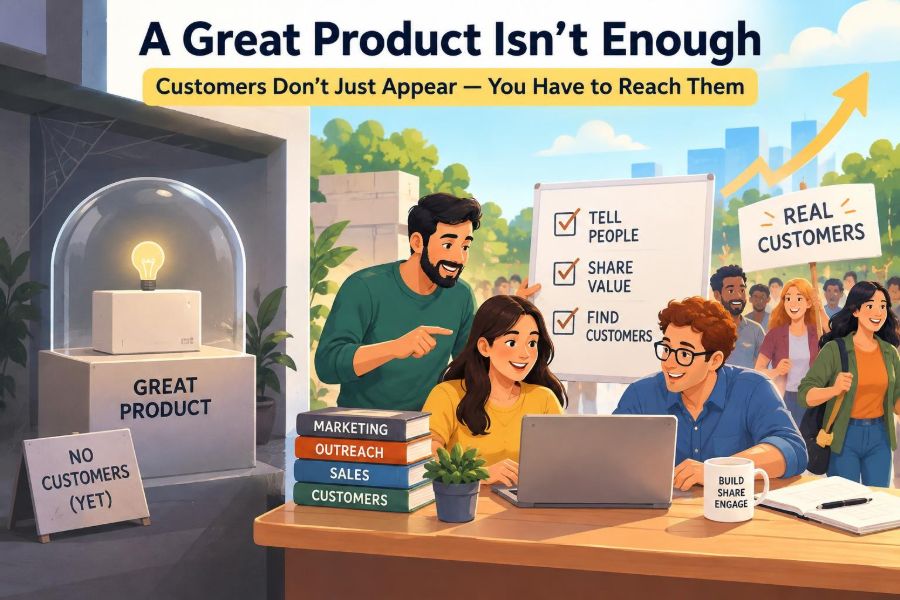

A great product is an advantage. It is not a distribution plan, a sales process, a message, or a reason for a busy stranger to change what they already do.
This matters especially to first-time founders, makers, consultants, and small-business owners who have spent months improving an offer before showing it to anyone. Building can feel productive and safe; asking for attention can feel awkward. But the market only rewards value that people can discover, understand, trust, and buy.
The opportunity is not to become a loud, pushy marketer. It is to build a repeatable path between a real customer problem and your genuinely useful solution. That path can begin with a handful of personal conversations, not a giant advertising budget.
Right now, customers have more choices, more content, and less attention than ever. The founders who win are usually not those with the most features. They are the ones who make the next step obvious and consistently earn the right to be noticed.
🧠 1. Start with the uncomfortable truth
The phrase “the product sells itself” is usually shorthand for something else: someone built trust, created demand, had a strong network, benefited from timing, or invested heavily in distribution.
Even products people love can remain invisible. A useful accounting tool, handmade skincare line, local cleaning service, or specialist course does not compete only on quality; it competes against habit, confusion, delay, and every other demand on a customer’s day.
- Product is what you deliver.
- Marketing helps the right people notice and understand it.
- Sales helps them decide and act.
- Customer success helps them get value and stay.
None of these jobs is optional. The goal is not to do all of them perfectly at once. The goal is to learn which one is currently blocking growth.
🔍 2. Separate product quality from market visibility
A product can be excellent and still fail commercially because its intended buyers never encounter it. It can also be visible and fail because the offer is unclear or the product disappoints.
Think of growth as a chain. Improving a strong link does little when another link is weak.
| Growth link | Question to ask | Early signal |
|---|---|---|
| Discovery | Can likely buyers find us? | Relevant visitors and introductions |
| Understanding | Do they quickly grasp the benefit? | People can repeat your value proposition |
| Trust | Why should they believe us? | Replies, demo requests, referrals |
| Conversion | Is buying easy and low-risk? | Paid trials, orders, deposits |
| Retention | Do customers get ongoing value? | Renewals, repeat orders, advocacy |
Do not respond to weak sales by automatically adding features. First identify the broken link.
🎯 3. Choose a painfully specific first customer
“Small businesses” is not a customer segment. Neither is “anyone who wants to save time.” Broad descriptions force you to use vague messages, and vague messages are easy to ignore.
Choose a narrow group you can reach and learn from: independent dental practices with two to five staff, freelance designers struggling with proposals, or parents seeking weekend coding activities for children.
Build a practical customer snapshot
- What job are they trying to get done?
- What triggers them to look for help now?
- What are they doing instead?
- What does delay cost them in time, money, risk, or frustration?
- Where do they already ask peers for advice?
Narrowing your focus does not permanently shrink your business. It makes the first message, channel, and offer easier to test. You can expand after you have evidence.
🗣️ 4. Talk to people before polishing your pitch
Customer conversations are not a ceremonial research step. They are your fastest route out of founder assumptions.
Ask about past behavior rather than hypothetical enthusiasm. “Tell me about the last time you handled this problem” is far more useful than “Would you use an app that does this?”
Use questions that reveal real demand
- “What happened the last time this became a problem?”
- “What did you try, and what did it cost?”
- “Who else is involved in deciding?”
- “What would a good outcome look like?”
- “Would you be open to seeing a simple approach next week?”
Take notes in the customer’s language. Their exact words often become better website copy than the polished phrases founders invent in isolation.
💬 5. Turn features into a message people recognize
Customers rarely wake up wanting your feature list. They want a result, relief from a pain, or progress toward a goal.
A weak message says, “AI-powered workflow platform with customizable dashboards.” A clearer message says, “Help your operations team spot delayed orders before customers complain.” The second version gives a person, a problem, and an outcome.
Use a simple message formula
We help [specific customer] achieve [valuable outcome] without [common frustration or trade-off].
For example: “We help independent consultants send professional proposals in an hour without rebuilding documents from scratch.” Test several versions in conversations, emails, landing pages, and sales calls.
Clarity is not dumbing down. It is respect for a customer who has limited time and no obligation to decode your business.
🧲 6. Create an offer, not just a product
A product is the thing you make. An offer is the complete reason someone should buy it now. It includes the outcome, price, scope, proof, onboarding, timing, and risk reduction.
For a service, an offer might be a fixed-price “website conversion audit delivered in five days.” For software, it might be an onboarding package for one team and a 14-day guided trial. For a physical product, it might be a starter bundle with useful instructions.
- State what is included and excluded.
- Make the first outcome achievable quickly.
- Remove unnecessary choices.
- Set a clear next step: buy, book, reply, or request a sample.
Be careful with discounts. A lower price may increase interest, but it cannot repair a vague or unimportant offer.
🛠️ 7. Build the smallest proof that can be sold
You do not always need a finished product to validate demand. You need an honest representation of what you can deliver, plus a credible plan to deliver it.
That could be a manual service behind a simple form, a prototype walkthrough, a paid workshop, a concierge version of software, or a small batch of a physical item. Never pretend an unfinished capability already exists.
Pick the lowest-cost test
| Test | Best for | Effort | What it proves |
|---|---|---|---|
| Customer interviews | Early problem discovery | Low | Whether the pain is real and urgent |
| Landing page with call to action | Message testing | Low to medium | Whether people want to learn more |
| Paid pilot | Services and B2B | Medium | Willingness to pay and delivery fit |
| Pre-order or deposit | Physical products | Medium | Demand before larger inventory spend |
| Free trial | Software with onboarding | Medium to high | Activation and early product value |
A compliment is not proof. A scheduled call is better. A deposit, purchase order, or paid pilot is stronger still.
📣 8. Pick one reachable acquisition channel
Early-stage businesses do not need to be everywhere. They need one reliable way to start enough conversations with the right people.
Choose the channel based on customer behavior, your strengths, and the buying cycle. A local catering business may win through venue partnerships and tastings. A niche B2B tool may begin with founder-led outreach. A visual consumer product may benefit from demonstrations and creator partnerships.
Match channel to context
- Warm introductions: best when trust and referrals matter.
- Direct outreach: useful for defined B2B audiences and high-value services.
- Local partnerships: useful for location-based businesses.
- Educational content: useful when buyers research before purchasing.
- Communities and events: useful when a niche gathers around a shared problem.
- Paid advertising: more useful after your message and conversion path work.
One channel does not mean one tactic forever. It means giving one reasonable method enough focused effort to learn from it.
✉️ 9. Make founder-led outreach useful, not spammy
Early outreach works best when it is personal, relevant, brief, and easy to decline. The objective is often a conversation, not an immediate sale.
Start with people who plausibly have the problem. Mention a specific reason you thought of them, then make a small request.
A simple outreach structure
Hi [Name], I noticed [relevant observation].

I am speaking with [type of customer] about [specific problem]. We are testing a way to [outcome].

Would you be open to a 15-minute conversation next week? If it is not relevant, no problem at all.
Do not automate before you understand what earns replies. Sending a bad message to more people is not a growth strategy.
🤝 10. Borrow trust through partnerships
Customers often trust a familiar source before they trust a new company. Partnerships let you meet buyers through organizations, professionals, or communities that already serve them.
Examples include a bookkeeping firm referring an expense-management service, a gym introducing a nutrition coach, or a local retailer carrying a complementary product.
Make the partnership worthwhile
- Choose partners with the same audience but a non-competing offer.
- Explain the customer benefit before discussing your benefit.
- Offer a simple referral process, not a complicated scheme.
- Track introductions, conversions, and customer quality.
- Put payment terms and responsibilities in writing where appropriate.
Referral fees, affiliate arrangements, data handling, consumer disclosures, taxes, and industry rules vary by country. Get appropriate legal or accounting advice before formalizing an arrangement.
🧾 11. Reduce the risk of saying yes
Buying from an unknown business feels risky. Customers may worry about wasting money, losing time, choosing the wrong provider, or having no support after payment.
Your job is to reduce legitimate uncertainty without making promises you cannot keep.
- Show a clear process and realistic timeline.
- Use transparent pricing or explain how pricing is determined.
- Provide relevant samples, demonstrations, or a small first engagement.
- Publish straightforward cancellation, return, and support terms.
- Collect permission-based testimonials only after customers have had a real experience.
A guarantee can help, but only if you can honor it financially and operationally. Do not use fine print to create false reassurance.
💵 12. Price to learn, not merely to look cheap
Many founders underprice because they believe a low price will make marketing unnecessary. In reality, a very low price can signal low value, attract poor-fit customers, and leave no room to support growth.
Set an initial price based on the value created, alternatives available, delivery cost, and your capacity. Then treat it as a hypothesis to test.
Track the economics of each sale
- Revenue received
- Direct cost to deliver
- Time required from you or your team
- Acquisition cost, including ads, commissions, and sales time
- Refunds, churn, repeat purchases, and support burden
Use simple math. If an offer generates sales but consumes more time and cash than it brings in, you have evidence of demand but not yet a sustainable model. Costs, taxes, payment fees, and registration requirements vary by country and business type.
📊 13. Track a small set of honest metrics
Vanity metrics can feel encouraging while hiding a weak business. Followers, impressions, and website traffic matter only when they lead to meaningful customer behavior.
Create a simple weekly dashboard. You can begin with a spreadsheet; sophisticated software is unnecessary.
Early metrics worth watching
| Metric | Why it matters | Useful question |
|---|---|---|
| Qualified conversations | Measures access to likely customers | Are we speaking with the right people? |
| Response rate | Tests targeting and message relevance | Does our first contact earn attention? |
| Demo or call-to-sale rate | Tests offer and sales process | Does interest become commitment? |
| Activation rate | Tests first customer value | Do buyers reach an early success point? |
| Retention or repeat purchase | Tests durable value | Do customers come back? |
| Referral rate | Tests satisfaction and trust | Would customers recommend us? |
Look for patterns over time. A single week can be noisy; repeated behavior is more informative.
🧪 14. Run marketing experiments with a clear hypothesis
Marketing is not guessing loudly. It is a series of controlled learning loops: make a claim, test it with a defined audience, observe behavior, and change one important variable.
For example: “Independent consultants who mention proposal turnaround time in outreach will book more calls than those who describe document features.” Send comparable messages to small, relevant groups and record outcomes.
Use a lightweight experiment log
- Hypothesis: what you believe will happen.
- Audience: who will see it.
- Change: one message, offer, channel, or price variable.
- Success measure: replies, calls, purchases, or activation.
- Decision: continue, revise, or stop.
A failed test is useful when it gives a clear answer. Random activity with no measurement is much harder to learn from.
⚠️ 15. Avoid the most common founder traps
Most early growth problems are not caused by laziness. They come from sensible-looking choices that delay contact with the market.
- Building in secret: waiting for perfection before asking for feedback.
- Targeting everyone: making every message generic.
- Listing features: expecting customers to translate them into benefits.
- Changing everything at once: making results impossible to interpret.
- Chasing every channel: never becoming competent in one.
- Buying ads too early: paying to expose an unproven offer faster.
- Ignoring retention: treating a sale as the end of the customer relationship.
The antidote is simple, though not always easy: speak with customers weekly, test one thing at a time, and let evidence change your plans.
🔄 16. Build a feedback loop between sales and product
Marketing should not be a separate department that merely “gets leads.” The questions, objections, and drop-offs your team sees are product intelligence.
If prospects repeatedly ask whether your service works for a particular use case, that may signal a messaging gap, a missing capability, or a valuable niche. If customers need extensive help to get started, your onboarding needs attention.
Create a weekly learning ritual
- Review recent calls, emails, support requests, and cancellations.
- List repeated customer phrases and objections.
- Choose one message, process, or product improvement to test.
- Assign an owner and a deadline.
- Review the result the following week.
This loop keeps you from treating customer acquisition as a mysterious art. It becomes an operational discipline.
🌱 17. Earn retention before chasing scale
Acquiring customers becomes much easier when existing customers stay, succeed, and tell others. Growth built on churn is like filling a bucket with a hole in it.
Define the earliest moment a customer experiences real value. For a bookkeeping service, it may be receiving a clean monthly report. For a learning product, it may be completing a useful first project. For software, it may be finishing a key workflow.
- Guide customers toward that moment quickly.
- Check in before confusion becomes cancellation.
- Ask what outcome they expected and whether they achieved it.
- Use feedback to improve onboarding and documentation.
- Invite referrals only after value is clear.
Scale magnifies what already exists. A healthy retention engine makes scaling more resilient; a weak one makes it more expensive.
📈 18. Scale the repeatable parts carefully
Once you can reliably explain who buys, why they buy, and how they discover you, begin documenting the process. That is when templates, automation, contractors, and paid acquisition become more useful.
Do not confuse repetition with boredom. A repeatable process is an asset because it lets other people produce a dependable result without relying entirely on founder instinct.
Document before delegating
- Define customer qualification criteria.
- Save effective outreach and follow-up templates.
- Write the sales-call structure and common objections.
- Document onboarding steps and support standards.
- Set approval limits, budget limits, and quality checks.
Increase spend and volume gradually. Watch whether conversion, support quality, margins, and retention stay healthy as volume rises.
🗓️ 19. Your action plan for this week
You do not need a complete growth machine by Friday. You need direct evidence from the market and one small system for acting on it.
- Write a one-sentence description of your specific customer and the urgent problem you solve.
- Make a list of 20 people or organizations that plausibly fit that description.
- Contact 10 with a short, personal request for a conversation.
- Hold at least three conversations using past-behavior questions.
- Rewrite your offer using the words customers use.
- Choose one call to action: book a call, request a sample, join a pilot, or place a deposit.
- Create a basic weekly dashboard with conversations, offers made, sales, and customer feedback.
Then repeat next week. Consistent contact with the market is more valuable than a burst of motivation followed by another month of private building.
A great product deserves to be discovered, but discovery is built through deliberate customer understanding, clear communication, and repeatable trust—not wishful thinking. 🚀🤝📈