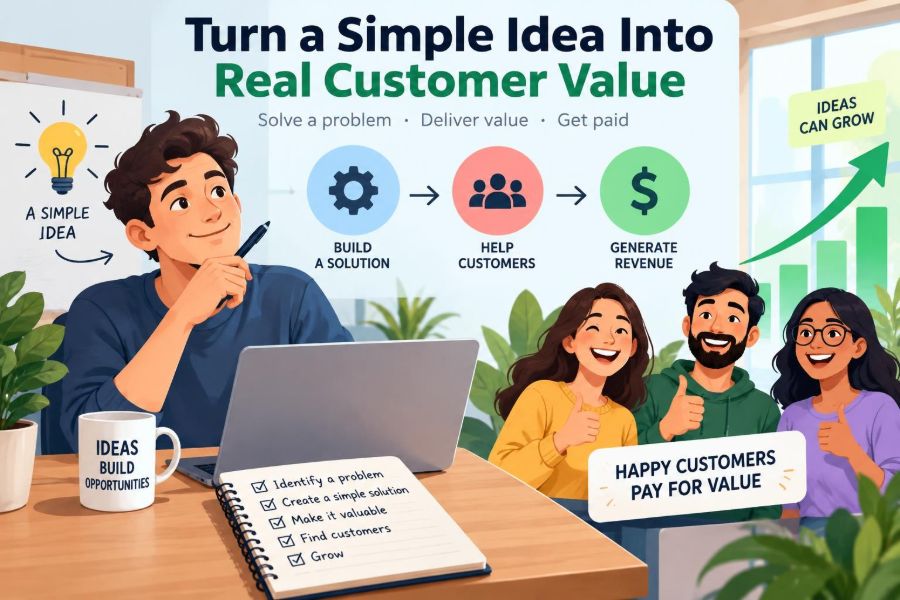

A simple startup idea is not a disadvantage. In many cases, simplicity is the point: a customer has one frustrating job, a costly delay, or a confusing decision, and they want it handled without buying another complicated system.
This opportunity suits first-time founders, consultants, makers, small-business owners, and side hustlers who have more observation than capital. You do not need to invent a new category. You need to make an existing problem easier, safer, faster, or more profitable to solve.
It matters now because customers are careful with their time and budgets. They may ignore interesting features, but they will pay for an outcome that removes work, reduces risk, or helps them capture revenue they are currently missing.
The real challenge is not having an idea. It is turning a vague thought such as “a tool for local shops” into a specific offer a particular person can understand, trust, and buy. This guide will help you do that before you spend months building.
🧭 1. Start With a Painful Job, Not a Clever Concept
Customers do not wake up wanting your app, service, template, or course. They wake up wanting a job done. The stronger that job is connected to money, time, stress, compliance, or reputation, the more likely they are to pay.
Replace broad concepts with a sentence that names the job:
- Weak: “An AI tool for restaurants.”
- Better: “A service that turns a restaurant’s weekly specials into ready-to-post social content in 30 minutes.”
- Stronger: “A managed service that helps independent restaurants fill quiet weekday tables using weekly campaigns.”
The last version points toward a measurable business outcome. It also gives you a way to decide what belongs in the offer and what does not.
🎯 2. Choose a Customer Narrow Enough to Reach
“Small businesses” is not a customer segment. A self-employed wedding photographer, a three-location dental practice, and an online craft seller have different budgets, language, workflows, and urgency.
Pick a starting niche using three filters: you can identify where they gather, you can speak with at least ten of them, and the problem happens often enough to justify a purchase. A narrow market is easier to sell to, not necessarily smaller in opportunity.
A useful starting profile
- Role: Who makes or influences the buying decision?
- Trigger: What event makes the problem urgent?
- Current workaround: What do they use today?
- Cost of inaction: What does the problem cost in time, money, or lost opportunities?
- Buying constraint: What could stop them from saying yes?
For example, “independent accountants with one to five staff who lose time chasing client documents before tax deadlines” is far more usable than “finance professionals.”
🔎 3. Find Evidence Before You Build
Validation is not collecting compliments. It is finding evidence that people already feel the pain and are willing to change their behavior to solve it.
Start with conversations, reviews of existing products, niche online communities, job listings, support forums, and your own work history. Look for repeated wording, messy workarounds, and moments when people say they have tried several fixes.
Ask about the past, not hypothetical enthusiasm. “Tell me about the last time this happened” gets better information than “Would you use this?”
- What did you do when the issue came up?
- How long did it take?
- What did it cost, directly or indirectly?
- What have you already tried?
- Who needs to approve a new solution?
If nobody has tried to solve the issue, it may be minor, unfamiliar, or too difficult to buy around. That does not automatically kill the idea, but it means you need stronger evidence.
💸 4. Calculate the Cost of Doing Nothing
Your offer becomes valuable when the customer can see that inaction costs more than action. This calculation does not need to be perfect; it needs to be credible and based on their own numbers.
A freelance designer who spends four hours each week writing proposals may lose billable time. A clinic missing appointment follow-ups may lose bookings. A shop owner manually reconciling stock may reorder late and disappoint customers.
Monthly cost of problem = hours lost × realistic hourly value
+ avoidable errors or lost sales
+ risk exposure or delayed cash flow
Suppose a business owner loses six hours monthly on a task. If those hours are worth roughly $50 each, the visible time cost is $300 before you include errors or frustration. A $79 monthly solution is easier to discuss in that context than in a vacuum.
Do not inflate the numbers. Sophisticated buyers can smell invented return-on-investment claims immediately.
⚙️ 5. Improve One of Four Value Levers
A simple idea gains commercial value when it clearly improves at least one meaningful lever. Most strong first offers improve two, but trying to improve everything often produces a muddled product.
| Value lever | What the customer gains | Simple example |
|---|---|---|
| More revenue | More leads, sales, retention, or average order value | Follow-up system for abandoned enquiries |
| Less cost | Fewer wasted hours, mistakes, or outside fees | Invoice data extraction workflow |
| Less risk | More reliability, compliance, security, or visibility | Expiry-date tracking for a regulated process |
| Better experience | More convenience, speed, confidence, or status | Concierge onboarding for a complex tool |
“Better experience” can be valuable, especially in consumer markets, but it is harder to price unless you can tie it to a habit, identity, or desirable result. For an early business, revenue, cost, and risk are usually easier value stories.
🧩 6. Turn Features Into a Specific Promise
Features describe what you made. A promise describes what changes for the customer. People buy the second one.
Compare “a dashboard with automated reminders” with “help your property management team collect missing maintenance details before a contractor visit.” The second phrase creates a picture of useful work getting done.
Use this offer formula
We help [specific customer] achieve [specific outcome] without [painful old method] through [credible mechanism].
For example: “We help independent consultants turn scattered discovery notes into client-ready project scopes without spending evenings formatting documents, using a guided intake and review workflow.”
Your first promise should be modest enough to deliver consistently. Do not claim transformation across someone’s whole business when you only solve one step.
🛠️ 7. Sell the Smallest Complete Outcome
An MVP is not necessarily a stripped-down app. It is the smallest version of an outcome that a customer can use and judge. Sometimes that is a manual service behind a simple form; sometimes it is a spreadsheet, audit, template pack, or workshop.
Ask: what must happen for a customer to say, “That saved me time,” “That helped me decide,” or “That produced a result I could not easily get alone?” Build only that path first.
- Use a landing page to explain the offer and collect interest.
- Use a form or call to gather customer inputs.
- Deliver the first results manually if necessary.
- Document each repeated step before automating it.
- Ask for payment or a paid pilot early.
Manual delivery is not failure. It is research funded by real customer work.
🧪 8. Test Willingness to Pay, Not Just Interest
Many people will say an idea is useful because being encouraging costs them nothing. A payment, deposit, signed pilot, or commitment to introduce you to a decision-maker is much stronger evidence.
You do not need a finished product to ask for a sale. You do need honesty. Explain what exists, what will be delivered, the timeline, and what support the customer will receive.
Low-risk ways to test
- Offer a paid setup or audit with a defined deliverable.
- Sell a limited pilot to three to five early customers.
- Ask for a refundable deposit to reserve onboarding.
- Pre-sell a workshop or cohort with a minimum attendance threshold.
- Offer a discounted annual commitment only if you can honor it.
A “not now” can still be useful. Find out whether the barrier is price, timing, trust, missing functionality, or a problem that simply is not urgent.
💰 9. Price Against Value, Not Your Anxiety
New founders often underprice because they are uncertain. But a very low price can make a business unsustainable, attract customers who demand too much, and signal that the problem is not important.
Start by comparing the customer’s likely value, your delivery cost, and available alternatives. Your price does not need to capture all the value you create, but it must leave room for support, acquisition, taxes, payment fees, and profit.
| Offer type | Best when | Pricing approach |
|---|---|---|
| One-off service | The problem is project-based | Fixed project fee or paid diagnostic |
| Subscription | Value repeats monthly or weekly | Monthly tier tied to usage or outcomes |
| Setup plus recurring | Implementation takes real work | Onboarding fee plus ongoing support |
| Performance component | Results can be measured fairly | Base fee plus carefully defined bonus |
Costs, taxes, consumer protection rules, and invoicing requirements vary by country. Check the rules that apply to your business before taking payments or making performance-based claims.
🧱 10. Make Trust Part of the Product
Customers are not only evaluating whether your solution works. They are evaluating whether you will deliver it, handle their information responsibly, answer when something breaks, and remain in business long enough to matter.
Trust is especially important if your product touches money, customer data, health, legal decisions, or regulated operations. You cannot design it in at the end.
- State exactly what is included and excluded.
- Show a simple process and realistic delivery timeline.
- Use clear contracts, invoices, and cancellation terms.
- Request only the data you genuinely need.
- Be transparent about manual steps, limitations, and early-stage status.
A small, reliable offer beats a grand promise with unclear boundaries.
📣 11. Find First Customers Where the Problem Is Already Discussed
Do not begin with broad advertising because it feels scalable. Start where your chosen buyers already seek advice, complain about the problem, or gather professionally.
That could mean former colleagues, local business groups, specialist communities, trade events, service providers who serve the same niche, or direct outreach to a carefully researched list. The goal is conversation and learning, not volume.
A practical first outreach message
Briefly mention the specific problem you noticed, why it may matter to their role, and a small relevant offer. Ask for a short conversation, not an immediate purchase. If you are selling a pilot, make the scope and expected result clear.
Personalization should come from genuine research. Sending hundreds of generic messages usually damages your reputation and teaches you little.
🗣️ 12. Make the Buying Decision Easier
Even a valuable offer can stall when buying feels complicated. Your early sales process should reduce uncertainty, not create a maze of demos, documents, and options.
Use a straightforward sequence: identify the problem, confirm its impact, show the focused solution, explain implementation, state the price, and agree on a next step. A prospect should know what happens after they say yes.
- Offer one recommended plan before adding choices.
- Use plain language instead of product jargon.
- Give a short written summary after a sales call.
- Set a reasonable decision date for pilots.
- Address objections directly rather than discounting automatically.
If prospects repeatedly ask the same question, improve the offer explanation. Repeated confusion is product feedback.
📏 13. Track Signals That Reveal Real Value
Vanity metrics such as social followers and page views can be pleasant, but they do not prove a startup is becoming valuable. Track behavior connected to the promised outcome.
For a service, that might be time to deliver, gross margin, repeat purchase rate, and referrals. For software, it might be activation, weekly use of the core workflow, retention, support burden, and conversion from trial to paid.
A small early dashboard
- Conversations: How many qualified buyer discussions did you have?
- Conversion: What percentage became paid pilots or customers?
- Time to value: How quickly did they receive the promised result?
- Retention: Did they return, renew, or keep using the solution?
- Unit economics: Is revenue comfortably above direct delivery and acquisition costs?
Numbers are prompts for investigation, not verdicts. Talk to customers behind both the good and bad numbers.
🔁 14. Improve the Offer From Objections and Usage
Early customers will show you where the value is fuzzy. Listen carefully when they hesitate, ask for workarounds, fail to complete onboarding, or describe the product differently from how you market it.
Keep a simple objection log. Record the exact words, the stage of the sale, the customer type, and whether the objection reflects a real gap or a misunderstanding. Patterns will emerge faster than you expect.
Then change one thing at a time: a promise, onboarding step, feature, price structure, or customer segment. Changing everything at once makes it impossible to know what improved.
🚫 15. Avoid the Most Expensive Early Mistakes
The biggest waste is often not money. It is building in isolation while assuming customers will understand why the product matters.
- Building too much: Solve one high-value workflow before expanding.
- Targeting everyone: Start with one reachable customer group.
- Confusing activity with demand: Likes and polite calls are not revenue.
- Discounting before learning: Diagnose the objection before cutting price.
- Automating a broken process: Deliver manually until the workflow is proven.
- Ignoring legal obligations: Check data, tax, licensing, employment, and industry rules relevant to your location.
Some ideas will not validate. Ending or reshaping a weak idea after ten interviews is progress, not embarrassment.
📈 16. Scale Only After You Can Repeat the Result
Scaling magnifies whatever is already true. If customers love the outcome and onboarding is clear, growth can amplify a useful engine. If delivery is inconsistent and retention is weak, growth amplifies support tickets and cash burn.
Look for repeatability before investing heavily in ads, hires, or custom technology. Can you explain why customers buy? Can a second person deliver the service? Can a new customer reach value without a founder-led rescue?
Possible next steps include productizing a common service, creating templates and standard operating procedures, adding integrations, partnering with trusted channel providers, or moving upmarket only after the core segment is working.
🤝 17. Keep the Customer Relationship Human
Simple startup ideas often win because they feel more attentive than the alternatives. That does not mean providing unlimited custom work. It means understanding the context around the task you solve.
Schedule brief check-ins with early customers. Ask what changed in their work, where your solution fell short, and what they would be disappointed to lose. Their answers help you protect the part of the offer that matters most.
As you grow, turn recurring insight into onboarding materials, product decisions, and support standards. Preserve the empathy; systemize the repetition.
✅ 18. Your Action Plan for This Week
Do not wait for a flawless business plan. Use the next seven days to create evidence.
- Write one sentence naming a specific customer, painful job, and outcome.
- Make a list of 20 people or businesses that fit that customer profile.
- Request ten short problem interviews using a personal message.
- Run at least five conversations focused on past behavior and current workarounds.
- Calculate a rough cost of the problem with two interested prospects.
- Create a one-page offer for the smallest complete outcome.
- Ask one qualified prospect to buy a paid pilot, deposit, or defined service.
Keep notes in one place. At the end of the week, decide whether to refine the customer, the problem, the promise, or the delivery method based on what people actually did and said.
A simple startup becomes valuable when it solves a specific, expensive-to-ignore problem for a reachable customer and proves that outcome before it tries to scale. Build less, listen more, and let real customer commitments guide the next move. 🚀💡🤝