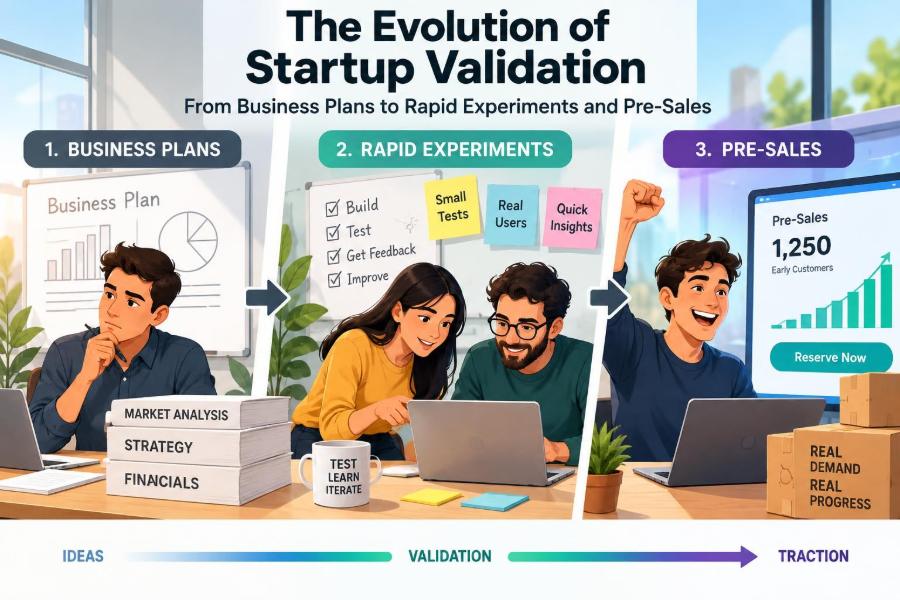

For decades, aspiring founders were told to begin with a detailed business plan: market analysis, five-year projections, organizational charts, and a thick binder meant to prove the idea was real. The problem is that a plan can look convincing long before a customer agrees to pay.
Today, validation is faster, cheaper, and more direct. You can test a problem through conversations, test a message with a simple page, test demand with a small offer, and sometimes collect payment before you build the full product.
This approach suits first-time founders, side hustlers, local business owners, consultants, and product teams with limited time or cash. It is especially useful when uncertainty is high and building the wrong thing would be expensive.
It matters now because customers have more choices, attention is harder to earn, and software makes building unusually easy. Your advantage is not merely shipping quickly; it is learning quickly enough to make better decisions before your resources run out.
🧭 1. Understand What Startup Validation Really Means
Validation is evidence that a specific group of people has a meaningful problem and will take a meaningful action to solve it. That action may be booking a call, joining a paid pilot, placing a deposit, or making a purchase.
It is not a compliment. “That sounds cool” is encouragement, not proof of demand. Validation becomes stronger as a customer gives up something scarce: time, reputation, access to data, or money.
- Weak signal: likes, survey responses, friendly feedback.
- Moderate signal: email sign-ups, detailed interviews, demo bookings.
- Strong signal: deposits, pre-orders, paid trials, signed letters of intent.
- Very strong signal: repeat purchases, referrals, and sustained use.
📜 2. Keep the Useful Parts of the Business Plan
Business plans are not obsolete. They are simply a poor first tool for discovering whether strangers care. Planning is valuable after you have enough evidence to plan around.
Use a lightweight plan to clarify your assumptions, costs, constraints, and next experiment. Save detailed financial models for situations where they are truly required, such as a loan application, lease negotiation, regulated operation, or formal investor process.
What to keep
- A one-sentence description of the customer and problem.
- A simple view of expected costs and gross margin.
- A list of key assumptions that could make the idea fail.
- A 90-day learning plan with a small budget limit.
The aim is not to predict the future perfectly. It is to identify what you must learn before making a larger commitment.
🔍 3. Start With a Testable Problem Hypothesis
Good validation begins with a narrow hypothesis, not a broad ambition. “Small businesses need better marketing” is too vague to test. “Independent dentists lose new leads because website inquiries are answered too slowly” is specific enough to investigate.
Write your hypothesis in a format that forces clarity:
We believe [specific customer] struggles with [specific problem].
They currently use [current workaround].
They would consider paying for [proposed outcome] because [reason].
Then list the assumptions underneath it. Which customer has the problem? How often does it happen? Is it expensive or frustrating enough to change behavior? Can you reach them? Will your solution fit their budget and workflow?
🎯 4. Choose a Customer Segment You Can Actually Reach
Do not begin with “everyone.” A tight segment makes conversations easier, messaging sharper, and early sales more realistic. You can expand later after learning what works.
Choose customers based on accessibility as well as need. A niche where you already have contacts, industry knowledge, or a credible reason to start conversations is often better than a huge market you cannot enter.
A practical segment formula
Combine a role, situation, and trigger: “freelance designers who have just hired their first contractor” or “property managers handling more than 50 units without a dedicated maintenance coordinator.”
- Can you name 30 potential customers today?
- Do they share a recurring problem?
- Do they gather in identifiable online or offline places?
- Can one clear offer serve most of them?
🗣️ 5. Run Problem Interviews Before Pitching
Interviews are not sales calls disguised as research. Their purpose is to understand the customer’s current reality: what happened recently, what they did, what it cost, and why existing options fell short.
Ask about past behavior, not imaginary future behavior. People are usually poor predictors of what they might buy, but their recent actions reveal priorities.
Questions worth asking
- “Tell me about the last time this happened.”
- “What did you do to solve it?”
- “What was difficult, slow, expensive, or risky?”
- “What tools or people are you using now?”
- “What happens if you do nothing?”
- “Who decides whether to spend money on this?”
Avoid asking, “Would you use my app?” It invites politeness. Instead, listen for urgency, budget, repeated pain, and a concrete workaround.
📝 6. Document Evidence Instead of Trusting Your Memory
Founders tend to remember praise and forget ambiguity. Create a simple interview sheet and record the same fields after every conversation.
| Evidence to record | Why it matters | Example |
|---|---|---|
| Problem frequency | Separates annoyance from recurring pain | “Every week during invoicing” |
| Current workaround | Shows existing behavior and competitors | Spreadsheets plus manual reminders |
| Cost of the problem | Helps set a sensible price range | Lost staff time or missed sales |
| Buying process | Prevents surprises during sales | Owner approves purchases over a limit |
| Exact language | Improves future marketing copy | “I never know what is slipping” |
Look for patterns across conversations. One passionate person can be misleading; repeated language and repeated behavior across a focused segment are far more valuable.
🧪 7. Turn Assumptions Into Rapid Experiments
A rapid experiment is a small, time-bound test designed to answer one important question. It is not an excuse to collect vague feedback indefinitely.
Every experiment should include a hypothesis, audience, offer, channel, success threshold, budget cap, and deadline. Decide what result would make you continue, change direction, or stop.
Hypothesis: Independent accountants will pay for a monthly client-chasing service.
Test: Offer a 10-client pilot to 30 accountants by direct outreach.
Success: At least 4 qualified calls and 1 paid pilot in 14 days.
Limit: No more than a modest fixed outreach and setup budget.
The exact threshold depends on price, audience size, and sales cycle. What matters is defining it before you see the result.
🪜 8. Match the Test to the Question
Different questions require different tests. Do not build an interactive prototype when you only need to learn whether your message captures attention.
| Question | Best early test | Cost estimate | Useful metric |
|---|---|---|---|
| Is this problem real? | Customer interviews | Low: mainly time | Repeated urgent stories |
| Does the message resonate? | Landing page or outreach | Low | Replies or conversion rate |
| Will people pay? | Paid pilot or pre-sale | Low to medium | Payments or deposits |
| Can we deliver value? | Concierge service | Medium: labor-intensive | Retention and outcomes |
| Will they use a product? | Prototype or MVP | Medium to high | Activation and repeat use |
These are estimates, not guarantees. Costs depend on your market, design needs, advertising prices, labor, taxes, payment processing, and local regulations.
🌐 9. Use a Landing Page as a Message Test
A landing page can test whether a clear audience responds to a clear promise. It does not need a full product behind it, but it must never mislead visitors about what exists or when it will be available.
A simple page structure
- A headline describing the outcome for a specific customer.
- A short explanation of the painful current situation.
- Three practical benefits, not a long feature list.
- Who the offer is for and who it is not for.
- One call to action: join a waitlist, book a call, or reserve a pilot.
- A transparent note if the service is in pilot or pre-sale.
Send relevant traffic through direct outreach, communities where promotion is permitted, partnerships, content, or carefully limited ads. A high conversion rate from irrelevant traffic is not validation; qualified visitors matter more than raw volume.
📬 10. Use Direct Outreach to Learn Faster
For most early B2B, local, and service startups, direct outreach beats broad advertising. It gives you conversations, objections, and a chance to refine the offer quickly.
Personalize the first sentence. Show that you understand the prospect’s context, then make a small, easy request rather than delivering a long pitch.
Hello [Name], I noticed you work with [relevant situation].
I am researching how [peer group] handles [specific recurring problem].
Would you be open to a 15-minute conversation? I am not selling anything on the call.
Once you understand the problem, ask whether they would like to see a pilot. Be respectful of privacy rules, consent requirements, platform policies, and anti-spam laws in your country and your customer’s country.
💳 11. Treat Pre-Sales as a Serious Commitment
A pre-sale is an agreement to buy before the final product is available. It is one of the clearest demand signals because the customer accepts real risk alongside you.
That also creates an obligation. Be explicit about what is included, delivery timing, limitations, refund terms, and what happens if you cannot complete the project. Do not use pre-sales to fund promises you have no plausible way to fulfill.
Good pre-sale candidates
- A cohort-based workshop with a defined start date.
- A productized service with limited founding-client slots.
- A physical product with a realistic production plan.
- A software beta with a narrow, clearly described scope.
Pre-sales, deposits, consumer rights, sales tax, VAT, refund duties, and advertising disclosures vary by country. Use clear written terms and seek qualified local legal or tax advice when the stakes justify it.
🤝 12. Sell a Concierge MVP Before Automating
A concierge MVP delivers the desired outcome manually while you learn what customers actually value. For example, instead of building automated reporting software, you might compile and send the report yourself each week using existing tools.
This is not “fake it until you make it.” It is a deliberate way to test a service before investing in automation. Customers should know when a service is manual, especially if their data or expectations are involved.
What manual delivery teaches you
- Which steps customers truly care about.
- Where data is messy or unavailable.
- Which requests repeat across accounts.
- What service level customers expect.
- Whether your proposed price covers the work.
If customers get value but the manual work is unprofitable, you may have found a workflow worth redesigning rather than a business ready to scale.
💰 13. Price Early to Test Value, Not Just Demand
Free sign-ups can indicate interest, but payment tests value. Charge early when appropriate, even if you offer a reduced founding-customer rate in return for feedback and tolerance for an unfinished process.
Start with a price connected to the problem’s value, your delivery cost, and comparable alternatives. Avoid pricing solely from the amount of time it took you to build something.
- One-time fee: useful for workshops, setup projects, and physical goods.
- Monthly subscription: useful when value repeats and delivery is ongoing.
- Usage-based fee: useful when customer volume varies widely.
- Deposit plus balance: useful for custom services and pre-orders.
A discount should buy something valuable: faster payment, a testimonial if permitted, structured feedback, a case-study interview, or a defined pilot commitment. Do not keep prices artificially low just to avoid hearing “no.”
📊 14. Track Metrics That Change Decisions
Early metrics should answer a question, not decorate a dashboard. Track the smallest set that tells you whether people are moving toward a purchase and receiving value after buying.
Useful early-stage metrics
- Interview pattern rate: how many relevant interviews reveal the same high-priority problem.
- Qualified response rate: replies or calls from your target audience.
- Landing-page conversion: qualified visitors who take the intended next step.
- Sales conversion: qualified conversations that become customers.
- Activation: customers reaching the first valuable outcome.
- Retention: customers returning, renewing, or continuing use.
- Gross margin: revenue left after direct delivery costs.
Do not obsess over one universal benchmark. A high-priced enterprise offer, a local service, and a low-cost consumer app naturally have different conversion paths and timelines.
⚖️ 15. Decide Whether to Persevere, Pivot, or Pause
Validation is not about forcing a yes. It is about making an informed decision. After a defined test, review the evidence against the threshold you set.
Persevere when the problem is urgent, the customer is reachable, and paid interest is growing. Pivot when the pain is real but the audience, offer, channel, or business model is wrong. Pause when repeated experiments show weak urgency and no credible path to improvement.
A pivot is not automatically a failure. You may keep the same customers while changing the problem you solve, or keep the problem while changing the way you serve it.
🚧 16. Avoid the Most Common Validation Traps
Many founders move fast but still learn the wrong lessons. The following mistakes are common because they feel productive.
- Building before talking: months of development can hide a weak problem.
- Asking leading questions: “Wouldn’t this save you time?” produces biased answers.
- Counting friends as a market: supportive feedback is not independent demand.
- Measuring vanity metrics: views and followers do not automatically translate into sales.
- Testing too many changes at once: you cannot tell what caused the result.
- Ignoring economics: paid customers are not enough if delivery loses money.
- Overpromising pre-sales: short-term cash is not worth damaged trust.
Speed without honesty becomes noise. The goal is disciplined learning, not performative hustle.
🔁 17. Build a Weekly Validation Loop
A repeatable cadence prevents research from becoming procrastination. Keep the loop short enough that you can act on what you learn while it is still fresh.
- Pick one assumption that creates the most risk.
- Write one measurable hypothesis.
- Choose the cheapest credible test.
- Set a deadline and a spending limit.
- Run the test with a defined audience.
- Review evidence, including negative feedback.
- Record the decision and choose the next assumption.
For a side hustle, this might mean five conversations and ten outreach messages each week. For a funded team, it may mean dozens of interviews and several parallel channel tests. The principle is the same: learn in small batches.
🏗️ 18. Know When It Is Time to Build More
Build beyond a prototype when manual delivery is becoming repetitive, customers repeatedly ask for the same functionality, and you have evidence that automation would improve margins, quality, or retention.
Start with the smallest product that removes the biggest recurring friction. Resist turning every customer request into a feature. Early customers are useful guides, but your product needs a coherent direction.
Signals that justify deeper investment
- Customers have paid and can explain the value in their own words.
- The same workflow appears across multiple customers.
- Customers return or renew without being heavily chased.
- You understand the delivery process and its direct costs.
- You have a credible route to acquire similar customers repeatedly.
At this point, a stronger operating plan, product roadmap, hiring plan, and financial forecast become more useful because they are grounded in real behavior.
📅 19. Your Validation Action Plan for This Week
Do not wait for a perfect idea or a polished deck. Pick one customer group and one problem you can investigate now.
- Day 1: Write your one-sentence problem hypothesis and list ten assumptions.
- Day 2: Find 20 potential customers you can ethically contact.
- Days 3-4: Request and conduct five problem interviews.
- Day 5: Review notes, identify repeated language, and draft one narrow offer.
- Day 6: Create a simple landing page or a concise pilot message.
- Day 7: Send ten personalized outreach messages and set your next test threshold.
Keep your first experiment small enough to finish and serious enough to teach you something. If you receive no response, that is information—not a verdict on your ability as a founder.
The modern path to a stronger startup is simple: make your assumptions visible, test them with real people, ask for commitment early, and let evidence—not optimism alone—guide the next build. 🚀🧪📈