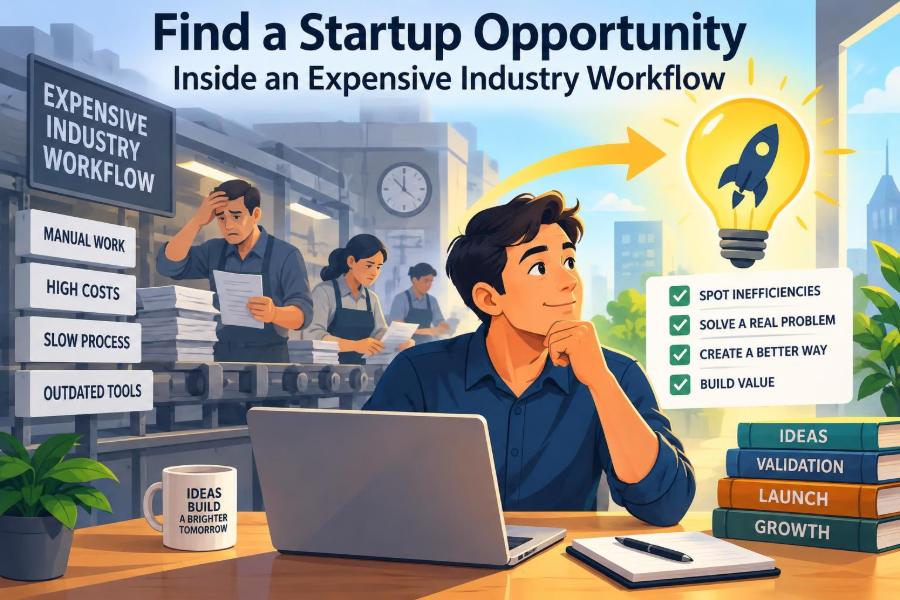

Most good startup opportunities do not begin with a clever app idea. They begin with a frustrating, expensive workflow that people have accepted as “just how the industry works.”
That is useful news for aspiring founders. You do not need to invent a new market; you need to notice where a valuable task is still being handled through email chains, spreadsheets, phone calls, rekeying data, and expensive specialist time.
This approach suits practical builders, consultants, operators, and side hustlers who can get close to a specific customer group. It is especially strong if you have worked in a messy industry or can spend time learning one deeply.
It matters now because businesses face pressure to control costs while customers expect faster service. Better automation tools make small workflow improvements possible, but the real opportunity is not “using AI.” It is removing a painful bottleneck people will pay to eliminate.
🔎 1. Start With Costly Work, Not Cool Technology
A workflow is a repeatable sequence of actions that turns an input into an outcome: processing an insurance claim, preparing a construction estimate, onboarding a patient, or reconciling supplier invoices.
Look for work that is expensive because it consumes skilled labor, causes delays, creates errors, or exposes the business to risk. A dull workflow can be a far better startup opportunity than a trendy consumer concept.
- Bad starting point: “I want to build an AI product.”
- Better starting point: “Why does a clinic coordinator spend three hours daily chasing incomplete referral information?”
- Best starting point: “Can we cut that three-hour task to 30 minutes without increasing compliance risk?”
💸 2. Learn What “Expensive” Actually Means
Expense is not only payroll. A workflow becomes costly when it delays revenue, creates rework, frustrates customers, wastes inventory, or puts a contract or license at risk.
During discovery, ask customers to estimate the full consequence of the problem. They may not know an exact number, but their answers reveal whether the pain is a real buying trigger.
Cost signals worth investigating
- Multiple employees touch the same information.
- A qualified person performs clerical work.
- Tasks wait in queues for approval or missing details.
- Errors lead to credits, write-offs, penalties, or repeat visits.
- Revenue cannot be invoiced until paperwork is complete.
- Customers call repeatedly for status updates.
Use a simple estimate: hours per week × fully loaded hourly cost × number of sites or teams. Treat it as a conversation tool, not a claim of certainty.
🏭 3. Choose an Industry You Can Reach
Do not start with “healthcare,” “real estate,” or “manufacturing.” Those are vast categories. Pick a narrow environment where you can speak to people regularly and understand the context.
Your unfair advantage may be former colleagues, a family business, a local professional group, or your own experience as a customer. Access beats abstract market size in the earliest stage.
| Starting point | Why it helps | Early difficulty |
|---|---|---|
| Former industry job | You understand language and pain | May assume your experience is universal |
| Local service businesses | Fast conversations and shorter sales cycles | Smaller budgets |
| Regulated operations | High cost of mistakes can support pricing | Longer trust and compliance process |
| Supplier or agency niche | You see many clients’ repeated problems | Must avoid selling a generic service |
🗺️ 4. Map One Workflow End to End
Ask someone to walk you through the last real example, not their ideal process. “What happened after the email arrived?” is more revealing than “How do you usually handle this?”
Draw the workflow in plain language. Include people, systems, documents, handoffs, waiting periods, decisions, exceptions, and the final outcome.
Questions that expose friction
- What starts this process?
- Who owns the next step, and how do they know?
- Where is information copied or manually checked?
- What happens when information is missing or wrong?
- Which step takes the longest to complete?
- What would break if this task were skipped?
Do not be embarrassed if the map looks messy. The mess is often where the business opportunity lives.
⏱️ 5. Find the Delay, Rework, and Risk Triangle
The strongest early opportunities often combine three things: delay, repeated manual work, and meaningful consequences when something goes wrong.
For example, a contractor may lose days collecting site photos, matching them to jobs, and preparing change-order evidence. The issue is not merely photo storage; it is slow billing, disputed work, and administrative time.
A problem with only one dimension can still work, but it may be harder to charge enough. A minor annoyance is rarely a business. A recurring operational cost can be.
🧮 6. Quantify the Pain Before Designing a Solution
You do not need a perfect financial model. You need enough evidence to know whether solving the problem produces an outcome a buyer values.
Weekly cost = staff hours × loaded hourly cost
Monthly value at stake = weekly cost × 4 + avoidable errors + delayed cash impact
For a small firm, saving six hours a week may be meaningful if it lets the owner quote more jobs. For a larger company, reducing errors may matter more than labor savings.
Ask which budget would pay: operations, finance, customer success, compliance, or the owner’s discretionary budget. A clear budget owner is a very positive signal.
🗣️ 7. Conduct Problem Interviews, Not Sales Calls
Your first goal is learning, not persuading. If you pitch too early, people will politely react to your concept instead of describing what they really do.
A practical interview sequence
- Ask about their role and the outcomes they are responsible for.
- Ask for a recent example of the workflow.
- Explore delays, mistakes, workarounds, and consequences.
- Ask what they already use and why it falls short.
- Ask what they have tried, bought, or considered changing.
- Only then share a short hypothesis and ask for feedback.
Listen for specific stories, screenshots, forms, and language such as “we have to,” “every week,” or “this always gets stuck.” Vague enthusiasm is weaker evidence than a detailed complaint.
🎯 8. Separate Users, Buyers, and Blockers
The person suffering may not control the budget. The buyer may care about a different outcome, and another department may need to approve the change.
- User: the coordinator, technician, accountant, or dispatcher doing the work.
- Buyer: the operations leader, practice owner, finance director, or department head.
- Blocker: IT, legal, compliance, procurement, or an incumbent vendor.
Build your message for all three. Users want fewer frustrating tasks. Buyers want cost control, speed, revenue, or retention. Blockers want security, reliability, and a low-risk implementation.
🧲 9. Score Opportunities Before Falling in Love
Use a simple scorecard after every set of interviews. It will keep you from chasing the loudest person or the most technically interesting problem.
| Criterion | What a high score looks like | Score 1-5 |
|---|---|---|
| Frequency | Happens daily or weekly | 1-5 |
| Economic impact | Labor, revenue, or risk is significant | 1-5 |
| Urgency | Customers want change this quarter | 1-5 |
| Access | You can reach many similar buyers | 1-5 |
| Willingness to pay | They already spend money or seek alternatives | 1-5 |
| Implementation friction | You can start without a major system replacement | 1-5 |
Prioritize problems with high value and low initial integration complexity. You can tackle harder technical work after proving that customers care.
🧩 10. Look for the Smallest Valuable Wedge
A wedge is a narrow first use case that earns trust and creates a path into a bigger workflow. It should be painful enough to matter, but small enough to adopt without a year-long transformation project.
Instead of “software for construction administration,” start with “capture and package site evidence for change-order approval.” Instead of “healthcare automation,” start with “check referral completeness before scheduling.”
The wedge should have a crisp before-and-after state. If you cannot explain that change in one sentence, narrow it further.
🛠️ 11. Test a Concierge Version First
Before building a platform, deliver the outcome manually or with lightweight tools. This is sometimes called a concierge MVP, and it teaches you what must be automated versus what merely sounds automatable.
Useful low-code test tools
- Spreadsheets for tracking cases and outcomes.
- Forms for structured intake.
- Shared folders or secure document tools where appropriate.
- Automation software for notifications and data movement.
- A basic dashboard or weekly report.
Be transparent that the service is in pilot form. Never pretend manual work is fully automated, and take special care with sensitive customer, health, financial, or personal data.
💼 12. Three Workflow Opportunity Patterns to Explore
These are patterns, not promises. Validate local demand, competition, data requirements, and regulations before spending heavily.
📄 Document-to-decision workflow
What it is: A service or software layer that collects documents, checks completeness, extracts key fields, and routes exceptions to the right person.
Target customers: Brokers, property managers, logistics firms, accounting practices, clinics, and business lenders with document-heavy processes.
Estimated startup costs: Roughly $200-$2,000 for basic tools, a landing page, secure storage, and pilot operations; much more if custom integrations or certified compliance are required.
Skills and tools: Process mapping, customer interviews, privacy awareness, forms, automation, and possibly document-processing APIs.
First customers: Offer a paid pilot to firms that already complain about incomplete submissions. Show a weekly report on turnaround time and exceptions.
Revenue model: Monthly subscription, per document, per case, or a managed-service fee.
Risks and scale: Data security and edge cases are major risks. Scale by standardizing one document type and integrating into the customer’s existing system.
🚚 Field-to-office handoff workflow
What it is: A mobile-first workflow that turns field observations, photos, approvals, and notes into office-ready records or invoices.
Target customers: Trades, facilities teams, inspection companies, maintenance providers, and event operators.
Estimated startup costs: Roughly $100-$1,500 for a no-code pilot; custom mobile software and integrations can increase costs substantially.
Skills and tools: Mobile workflow design, forms, image handling, operations knowledge, and customer support.
First customers: Start with one team that currently sends job evidence through messaging apps and email. Help them shorten a single billing or reporting step.
Revenue model: Per active worker, per job, or a monthly team subscription.
Risks and scale: Field adoption fails when the tool adds taps. Scale through templates for a specific trade and integrations with accounting or job-management tools.
📞 Status-chasing workflow
What it is: A system that collects status from multiple parties, identifies stalled cases, and sends useful updates before customers need to ask.
Target customers: Freight coordinators, recruiting agencies, repair shops, legal support teams, and high-touch B2B service providers.
Estimated startup costs: Roughly $100-$1,000 for a manual-plus-automation pilot, excluding specialized messaging, security, or integration costs.
Skills and tools: CRM hygiene, workflow logic, communication design, automation, and reporting.
First customers: Find a team with a visible inbox backlog and offer to reduce a defined class of “Where is this?” messages.
Revenue model: Monthly subscription by team, case volume, or managed operations fee.
Risks and scale: Poor data creates inaccurate updates. Scale by owning one status category first and measuring fewer inbound requests and faster completion.
💰 13. Price the Outcome, Not the Number of Buttons
Early pricing should reflect the value of the workflow, your delivery effort, and the customer’s ability to adopt—not the elegance of your software.
For a pilot, a fixed fee is often simplest. It creates commitment and lets you learn whether the buyer will pay before you build more.
- Paid pilot: A fixed amount for a defined workflow, timeframe, and success measure.
- Managed service: A monthly fee while you perform part of the work.
- Software subscription: A recurring fee once the process is repeatable.
- Usage pricing: Useful when value closely follows documents, jobs, claims, or cases.
Avoid pricing so low that you cannot provide reliable support. Also avoid promising savings you cannot credibly measure.
📏 14. Define One Measurable Pilot Result
A pilot without a baseline becomes an opinion contest. Agree on one or two measurements before work begins.
Good pilot metrics
- Time from request to completion.
- Number of cases completed per coordinator.
- Percentage of submissions complete on first attempt.
- Number of manual touches per case.
- Time from completed work to invoice.
- Inbound status requests or customer complaints.
Also track adoption: how many eligible cases actually use your process. A strong result on only a handful of cases may indicate a training or workflow-fit problem.
⚠️ 15. Respect Regulation, Security, and Procurement
In expensive industries, the most valuable workflows often involve sensitive information. That can create a moat, but it also creates real obligations.
Costs, taxes, privacy rules, employment law, sector regulations, and record-keeping requirements vary by country and industry. Get qualified local legal, tax, and security advice when handling regulated data or making compliance claims.
- Collect only data you truly need.
- Clarify who owns data and how it can be exported or deleted.
- Document access controls and incident procedures.
- Do not claim certification, compliance, or savings you have not earned.
- Start with lower-risk data or a non-sensitive workflow when possible.
🚫 16. Avoid the Most Common Founder Mistakes
The first mistake is building from a single interview. One enthusiastic customer may have an unusual process, political motive, or temporary problem.
The second is solving the whole workflow immediately. Broad products create long build cycles, unclear sales messages, and difficult onboarding.
The third is confusing interest with commitment. A calendar meeting, introduction, data sample, signed pilot, or payment is progressively stronger evidence.
- Do not lead with features before understanding the job.
- Do not automate a broken process without questioning it.
- Do not ignore the person who must change daily habits.
- Do not take on every custom request from your first client.
📈 17. Turn a Service Into a Repeatable Product
Many workflow startups begin as services, and that is not a failure. Manual delivery lets you identify recurring decisions, standardize inputs, and understand the exceptions software must handle.
Productize only after you see the same workflow across several customers. Build what repeats, create templates around what varies, and keep high-value human judgment where it matters.
Signals you are ready to productize
- Customers describe the problem in similar language.
- Your onboarding steps are becoming consistent.
- The same data fields and exceptions appear repeatedly.
- You can explain your ideal customer clearly.
- At least a few customers will pay for the same core offer.
🤝 18. Build Distribution Into the Workflow
The easiest sales channel is often adjacent to the workflow itself. Accountants, implementation consultants, industry associations, equipment suppliers, and vertical software partners may already have trusted customer relationships.
Do not ask for a broad partnership on day one. First prove a narrow result for one shared customer type, then show the partner how it helps their own retention, service, or revenue.
Track where your best conversations come from. A channel that produces fewer but better-fit pilots is more valuable than broad attention from people who cannot buy.
📊 19. Watch the Metrics That Tell You the Truth
Vanity metrics will not rescue a weak workflow business. Track whether you are creating measurable operational value and whether you can deliver it efficiently.
| Stage | Metric to track | Why it matters |
|---|---|---|
| Discovery | Interviews with the same role | Shows whether pain repeats |
| Pilot | Eligible cases using the new process | Shows real adoption |
| Value | Cycle time, errors, or manual touches | Shows operational impact |
| Sales | Pilot-to-paid conversion | Tests willingness to pay |
| Delivery | Support time per customer | Tests scalability |
| Retention | Renewals and expansion requests | Shows durable value |
🧭 20. Your Action Plan for This Week
Do not spend the week choosing a logo, registering a company, or debating a tech stack. Spend it close to an expensive real-world process.
- Choose one industry you can access.
- List five people who work in one specific role.
- Request three 20-minute workflow conversations.
- Map one recent process in detail.
- Write down every delay, handoff, error, and workaround.
- Score the top three problems using frequency, impact, urgency, access, and friction.
- Draft a one-sentence wedge and ask one potential buyer whether they would test it.
The startup opportunity is rarely hidden in a dramatic invention; it is hidden in the costly, repeated work that smart people have been forced to tolerate for too long. 🚀🔧