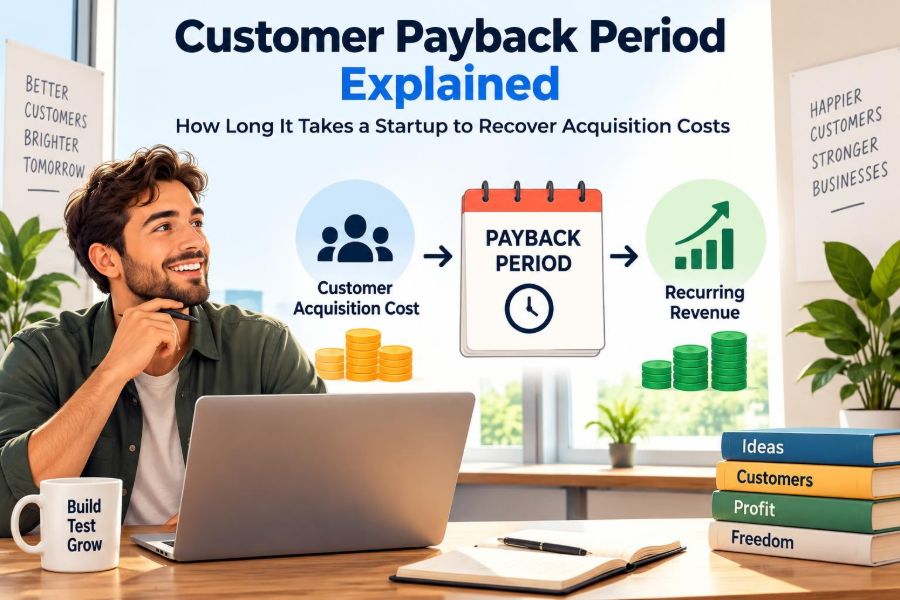

A startup can be growing fast on paper and still be in danger. If every new customer costs money today but takes many months to produce enough gross profit to repay that spend, cash can disappear long before the business reaches its potential.
That is the problem customer payback period helps you see. It answers a straightforward question: after you pay to win a customer, how long does it take for the gross profit from that customer to cover the acquisition cost?
This metric matters most for subscription businesses, agencies with recurring retainers, marketplaces, e-commerce brands with repeat buyers, and any company investing in sales or paid marketing. It also matters for a solo founder, because it turns vague growth plans into cash-aware decisions.
There is no universal “good” answer. Your ideal payback depends on margins, retention, growth rate, funding, and how reliably you can predict customer behavior. But understanding the number now can help you build a business that survives long enough to grow.
🧭 1. Start With the Plain-English Definition
Customer payback period is the time required for the gross profit generated by an acquired customer to equal the cost of acquiring that customer.
Suppose you spend $300 to acquire a customer. That customer produces $100 in monthly revenue, and your gross margin is 80%. You earn $80 in gross profit each month, so the simple payback period is 3.75 months.
Customer payback period = Customer acquisition cost / Monthly gross profit per new customer
The key word is gross profit, not revenue. Revenue can make a business look healthier than it is when fulfillment, payment processing, hosting, inventory, support, or delivery consume a meaningful share of each sale.
💡 2. Know Why This Metric Matters So Much
Payback period connects marketing, sales, pricing, operations, and cash flow. It tells you whether your acquisition engine is likely to strengthen the business or create a funding hole.
- Shorter payback means cash returns faster and can potentially fund more growth.
- Longer payback means you need more working capital and greater confidence in retention.
- Rising payback can warn that channels are becoming saturated, sales are less efficient, or margins are slipping.
- Falling payback may show better targeting, better conversion, higher prices, or a more efficient sales process.
A customer may have excellent lifetime value and still be difficult to fund if the cash arrives too slowly. Lifetime value answers “how valuable might this customer become?” Payback asks “can we afford to get there?”
🧮 3. Gather the Four Numbers You Need
Do not begin with a complicated spreadsheet. Begin with inputs you can explain and update every month.
Customer acquisition cost
CAC is your acquisition spending divided by the number of new customers acquired in the same period. Include costs that genuinely exist because you are trying to acquire customers.
CAC = Total sales and marketing acquisition costs / New customers acquired
Depending on your business, costs can include advertising, commissions, sales salaries, contractors, lead-list tools, event fees, creative production, and agency fees. Decide what you include, document it, and use the same method consistently.
Monthly revenue per customer
For subscriptions, use average monthly recurring revenue from the relevant customer cohort. For a store or marketplace, estimate average monthly contribution from a newly acquired buyer, not merely their first order.
Gross margin
Gross margin is revenue left after direct costs of serving customers. It is commonly calculated as:
Gross margin = (Revenue - Cost of goods or services sold) / Revenue
Direct costs might include inventory, packaging, shipping subsidies, transaction fees, cloud infrastructure, contractor fulfillment, and customer-specific onboarding. Fixed founder salaries and general rent are normally operating expenses, not direct costs, although accounting rules and tax treatment vary by country.
Retention and churn
Customers who leave before they repay their CAC never reach payback. Track cancellations, downgrades, repeat purchase behavior, refunds, and failed payments from the beginning.
📊 4. Calculate a Simple Payback Period First
The simplest version works well when revenue and gross margin are reasonably stable month to month.
Imagine a project-management software company with a $240 CAC. Its average new customer pays $60 per month. Hosting, support, payment fees, and other direct costs leave an 85% gross margin.
Monthly gross profit = $60 x 0.85 = $51
Payback period = $240 / $51 = 4.7 months
The company recovers its acquisition cost in about five months, assuming the customer remains active and continues paying. That result is not a promise; it is an operating assumption you should test against actual cohorts.
| Business model | Example CAC | Monthly revenue | Gross margin | Simple payback |
|---|---|---|---|---|
| Software subscription | $240 | $60 | 85% | 4.7 months |
| Managed service | $600 | $400 | 55% | 2.7 months |
| Repeat-purchase store | $45 | $30 | 45% | 3.3 months |
These are illustrations, not industry benchmarks. Your costs, taxes, refund policies, customer behavior, and sales cycle will differ.
🧱 5. Use Contribution Margin When It Gives a Clearer Answer
For many startups, gross margin is a useful shortcut. But contribution margin can be better when each additional customer creates variable sales and service costs that are not captured cleanly in a basic gross-margin figure.
For example, a service business may pay a freelancer for every client delivered, offer a customer-specific implementation, and pay commission only after a contract closes. Those costs materially affect how much cash a new client contributes.
Monthly contribution per customer = Monthly revenue - Variable costs tied to that customer
Payback = CAC / Monthly contribution per customer
Do not force precision you do not have. A transparent estimate that you revise is more useful than an elaborate model filled with unsupported assumptions.
🗓️ 6. Build a Cohort-Based Payback View
Simple formulas can hide reality. A cohort view follows customers acquired in the same month or through the same channel and records their actual cumulative gross profit over time.
For instance, put all customers acquired through January search ads into one cohort. In February, March, and later months, add the gross profit those customers generated. The cohort reaches payback when cumulative gross profit per acquired customer exceeds cohort CAC.
- Separate cohorts by acquisition month.
- Separate major channels, such as referrals, paid search, partnerships, and outbound sales.
- Record revenue, refunds, direct costs, churn, and expansion revenue.
- Compare actual payback with the forecast you used to set the budget.
This method exposes whether a channel attracts strong long-term customers or merely produces attractive first-month conversion data.
🔍 7. Separate Blended CAC From Channel CAC
Blended CAC combines all acquisition spending and all new customers. It is useful for understanding the whole business, especially when channels influence one another.
Channel CAC assigns costs and customers to a specific source. It helps you decide where the next marketing dollar should go.
| Metric | Best use | Common limitation |
|---|---|---|
| Blended CAC | Company-level planning and cash forecasting | Can hide a weak channel |
| Paid-channel CAC | Campaign optimization and budget decisions | Attribution can be incomplete |
| Sales-rep CAC | Hiring and sales efficiency decisions | New reps need ramp time |
| Segment CAC | Choosing the right customer profile | Small samples can mislead |
A buyer may first discover you through a podcast, later search your name, and finally convert through a retargeting ad. Avoid pretending attribution is perfect. Use a practical model, note its limits, and pair it with customer surveys asking, “How did you first hear about us?”
⚖️ 8. Compare Payback With Customer Lifetime Value Carefully
Payback and lifetime value are related but distinct. Payback focuses on the speed of recovery. Lifetime value estimates total gross profit a customer may generate over their relationship with you.
A basic lifetime gross profit estimate is:
LTV = Average monthly gross profit per customer x Average customer lifetime in months
If your average customer generates $50 in monthly gross profit and stays for 18 months, estimated lifetime gross profit is $900. If CAC is $300, the LTV-to-CAC ratio is 3:1.
That can look healthy, but a 12-month payback may still pressure a bootstrapped business. Conversely, a short payback with low lifetime value may indicate customers are profitable but your growth ceiling is limited. Look at both measures together.
🚨 9. Watch for the Cash-Flow Trap
Growth consumes cash before it produces cash. The faster you add customers with a long payback period, the more money you may need to finance the gap.
Consider a startup spending $10,000 each month to acquire customers with a 10-month payback. Even if every cohort eventually becomes profitable, the company is continually funding many unrecovered cohorts at once.
This does not automatically make the strategy wrong. It means you need a realistic cash plan, a funding source, and confidence that retention and margin assumptions will hold.
- Model cash outflows before revenue arrives.
- Include payroll, taxes, refunds, chargebacks, and supplier payment terms.
- Keep a buffer for slower sales or higher churn.
- Do not scale an unproven channel just because early revenue looks exciting.
🎯 10. Set a Sensible Target for Your Stage
There is no magic payback number. A self-funded founder often needs quicker recovery than a well-capitalized company with predictable contracts and strong retention.
Instead of copying a target from social media, set a threshold based on your cash position, margin, and business model. Ask: “How many months of acquisition spending can we carry without putting payroll, suppliers, or product delivery at risk?”
Illustrative operating choices
- Bootstrapped service: prioritize deposits, setup fees, annual prepayment, referrals, and offers with quick contribution margins.
- Early SaaS startup: test for a payback period that your available runway can support, while validating retention before spending aggressively.
- E-commerce brand: model first-order contribution separately from repeat-order payback and watch inventory cash needs.
- Enterprise seller: plan for a long sales cycle and negotiate implementation fees or annual contracts where appropriate.
Your target should be a decision tool, not a vanity metric. Revisit it when your pricing, margins, funding, or growth plans change.
💸 11. Lower CAC Without Chasing Cheap, Poor-Fit Leads
The fastest apparent way to improve payback is to cut acquisition cost. But cheap leads are not a win if they churn, request refunds, consume excessive support, or never become profitable customers.
Start by identifying the customer profile that reaches activation, gets value quickly, and remains profitable. Then sharpen your message for that group.
- Interview recent buyers and ask what problem triggered their search.
- Review lost deals to find recurring objections and mismatched expectations.
- Create one focused landing page or sales message per customer segment.
- Use referral incentives only after confirming referred customers retain well.
- Improve follow-up speed for qualified leads before increasing ad spend.
- Pause campaigns that produce activity but not contribution profit.
Organic content, partnerships, communities, and referrals can reduce cash CAC over time, but they still require labor and patience. Track the cost of producing them rather than calling them free.
📈 12. Improve Gross Margin Before You Spend More
A small margin improvement can shorten payback without adding a single customer. This is especially important for physical products, marketplaces, and service-heavy offers.
Review the direct cost of serving your newest customers. Are you giving away too much onboarding? Are support requests caused by a confusing setup? Are rush deliveries, discounts, or payment fees eating the margin?
Practical margin levers
- Raise prices carefully after improving the offer or clarifying its value.
- Set a minimum order size or minimum contract term.
- Replace manual work with templates, automation, or better onboarding.
- Negotiate supplier terms once volume justifies it.
- Reduce avoidable refunds by setting clearer expectations before purchase.
- Offer premium support or implementation as a paid add-on.
Do not reduce product quality or customer support blindly. A margin improvement that causes higher churn can make payback worse, not better.
🔁 13. Increase Retention and Expansion Revenue
Retention does not always change the first month of payback, but it makes the entire acquisition model less fragile. It also increases the chance that expansion revenue will improve cumulative contribution.
Focus on the first moment when a customer receives real value. For a software product, that may be completing an important workflow. For a service, it may be receiving a clear deliverable. For a product brand, it may be a successful first use.
- Define one meaningful activation event.
- Guide customers to it with a simple onboarding sequence.
- Contact new customers when their behavior shows they are stuck.
- Track cancellation reasons and categorize them consistently.
- Offer upgrades only when they solve a demonstrated next problem.
Expansion revenue should not be used to excuse poor retention. First make the core promise reliable; then earn the right to sell more.
🧾 14. Use Pricing and Payment Terms as Payback Tools
Pricing affects payback in two ways: it changes the gross profit earned per customer, and payment timing changes when cash reaches your bank account.
An annual plan paid upfront can dramatically improve cash recovery compared with a monthly plan, even if the customer receives the same service over time. A setup fee can also help cover labor-intensive onboarding.
These options must be fair and clear. Do not pressure customers into long commitments they do not understand, and follow consumer protection, tax, billing, cancellation, and auto-renewal rules in the countries where you operate.
| Option | Potential payback effect | Trade-off to test |
|---|---|---|
| Price increase | More gross profit per month | Conversion and churn may change |
| Annual prepayment | Earlier cash collection | Requires trust and may need a discount |
| Setup fee | Offsets acquisition and onboarding cost | Can create purchase friction |
| Higher-tier package | Raises average contribution | Must provide genuine added value |
🛠️ 15. Create a Lightweight Monthly Dashboard
You do not need expensive analytics software to begin. A spreadsheet can track the fundamentals until the business becomes more complex.
Create one row per acquisition month and channel. Then update it as customers pay, expand, churn, or receive refunds.
Metrics to track every month
- New customers and qualified leads
- Blended CAC and channel CAC
- Average revenue per new customer
- Gross margin or contribution margin
- Simple estimated payback period
- Cohort cumulative gross profit
- Logo churn, revenue churn, refunds, and repeat purchase rate
- Cash collected versus revenue recognized
- Sales cycle length and close rate
Use tools that match your stage: a spreadsheet, accounting software, payment processor exports, CRM reports, and product analytics may be enough. The best tool is the one your team will update accurately.
🧪 16. Run Experiments One Variable at a Time
When payback is too slow, resist the urge to change your audience, price, landing page, sales script, and onboarding all at once. You will not know what worked.
Choose one hypothesis, define a measurable result, and run it for long enough to get a useful signal. For example: “A clearer industry-specific page will improve qualified-demo conversion without increasing early churn.”
- Choose the bottleneck: cost, conversion, margin, activation, or retention.
- Write the hypothesis and expected metric movement.
- Set a budget, time frame, and stopping rule.
- Keep a control or compare against a recent baseline where possible.
- Review quality metrics, not just initial sales.
- Document what you learned before the next test.
Small experiments protect cash and create institutional knowledge, even when the result is negative.
⚠️ 17. Avoid the Most Common Calculation Mistakes
Payback is only as useful as the assumptions underneath it. Most errors come from making the number look cleaner than the business really is.
- Using revenue instead of gross profit: this almost always makes payback look faster.
- Ignoring sales labor: if a salesperson or founder spends time closing deals, account for it appropriately.
- Mixing old and new customers: mature customers often behave differently from newly acquired ones.
- Ignoring refunds and failed payments: booked revenue is not always retained cash.
- Assuming retention too early: new companies have limited history, so use cautious scenarios.
- Counting all organic customers as free: content, partnerships, and founder time have costs.
- Reporting only averages: a few large customers can hide a weak typical customer experience.
When in doubt, make the conservative assumption. A model that survives a disappointing month is more valuable than one designed to impress a pitch deck.
🧠 18. Make Better Decisions With Scenario Planning
Build three versions of your model: conservative, expected, and optimistic. Change CAC, margin, conversion, retention, and payment timing to see what happens to payback and cash.
For example, your expected plan may assume a $200 CAC and $50 monthly gross profit, producing a four-month payback. Your conservative case might assume a $260 CAC, $42 monthly gross profit, and more refunds. Can you still fund growth comfortably?
Scenario planning does not predict the future. It prepares you to choose a pace of growth that the business can afford.
🤝 19. Match Your Growth Strategy to Your Payback Reality
If payback is short and retention is proven, you may be ready to increase spend gradually while watching cohorts closely. If payback is long or uncertain, prioritize cash-efficient channels and offer design before trying to scale.
That could mean selling annual contracts, improving onboarding, narrowing your ideal customer profile, increasing deposits, partnering with trusted distributors, or building a referral engine. These are not glamorous moves, but they often create a more durable foundation.
Founders sometimes treat paid acquisition as the only growth lever. In reality, better positioning, pricing, product experience, and customer success can improve payback more permanently than another campaign optimization.
✅ 20. Your Action Plan for This Week
Do not wait for perfect data. Complete a first pass, label assumptions clearly, and make the next decision with more clarity than you had before.
- Export the last one to three months of sales, marketing, payment, refund, and direct-cost data.
- Calculate blended CAC using one documented definition.
- Calculate monthly gross profit for a typical new customer.
- Estimate your simple payback period and write down the assumptions.
- Split the result by your two largest acquisition channels.
- Identify one likely lever: lower CAC, better margin, higher price, faster activation, or stronger retention.
- Run one small, measurable experiment next week rather than launching a broad overhaul.
A healthy startup does not merely acquire customers; it can afford to acquire them, learn from them, and serve them profitably over time. Keep your payback period visible, treat it as a guide rather than a trophy, and let it shape a growth pace your cash can support. 🚀💡📈