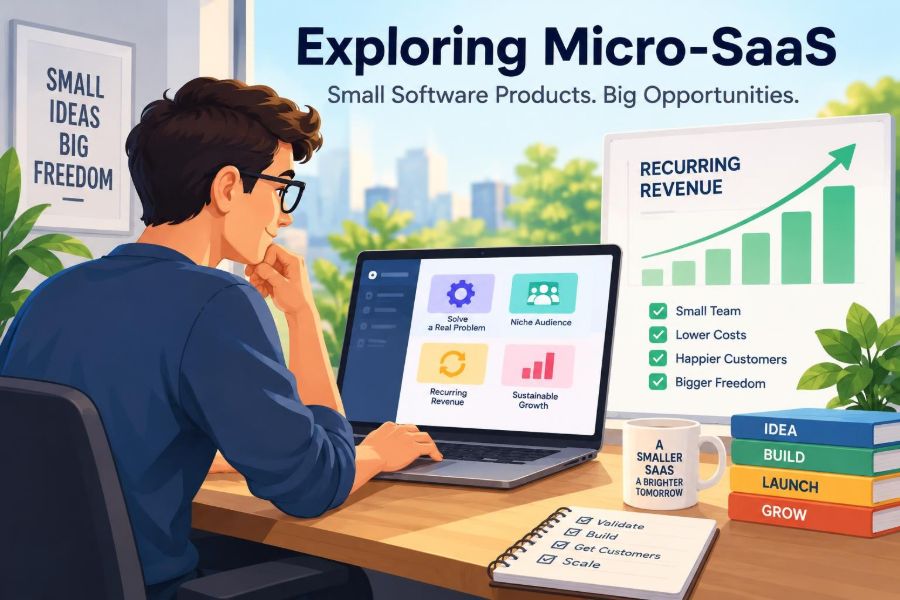

Micro-SaaS is not a shortcut to effortless income. It is a practical way to build a small software business around a narrow, expensive, or persistently annoying problem. Instead of trying to serve everyone, you serve one kind of customer exceptionally well.
This model suits founders who prefer focus over hype: developers looking for a sustainable side business, operators who understand an industry, consultants who repeatedly solve the same client problem, and small teams that want to avoid raising outside capital. You do not need to build the next giant platform to create something useful.
The timing matters because small businesses now run more of their work through digital tools, yet many workflows are still held together with spreadsheets, inboxes, copied data, and manual reminders. Broad software products often leave awkward but valuable gaps behind.
A good Micro-SaaS product can turn one of those gaps into recurring revenue. The goal is not “passive income.” The goal is a dependable product, a clearly defined customer, and enough recurring value that customers choose to keep paying.
🔎 1. Understand What Micro-SaaS Actually Means
Micro-SaaS is a small software-as-a-service business designed to solve a focused problem for a defined audience. It typically has a narrow feature set, a lean operating model, and subscription or usage-based revenue.
The “micro” part describes the scope and team, not the seriousness of the customer problem. A tool that saves a property manager hours of monthly reporting can be tiny in features and still be important to its users.
- Narrow audience: one role, trade, or workflow.
- Clear outcome: save time, reduce errors, capture leads, or meet a requirement.
- Repeat use: customers return weekly, monthly, or whenever a workflow occurs.
- Recurring payment: the price matches continuing value.
🎯 2. Pick a Problem Before You Pick a Product
Most early mistakes begin with an attractive product idea that has no urgent buyer. Start by looking for recurring friction, not clever features.
Talk to people who have a role you understand. Ask what they do every week, which reports they dread, where they re-enter information, and what happens when a task is missed.
Useful discovery questions
- What task takes longer than it should?
- What do you track in a spreadsheet because your current tool cannot do it?
- What mistake costs money, delays work, or frustrates clients?
- What have you tried already, and why did it fail?
- Would solving this be worth a monthly budget? Why?
Listen for concrete language: “Every Friday I export this,” “we always forget,” or “my assistant spends two hours on that.” Those details are more valuable than compliments about your concept.
🧭 3. Choose a Niche You Can Reach
A niche is not merely a demographic label. It is a group with shared work, shared vocabulary, and a reachable place to learn about solutions. The best early niche is often one where you already have credibility or access.
| Niche type | Example pain | Customer access | Early challenge |
|---|---|---|---|
| Service businesses | Missed follow-ups and quote tracking | Local groups, referrals, direct outreach | Many small budgets |
| Agencies | Client approvals and reporting | Professional communities, consultants | Existing tools are common |
| Regulated trades | Renewal and compliance reminders | Industry associations, suppliers | Rules vary by location |
| Online sellers | Inventory and margin alerts | Seller communities and content | Platform changes can affect you |
Start with a niche small enough to understand but large enough to contain many potential buyers. “Independent dental clinics using a specific appointment system” is far more actionable than “healthcare.”
💡 4. Evaluate Ideas With a Simple Scorecard
Not every irritation deserves software. Score ideas before investing months of engineering effort. Give each factor a score from one to five, then compare opportunities honestly.
- Frequency: Does the problem happen repeatedly?
- Urgency: Is delay costly or stressful?
- Willingness to pay: Does the buyer already spend money to address it?
- Reachability: Can you identify and contact prospects?
- Build simplicity: Can version one solve the core job without a huge platform?
- Retention potential: Is the value needed beyond the first month?
An idea with a modest market and high urgency is often better than a fashionable idea with a giant, vague market. You are seeking a durable corner, not an abstract total addressable market slide.
🧱 5. Idea One: Compliance and Renewal Reminder Hub
What it is: A simple dashboard that tracks licences, insurance documents, certifications, equipment inspections, or recurring filings and alerts the right person before deadlines.
Target customers: Contractors, property managers, small care providers, transport firms, specialist consultants, or any business managing recurring documents.
- Estimated startup cost: roughly $50–$500 for a domain, hosting, email delivery, basic design assets, and early software services if you build it yourself. Outsourced development can raise this substantially.
- Skills and tools: user interviews, database design, authentication, scheduled jobs, email notifications, and a payment provider.
- First customers: interview local operators, offer a guided setup, and ask accountants or industry consultants for introductions.
- Revenue model: monthly subscription per company, with higher tiers for more records, users, or locations.
- Risks: missed reminders can harm trust; regulations and requirements vary by country and industry.
- How to scale: add document templates, team permissions, audit exports, and carefully chosen integrations after validating the core reminder workflow.
Do not market it as legal or regulatory advice unless you are qualified to do so. Position it as an organizational tool and make responsibilities clear in your terms.
📬 6. Idea Two: Quote Follow-Up Assistant for Service Businesses
What it is: A lightweight tool that imports or records estimates, schedules personalized follow-ups, and shows which quotes need attention. It can be much simpler than a full customer relationship management system.
Target customers: Cleaning companies, landscapers, photographers, repair services, small agencies, and independent tradespeople.
- Estimated startup cost: roughly $100–$800 for messaging services, hosting, a domain, and basic product infrastructure.
- Skills and tools: workflow design, email or SMS integrations, data privacy basics, forms, and simple analytics.
- First customers: offer a free workflow audit to five businesses, then set up their first follow-up sequence personally.
- Revenue model: monthly plans based on active quotes or team members; optional setup fee for migration.
- Risks: customers may already use a broad CRM, and messaging rules can be strict in some countries.
- How to scale: connect to common invoicing or scheduling systems and add performance reporting without becoming a full CRM.
The value proposition should be specific: “never lose track of an estimate” is stronger than “improve your sales process.”
📊 7. Idea Three: Client Reporting Portal for Small Agencies
What it is: A branded, simple portal that turns selected marketing, project, or support data into monthly client updates. Its job is to reduce repetitive reporting and make work visible.
Target customers: Freelance marketers, web studios, bookkeeping firms, IT support providers, and boutique agencies.
- Estimated startup cost: roughly $100–$1,000, depending on data integrations and storage needs.
- Skills and tools: API integrations, data handling, permissions, dashboard design, and customer support.
- First customers: begin with agencies where you know the reporting process; sell a paid pilot around one recurring report.
- Revenue model: base subscription plus a fee per client portal or data source.
- Risks: third-party APIs can change, and agencies may expect extensive custom work.
- How to scale: standardize templates by agency type, add scheduled reports, and charge separately for custom integrations.
Avoid building a dashboard for every metric imaginable. Start with the handful of numbers an agency already explains to clients every month.
🗂️ 8. Idea Four: Inventory and Reorder Alerts for Specialty Sellers
What it is: A focused inventory alert tool that flags low stock, slow-moving items, supplier lead-time issues, or products with shrinking margins.
Target customers: Small online retailers, independent wholesalers, specialty food shops, craft suppliers, and multi-channel sellers.
- Estimated startup cost: roughly $150–$1,200, especially if integrations, data synchronization, and alert delivery are needed.
- Skills and tools: spreadsheet analysis, e-commerce APIs, background processing, security, and onboarding design.
- First customers: recruit sellers who already maintain complicated inventory spreadsheets and build alerts around their existing rules.
- Revenue model: subscription based on order volume, stock-keeping units, or sales channels.
- Risks: inaccurate inventory data causes frustration; marketplace policies and APIs may change.
- How to scale: add forecasting only after alert accuracy is trusted, then expand to supplier and purchase-order workflows.
Inventory is emotionally charged because stock ties up cash. Reliability and plain-language explanations matter more than sophisticated-looking charts.
📝 9. Idea Five: Meeting-to-Action Tracker for One Professional Role
What it is: A role-specific tool that turns recurring meetings into assigned actions, deadlines, and a simple accountability record. The specialization could be for construction project coordinators, nonprofit boards, school administrators, or HR teams.
Target customers: Teams with recurring meetings and scattered action items, especially where a generic task manager feels too flexible or too complicated.
- Estimated startup cost: roughly $50–$600 for a basic application, hosting, email, and payment infrastructure.
- Skills and tools: product design, collaboration permissions, reminders, data security, and discovery interviews.
- First customers: observe a real meeting process, build a narrow prototype, and charge for the workflow rather than the software alone.
- Revenue model: subscription per team, with an annual plan for organizations that need predictable budgeting.
- Risks: generic productivity tools are entrenched, and poor adoption destroys retention.
- How to scale: add meeting templates, exportable records, and integrations only when they support a proven habit.
This idea wins through language and workflow fit. “Board decision register” may outperform “collaborative task management” for the right buyer.
🧪 10. Validate Demand Before Building the Full Product
Validation is not asking friends whether they like your idea. It is collecting evidence that someone will give time, access, money, or a serious commitment to solve the problem.
- Write a one-sentence promise for one customer type.
- Speak with at least ten potential users about their current process.
- Create a simple page or brief that describes the outcome, not every feature.
- Ask for a paid pilot, deposit, letter of intent, or scheduled implementation call.
- Deliver some of the outcome manually before automating it.
If nobody will discuss a real workflow or commit to a pilot, change the problem framing before you write more code. Silence is feedback, not a cue to add features.
🛠️ 11. Build the Smallest Valuable Version
Your minimum viable product should complete one important job from start to finish. It is not a demo with unfinished buttons, and it is not an undersized version of a future suite.
For a renewal reminder tool, version one might include record creation, a deadline, an owner, and an email alert. It does not need custom dashboards, native apps, artificial intelligence features, or ten integrations.
Build priorities
- Make the primary workflow reliable.
- Provide an obvious first-use experience.
- Protect customer data and use secure authentication.
- Include a way for users to contact you.
- Track key events so you can see whether users reach value.
Use no-code tools, low-code platforms, or custom code according to your strengths. The customer does not care how you built it; they care whether it reliably saves them work.
💳 12. Price for Ongoing Value, Not for Your Anxiety
Pricing feels personal when you are new, but it is a business design decision. A very low price can attract curious users while making support, payments, and growth uneconomical.
| Pricing approach | Best when | Watch out for |
|---|---|---|
| Flat monthly fee | Value is similar across small customers | Large accounts may consume more support |
| Tiered plans | Usage naturally grows with teams or records | Too many tiers create confusion |
| Per user or location | Expansion is easy to measure | Users may share logins or resist seats |
| Usage-based | Costs and value track a measurable activity | Unpredictable bills can worry small firms |
Start with a simple price that a customer can explain to a colleague. Offer annual billing with a reasonable discount if it helps cash flow, but do not hide the monthly option.
Taxes, invoicing rules, consumer protections, and payment regulations differ by country. Get local accounting and legal advice as your business becomes established.
📣 13. Get the First Customers Through Conversations
Your first customers rarely come from a polished launch. They come from direct contact, relevant expertise, and patient follow-up. Begin where your niche already gathers.
- Make a list of 30 prospects who closely match your chosen niche.
- Personalize outreach around a workflow you believe they manage.
- Ask for a short learning conversation, not an immediate sale.
- Show a tailored prototype or manual version after you understand their process.
- Ask for a paid pilot with a defined start, success measure, and review date.
Useful channels include professional communities, industry newsletters, partnerships with consultants, local business networks, targeted educational content, and referrals. Broad social posting can help, but it is usually slower than focused conversations at the beginning.
🧲 14. Make Onboarding Your First Growth Lever
Acquiring a trial user is not the same as earning a customer. The critical moment is when they experience the promised outcome for the first time.
Define one activation event for your product. It might be “created the first alert,” “sent the first report,” or “imported the first quote list.” Then remove every unnecessary step before that event.
- Use one clear setup checklist.
- Import data for early customers if needed.
- Provide useful sample data rather than an empty screen.
- Send timely, plain-language onboarding messages.
- Offer a short setup call for higher-value plans.
Common mistake: celebrating sign-ups while users quietly abandon the product before setup. Track activation, not just registrations.
📈 15. Track Metrics That Help You Make Decisions
Early-stage metrics should tell you whether customers reach value, stay, and pay. A complicated analytics dashboard cannot replace regular conversations with users.
- Qualified conversations: how many relevant prospects you speak with each week.
- Activation rate: the share of sign-ups reaching the key first-value event.
- Trial-to-paid conversion: whether the offer and onboarding support a purchase.
- Monthly recurring revenue: predictable subscription revenue before variable costs.
- Churn: customers or revenue lost in a period.
- Support volume: repeated confusion that may reveal a product problem.
- Time to value: how long a new user takes to get a useful result.
Do not obsess over a single week. Look for patterns, read cancellation reasons, and pair numbers with actual customer stories.
🛡️ 16. Handle Trust, Security, and Support Early
Small businesses still expect their information to be handled responsibly. Trust is a feature, particularly if your product touches customer data, financial information, health-related records, or compliance documents.
- Collect only data you genuinely need.
- Use established payment providers rather than storing card details yourself.
- Set up backups, access controls, and a process for account deletion.
- Explain your privacy practices in plain language.
- Respond quickly when a customer reports a problem.
Regulated sectors may require specialist legal, security, or compliance advice. Do not claim certifications, security standards, or legal capabilities your product has not earned.
🔄 17. Avoid the Most Common Micro-SaaS Traps
The biggest danger is often not competition. It is building too broadly, listening selectively, or treating a recurring-revenue business as a one-time project.
Trap: building for yourself alone
Your own pain can be a strong starting point, but your habits may not represent a market. Confirm that others experience the same problem and will pay to solve it.
Trap: adding features to fix weak positioning
If prospects do not understand the value, more features usually create more confusion. Improve the promise, audience definition, and onboarding first.
Trap: underestimating support
Every integration, exception, and custom request has a maintenance cost. Say no politely when a request pulls you away from your core customer.
Trap: ignoring churn
A cancelled account is not merely lost revenue. It is a research opportunity. Ask what changed, what was missing, and whether the product ever became part of their routine.
🌱 18. Scale Deliberately Without Losing Focus
Scaling a Micro-SaaS does not always mean chasing a huge team or a giant market. It can mean improving retention, raising prices for stronger value, serving a related sub-niche, or making onboarding less dependent on you.
Expand only when the current core is stable. If customers do not activate or stay, more acquisition will amplify the problem rather than solve it.
- Document the repeatable sales and onboarding process.
- Fix the top recurring support issue.
- Improve the feature most closely tied to retention.
- Test one adjacent customer segment at a time.
- Hire or outsource only after a recurring workload is clearly defined.
A focused product can remain a healthy small business. Growth should serve the business you want to run, not someone else’s definition of success.
✅ 19. Your Action Plan for This Week
Do not spend this week choosing colors, registering multiple domains, or drafting a five-year forecast. Spend it getting closer to a real customer problem.
- Day 1: list five industries or roles you can access.
- Day 2: write ten specific workflow problems you have seen or heard about.
- Day 3: select two ideas using the scorecard in this article.
- Day 4: contact five potential users for short discovery conversations.
- Day 5: summarize their exact words, current workarounds, and buying signals.
- Weekend: choose one problem and outline the smallest paid pilot you could deliver.
The strongest Micro-SaaS businesses begin with a narrow promise kept reliably for a real group of customers. Start smaller than your ambition, learn faster than your assumptions, and let recurring customer value guide the next step. 🚀🧩💼