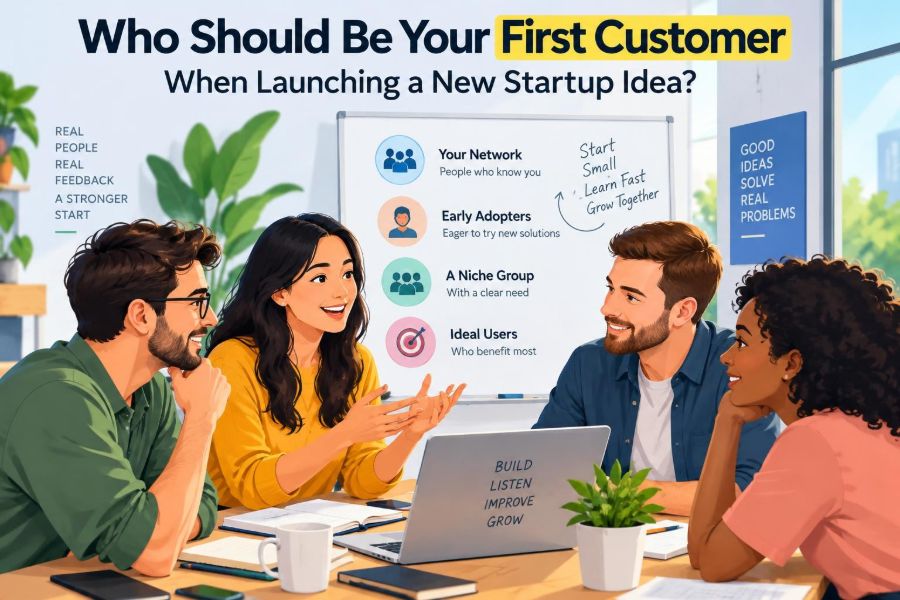

A startup rarely fails because its founder could not imagine a big enough market. It usually struggles because the founder starts with a vague customer: “small businesses,” “busy parents,” or “anyone who wants to save time.” Those groups are markets, not first customers.
Your first customer should be specific enough that you can picture their Tuesday morning, understand the costly problem in front of them, and know where to reach them without spending a fortune on ads. They do not need to represent everyone you will serve later. They need to have a reason to act now.
This approach suits founders building software, services, physical products, marketplaces, or a serious side hustle. It is especially useful if you have limited cash, limited credibility, and no interest in spending months building something nobody has agreed to buy.
Choosing the first customer well matters more than polishing a logo or launching a broad marketing campaign. A real early buyer gives you cash, language, objections, proof, referrals, and a much clearer product roadmap.
Here is a practical way to find that person, earn the first sale, and use it to build a business that can expand without losing focus.
🎯 1. Define “first customer” correctly
Your first customer is not necessarily the first person who clicks “sign up” or accepts a free trial. It is the first person or business that gives you a meaningful commitment: money, a deposit, a signed pilot, a purchase order, or consistent use tied to a clear outcome.
For an early startup, the ideal first customer has a painful problem, authority to buy, urgency, and enough patience to work with an unfinished solution. They are buying a result, not perfection.
- Consumer example: A freelance designer who needs faster invoice follow-up this month.
- Business example: A five-person agency losing leads because nobody follows up after inquiry forms.
- Local-service example: A salon owner with frequent no-shows and no practical reminder system.
Do not confuse a friendly supporter with a customer. Friends may praise your idea. Customers make trade-offs and pay because not solving the problem costs them more.
🧭 2. Start with a narrow customer, not a huge market
“Restaurants” is a market. “Independent lunch cafés with 10 to 30 seats that lose money on last-minute cancellations” is a starting point. The narrower description may feel restrictive, but it makes every early decision easier.
You can later expand from cafés to restaurants, then hospitality. Early on, specificity gives you a believable message, a focused product, and a short list of people to contact.
| Customer definition | Message clarity | Sales difficulty | Early learning quality |
|---|---|---|---|
| “Small businesses” | Low | High | Low |
| “Local service businesses” | Medium | Medium | Medium |
| “Independent salons with repeat booking clients” | High | Lower | High |
A narrow first niche is not a life sentence. It is a learning strategy. Your goal is to win one small corner before claiming the whole map.
🔥 3. Look for pain, urgency, and a workaround
The strongest first customers already feel the problem. They may be using spreadsheets, sticky notes, a virtual assistant, several disconnected tools, or manual late-night work to cope.
A workaround is a valuable signal because it proves the problem is real. If people are investing time or money in an awkward alternative, they may pay for a simpler one.
Questions to ask in customer conversations
- What happened the last time this problem occurred?
- How often does it happen?
- What does it cost in time, revenue, stress, or risk?
- What have you tried already?
- Who owns the budget or makes the final decision?
- What would need to happen for you to solve it this month?
Listen for concrete stories, not polite opinions. “We spent two hours rebuilding that report every Friday” is much stronger than “That could be useful.”
👤 4. Find the person with both pain and buying power
In business-to-business sales, the user, champion, and buyer can be different people. An operations coordinator may use your tool, a manager may advocate for it, and an owner or finance lead may approve the budget.
Your first customer should ideally combine these roles, or be close enough to the decision-maker to move quickly. That is why owner-operated businesses and team leads with clear budgets are often good early targets.
In consumer businesses, buying power means something different. Your first customer needs discretionary budget, a strong personal reason to act, and a low-friction path to purchase.
- User: experiences the problem daily.
- Champion: wants your solution internally.
- Buyer: can approve spending.
- Blocker: worries about cost, security, change, or compliance.
Map these roles before building an elaborate sales process. A product with an enthusiastic user but no reachable buyer can stall for months.
🔎 5. Rank customer segments with a simple scorecard
Do not choose a first segment by instinct alone. List three to five possible groups, then score each one honestly. This prevents you from pursuing the segment that sounds impressive but is expensive and slow to sell to.
| Criterion | Score 1 | Score 5 |
|---|---|---|
| Problem severity | Minor inconvenience | Costly, frequent pain |
| Urgency | “Maybe later” | Needs action now |
| Reachability | Hard to identify | Easy to contact directly |
| Budget access | No clear budget | Buyer can spend quickly |
| Feedback quality | Vague opinions | Practical, specific feedback |
| Expansion potential | One-off need | Similar buyers nearby |
Give each segment a score from one to five for every criterion. The highest score is not automatically right, but it gives you a rational place to begin.
🗣️ 6. Conduct problem interviews before pitching
Before you explain your solution, learn how customers describe their world. Ask for a 20-minute conversation about their current process. Avoid asking, “Would you buy this?” People are naturally generous with hypothetical encouragement.
Instead, ask about past behavior. What did they do? What did they pay? Who was involved? What went wrong? Those answers reveal whether a problem is commercially important.
A simple interview opening
“I am researching how independent salons manage last-minute cancellations. I am not selling anything on this call. Could you walk me through how you handled the last few?”
Take notes on their exact words. If several people say “empty chairs,” “wasted slots,” or “constant texting,” those phrases belong in your future sales copy.
🧪 7. Sell the smallest credible outcome
Your first offer should solve one narrow, valuable problem. It does not need every feature you imagine. In fact, an oversized first offer often creates delays, confusion, and costly support.
If you are building software, you may initially deliver some work manually behind the scenes. If you are launching a service, package one defined result rather than offering unlimited custom help.
- Weak offer: “An all-in-one growth platform for local businesses.”
- Stronger offer: “We set up missed-call text-back and appointment reminders for salons in seven days.”
- Weak offer: “AI reporting for agencies.”
- Stronger offer: “A weekly client-report draft built from your existing campaign exports.”
Be transparent about what is manual, beta-stage, or limited. Early customers can accept rough edges; they should never be misled about them.
💵 8. Ask for payment earlier than feels comfortable
Payment is not just revenue. It is evidence that the problem matters and that your offer is understandable. A paid pilot, deposit, or pre-order is usually more informative than a large list of free sign-ups.
Price based on the value and effort involved, while recognizing that early pricing may change. You do not need to undercharge simply because your startup is new.
Practical early pricing options
- Paid pilot: A fixed fee for a defined trial period and outcome.
- Setup plus monthly fee: Useful for implementation-heavy services and software.
- Pre-order: Useful for a physical product with clear delivery timing.
- Founding-customer rate: A discounted price in exchange for feedback, with clear terms.
State what is included, what is not, when payment is due, and what happens at the end of a pilot. Taxes, invoicing rules, consumer rights, and contract requirements vary by country, so use suitable local advice where needed.
🤝 9. Choose early adopters, not merely cheap customers
The cheapest customers can become the most expensive in support, churn, and distractions. A good first customer values the outcome, responds promptly, and understands that an early product requires collaboration.
Look for people who have adopted other new tools, actively seek improvements, or have publicly discussed the problem. They are more likely to provide useful feedback than customers who expect a mature enterprise product at bargain pricing.
- They can describe the problem clearly.
- They respond within a reasonable time.
- They agree on success criteria.
- They will test a new process.
- They respect boundaries and payment terms.
Being selective is not arrogance. It protects the limited time you have to learn.
📍 10. Go where your first customers already gather
You do not need a huge audience to find the first few buyers. You need a repeatable place where a concentrated group already spends attention: an industry group, local event, trade newsletter, professional community, online forum, supplier network, or direct list of businesses.
Start with channels that allow conversations. Broad paid advertising can be useful later, but it often hides the reasons people do or do not buy.
Low-cost customer discovery channels
- Personal introductions from people who serve your target market.
- Thoughtful direct outreach to a tightly researched list.
- Local business visits when the product is locally relevant.
- Professional events and small workshops.
- Niche online communities where participation is welcomed.
- Partners such as accountants, agencies, consultants, or suppliers.
Do not spam communities or scrape contact details in ways that break platform rules or privacy laws. Respectful outreach protects your reputation and improves response quality.
✉️ 11. Write outreach that earns a reply
Your first message should prove you understand the recipient’s situation. Keep it short, specific, and easy to decline. You are requesting a conversation or offering a relevant result, not delivering a long product presentation.
A simple outreach structure
Hi [Name],

I noticed [specific relevant observation]. I am speaking with [type of customer] about [specific problem].

I am testing a simple way to [outcome]. Would you be open to a 15-minute conversation next week? If it is not relevant, no problem at all.

[Your name]
Personalization is not adding a first name to a template. It is mentioning something that shows why this person belongs in your carefully chosen group.
🧱 12. Build trust before you have a brand
At the beginning, customers are evaluating you as much as the product. They want to know whether you understand the problem, communicate reliably, and will still answer if something breaks.
You can build trust without pretending to be larger than you are. Be clear about your background, show a simple demo or prototype, explain the process, and follow through on small promises.
- Send a concise recap after every conversation.
- State timelines you can actually meet.
- Use a clear invoice, proposal, or agreement.
- Document the expected result and limitations.
- Reply professionally, even when the answer is no.
A polished website helps, but reliability beats visual polish in an early sale.
📏 13. Agree on a measurable pilot
A pilot should not be “try it and let me know.” Define the customer, the problem, the time period, the work each side will do, and the signal that means it worked.
For example, a lead-follow-up service might measure response time, number of leads contacted, and appointments booked. A reporting product might measure hours saved and whether reports are delivered on schedule.
Pilot checklist
- Starting point: What happens today?
- Target outcome: What improvement are you aiming for?
- Time frame: Usually short enough to maintain urgency.
- Customer commitment: Access, data, feedback, and payment.
- Your commitment: Deliverables, support, and review date.
- Next step: Renewal, expansion, revision, or stop.
Do not promise results you cannot control. External factors, customer effort, seasonality, and data quality can all affect outcomes.
🔁 14. Turn every sale into a learning loop
Your first customers are not just validation badges. They are a source of disciplined learning. After onboarding, ask what was confusing, what nearly stopped the purchase, what they expected, and what they would miss if you disappeared.
Separate feature requests from root problems. If three customers ask for different buttons, they may all be trying to solve the same workflow issue.
Use this review after each customer interaction
- What triggered their interest?
- What objection appeared first?
- What did they value enough to pay for?
- Where did onboarding slow down?
- What result did they actually experience?
- Would they refer someone similar? Why or why not?
Keep a simple document of repeated patterns. Over time, this becomes your sales playbook and product roadmap.
📊 15. Track leading metrics, not vanity metrics
Early-stage numbers should help you make decisions. A large social following or a high number of free registrations can feel encouraging, but neither proves a sustainable business.
| Metric | What it tells you | Warning sign |
|---|---|---|
| Qualified conversations | Whether you can reach the right people | Many chats with no relevant pain |
| Conversation-to-pilot rate | Offer and urgency strength | Interest but no commitments |
| Time to first value | Onboarding quality | Customers wait too long for results |
| Pilot conversion or renewal | Real value and fit | Customers leave after trial |
| Referral rate | Customer confidence | Happy words, no introductions |
Track a small set weekly. The point is not impressive reporting; it is noticing problems while they are still cheap to fix.
⚠️ 16. Avoid the common first-customer traps
The most damaging mistakes are usually understandable. Founders want momentum, so they say yes to every request, build too much, and avoid asking for money. The result is activity without evidence.
- Building before talking: You may perfect the wrong solution.
- Giving everything away free: You attract curiosity rather than commitment.
- Serving everyone: Your message becomes forgettable.
- Taking any customer: One demanding mismatch can consume your month.
- Custom-building every request: You create an agency disguised as a scalable product.
- Ignoring paperwork: Scope, payment, privacy, and ownership disputes become harder later.
- Chasing praise: Compliments are not purchase intent.
Some custom work is appropriate at the start. The key is to learn which parts repeat and which parts should be declined, priced separately, or automated.
🌱 17. Use the first customer to find the next ten
Once one customer pays and gets value, look for adjacent buyers with the same context. They may be competitors in the same local area, peers in a professional association, or similar companies using the same tools.
Ask for introductions only after delivering a clear benefit. Make the request specific: “Is there one other salon owner who also has trouble filling cancelled appointments?” is easier to answer than “Do you know anyone who might be interested?”
Turn the first success into a simple, truthful proof point. Describe the problem, the process, and the outcome without revealing confidential information or exaggerating results.
🪜 18. Know when to broaden the market
Broaden only after your first niche gives you a repeatable pattern. You should understand the buyer, common pain, basic onboarding, pricing logic, and why customers stay.
Expansion may mean serving a neighboring niche, adding a higher-priced tier, offering a partner channel, or reducing manual work through software and systems. Expand one variable at a time so you know what changed.
- Can you explain the offer in one sentence?
- Have multiple similar customers paid?
- Do you know the common objections?
- Can you deliver value without heroic effort every time?
- Is there a repeatable path to reach more buyers?
If the answer is mostly no, stay narrow a little longer. Focus is often the fastest route to eventual scale.
✅ 19. Your action plan for this week
- Write down three possible first-customer segments, each described in one precise sentence.
- Score them for pain, urgency, reachability, budget access, and expansion potential.
- Choose one segment for the next seven days, not forever.
- Make a list of 20 real people or businesses in that segment.
- Invite at least 10 to short problem interviews using a personal message.
- Conduct five conversations and record exact phrases, workarounds, and objections.
- Create a one-sentence offer for the most repeated painful problem.
- Ask one qualified prospect for a paid pilot, deposit, or pre-order.
You may not get a yes immediately. That is normal. A clear no with a real reason is still valuable evidence, especially when you collect several and see the pattern.
Your first customer should be the person with a painful, urgent problem who can buy, collaborate, and teach you what to do next—not simply the first person willing to be polite. Start narrow, ask directly, deliver one meaningful result, and let real customer behavior guide the business. 🚀🤝📈