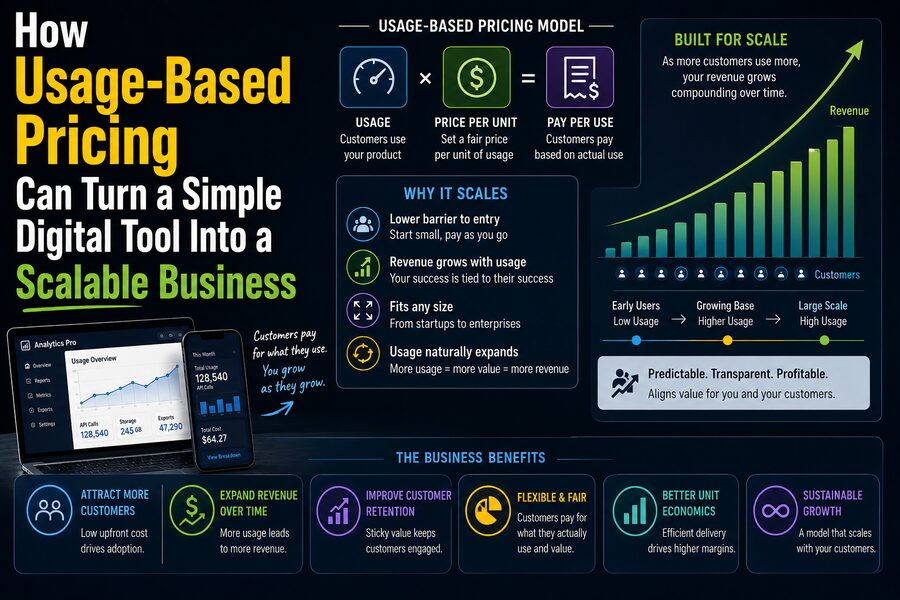

A digital product does not always need dozens of features, complex enterprise contracts, or expensive sales teams to become a successful business. Sometimes a relatively simple tool—an API, automation service, data converter, AI utility, analytics engine, storage product, or developer platform—can become highly scalable when its pricing model grows naturally with customer usage.
One of the most powerful approaches is usage-based pricing. 📈⚙️
Instead of charging every customer the same fixed monthly fee, a usage-based business charges according to how much of the product a customer actually consumes. That might mean paying per API request, gigabyte stored, minute processed, transaction completed, document generated, email sent, or unit of computing power used.
The idea sounds simple:
Customers pay more when they receive more value or consume more resources.
When designed carefully, this model can reduce the barrier to trying a product, allow small customers to start cheaply, and automatically increase revenue as successful customers use the product more.
That combination can turn a modest digital utility into a business capable of scaling alongside its users. 🚀
🧠 What Is Usage-Based Pricing?
Usage-based pricing—sometimes called consumption-based pricing or metered pricing—links the customer’s bill to measurable product activity.
Examples include:
- $0.01 per API call
- $5 per 1,000 documents processed
- $0.10 per gigabyte stored
- $2 per hour of computing
- $0.005 per message delivered
- A percentage or flat fee per transaction
This differs from a traditional subscription where every customer might pay:
$49 per month
regardless of whether they use the product heavily or barely at all.
A usage-based model instead asks:
How much value or capacity did the customer actually consume?
That measurement becomes the basis of billing.
💡 Why Usage-Based Pricing Fits Simple Digital Tools
Many digital tools solve narrow but repeatable problems.
Imagine a service that converts images into optimized web formats.
Its core function might be technically simple:
Upload image → process image → download result
Yet customers may use it at dramatically different scales.
A freelancer might process:
100 images per month
while a large e-commerce company might process:
10 million images per month.
A flat monthly price creates a problem.
If the price is low enough for the freelancer, it may severely undercharge the large company.
If the price is high enough for the enterprise, small users may never sign up.
Usage-based pricing allows both customers to use the same product under the same economic logic. ⚖️
The freelancer pays little.
The enterprise pays much more because it consumes far more of the service.
🚪 Low Entry Cost Can Accelerate Adoption
One of the strongest advantages of usage-based pricing is that it can make a product easier to try.
Imagine two competing APIs.
API A costs:
$99 per month before the first request
API B costs:
$0.002 per request with no minimum
A developer experimenting with a new project may be much more willing to try API B.
The financial commitment is extremely small.
This creates a powerful adoption loop:
Low initial cost → more trials → more integrations → more successful users → greater usage → higher revenue
Usage-based pricing can therefore act as both a pricing model and a customer-acquisition mechanism.
📈 Revenue Can Expand Automatically With Customer Success
Traditional subscription businesses often need to convince customers to upgrade manually.
A customer begins on:
Starter Plan → Professional Plan → Enterprise Plan
Each transition may require sales discussions, approvals, or additional purchasing decisions.
With usage-based pricing, expansion can happen naturally.
Suppose a startup uses an email-delivery API.
During its first month, it sends:
50,000 emails
A year later, the startup has grown and sends:
5 million emails per month.
If pricing is tied to email volume, revenue from that customer may increase automatically as the customer’s business expands.
No salesperson necessarily needs to renegotiate the account every time volume increases.
This characteristic is often described as revenue scaling with usage. 📊
🔁 The Product Can Become Embedded in Customer Workflows
Usage-based businesses become especially powerful when the product is integrated directly into another company’s operations.
Consider:
🔌 Payment APIs
📨 Messaging services
☁️ Cloud storage
🤖 AI inference APIs
📊 Data pipelines
🗺️ Mapping services
🔐 Identity verification platforms
Once a customer builds one of these services into its software, every new user or transaction can generate additional consumption.
The tool stops being something the customer occasionally opens.
It becomes infrastructure.
That can create strong retention because replacing deeply integrated infrastructure requires engineering effort, testing, migration, and risk.
⚙️ Marginal Cost Is Critical
Usage-based pricing works best when the business understands the cost of serving each additional unit of demand.
Suppose an AI transcription service charges:
$1.00 per hour of audio
If computing infrastructure costs:
$0.20 per hour
then the gross contribution before other expenses is approximately:
$0.80 per hour.
But if infrastructure actually costs:
$1.10 per hour
the company loses money every time customers use the product more.
That creates a dangerous situation:
More growth → larger losses
rather than:
More growth → larger profits
For this reason, usage-based businesses must carefully track unit economics.
🧮 Understanding Unit Economics
Unit economics asks whether each measurable unit of consumption is financially attractive.
A simplified formula is:
Contribution per Unit = Revenue per Unit − Variable Cost per Unit
Suppose a document-processing API charges:
$0.05 per document
and variable costs include:
- $0.008 computing
- $0.002 storage
- $0.001 networking
- $0.004 third-party services
Total variable cost:
$0.015
Contribution per document:
$0.05 − $0.015 = $0.035
That means increased volume can contribute positively toward fixed costs and profit.
Understanding this number is essential before aggressively scaling acquisition.
🏗️ Digital Products Often Have Attractive Scaling Characteristics
Software can scale differently from physical products.
A company manufacturing chairs must purchase more wood, hardware, warehouse space, and transportation capacity as sales rise.
A digital product also has costs, but copying and delivering software can often be relatively inexpensive.
For some products, once the core platform exists, additional customers require comparatively modest incremental infrastructure.
This creates potential operating leverage.
The company may pay for:
💻 Servers
☁️ Cloud infrastructure
📡 Bandwidth
🔐 Security
🧠 Engineering
🎧 Support
But the cost of serving the ten-thousandth customer may be much smaller than building the product from scratch.
Usage-based pricing can capture some of that scaling advantage.
🎯 Choosing the Right Usage Metric
The most important pricing decision may be what to meter.
A good usage metric should ideally satisfy several conditions.
It should be:
✅ Easy to understand
✅ Easy to measure
✅ Difficult to manipulate
✅ Closely connected to customer value
✅ Predictable enough for budgeting
✅ Related to the provider’s cost structure
For example, a messaging platform might charge per message.
That makes sense because customers understand what a message is, usage can be counted precisely, and sending more messages generally creates more value.
❌ A Bad Usage Metric Can Create Confusion
Suppose a simple reporting tool charges customers according to:
CPU milliseconds consumed during report generation
That may accurately reflect infrastructure cost.
But customers probably do not know how many CPU milliseconds they will use.
They may find billing unpredictable.
A better metric might be:
Reports generated
or:
Records processed
These units are closer to how customers think about the product.
Pricing should ideally connect technical consumption to a business concept customers can understand. 🧠
💰 Value Metric vs. Cost Metric
The best pricing unit is not always the provider’s underlying cost unit.
Imagine a fraud-detection service.
Its actual infrastructure cost might depend on CPU usage.
But customers value the service according to the number of transactions analyzed.
Charging:
$0.002 per transaction screened
may therefore make more sense than charging for computing seconds.
The transaction becomes the value metric.
A strong usage-based model often aligns:
Customer value + provider cost + measurable usage
as closely as possible.
📦 Pure Usage Pricing Is Not the Only Option
Companies do not have to choose between completely fixed subscriptions and completely variable pricing.
Many successful products use hybrid models.
For example:
$29/month includes 10,000 requests
then:
$0.001 per additional request
This gives the company predictable baseline revenue while still allowing customer spending to expand with usage.
Other possibilities include:
🔹 Monthly platform fee + usage
🔹 Usage tiers
🔹 Volume discounts
🔹 Prepaid credits
🔹 Minimum commitments
🔹 Enterprise annual contracts
Hybrid structures can combine the benefits of subscription predictability with consumption-based expansion.
📊 Tiered Usage Pricing
Usage pricing can become cheaper per unit as customers consume more.
For example:
First 100,000 requests: $0.01 each
Next 900,000: $0.007 each
Above 1 million: $0.004 each
This is called volume-tiered pricing.
It rewards customers for scaling while still allowing the provider to capture more total revenue from larger accounts.
Volume discounts can also reduce the incentive for large customers to build competing technology internally.
🪙 Prepaid Credits Can Reduce Billing Friction
Another common model uses credits.
A customer buys:
$100 of credits
and the service deducts credits whenever usage occurs.
For example:
1 image processed = 2 credits
1 minute of video processed = 10 credits
Credit systems are useful when a service supports several different actions with different costs.
They can also simplify payment collection from smaller customers.
However, the conversion between real money, credits, and product usage must remain easy to understand.
If customers cannot predict what they are paying, trust can decline.
📉 Predictability Is a Major Challenge
The greatest strength of usage pricing can also become one of its weaknesses.
Customers pay according to consumption—but consumption may fluctuate.
A company might receive a bill of:
$500 one month
and:
$4,000 the next month
after unexpected traffic growth.
Even if the customer gained value from that additional usage, unpredictable bills can make finance teams uncomfortable.
This is sometimes called bill shock. ⚠️💳
Businesses can reduce this problem using:
- Usage dashboards
- Spending alerts
- Budget caps
- Cost forecasts
- Rate limits
- Prepaid commitments
- Volume discounts
Transparency becomes extremely important.
🔔 Real-Time Usage Monitoring Improves Trust
Customers should not have to wait until the end of the month to discover what they consumed.
A good usage-based platform may show:
📊 Requests used today
💰 Estimated current bill
📈 Usage trend
⚠️ Budget thresholds
🧾 Historical invoices
For example, a company could receive an alert:
“You have reached 80% of your monthly $1,000 spending budget.”
This gives customers time to investigate unusual activity before receiving a surprise invoice.
Good billing visibility can be a competitive advantage.
🔐 Metering Must Be Extremely Accurate
When billing depends on usage, the metering system becomes part of the product.
Imagine a cloud service charging customers per gigabyte stored.
If the system incorrectly counts storage, customers may be overcharged or undercharged.
Both outcomes are serious.
Reliable metering usually requires:
🧾 Unique usage events
⏱️ Timestamps
🔁 Duplicate-event protection
📊 Aggregation systems
💾 Durable storage
🔍 Auditable logs
Billing systems must often process huge volumes of events without losing or double-counting them.
🔁 Idempotency Matters in Usage Metering
Suppose a billing pipeline receives the same usage event twice because a message was retried.
Without protection, a customer might be billed twice for one action.
Usage systems therefore often attach a unique identifier to each billable event.
For example:
usage_event_871920
If the event arrives again, the billing system recognizes that it has already been recorded.
This is an example of idempotent processing applied to metered billing.
Reliable pricing depends on reliable data engineering.
📈 Expansion Revenue Can Improve Customer Economics
A powerful characteristic of usage-based products is account expansion.
Imagine a customer spends:
$100 in January
and then increases usage until spending reaches:
$600 per month the following year.
The business did not necessarily need to acquire a new customer to create the additional $500 of monthly revenue.
This can improve the economics of customer acquisition.
If satisfied customers naturally increase consumption, the revenue generated from an account may grow substantially over time.
This is one reason investors and operators pay close attention to metrics such as net revenue retention.
🔢 Understanding Net Revenue Retention
Net Revenue Retention, or NRR, measures how revenue from an existing group of customers changes over time after accounting for expansion, contraction, and churn.
A simplified formula is:
NRR = (Starting Revenue + Expansion − Contraction − Churn) / Starting Revenue
Suppose customers began the year generating:
$1 million
During the year:
- Expansion adds $300,000
- Contraction removes $50,000
- Churn removes $100,000
Ending revenue from that original group becomes:
$1.15 million
NRR would be:
115%
Usage-based businesses can sometimes produce strong expansion because growing customers automatically consume more.
📉 But Usage Can Also Contract Automatically
The same mechanism works in reverse.
If a customer’s business slows, product usage may fall immediately.
Revenue falls with it.
For example, an analytics provider serving an online retailer may process fewer events during a weak sales period.
The retailer’s bill decreases automatically.
This can make usage-based revenue more volatile than fixed subscriptions.
Companies should therefore understand seasonal and economic patterns in customer consumption.
🧲 Usage Pricing Can Reduce Customer Churn
A fixed subscription sometimes encourages customers to cancel products they are not using enough.
Imagine paying:
$100 every month
for a tool used only twice.
Eventually, the customer may decide the subscription is wasteful.
With usage-based pricing, the customer may simply pay very little during quiet periods.
This can reduce pressure to cancel the account completely.
The customer remains integrated and can automatically spend more when usage returns.
That creates a form of flexible retention. 🔄
🧑💻 Developer Tools Are Especially Well Suited
Usage pricing is common in developer infrastructure because developers often prefer starting without sales conversations.
A developer can:
- Create an account
- Obtain an API key
- Make a few requests
- Evaluate results
- Integrate the product
- Increase usage gradually
This approach is often associated with product-led growth.
The product itself drives acquisition, activation, and expansion.
If the API becomes valuable, customer spending rises naturally with production traffic.
🤖 AI Tools Are a Clear Modern Example
AI software often has direct variable costs because models consume computational resources whenever users generate outputs.
A service might charge based on:
📝 Text processed
🖼️ Images generated
🎙️ Audio minutes
🎥 Video processing
🧠 Model inference
Usage-based pricing can align customer payment with these underlying costs.
A small developer experiment may cost only a few dollars.
A company processing millions of interactions may spend thousands or substantially more.
The same technical product can serve both customers without requiring completely different versions.
☁️ Cloud Computing Demonstrates the Model at Scale
Cloud infrastructure is one of the clearest demonstrations of usage-based economics.
Customers can consume:
💻 Compute
💾 Storage
🌐 Networking
🗄️ Databases
📨 Messaging
🤖 Specialized processing
and pay according to measured consumption.
A startup can begin with a tiny amount of infrastructure.
If its application becomes successful, resource consumption grows.
The cloud provider’s revenue grows at the same time.
This removes the need for customers to purchase enormous amounts of hardware before knowing whether their own businesses will succeed.
🧮 Gross Margin Still Matters
Even highly scalable digital businesses need healthy gross margins.
Suppose a product generates:
$1 million of annual revenue
but serving that usage costs:
$800,000.
Gross profit is only:
$200,000
or a 20% gross margin.
Another product might generate the same revenue with only:
$200,000
of usage-related infrastructure cost.
Its gross margin would be:
80%.
The second business has significantly more money available for:
🧠 Engineering
📣 Marketing
🎧 Support
💰 Profit
🚀 Growth
Usage-based founders should therefore optimize both price and infrastructure efficiency.
⚙️ Cost Optimization Can Become a Growth Lever
Suppose an API initially costs the company:
$0.004 per request
to operate.
Engineers improve caching, database efficiency, and infrastructure utilization.
The cost falls to:
$0.002 per request.
If customer pricing remains unchanged, contribution margin improves significantly.
Alternatively, the company can lower prices to attract more usage while maintaining acceptable margins.
Technical optimization therefore directly influences business strategy.
In usage-based products, engineering efficiency can become a pricing advantage. 💻💰
🧪 Free Tiers Can Encourage Experimentation
Many usage-based products provide a free allowance.
For example:
First 10,000 API calls each month are free
or:
$5 in free credits for new accounts
This allows developers and small teams to evaluate the product with almost no purchasing friction.
A good free tier should be large enough to demonstrate value but small enough that successful production customers eventually begin paying.
If the free tier is excessively generous, users may receive substantial value without converting.
🎯 The Ideal Customer Journey
A well-designed usage-based business can create a smooth progression:
Discover product 🔍
⬇️
Try for free 🆓
⬇️
Build initial integration 🧑💻
⬇️
Begin small paid usage 💳
⬇️
Customer succeeds 📈
⬇️
Usage increases ⚙️
⬇️
Revenue expands automatically 💰
This is one of the strongest reasons the model can turn a simple utility into a scalable company.
Growth becomes partially connected to the growth of customers themselves.
🏢 Enterprise Customers May Still Want Contracts
Large companies often prefer predictability.
An enterprise expecting to spend:
$500,000 per year
may not want completely variable monthly invoices.
The provider may therefore negotiate an annual commitment.
For example:
Commit to $500,000 of annual usage in exchange for discounted rates.
This benefits both parties.
The customer gets predictable pricing.
The vendor receives more predictable revenue.
If the customer uses more than the committed amount, additional usage can still be billed.
Thus usage-based pricing and enterprise contracts can coexist.
🤝 Commitments Can Improve Business Predictability
Pure usage businesses can have uncertain revenue because consumption changes every month.
Minimum commitments create a floor.
Suppose a customer agrees to consume at least:
$10,000 per month
even if actual usage is lower.
The provider can plan infrastructure and staffing with greater confidence.
In exchange, the customer may receive:
💰 Lower unit prices
🎧 Premium support
🔐 Security features
📊 Advanced reporting
🤝 Contractual guarantees
This hybrid approach is common as usage-based products mature.
🧠 Pricing Should Follow Perceived Value
A frequent mistake is pricing only according to infrastructure cost.
Suppose a service costs:
$0.001
to process a document.
That does not automatically mean it should charge:
$0.002.
If processing that document saves the customer:
$5 of manual labor
the business may be able to charge much more while still providing excellent value.
Good pricing considers:
Cost floor + competitive alternatives + customer value
The customer’s willingness to pay often depends more on the outcome created than on the provider’s server bill.
🚨 The Danger of Underpricing
Usage pricing can make underpricing particularly painful.
Imagine charging:
$0.0001 per API request
when customers would comfortably pay:
$0.001.
At one million requests, the difference is:
$100 vs. $1,000.
At one billion requests:
$100,000 vs. $1 million.
A tiny pricing mistake per unit becomes enormous at scale.
Companies should therefore continuously evaluate whether their pricing reflects the value delivered.
🛑 The Danger of Overpricing
Overpricing creates the opposite problem.
If customers pay too much for each incremental action, they may begin deliberately avoiding product usage.
That is especially damaging because usage should ideally correlate with value.
A customer might hesitate to run reports, store more data, or send more messages because every action feels expensive.
This creates usage anxiety.
Strong pricing encourages customers to use the product when it benefits them rather than making them afraid of the meter.
📊 Usage Analytics Can Improve the Product
Metered businesses naturally collect detailed information about how customers use their products.
This data can reveal:
🔍 Most popular features
📈 Fastest-growing workloads
📉 Drop-off points
⚙️ Expensive operations
👥 Customer segments
💰 High-value use cases
Product teams can use these insights to prioritize development.
For example, if 70% of customer spending comes from one API endpoint, improving that endpoint’s reliability may have a disproportionate effect on revenue.
🧩 A Simple Digital Tool Can Become a Platform
A company may begin with one narrow utility.
For example:
Convert PDFs into structured text.
At first, customers pay per document.
Over time, the company could add:
- OCR
- Data extraction
- Classification
- Search
- Workflow automation
- API integrations
Now each original customer has additional ways to consume the platform.
The pricing model can expand alongside the product.
Instead of selling one static software package, the company becomes infrastructure for an entire workflow.
🔄 More Usage Can Create Better Products
Some digital services can benefit from scale indirectly.
Higher usage may generate:
📊 More performance data
🐛 More edge cases
🧠 Better optimization opportunities
💰 More resources for development
🔐 More investment in security
This can create a positive cycle:
More customers → more usage → more revenue → better product → more customers
Usage-based pricing does not create this cycle automatically, but it can strengthen it by connecting revenue directly to product adoption.
🚀 When Usage-Based Pricing Works Best
Usage-based pricing is particularly attractive when:
✅ Usage is easy to measure
✅ Customers start small and can grow significantly
✅ Product value rises with consumption
✅ Variable costs are understood
✅ Gross margins remain healthy
✅ Customers can monitor spending
✅ Repeated usage indicates successful adoption
Examples often include APIs, infrastructure, transaction platforms, communication services, data products, and AI utilities.
⚠️ When Usage-Based Pricing May Be a Poor Fit
The model is not ideal for every product.
Suppose a strategy application creates huge value when executives log in only once per month.
Charging per login would make little sense.
Similarly, software with almost no relationship between usage volume and customer value may work better with:
📅 Subscription pricing
👤 Per-seat pricing
🏢 Enterprise licensing
📦 Feature-based plans
The pricing model should reflect how customers receive value.
Usage pricing is a tool, not a universal rule.
🧠 Building a Scalable Usage-Based Business
A simple framework for designing this type of business is:
1️⃣ Identify the customer’s measurable value unit
What action represents real value?
2️⃣ Measure the provider’s cost per unit
Understand infrastructure and third-party expenses.
3️⃣ Create low-friction entry pricing
Allow customers to test the product cheaply.
4️⃣ Make billing transparent
Provide dashboards, alerts, and forecasts.
5️⃣ Design for automatic expansion
Ensure successful customers naturally consume more.
6️⃣ Protect margins
Improve infrastructure efficiency as volume grows.
7️⃣ Add enterprise commitments later
Introduce predictability without abandoning usage economics.
A simple product with strong execution across these areas can become a surprisingly powerful business.
✅ Conclusion
Usage-based pricing can transform a simple digital tool because it aligns three important forces:
customer adoption, customer success, and company revenue. 📈
Small customers can begin with minimal financial risk. As they receive more value and increase consumption, their spending rises naturally. The provider does not necessarily need to force every customer through rigid pricing tiers or repeated upgrade conversations.
This makes the model especially powerful for APIs, cloud services, AI tools, developer infrastructure, transaction platforms, and other digital products where usage can be measured accurately.
However, successful consumption pricing requires much more than adding a meter to a product. Companies must choose a meaningful billing unit, understand variable costs, prevent inaccurate metering, avoid unpredictable bills, maintain healthy margins, and provide customers with clear visibility into spending.
When these pieces work together, the economics can become highly scalable.
A customer may begin by spending only a few dollars.
If the customer’s own product grows, the same integration might eventually generate hundreds, thousands, or even millions of dollars in annual usage—without requiring the vendor to reinvent the product for every stage of that journey. 🚀💰
That is the central power of usage-based pricing:
A simple digital tool can start small with the customer, grow automatically with the customer, and turn increasing product usage into increasing business revenue.