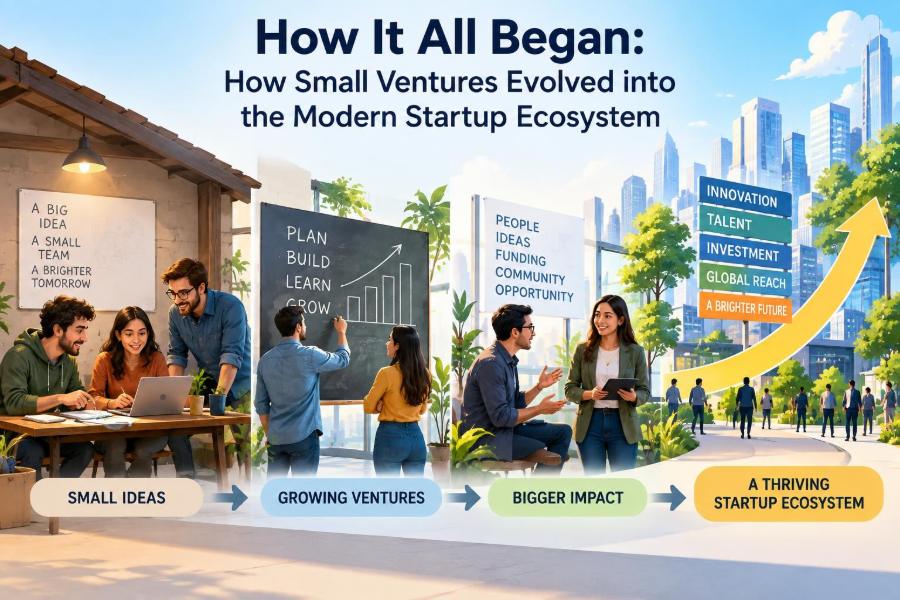

Most startups do not begin as “startups.” They begin as a person noticing friction: a shop owner losing track of stock, a freelancer tired of chasing invoices, or a parent wishing one everyday task worked better. The first version is often a service, a spreadsheet, a basic website, or a conversation with ten potential customers.
That is encouraging for aspiring founders because the modern startup ecosystem was not built only by people with venture capital, engineering teams, or perfect pitch decks. It grew from small ventures that learned to solve repeatable problems, then found ways to serve more people without rebuilding the business from scratch.
This history matters now because starting is cheaper in some ways and noisier in others. You can test demand with simple software, online communities, and direct outreach, but customers have more choices and less patience. A useful business still has to earn attention and trust.
If you are a side hustler, small-business owner, or first-time founder, the practical lesson is simple: understand where entrepreneurship came from so you can choose a sensible next step. You do not need to copy a famous founder’s path. You need a path that fits your problem, skills, resources, and customers.
🧭 1. Start with the real origin story: solving a local problem
Before “startup” became a widely used label, most new businesses were straightforward ventures: trades, shops, agencies, manufacturers, and professional practices. Their founders spotted a need in a particular place and organized people, materials, and money to meet it.
The underlying pattern has not changed. A business begins when someone can deliver a valuable outcome more reliably, conveniently, affordably, or pleasantly than the current alternative.
What to do now
- Write down three recurring frustrations you see in your work, neighborhood, or hobby.
- Describe the existing workaround people use, including doing nothing.
- Ask whether the problem is painful enough that someone would change behavior to solve it.
Common mistake: falling in love with an idea before confirming that the problem is real. Interesting is not the same as urgent.
🏪 2. Learn from the small-venture model
Traditional small ventures usually grew through cash flow. A baker sold bread, used the profit to buy better equipment, hired help, and opened another channel. The owner stayed close to customers because daily sales provided the clearest signal of what worked.
This model remains powerful. It is especially suitable when you can start with a service, pre-orders, a small inventory, or a narrow local audience.
| Path | Early funding source | Best fit | Main constraint |
|---|---|---|---|
| Bootstrapped small venture | Sales and owner savings | Services, local businesses, niche products | Slower capacity growth |
| Venture-backed startup | Outside equity investment | Potentially scalable markets | Pressure to grow rapidly |
| Hybrid path | Revenue first, capital later | Validated software or product businesses | Requires disciplined timing |
Neither path is morally superior. The sensible choice depends on the economics of your business, not on which story sounds more impressive online.
🏭 3. See how industrial growth changed the meaning of scale
As production, transport, and distribution improved, entrepreneurs could reach customers beyond one street or town. Scale increasingly meant building repeatable systems: standard processes, dependable suppliers, trained staff, and recognizable offers.
Modern startups inherited this lesson. Growth is not simply getting busier. It is delivering the same core value to more customers with less additional effort per customer.
A useful test
Ask: “If demand doubled next month, what would break first?” Your answer may be your time, inventory, customer support, delivery process, or technology. That bottleneck tells you what system to improve before chasing growth.
📞 4. Understand why communication created new businesses
Each major communications shift created opportunities. Better postal systems, telephones, personal computers, mobile devices, and the internet lowered the cost of coordinating buyers, sellers, teams, and information.
Today, a founder can sell internationally, work with contractors remotely, and test an offer quickly. But easy access also means competitors can reach the same market. Your advantage needs to come from insight, execution, trust, or a sharper customer experience.
- Then: location and physical distribution were often the moat.
- Now: speed of learning, audience trust, workflow integration, and specialized knowledge can be stronger advantages.
💻 5. Recognize the software shift
Software changed entrepreneurship because one product can often be copied and delivered to another customer at a low incremental cost. That created the possibility of rapid growth, recurring subscriptions, and global distribution.
It also produced a misleading idea: that every business should become software. Many excellent businesses should remain service-led, local, product-based, or deliberately small. Software is a tool for a particular business model, not a badge of ambition.
Choose the right starting format
- Start with a service when the customer’s needs are complex and you need to learn fast.
- Start with a productized service when you can standardize a useful outcome.
- Build software when the same workflow repeats across enough customers.
- Use a marketplace only when you can solve the difficult task of attracting both supply and demand.
🌐 6. Notice how the internet lowered the cost of experimentation
The internet made it possible to publish, sell, collect feedback, and build an audience without owning a storefront or a large advertising budget. It did not remove the need for customer discovery; it made customer discovery easier to avoid.
A landing page, a simple demo, and a handful of interviews can teach more than months of private planning. Your early goal is not to look established. It is to learn whether your promise is specific enough to earn a response.
Simple validation sequence
- Define one customer type and one costly problem.
- Speak with 10 people who have recently faced that problem.
- Create a clear offer using their language.
- Ask for a concrete next step: a deposit, trial, call, or pre-order.
- Review objections and revise the offer.
🎯 7. Treat customer discovery as the modern founder’s apprenticeship
Older businesses learned from the counter, the workshop, and the sales visit. Startups learn in similar ways, even when the product is digital. A founder must hear what customers do, not merely what they say they might do.
Ask about the last time they faced the problem. What triggered it? What did they try? What did it cost in money, time, risk, or frustration? Who approved the purchase? These details are more useful than “Would you use this?”
Common mistake: asking leading questions such as “Would an app that saves time be useful?” Almost everyone wants saved time. Few will pay for a vague promise.
🧪 8. Build a minimum useful offer, not a minimum impressive product
The modern startup ecosystem popularized the minimum viable product, but the term is often misunderstood. A first version should be the smallest thing that can honestly deliver a valuable result and test a meaningful assumption.
That might be a manual concierge service, a paid workshop, a curated spreadsheet, or a no-code prototype. The customer does not care whether your internal process is elegant. They care whether the outcome helps them.
Example
Instead of building a full scheduling platform for independent tutors, offer to match ten parents with suitable tutors manually. If matching is difficult, demand is weak, or parents will not pay, software will not fix the underlying issue.
- Define the one outcome you promise.
- State what is included and excluded.
- Set a fair early price.
- Deliver personally and document every repeated step.
💳 9. Let revenue teach you what applause cannot
Interest, likes, newsletter signups, and friendly feedback can be useful signals. Payment is a stronger signal because it asks a customer to choose your solution over keeping their money, time, and current workaround.
You do not need to charge a high price on day one, but avoid indefinite free work. A paid pilot, refundable deposit, or limited pre-order creates a more honest conversation about value.
Metrics to track early
- Customer conversations: how many relevant people you spoke with each week.
- Conversion rate: the share who take your chosen next step.
- Time to value: how quickly a new customer gets a useful result.
- Repeat use or renewal: whether value persists after first purchase.
- Gross margin: revenue left after direct delivery costs.
Taxes, payment fees, refunds, and regulations vary by country, so use local guidance when calculating your actual margins and obligations.
📈 10. Separate healthy growth from expensive activity
Startup culture sometimes treats growth as the only score. In reality, growth without retention can create a leaky bucket: you spend more to acquire customers who leave before your business recovers the cost of serving them.
Healthy growth begins with a product or service people continue to value. Then you build a repeatable way to reach similar customers.
| Metric | What it reveals | Early warning sign |
|---|---|---|
| Retention | Whether customers keep receiving value | Customers disappear after first use |
| Customer acquisition cost | What it costs to win a customer | Costs rise faster than revenue |
| Average revenue per customer | Value of each customer relationship | Discounting becomes normal |
| Referral rate | Strength of customer trust | Happy-sounding customers never recommend |
🤝 11. Build networks before you need them
The startup ecosystem is more than investors and accelerators. It includes customers, suppliers, peers, mentors, contractors, local business groups, universities, and communities that share practical knowledge.
Relationships shorten the learning curve when they are built with genuine curiosity rather than a constant request for favors. Offer useful feedback, make introductions when appropriate, and share what you are learning.
A practical weekly habit
- Have one customer conversation.
- Meet one peer founder or business owner.
- Help one person without expecting an immediate return.
- Document one lesson that could save another founder time.
💰 12. Understand funding as fuel, not proof
Outside capital can help a company hire, build, acquire customers, or enter a market before competitors. It can also create pressure to pursue a pace and size that does not fit the business.
Funding does not validate customer demand. It buys time to validate it, and that time has a cost: dilution, reporting, expectations, and reduced flexibility.
Ask these questions before seeking investment
- Is the market large enough to support the growth investors expect?
- Does capital unlock something revenue alone cannot fund soon enough?
- Can you explain how money turns into measurable progress?
- Would a loan, grant, pre-sales, partnership, or slower bootstrapping be safer?
Get qualified legal, tax, and financial advice in your jurisdiction before taking investment, issuing equity, borrowing, or selling regulated products.
🧱 13. Build systems before complexity builds them for you
Every successful small venture eventually faces the same transition: the founder can no longer remember every order, customer request, decision, and exception. Systems turn individual effort into a business that can operate consistently.
Start with simple documentation. Write the steps for onboarding, delivery, invoicing, support, and quality checks. Improve the process after each real customer interaction.
Tools are secondary to clarity
You may begin with a calendar, spreadsheet, invoicing tool, shared documents, and a basic customer relationship system. Do not buy an elaborate software stack before you have a stable workflow to support.
Common mistake: automating a confusing process. First make the work clear and repeatable; then automate the parts that genuinely save time.
🛡️ 14. Treat trust, compliance, and resilience as growth work
In the early days, founders often focus on speed. As you handle customer data, payments, contracts, employees, and suppliers, reliability becomes part of the product. One preventable failure can cost more than a delayed feature.
- Use clear terms, accurate claims, and straightforward refund policies.
- Protect customer information and limit access to sensitive data.
- Keep basic financial records from the beginning.
- Check licensing, consumer protection, employment, privacy, and tax rules that apply where you operate.
- Maintain backups and a plan for supplier or platform disruptions.
Rules differ considerably by country and industry. “We are small” is not a dependable compliance strategy.
🌱 15. Choose sustainable ambition over borrowed ambition
The startup ecosystem can make a founder feel behind unless they are hiring quickly, raising money, or announcing a major launch. That is a poor benchmark. A healthy business can be small, profitable, durable, and deeply useful.
Define what success means in practical terms: income, flexibility, jobs created, customers served, a future acquisition, a mission, or a product that reaches a large market. Your definition should shape your business model.
Decide your constraints early
- How much financial risk can you personally absorb?
- How many hours can you sustainably work?
- What level of customer support can you promise?
- What compromises would damage your health, reputation, or values?
Constraints are not signs of weak ambition. They are design requirements for a business you can keep running.
🔄 16. Use the old-to-new playbook in your own venture
The evolution from small ventures to modern startups is not a replacement story. It is a collection of tools. Take the customer closeness and cash discipline of a small business, then add the experimentation, systems, technology, and network effects that genuinely fit your opportunity.
A practical sequence is: solve one painful problem manually, earn trust and revenue, standardize the result, measure retention, improve the channel that brings customers, and only then invest heavily in scale.
Your action plan for this week
- Choose one customer group you can reach directly.
- Schedule five conversations about one specific recent problem.
- Write a one-sentence offer focused on an outcome, not a feature.
- Make one paid or commitment-based ask.
- Track objections in a simple document and decide what to test next.
The modern startup ecosystem rewards founders who learn quickly, but lasting businesses are still built by solving real problems, earning trust, and improving one repeatable step at a time. 🚀🌱💼