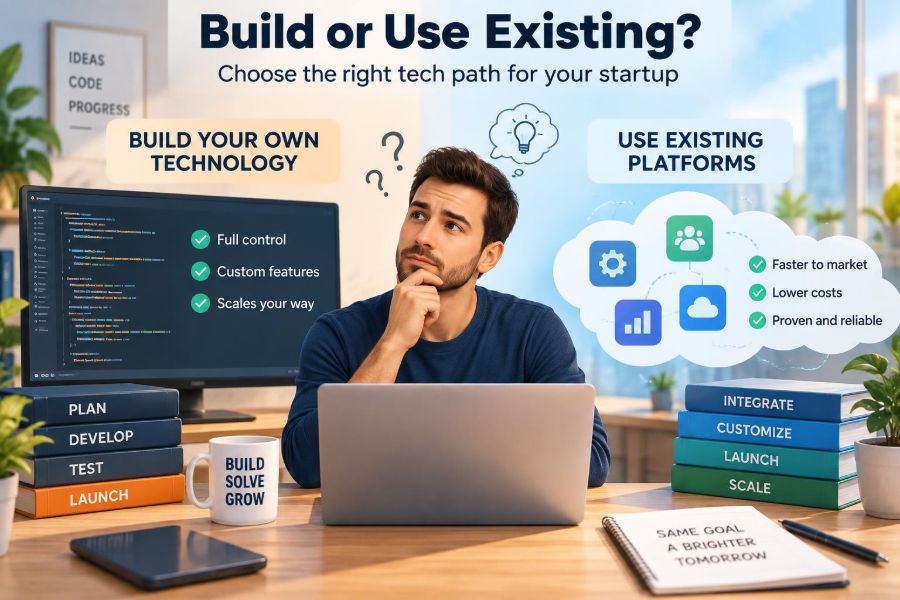

One of the earliest and most expensive startup decisions is deceptively simple: should you build the technology yourself, or assemble the business on platforms that already exist?
This question suits founders launching software products, marketplaces, online services, agencies, local businesses, and side hustles. If your idea relies on a website, app, payments, automation, data, or customer communication, you will face some version of it.
It matters now because powerful platforms make it possible to launch in days, while modern development tools make custom software more accessible than it used to be. Both paths can be smart. Both can also become expensive traps when chosen for the wrong reason.
The goal is not to look more “technical” or more “lean.” The goal is to make the next decision that gets you closer to real customers, useful learning, and a durable business.
🧭 1. Start With the Real Question
Do not frame the decision as “build versus buy.” Frame it as: what must we own to create a meaningful advantage, and what can we rent until the business proves itself?
Most early startups do not fail because their first website was too basic. They fail because they built features before confirming that customers had a painful, specific problem and would pay for relief.
- Build when technology itself is central to your unique customer value.
- Use platforms when the technology is mostly standard business infrastructure.
- Combine both when you need a fast launch now and a custom layer later.
🎯 2. Define What Customers Are Actually Buying
Customers rarely buy “a custom tech stack.” They buy an outcome: faster bookkeeping, more bookings, safer compliance, easier team coordination, or better insight into a problem.
Write one sentence: “Our customer pays us because we help them achieve outcome without painful alternative.” Then identify whether the software mechanism is visible and important to that promise.
Simple examples
- A neighborhood bakery needs online ordering. Customers buy baked goods, not proprietary checkout code.
- A consultant selling operational audits may need scheduling, video calls, invoices, and a client portal. These are often standard infrastructure.
- A logistics startup promising a novel way to optimize routes may need to own the optimization logic because it is the product.
🔍 3. Separate Commodity Work From Strategic Work
Commodity work is solved well enough by many vendors. Think payments, email delivery, cloud storage, appointment booking, authentication, basic e-commerce, accounting, and internal task management.
Strategic work is where your insight, data, workflow, or experience produces a result competitors cannot easily copy. That may be a specialized recommendation engine, a vertical-specific workflow, a proprietary data model, or an unusually effective user experience.
Founders often overestimate how strategic their first feature set is. If ten established tools already handle it well, your advantage may be distribution, service, brand, specialization, or pricing rather than code.
⚖️ 4. Compare the Paths Honestly
| Approach | Upfront cost | Launch speed | Control | Ongoing burden | Best early use |
|---|---|---|---|---|---|
| Existing platform | Usually low to moderate | Days to weeks | Limited | Subscriptions and platform rules | Testing demand and standard workflows |
| Custom build | Moderate to high | Weeks to months | High | Engineering, security, maintenance | Core differentiated product |
| Hybrid | Moderate | Days to weeks initially | Selective | Integrations plus gradual engineering | Validated businesses approaching scale |
These are directional comparisons, not guarantees. Costs, vendor pricing, salaries, taxes, legal duties, and regulations vary substantially by country and industry.
💸 5. Calculate the Full Cost, Not Just the First Invoice
A platform subscription can look expensive beside “building it once.” That comparison is almost always incomplete. Custom software is never built only once.
Include planning, design, development, testing, hosting, security updates, bug fixes, customer support, integrations, documentation, and the opportunity cost of founder time.
Rough cost estimates
- Platform-first launch: an estimate of a few hundred to several thousand in setup costs, plus monthly subscriptions, depending on complexity and professional help.
- Custom minimum product: an estimate of several thousand to tens of thousands or more, especially when hiring experienced specialists.
- Hybrid launch: an estimate between those ranges, with custom work focused on one essential workflow or interface.
These are broad estimates, not quotes. Get local quotes, account for sales tax or VAT, and consider sector-specific requirements before committing.
🧪 6. Use Platforms to Test Demand Before You Automate
The fastest valid test is often a manual service behind a simple storefront. You can use forms, spreadsheets, calendars, payment tools, email, and basic automations to deliver the first version.
If customers will not buy a partly manual solution, a polished app may not solve the real issue. Manual delivery also reveals the exceptions and edge cases your future product must handle.
A practical test sequence
- Interview people with the problem and listen for current workarounds.
- Create one clear offer with a price or paid pilot.
- Use existing tools to fulfill the service for five to ten customers.
- Record every repetitive step, request, delay, and complaint.
- Build only the repeated parts that customers value and will pay for.
🏗️ 7. Build When the Product Cannot Exist Without It
Custom technology becomes sensible when it is not merely an efficiency upgrade but the reason customers choose you. You may need to build when the business requires a unique model, real-time behavior, deep workflow control, difficult technical integration, or defensible proprietary data handling.
For example, an app that turns a distinctive expert process into personalized decisions may need custom logic. A standard site builder can market it, but it cannot necessarily deliver the core result.
Even then, build the smallest version that proves the critical behavior. “Custom” does not mean creating every supporting system yourself.
🛒 8. Use Existing Platforms for Standard Business Functions
Most startups should seriously consider renting the boring but necessary layers. A reliable existing service can let you focus scarce attention on customers.
- Website and landing pages
- Online store and checkout
- Payment processing and invoicing
- Scheduling and video meetings
- Email newsletters and customer support
- Customer relationship management
- Analytics, bookkeeping, and internal collaboration
Using a platform is not a lack of ambition. It is a decision to avoid rebuilding plumbing while you learn what deserves your ambition.
🧩 9. Choose the Hybrid Path Deliberately
Many good businesses are hybrid businesses. They use platforms for identity, payments, notifications, storage, and administration, while developing a focused proprietary layer for the customer experience or unique workflow.
Think of the hybrid approach as a boundary. Keep everything outside your differentiation replaceable. Invest deeply inside the part that makes your promise credible.
Example boundary
A niche coaching marketplace might use third-party scheduling, payments, email, and video. It could build its own matching method, progress dashboard, and specialized coach workflow once those elements prove central to retention.
🧱 10. Watch for Platform Risk
Platforms save time, but they introduce dependency. Prices can rise, policies can change, features can disappear, integrations can break, and your account can face restrictions.
The answer is not to avoid every platform. The answer is to identify dependencies before they become existential.
- Export customer and transaction data regularly where permitted.
- Keep a copy of important content, designs, and operating procedures.
- Understand account review, payout, and acceptable-use policies.
- Avoid making a single vendor the only path to your customers if possible.
- Document a fallback process for payments, communication, and fulfillment.
🔐 11. Do Not Underestimate Security and Compliance
Building your own technology means accepting responsibilities that platforms may partially handle: access control, backups, incident response, data retention, permissions, and secure updates.
Using a platform does not remove your responsibility entirely. You still need sensible internal access rules, accurate customer communication, and an understanding of applicable privacy, consumer, payment, employment, and industry regulations.
If you work with health, financial, children’s, or other sensitive data, get qualified local legal and security advice early. Do not assume a tool’s marketing page makes your business compliant.
👥 12. Assess Your Team’s True Capability
Having a developer friend, a no-code enthusiast, or an AI coding assistant is useful. It is not automatically the same as having long-term product engineering capability.
Ask who will maintain the system six months after launch, respond to a failure on a weekend, review security issues, and understand the code if the original builder leaves.
Questions to ask before custom development
- Do we have a technical founder or a trusted long-term engineering partner?
- Can we write clear customer requirements rather than a feature wish list?
- Can we afford maintenance after the first release?
- Is this feature important enough to delay launch?
- What customer evidence says this is the right thing to build?
📈 13. Let Metrics Decide the Next Investment
Emotion is expensive here. Track evidence that tells you whether a platform limitation is genuinely hurting the business or merely offending your preferences.
| Metric | What it reveals | Potential response |
|---|---|---|
| Conversion rate | Whether visitors take the desired next step | Improve offer and flow before rebuilding |
| Time to deliver | Manual operational burden | Automate the repeated bottleneck |
| Retention or repeat purchase | Whether customers get continuing value | Build features tied to retention |
| Support requests | Where users get confused or blocked | Simplify the workflow or interface |
| Gross margin | Whether delivery economics work | Automate only where savings matter |
A platform’s monthly fee may be rational if it saves valuable hours. A custom build may be rational if it meaningfully improves conversion, retention, margin, or a required compliance outcome.
🗺️ 14. Create a Technology Roadmap, Not a Forever Decision
You do not need to decide your final architecture on day one. Create stages with triggers for change.
- Stage one: validate the problem with a landing page, conversations, and manual fulfillment.
- Stage two: standardize delivery with platforms and basic automation.
- Stage three: build a narrow custom feature when repeated evidence shows it matters.
- Stage four: strengthen infrastructure when usage, risk, or complexity justifies it.
Define triggers in advance. For example: “When manual matching takes more than a set number of hours each week and affects response time, we will prototype matching software.”
🚫 15. Avoid These Common Mistakes
Building to avoid selling
Product work feels productive because it is controllable. Sales conversations can feel uncomfortable. But early customer contact is usually more valuable than another feature.
Confusing a prototype with a business
A working app is not proof of demand. Seek payment, usage, renewal, referrals, or a clear commitment to pilot.
Choosing tools only because they are familiar
Your favorite tool may not fit your customers, market, budget, or operations. Compare requirements before deciding.
Over-customizing a platform
Complex workarounds can become fragile pseudo-software. When your system depends on many patches, hidden rules, and manual fixes, either simplify or plan a targeted rebuild.
🗣️ 16. Talk to Customers Before You Talk to Developers
Before commissioning a build, interview potential users about their actual behavior. Ask what they do now, how often the problem occurs, what it costs them, and what they have already tried.
Do not ask, “Would you use an app that does this?” Most people want to be encouraging. Ask for examples, documents, screens, and recent stories instead.
- “Walk me through the last time this happened.”
- “What did you do after you noticed the problem?”
- “What does the current workaround cost in time or money?”
- “Who approves a purchase to solve it?”
- “Would you consider a paid pilot if it solved this part?”
💡 17. Make the First Build Small and Reversible
If you decide to build, choose one high-value job, one customer type, and one measurable outcome. Resist the urge to create a universal platform for every future customer.
Use simple specifications. Describe who uses the feature, what triggers it, what result they need, what can go wrong, and how success will be measured. This reduces expensive ambiguity with contractors or employees.
Customer: independent clinic manager
Trigger: missed appointment risk
Need: identify patients needing a reminder
Success: staff can act in under five minutes
Keep the first release reversible. Avoid irreversible data structures, long contracts, and large commitments until the behavior is proven.
🤝 18. Decide With a Simple Founder Scorecard
Score each statement from one to five. A higher score suggests stronger reasons to build a focused custom solution.
- Our unique technology directly drives the customer outcome.
- Existing tools cannot deliver the essential workflow adequately.
- Customers repeatedly ask for this capability or pay to work around its absence.
- We have the resources to maintain what we build.
- Owning this layer improves retention, margin, trust, or defensibility.
- The lost time and lost sales from platforms exceed the cost of building.
If your score is low, start with platforms. If it is mixed, use a hybrid approach. If it is high and supported by customer evidence, build carefully and narrowly.
✅ 19. Your Action Plan for This Week
- Write your customer outcome in one sentence.
- List every function your business needs in the next 90 days.
- Label each function commodity, strategic, or unknown.
- Choose existing tools for commodity functions and estimate their full monthly cost.
- Schedule five customer conversations focused on the strategic or unknown workflow.
- Create a manual test or paid pilot before commissioning major development.
- Set one measurable trigger that would justify a custom build later.
The best technology choice is the one that helps you learn from customers quickly while preserving the freedom to invest deeply when the evidence is real. Build what makes you meaningfully different; rent the rest until your business earns the right to own more. 🚀🛠️📊