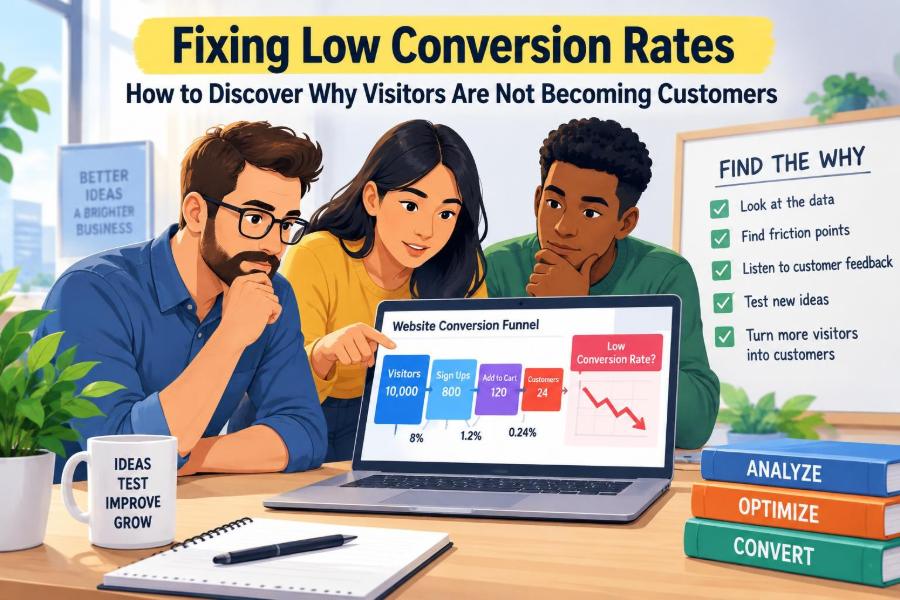

Low conversion rates are frustrating because they create a misleading picture: people are finding your website, reading your posts, clicking your ads, and then quietly leaving. It can feel like your product is the problem, when the real issue may be a confusing page, a weak offer, an unanswered question, or the wrong audience arriving in the first place.
This is a valuable problem to solve whether you run a new SaaS product, local service, ecommerce store, newsletter, digital product, or side hustle. You do not need a giant traffic budget to improve conversions. In fact, small businesses often benefit most because a handful of extra qualified customers can meaningfully change monthly cash flow.
It matters now because attention is expensive and trust is harder to earn. Sending more visitors into a leaky funnel usually makes your marketing less efficient. Learning why people hesitate lets you improve the business you already have before spending more on acquisition.
Approach conversion work like a founder, not a magician. Form a sensible hypothesis, inspect evidence, make one clear change, and measure what happens. The goal is not a flashy redesign; it is a smoother path for the right customer to confidently say yes.
🔎 1. Define “Conversion” Before You Try to Fix It
A conversion is the meaningful action a visitor takes toward becoming a customer. It is not always a purchase. For a service business, it might be a booked call. For an early-stage product, it might be a qualified demo request or completed trial setup.
Pick one primary conversion for each important page. If your landing page asks visitors to buy, book a call, join a newsletter, follow social accounts, and download a guide, it is making the decision harder.
Start with a simple funnel
- Visitor lands on a relevant page.
- Visitor understands the problem and proposed outcome.
- Visitor evaluates proof, price, effort, and risk.
- Visitor takes the next action.
- Visitor completes the promised step after clicking.
Write this funnel down for your main traffic source. A person arriving from a search about “emergency plumbing” has a different intent from someone reading a broad article about preventing leaks.
📏 2. Establish a Clean Baseline
Do not optimize based on a bad week, one sale, or a few comments from friends. Start by documenting current performance over a period that gives you enough traffic to spot patterns.
Use the basic formula: conversion rate = conversions ÷ visitors × 100. Track both the total result and the steps leading to it.
| Metric | What it can reveal | Useful question |
|---|---|---|
| Landing-page conversion rate | Whether the offer and page persuade | Do visitors take the next step? |
| Button click rate | Interest in your call to action | Is the action appealing and visible? |
| Form completion rate | Friction after the click | Are we asking for too much? |
| Checkout completion rate | Purchase confidence and technical issues | Where do buyers abandon? |
| Lead-to-customer rate | Lead quality and sales process health | Are we attracting the right people? |
Set up event tracking for meaningful actions, such as pricing-page views, checkout starts, form errors, bookings, and successful purchases. Check that events actually fire correctly before you make decisions from them.
🎯 3. Segment Visitors Instead of Trusting the Average
An overall conversion rate hides important differences. A page converting poorly for everyone needs a different response than a page converting well for referrals but badly for paid social traffic.
Break performance down by channel, device, location where relevant, landing page, new versus returning visitor, and campaign. Respect privacy laws and obtain appropriate consent for analytics and marketing tracking; requirements vary by country.
Look for high-contrast segments
- Search visitors convert, social visitors do not: your social message may create curiosity without purchase intent.
- Desktop converts, mobile does not: the mobile experience may be slow, cramped, or broken.
- Returning visitors convert, new visitors do not: you may need stronger first-visit proof and clarity.
- One service page converts: study its language and audience rather than blindly copying its design.
Do not treat a segment as proof from a tiny sample. Treat it as a lead worth investigating.
🧭 4. Check Whether You Are Attracting the Right People
Sometimes the page is fine. The traffic is simply mismatched. Conversion cannot rescue an offer shown to people who do not have the problem, authority, budget, or urgency to buy.
Review the exact promise used in each ad, post, email, partnership, and search snippet. Then compare it with the first screen of the destination page. The message should feel like a clear continuation, not a bait-and-switch.
Ask these qualification questions
- What problem did this visitor expect us to solve?
- Does our page solve that exact problem or a broader, different one?
- Can this visitor make or influence a purchase?
- Is our price realistic for their situation?
- Are we attracting people seeking free education when we sell a premium service?
For example, a freelancer selling custom bookkeeping support may get plenty of clicks from a post about free accounting templates. Those visitors are not useless, but they may need an educational email path rather than an immediate sales page.
🗣️ 5. Make the Value Proposition Understandable in Seconds
Visitors should not need to decode what you sell. Your first screen needs to answer: what is this, who is it for, what outcome does it create, and what should I do next?
A weak headline describes your category: “Modern operations support.” A stronger one names the audience and result: “Operations support that helps small agencies deliver projects without spreadsheet chaos.”
Use a practical page-opening formula
Help [specific customer] achieve [valuable outcome] without [major frustration]. Add a short supporting sentence explaining the mechanism, then one focused call to action.
Avoid vague superlatives such as “revolutionary,” “best-in-class,” or “next generation” unless the rest of the page makes them concrete. Clear language usually beats clever language.
🧩 6. Match the Offer to the Customer’s Actual Job
Customers do not buy features because they exist. They buy progress: less risk, more time, more revenue, fewer errors, better status, or a simpler way to finish an important task.
Talk to recent buyers, qualified leads, lost deals, and even people who chose to do nothing. Ask them what they were trying to accomplish before they encountered your business.
Questions worth asking in interviews
- What happened that made you look for a solution?
- What alternatives did you consider?
- What nearly stopped you from buying?
- What words would you use to describe the desired result?
- What would make this offer feel safer or more worthwhile?
Do not turn every interview into a sales pitch. Listen for repeated phrases. Customer language is often better conversion copy than internal marketing language.
🧱 7. Remove Friction From the First Important Action
Every extra field, surprise requirement, unclear button, and unnecessary page can reduce follow-through. The right amount of friction depends on the purchase, but most small businesses ask for too much too early.
For a newsletter, an email address may be enough. For a consultation, ask only for details you genuinely need to prepare. For a high-value B2B service, a short qualification form may improve lead quality, but explain why each question matters.
Friction audit checklist
- Is the primary button visible without excessive scrolling?
- Does the button say what happens next?
- Can visitors complete the action on a phone?
- Are error messages specific and helpful?
- Are required fields truly necessary?
- Does the confirmation page explain the next step and timing?
“Submit” is generic. “Book your 20-minute project review” gives visitors a clearer commitment.
📱 8. Test the Mobile Journey Yourself
Do not assume a desktop page works on mobile because it technically loads. Open it on several phones, use ordinary mobile data if possible, and complete the full journey with one hand.
Look for oversized banners, pop-ups blocking content, tiny form fields, broken calendars, difficult payment flows, and calls to action buried beneath long introductions. These issues are especially costly when traffic comes from social platforms or local search.
Record the steps in a simple document. If you feel even minor annoyance as the owner, a busy first-time visitor will often leave.
⚡ 9. Fix Speed and Technical Trust Breakers
Slow pages, security warnings, broken images, failed payments, and confusing redirects damage confidence before your copy has a chance to work. Technical quality is part of the sales experience.
Use performance testing tools, browser checks, and real-device testing. Watch for pages that load a large hero video before essential text, forms that fail silently, or a checkout that sends customers unexpectedly to an unfamiliar-looking domain.
Prioritize the expensive failures first
- Broken purchase, booking, and contact flows.
- Mobile layout errors on high-traffic pages.
- Slow-loading pages used in paid campaigns.
- Missing confirmation emails or receipts.
- Incorrect tracking that hides successful conversions.
Ask a few people who have never seen the site to complete one task. Their confusion is more useful than your familiarity.
🛡️ 10. Add Proof Where Doubt Appears
Visitors are not only asking “Do I want this?” They are asking “Can I trust this business?” This is particularly important for an unfamiliar founder, expensive purchase, or offer that requires personal information.
Use truthful proof that relates directly to the buying decision. Never invent testimonials, customer counts, certifications, availability, or scarcity.
Useful forms of proof
- Specific customer testimonials used with permission.
- Before-and-after examples with realistic context.
- A clear portfolio or explanation of your process.
- Founder identity, contact details, and legitimate business information.
- Transparent delivery times, refund terms, and privacy practices.
- Relevant qualifications or compliance information where required.
A testimonial that says “Great service” is weaker than one that describes the initial problem, the work completed, and why the customer felt confident. Do not overclaim outcomes that cannot be typical or verified.
💵 11. Make Pricing Easier to Evaluate
Hiding every price can reduce low-quality inquiries, but it can also create anxiety and waste time for buyers who need a budget signal. The best approach depends on your market and offer complexity.
If custom pricing is necessary, give an honest range, starting price, package examples, or a clear explanation of what determines cost. If you sell online, show the full price before the final commitment, including material fees, shipping, taxes, and recurring charges where applicable.
| Pricing approach | Best fit | Conversion risk |
|---|---|---|
| Fixed public price | Simple products and standard services | Low ambiguity, but less flexibility |
| Starting price | Customized services | Can attract poorly matched budget expectations |
| Price range | Projects with variable scope | May feel imprecise without examples |
| Quote only | Complex, high-value work | Higher uncertainty and more unqualified leads |
Price objections are not always a pricing problem. They may indicate weak positioning, missing proof, unclear scope, or an audience that cannot afford the outcome you provide.
🧪 12. Create a Hypothesis Before Changing Anything
Random redesigns create activity without learning. Write one statement that connects an observed issue to a proposed solution.
Use this format: “Because [evidence], we believe changing [element] for [audience] will improve [metric]. We will know this if [measurement].”
For example: “Because mobile visitors click the booking button but abandon the long form, we believe reducing the form from nine required fields to four will improve booking completion rate. We will compare completed bookings per mobile visitor.”
This discipline protects you from attributing every change to the wrong cause.
🔬 13. Run Small, Interpretable Tests
When traffic is high enough, test one meaningful change against the current version. When traffic is limited, make a carefully chosen change, annotate the date, and observe results over a reasonable period while accounting for traffic mix and seasonality.
Do not change the headline, price, design, form, traffic source, and checkout all at once. Even if conversions improve, you will not know what worked.
Good early test ideas
- Replace a vague headline with an audience-and-outcome promise.
- Move a primary call to action closer to the core explanation.
- Clarify delivery time or what happens after booking.
- Shorten a lead form.
- Add a relevant customer example near the price.
- Match ad wording more closely to the landing page.
A test that does not win is still useful if it eliminates a plausible idea. Keep a record of what you tested, why, the dates, traffic, result, and next decision.
👀 14. Watch Behavior, But Do Not Guess From It Alone
Heatmaps, scroll maps, session recordings, form analytics, and on-site polls can reveal confusing patterns. They show where people hesitate, rage-click, abandon, or ignore a key section.
They do not tell you exactly why. A visitor may scroll quickly because they are delighted and ready to buy, or because the page is irrelevant. Pair behavioral data with customer conversations and funnel metrics.
Use privacy-conscious tools and configure them responsibly. Avoid collecting sensitive data in recordings, disclose tracking where required, and follow applicable privacy regulations.
📨 15. Ask Visitors and Customers Directly
A tiny survey can uncover objections your analytics cannot. Put one optional question on an exit point, thank-you page, or follow-up email: “What nearly stopped you from taking the next step?”
For abandoned carts or incomplete inquiries, a respectful follow-up can work if the visitor gave consent and contact information. Keep it helpful rather than manipulative.
Simple feedback prompts
- What information were you looking for that you could not find?
- What made you hesitate today?
- What would make this offer more useful to you?
- Which alternative are you considering?
- Was anything confusing or difficult to use?
Tag responses by theme: price, trust, timing, feature gap, unclear value, technical issue, or wrong fit. After several responses, prioritize recurring themes rather than the loudest single opinion.
🚧 16. Diagnose the Stage Where the Funnel Breaks
Different drop-off points call for different fixes. A low click rate on your main call to action is usually not solved by shortening the checkout. A high checkout abandonment rate is rarely fixed by rewriting a blog title.
| Where visitors leave | Likely issue | First action |
|---|---|---|
| Immediately after landing | Message mismatch, slow load, weak relevance | Review source message and first screen |
| After reading the offer | Unclear value or insufficient proof | Clarify outcome and add relevant evidence |
| After clicking CTA | Form or scheduling friction | Test the completion path on mobile |
| At price or checkout | Cost surprise, trust, payment friction | Improve transparency and inspect checkout |
| After becoming a lead | Slow follow-up or poor qualification | Track response time and sales outcomes |
Start at the biggest bottleneck that you can validate. This prevents a team from polishing areas that are not currently limiting growth.
📞 17. Treat Sales Follow-Up as Part of Conversion
For many service businesses, conversion does not end at the form submission. A lead can be genuinely interested and still disappear if your response is slow, generic, or unclear.
Create a basic follow-up system: confirm receipt immediately, explain the next step, respond within a realistic stated timeframe, and answer the specific concern that led them to inquire. A calendar link can help, but offer an alternative for people who prefer email or phone.
Track inquiry-to-call rate, call attendance, proposal acceptance, sales cycle length, and reasons deals are lost. Your landing page may be doing its job while your handoff process needs work.
📊 18. Choose Metrics That Protect the Business
A higher conversion rate is not automatically better. You can increase sign-ups by attracting freebie seekers, offering deep discounts, or removing qualification questions, then discover that customer quality and profitability have declined.
Track the complete picture: conversion rate, revenue per visitor, average order value, refunds or cancellations, qualified-lead rate, customer acquisition cost, and retention where relevant. Costs, payment processing fees, taxes, and refund obligations vary by country and business model.
Use a simple decision rule
Keep a change when it improves a meaningful business outcome without creating unacceptable operational, legal, or customer-experience costs. Do not celebrate vanity metrics that make fulfillment harder or margins thinner.
🗓️ 19. Build a Sustainable Optimization Routine
Conversion improvement is not a one-time project. Markets change, traffic sources shift, competitors adjust, products evolve, and customers develop new objections.
Give it a regular rhythm. Review the funnel monthly, listen to a few customer conversations, inspect key pages on mobile, and run one prioritized improvement at a time. After a major campaign or product launch, review the path while the details are fresh.
- Weekly: check technical failures, lead volume, and obvious drop-offs.
- Monthly: review segments, customer feedback, and one test opportunity.
- Quarterly: revisit positioning, offers, pricing communication, and funnel economics.
The founders who improve steadily are not always the ones with the cleverest ideas. They are the ones who stay close to the customer and keep learning from the evidence.
✅ 20. Your Action Plan for This Week
Keep the first pass focused. You do not need new software, a full rebrand, or dozens of tests to learn something valuable.
- Choose one page and define its single primary conversion.
- Verify that visits, clicks, completions, and purchases or leads are tracked correctly.
- Segment results by source and device to find the largest obvious gap.
- Complete the journey on your own phone and list every point of friction.
- Speak with two recent customers or leads using the interview questions above.
- Write one evidence-based hypothesis and make one focused improvement.
- Record the date, baseline, change, and metric you will review.
Low conversion rates are not a verdict on your business; they are a signal that your customer journey has something important to teach you. Listen closely, reduce uncertainty, and make the next right action easier. 🚀🔍📈