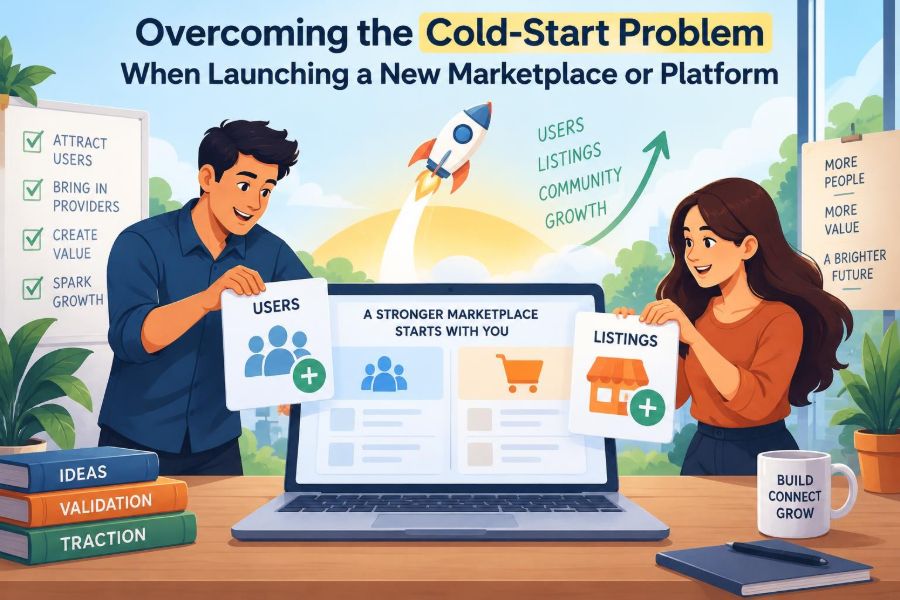

A marketplace is one of the most appealing businesses you can build. Instead of creating every product or delivering every service yourself, you help two groups find, trust, and transact with each other. When it works, each successful match can make the platform more useful for the next person.
The difficult part is the beginning. Buyers will not arrive if there is nothing worth buying, while sellers hesitate to join a place with no visible demand. That circular problem is the cold-start problem, and it defeats many otherwise solid ideas before they have enough activity to learn from.
This guide suits founders building local service marketplaces, B2B platforms, creator networks, rental platforms, talent marketplaces, vertical software communities, and peer-to-peer exchanges. It also applies to platforms that connect users with experts, suppliers, venues, agents, or audiences.
It matters especially now because digital tools make launching a website cheap, but they do not make trust, liquidity, or focused distribution cheap. Your early advantage will not be a polished app. It will be your willingness to create the first successful transactions manually and learn exactly why they happened.
🧭 1. Define the cold-start problem correctly
The cold-start problem is not simply “we need more users.” It is a shortage of useful interactions between the right users at the right moment.
A marketplace can have hundreds of sign-ups and still feel empty if nobody gets a relevant result. A freelancer marketplace needs clients with live projects and freelancers who can respond. A rental platform needs available inventory where renters are searching.
Think in liquidity, not vanity
Liquidity means a serious user has a reasonable chance of completing the action they came for. For a services marketplace, that might mean receiving three suitable responses within 24 hours. For a resale marketplace, it might mean finding a buyer within a week.
- Identify the core action: booking, buying, hiring, requesting, listing, or subscribing.
- Define a successful match in one sentence.
- Choose a narrow time window in which success should happen.
- Measure completed matches, not just registrations.
🎯 2. Start with one painfully specific market
Broad marketplaces sound large but launch poorly. “A platform for tutors” creates too many choices: subjects, grades, prices, regions, formats, and parent expectations. “Online math tutors for Year 11 students preparing for a specific exam” is much easier to seed.
Your initial niche should have a clear shared need, a reachable population, and enough repeat behavior to create useful feedback. Being narrow is not a permanent ceiling; it is a route to density.
A practical niche formula
Describe your starting market as one customer type + one urgent job + one geography or context. For example: independent cafés seeking local food photographers, or apartment owners in one neighborhood looking for vetted handymen.
| Starting approach | Early effort | Chance of liquidity | Typical problem |
|---|---|---|---|
| National, general marketplace | High | Low | Supply and demand are scattered |
| One city, one category | Moderate | Higher | Requires local hustle |
| One community, one use case | Low to moderate | Highest | May feel too small at first |
🔍 3. Find the side with the sharper pain
Most founders say they serve both sides equally. In practice, one side usually has a more urgent problem, a higher willingness to pay, or a stronger reason to change behavior. Begin there.
For example, small businesses may urgently need reliable temporary staff, while workers may have many job boards available. Win the businesses first, then recruit workers around real shifts. In another market, scarce suppliers may be the bottleneck, so earning their trust comes first.
Ask these interview questions
- What do you do today when you need this outcome?
- What does the current workaround cost in time, money, or stress?
- How often does this problem occur?
- Who approves spending or makes the final decision?
- What would make you distrust a new platform?
Run at least 15 to 20 conversations before building major features. Look for repeated language, existing spending, and a problem people actively try to solve rather than merely complain about.
🧲 4. Choose a deliberate entry strategy
There is no universal rule that supply or demand must come first. Choose the approach that lets you create successful matches with the least uncertainty.
Supply-first
Recruit supply before marketing to buyers when availability, quality, or exclusivity is the main promise. This works for specialists, unique venues, rare inventory, and highly regulated providers.
Demand-first
Collect requests first when providers are plentiful or easy to recruit after a request is visible. This works well for common local services, business procurement, and projects where the request itself motivates suppliers.
Concierge-first
Personally source both sides and make the introduction yourself. This is often the best initial strategy because it reveals what your future product must automate.
Do not treat this as “unscalable work” in a dismissive way. Manual work is research that gets paid for when it produces a transaction.
🤝 5. Make the first matches manually
Your first marketplace should often operate more like a focused agency or concierge service than an automated platform. Take requests by form, email, phone, or direct message. Curate options. Confirm availability. Follow up after the match.
Manual matching lets you overcome missing search, weak profiles, incomplete data, and low trust. It also prevents a damaging early experience in which a customer submits a request and hears nothing back.
A simple concierge workflow
- Qualify the request with five essential questions.
- Send it to a small, relevant group of providers.
- Personally introduce the best one to three options.
- Check whether a transaction happened.
- Record objections, timing, price, and outcome.
Use a spreadsheet or simple database before investing in complex marketplace software. The objective is repeatable learning, not technical elegance.
🏗️ 6. Build the minimum trust layer, not a full app
Early users need enough information to feel safe, but they do not need every feature your eventual platform might have. Build the smallest experience that helps people assess relevance and credibility.
Minimum trust elements
- Clear descriptions of what is offered and who it is for.
- Real names or business identities where appropriate.
- Basic verification or screening process explained plainly.
- Transparent pricing, fees, cancellation rules, and response expectations.
- A direct way to get human support when something goes wrong.
For higher-risk categories, insurance, identity checks, licenses, background checks, payment protection, and data privacy may be essential. Requirements vary by country and industry, so get qualified local legal and tax advice before claiming compliance or handling regulated transactions.
🪝 7. Give each side a compelling reason to join now
“Join our new marketplace” is not a strong offer. Early adopters are taking a risk on an unfamiliar product, so the value proposition must be concrete and immediate.
Suppliers may want qualified leads, lower admin work, premium positioning, or access to a new customer segment. Buyers may want faster selection, trusted options, availability, better terms, or a simpler purchasing process.
Early offer examples
- For suppliers: a founding-provider profile, no commission on the first completed jobs, and direct access to qualified requests.
- For buyers: a personal shortlist within one business day and a clear quality guarantee limited to what you can genuinely support.
- For both sides: hands-on onboarding that saves them time immediately.
Avoid discounts as your only lever. Discount-only users can disappear as soon as the incentive ends. Pair any promotion with convenience, curation, or access that remains valuable.
📍 8. Manufacture density in one place
Marketplaces feel alive when enough relevant activity happens within a tight boundary. That boundary can be a neighborhood, trade association, university, event series, software ecosystem, professional specialty, or defined customer segment.
Do not expand because a few people outside the niche ask for access. Expand after your initial segment can reliably produce matches without heroic intervention.
Density tactics
- Launch around a recurring local event or seasonal need.
- Partner with a trusted community organizer who already gathers your users.
- Set limited service areas and clear availability windows.
- Feature only active listings and pause inactive providers.
- Concentrate outreach on one building, district, group, or vertical at a time.
Density reduces marketing waste. It also makes word of mouth more likely because users share overlapping networks.
📣 9. Recruit supply with a founder-led pitch
Early supply recruitment is usually sales, not marketing. Your first providers need to believe you understand their workflow and will not waste their time with low-quality leads.
Create a short list of ideal providers, research them, and contact them personally. Explain the niche, the type of demand you are creating, your screening process, and exactly what joining requires.
What to say
Be specific: “We are matching independent interior designers with first-time apartment buyers in this district. We collect budget, timeline, style, and property details before making introductions. Would you test three qualified introductions over the next month?”
Do not exaggerate demand. If you have no customers yet, say you are recruiting a founding group before opening requests. Honest expectations build better long-term partners than inflated promises.
🧾 10. Create demand where intent already exists
Do not begin by buying broad awareness. Go where people are already discussing, searching for, or budgeting for the problem. The best early channel is usually narrow and labor-intensive.
Useful first-demand channels
- Direct outreach to businesses or individuals with visible, relevant needs.
- Community newsletters and niche groups, where permitted by their rules.
- Referral partnerships with adjacent service providers.
- Educational workshops, office hours, or practical guides that solve part of the problem.
- Search-focused landing pages for a small number of high-intent needs.
Track the source of every inquiry. A channel that produces ten curious visitors and no completed match is less valuable than one that produces two serious requests.
💸 11. Price for learning before optimization
Pricing is part of marketplace design. It influences who joins, whether they take transactions seriously, how supportable the model is, and whether either side tries to go around you.
You may start with a commission, lead fee, subscription, booking fee, payment-processing markup, or a managed-service fee. The right option depends on how clearly you can measure value.
| Model | Best when | Early advantage | Main risk |
|---|---|---|---|
| Commission | You can track completed transactions | Aligned with success | Users may transact off-platform |
| Lead fee | Suppliers value introductions | Simple to start | Arguments over lead quality |
| Subscription | Value is recurring and clear | Predictable revenue | Hard to sell before activity exists |
| Managed-service fee | You provide curation and operations | Supports manual launch | Can become labor-heavy |
Start with a price that is easy to explain and revise. State fees upfront. Taxes, payment rules, invoicing obligations, and consumer protections vary by location, so confirm your obligations before taking payments.
📊 12. Track the metrics that reveal marketplace health
Follower counts and sign-ups can be useful context, but they should not drive decisions. Watch the path from intent to completed value exchange.
Core early metrics
- Activation rate: the share of new users who take the meaningful first action.
- Match rate: the share of requests that receive a suitable response or outcome.
- Time to first match: how long a serious user waits.
- Fill rate: the share of demand requests completed successfully.
- Repeat rate: the share returning within a relevant period.
- Supply response rate: how often providers respond to opportunities.
- Contribution margin per transaction: revenue minus direct costs to serve that transaction.
Review failures by category. If requests fail because of price mismatch, improve expectations. If they fail because suppliers respond slowly, reduce the provider pool or improve incentives before acquiring more demand.
🗣️ 13. Build a feedback loop after every transaction
Early transactions are too valuable to treat as anonymous data points. Speak to both sides. Ask what nearly stopped the deal, what felt confusing, and whether they would use the service again.
Short conversations beat long surveys at the beginning because you can ask follow-up questions and notice contradictions. Record the answers consistently.
Questions worth asking
- Why did you choose this option over the alternatives?
- What information did you wish you had before deciding?
- What would make you hesitant to return?
- Would you refer someone? What exact problem would you describe us as solving?
- Did anyone try to move the transaction off-platform, and why?
Turn repeated feedback into changes. A better intake form, clearer minimum price, or faster response policy can matter more than a new feature.
⚖️ 14. Design against disintermediation and bad behavior
Once two parties meet, they may attempt to bypass your platform. Some leakage is inevitable, especially in relationship-based services. Your job is not to trap users; it is to provide continuing value worth keeping.
Make on-platform transactions easier through simple payments, records, support, dispute handling, scheduling, repeat booking, insurance where relevant, or loyalty benefits. Rules should be understandable and proportionate.
Common trust risks
- Fake listings, unreliable suppliers, or misleading credentials.
- Spam requests and low-quality leads.
- Late payments, cancellations, and disputes.
- Discrimination, harassment, or unsafe interactions.
- Improper handling of personal or payment data.
Create basic policies early, enforce them consistently, and document incidents. In sensitive categories, expert legal, safeguarding, and compliance guidance is not optional.
🛠️ 15. Automate only after the workflow repeats
Founders often automate the wrong process because they build before they understand exceptions. First run the process manually enough times to see the recurring decisions, handoffs, and edge cases.
Then automate the most frequent friction point. It might be provider availability, intake qualification, matching suggestions, reminders, payment collection, or review requests.
A sensible tooling path
- Use a landing page, form, calendar, spreadsheet, and payment or invoicing tool.
- Standardize messages and checklists.
- Connect repeat tasks with no-code automation.
- Build custom product features only when manual work is clearly limiting growth or quality.
Keep a human escalation route even as you automate. Marketplace exceptions are often where trust is won or lost.
📈 16. Scale one repeatable wedge at a time
Scale is not adding every city, category, and feature. Scale is reproducing a working local or vertical playbook with less founder intervention and without destroying match quality.
Before expanding, know your acquisition channels, onboarding steps, service standards, unit economics, and leading indicators of failure. If you cannot explain why the first wedge works, a second wedge usually compounds confusion.
Expansion checklist
- Can the initial segment achieve reliable match and repeat rates?
- Is there a documented supply-recruitment process?
- Can a trained team member handle key operations?
- Does each transaction contribute positively after direct support costs?
- Is there a clear adjacent segment with similar needs?
Expand by adjacency: a neighboring district, a related customer type, or a complementary category. Resist launching everywhere just because the software technically allows it.
🚫 17. Avoid the most common cold-start mistakes
The first mistake is building a feature-rich product before proving anyone will complete a transaction. The second is treating all users as equally valuable when a small segment creates most early liquidity.
Another frequent error is accepting every provider. Too much weak or inactive supply makes search worse and reduces buyer confidence. Curated supply is often better than abundant supply at launch.
- Do not confuse a waitlist with demand.
- Do not spend heavily on ads before your conversion path works.
- Do not hide fees or terms to increase sign-ups.
- Do not let unanswered requests accumulate.
- Do not expand geography before density exists.
- Do not ignore direct costs because early revenue looks exciting.
Most importantly, do not take rejection personally. A failed match is evidence. The useful question is not “Why do they not like our platform?” but “What condition was missing for this transaction to happen?”
✅ 18. Your action plan for this week
Do not wait for a finished product to begin solving the cold-start problem. Your goal this week is to create evidence that one small market will accept your help.
- Write a one-sentence niche statement with customer, problem, and boundary.
- List 30 potential users on the side with the sharper pain.
- Conduct five problem interviews and write down exact phrases.
- Recruit five to ten potential providers or counterparties personally.
- Create a simple intake form and a clear promise for response time.
- Try to facilitate one real match manually.
- Review what blocked the match and change one part of the process.
You may not earn meaningful revenue in a week, and that is fine. The win is learning whether people will take a real next step, not collecting compliments about the idea.
The cold-start problem is solved transaction by transaction: focus tightly, create trust manually, and earn the right to automate and expand. 🚀🤝📈