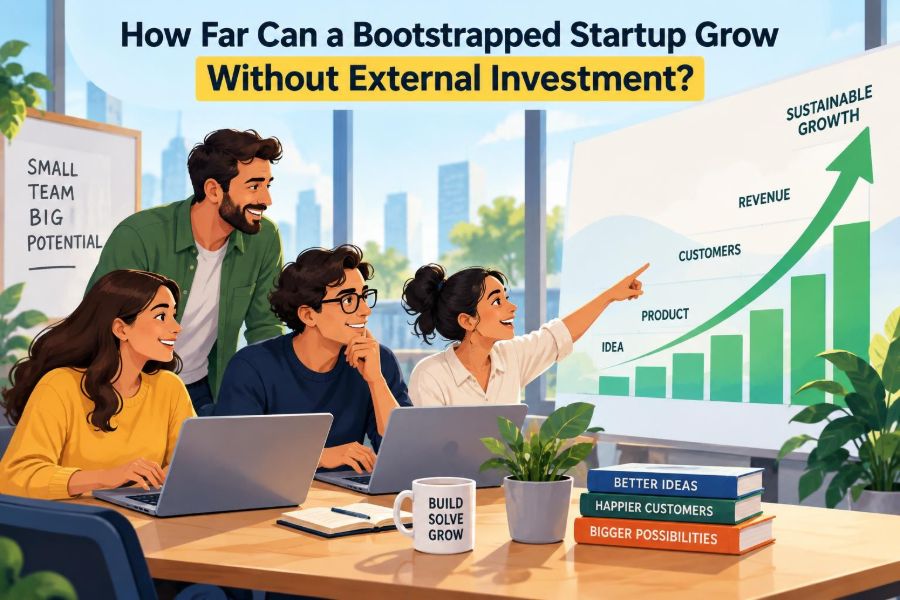

Bootstrapping is not a smaller version of venture-backed entrepreneurship. It is a different game with different rules: customers fund progress, time is a precious resource, and every expense has to earn its place.
For a consultant turning expertise into a product, a niche software founder, an agency owner, or a local operator with strong unit economics, this path can be remarkably powerful. You may not need a giant launch, a pitch deck, or permission to start solving a real problem.
It matters now because building tools are cheaper, distribution channels are more accessible, and many customers care more about useful solutions than flashy brands. At the same time, competition is intense, attention is expensive, and a bootstrapped company cannot hide weak economics behind a fundraising round.
The realistic question is not whether bootstrapping can make you successful. It is whether your market, model, ambitions, and personal finances fit a business designed to grow from its own cash flow.
🧭 1. Define What “Far” Actually Means
Before discussing funding, define the destination. “Grow far” might mean replacing your salary, employing 10 people, serving thousands of customers, opening several locations, or becoming a durable company that pays you meaningful dividends.
A bootstrapped startup can reach any of those outcomes in the right category. What it usually cannot do is spend years prioritizing market share over revenue while competing in a capital-heavy race.
Choose a concrete target
- Lifestyle independence: reliable owner income and flexible work.
- Small durable company: a profitable team with repeatable operations.
- Category specialist: leadership in a valuable, narrow market.
- Large independent business: substantial revenue funded by profits, debt, or customer cash.
Write a 36-month definition with revenue, profit, customer count, team size, and your weekly role. That turns a vague dream into operating constraints.
💡 2. Pick a Problem Customers Already Pay to Solve
Bootstrapping works best when demand is visible before you build much. Look for an expensive, frustrating, frequent problem with a buyer who has the authority and budget to act.
Start with conversations, not assumptions. Ask how people solve the problem today, what it costs them, what breaks, and who signs off on a purchase.
Strong bootstrap signals
- Customers already use spreadsheets, contractors, agencies, or clumsy software.
- The problem happens weekly or monthly, not once a year.
- The outcome can be explained in saved time, reduced risk, increased sales, or lower costs.
- You can reach likely buyers without a massive advertising budget.
A useful rule: if a prospect says your idea is “interesting” but cannot describe what budget would pay for it, you have curiosity, not necessarily demand.
🎯 3. Start Narrow Enough to Win
Early bootstrapped companies rarely win by being broad. They win by becoming obviously useful to a specific group faster than a general competitor can.
“Scheduling software” is broad. “Scheduling and reminder software for mobile pet groomers” is a market you can understand, speak to, and serve with a focused offer.
A practical positioning formula
We help [specific customer] achieve [valuable result] without [current pain or compromise].
For example: “We help independent accounting firms collect client documents without chasing email attachments.” This is clearer than claiming to be an all-in-one productivity platform.
Narrow positioning does not trap you forever. It gives you a beachhead, better referrals, and a simpler product roadmap.
💵 4. Choose a Model That Produces Cash Early
Some business models are naturally friendlier to bootstrapping because they create cash before costs get out of hand. Your model should match your available time, skills, and financial runway.
| Model | Upfront cost estimate | Time to first sale | Cash-flow profile | Scaling challenge |
|---|---|---|---|---|
| Productized service | $100–$2,000 | Days to weeks | Often positive quickly | Delivery capacity |
| B2B software | $500–$10,000+ | Weeks to months | Slower start, recurring potential | Product and support complexity |
| Digital products | $50–$3,000 | Days to months | High margin after creation | Distribution and trust |
| E-commerce inventory | $1,000–$25,000+ | Weeks to months | Cash tied up in stock | Inventory and acquisition costs |
| Local recurring service | $500–$15,000+ | Days to weeks | Can be steady and predictable | Hiring and operations |
Estimates only: costs vary widely by country, industry, product quality, and whether you can do technical or operational work yourself.
🧪 5. Sell the Smallest Useful Version First
Your first version does not need to be automated, polished, or fully scalable. It needs to create a result a customer recognizes and will pay for.
If you want to build a reporting platform, begin by delivering the report manually. If you want an AI workflow product, run the workflow with existing tools before writing custom software.
The validation sequence
- Describe the outcome in plain language.
- Speak with 15–30 plausible buyers.
- Offer a paid pilot with a defined result and timeline.
- Deliver manually where needed.
- Document repeated work before automating it.
This approach is not glamorous, but it protects you from building features customers never value.
🧾 6. Price for Survival, Not Applause
Underpricing is one of the fastest ways to turn a promising bootstrapped startup into a stressful job. Low prices attract volume before you have systems, support capacity, or enough margin to improve the business.
Anchor pricing to the value and cost of the alternative. If your service saves a business 10 hours each month, compare your price with the cost and friction of those hours, not with the price of a casual consumer app.
A simple pricing check
- Calculate direct delivery costs per customer.
- Reserve money for refunds, support, taxes, and payment fees.
- Leave room for sales effort, product improvement, and profit.
- Offer a clear scope so custom requests do not erase your margin.
Taxes, invoicing rules, consumer protections, and payment charges differ by country. Get local accounting and legal advice as your revenue becomes meaningful.
📣 7. Build a Repeatable Path to First Customers
Early sales are usually earned through direct, unscalable actions. That is normal. You are learning who buys, which message works, what objections appear, and what outcomes matter.
Practical first-customer channels
- Warm outreach: former colleagues, peers, suppliers, and existing professional contacts.
- Targeted cold outreach: a short, researched message to a well-defined list.
- Communities: contribute useful answers where your buyers already gather.
- Partnerships: work with trusted providers serving the same audience.
- Content: publish specific lessons that demonstrate your understanding of the problem.
Do not lead with “I built something.” Lead with a relevant observation, a question, or a practical result. Your aim is a conversation, not an immediate close.
🔁 8. Turn One-Off Revenue Into Recurring Revenue
Recurring revenue does not automatically make a business good, but it makes planning easier. It can fund hiring, reduce the pressure of monthly selling, and show whether customers keep receiving value.
Look for an ongoing job your company can own: monitoring, reporting, replenishment, compliance, maintenance, training, support, or software access.
Examples of sensible transitions
- A design project becomes a monthly creative subscription.
- A one-time systems cleanup becomes ongoing optimization and support.
- A spreadsheet template becomes a subscription with updates, training, and community.
- A local cleaning job becomes a scheduled service agreement.
Only add a subscription when customers receive continuing value. A forced recurring fee damages trust and increases churn.
📊 9. Track the Few Numbers That Keep You Honest
A bootstrapped founder needs a simple dashboard, not a wall of vanity metrics. Review it weekly and use it to decide what to stop, fix, or double down on.
Core metrics to track
- Cash runway: cash available divided by average monthly net cash outflow.
- Gross margin: revenue minus direct delivery costs, divided by revenue.
- Monthly recurring revenue: contracted recurring revenue, where applicable.
- Customer acquisition cost: sales and marketing spending divided by new customers acquired.
- Retention or churn: how many customers and how much revenue stay over time.
- Conversion rate: the share of qualified prospects who become customers.
- Founder time: hours spent on sales, delivery, support, and product work.
For a service business, utilization and project margin may matter more than app-style metrics. Use measures that reflect your actual model.
🏦 10. Treat Cash Flow as Your Main Investor
Profit on paper is useful; cash in the bank keeps the doors open. Bootstrapped businesses often fail because customers pay late, inventory arrives early, or growth creates obligations before revenue is collected.
Cash-protecting habits
- Request deposits or upfront payment for projects.
- Invoice immediately and follow up consistently.
- Use annual prepayment only when it genuinely benefits the customer.
- Keep fixed commitments low until demand is repeatable.
- Maintain a tax reserve rather than treating all incoming cash as spendable.
A rolling 13-week cash forecast is enough for many early companies. List expected collections, payroll or contractor costs, software, debt payments, taxes, and planned investments.
🛠️ 11. Automate Only After You Understand the Work
Automation is leverage, but premature automation can lock you into a bad process. First perform the task enough times to know the exceptions, customer language, and quality standard.
Then automate the repeatable middle while keeping human judgment where it creates trust or prevents costly mistakes.
Good early automation targets
- Lead capture and meeting scheduling.
- Proposal templates and contract workflows.
- Onboarding emails and customer checklists.
- Invoice reminders and recurring billing.
- Internal reporting and routine data collection.
Choose simple tools you can maintain. A complicated stack that only one founder understands becomes a hidden liability.
👥 12. Hire for Bottlenecks, Not Status
The first hire should remove a constraint that is limiting profitable growth. It should not be a symbolic milestone or an attempt to copy a larger company’s org chart.
If demand is strong but delivery consumes all your time, hire delivery support. If qualified leads are not being followed up, improve sales capacity. If technical quality is slowing retention, invest there first.
Use a staged hiring approach
- Document the task and expected outcome.
- Use a contractor or part-time specialist where appropriate.
- Measure quality, turnaround time, and economics.
- Convert to a permanent role only when work is reliable and affordable.
Employment law, benefits, classification rules, and payroll taxes vary significantly by location. Treat compliance as part of the hiring cost.
📈 13. Reinvest With a Clear Return in Mind
Bootstrapping does not mean refusing to spend. It means spending deliberately, using evidence to decide where the next dollar can create more capacity, retention, or profitable demand.
Good reinvestment often looks boring: better onboarding, stronger customer support, a salesperson for a proven offer, a production tool that reduces errors, or inventory that turns quickly.
Ask before every meaningful expense
- What bottleneck does this remove?
- What measurable outcome should it produce?
- How soon will we know if it worked?
- What happens if revenue is 30% lower than expected?
Separate experimentation money from essential operating money. That allows you to test growth ideas without risking payroll, taxes, or customer commitments.
⚖️ 14. Know Which Markets Are Hard to Bootstrap
Bootstrapping is not morally superior to outside investment. Some businesses genuinely require substantial capital before they can serve customers safely, competitively, or at the required scale.
Capital-intensive examples can include regulated financial products, biotech, advanced manufacturing, heavy logistics, hardware with tooling costs, and marketplaces requiring simultaneous supply and demand in many locations.
Warning signs your model may need capital
- Large upfront research, certification, or regulatory requirements.
- Long periods between spending cash and receiving revenue.
- Critical network effects that demand fast geographic expansion.
- Minimum inventory orders beyond your safe cash capacity.
- Competitors whose pricing depends on subsidized growth.
You may still start lean in these sectors through consulting, pre-orders, pilots, licensing, partnerships, grants, equipment leasing, or customer-backed contracts. But be honest about the gap between a lean test and the eventual capital need.
🚧 15. Avoid the Common Bootstrap Traps
The constraint is not usually a lack of ideas. It is continuing to do work that feels productive while avoiding the conversations, numbers, and decisions that determine survival.
Mistakes that quietly slow growth
- Building in isolation: replace it with frequent buyer conversations.
- Trying to serve everyone: choose a segment and message.
- Confusing revenue with profit: track direct costs and cash timing.
- Taking every custom request: protect your core offer and margins.
- Delaying price increases: test them thoughtfully before capacity disappears.
- Founder burnout: design a workload that can last longer than a launch sprint.
Frugality is useful. False economy is not. Skipping basic security, contracts, bookkeeping, insurance, or professional advice can become far more expensive later.
🌱 16. Build Distribution You Own
Paid ads, social platforms, and marketplaces can be useful, but they are rented channels. Algorithms change, costs rise, and accounts can be restricted.
Over time, build assets that make future sales easier: an email list with permission, a referral engine, strong customer testimonials, search-friendly educational content, partnerships, and a recognizable niche reputation.
A balanced distribution system
- One direct outbound channel for immediate learning.
- One relationship channel for trust and referrals.
- One compounding channel such as content, email, or partnerships.
- One retention system that turns current customers into advocates.
Measure qualified leads and closed business by source. Attention is not the goal; profitable, retained customers are.
🧱 17. Create Systems Before Growth Creates Chaos
Every repeated customer interaction is a candidate for a lightweight system. Write down how leads are qualified, how work is delivered, how support requests are handled, and when money is collected.
You do not need corporate bureaucracy. You need enough consistency that quality does not depend entirely on your memory and energy.
Your early operating manual can include
- A one-page ideal customer profile.
- Sales discovery questions and qualification criteria.
- Delivery checklists and quality standards.
- Onboarding and offboarding templates.
- A weekly scorecard and decision meeting agenda.
Systems make delegation possible. Delegation is what lets a business grow beyond the founder’s personal capacity.
🔄 18. Decide When to Stay Bootstrapped, Borrow, or Raise
Funding is a tool, not a verdict on your ambition. The right choice depends on whether capital can accelerate a proven engine and whether the obligations match your goals.
| Option | Best fit | Main advantage | Main trade-off |
|---|---|---|---|
| Bootstrapping | Early validation and profitable growth | Control and discipline | Slower pace and personal financial pressure |
| Customer funding | Projects, pre-orders, retainers | Validates real demand | Delivery obligations arrive quickly |
| Debt or revenue-based finance | Predictable cash flow or productive assets | Can preserve ownership | Repayment risk and qualification requirements |
| Equity investment | Large market with proven need for speed | Funds aggressive expansion | Dilution, expectations, and less autonomy |
Do not raise money to solve a problem caused by unclear positioning, poor retention, or weak margins. Capital can amplify a working system; it can also amplify confusion.
🗓️ 19. Your Action Plan for This Week
Keep the next seven days simple. Progress comes from contact with customers and honest measurement, not from endlessly refining a plan.
- Write one sentence describing your customer, painful problem, and promised outcome.
- Make a list of 30 people or businesses that fit that description.
- Book five problem interviews or sales conversations.
- Create a one-page paid pilot offer with scope, price, timeline, and success measure.
- Review your personal and business cash needs for the next 90 days.
- Choose one metric to improve this month: qualified conversations, conversion, retention, margin, or cash collection.
- Block two recurring hours each week for reviewing your numbers and customer feedback.
The goal is not to look like a startup. The goal is to create a company that customers pay to keep alive.
A bootstrapped startup can grow surprisingly far when it solves a painful problem, charges enough to create margin, and turns customer cash into repeatable systems. Build patiently, watch the numbers, and let real demand—not startup mythology—set the pace. 🚀🌿💪